

The opening scene of Jay Kelly, the new Noah Baumbach film, swoops through a soundstage, burnished by neon hues and a glassy body of water which, when we swivel around a few more corners, we’ll realize stands in for New York City’s East River.
Despite its hyperactivity, there’s little about this shot that feels outright evocative; instead the characters we witness flitting in and out of shadows catch our attention. Emily Mortimer, who plays a makeup artist, tells a story to another crew member about her crisis of eye dryness, while Adam Sandler, our protagonist’s talent manager, uses a break between takes to call his kid. The ensemble’s introductions suggest family life and mundane self-discovery to be had when the cameras stop rolling.
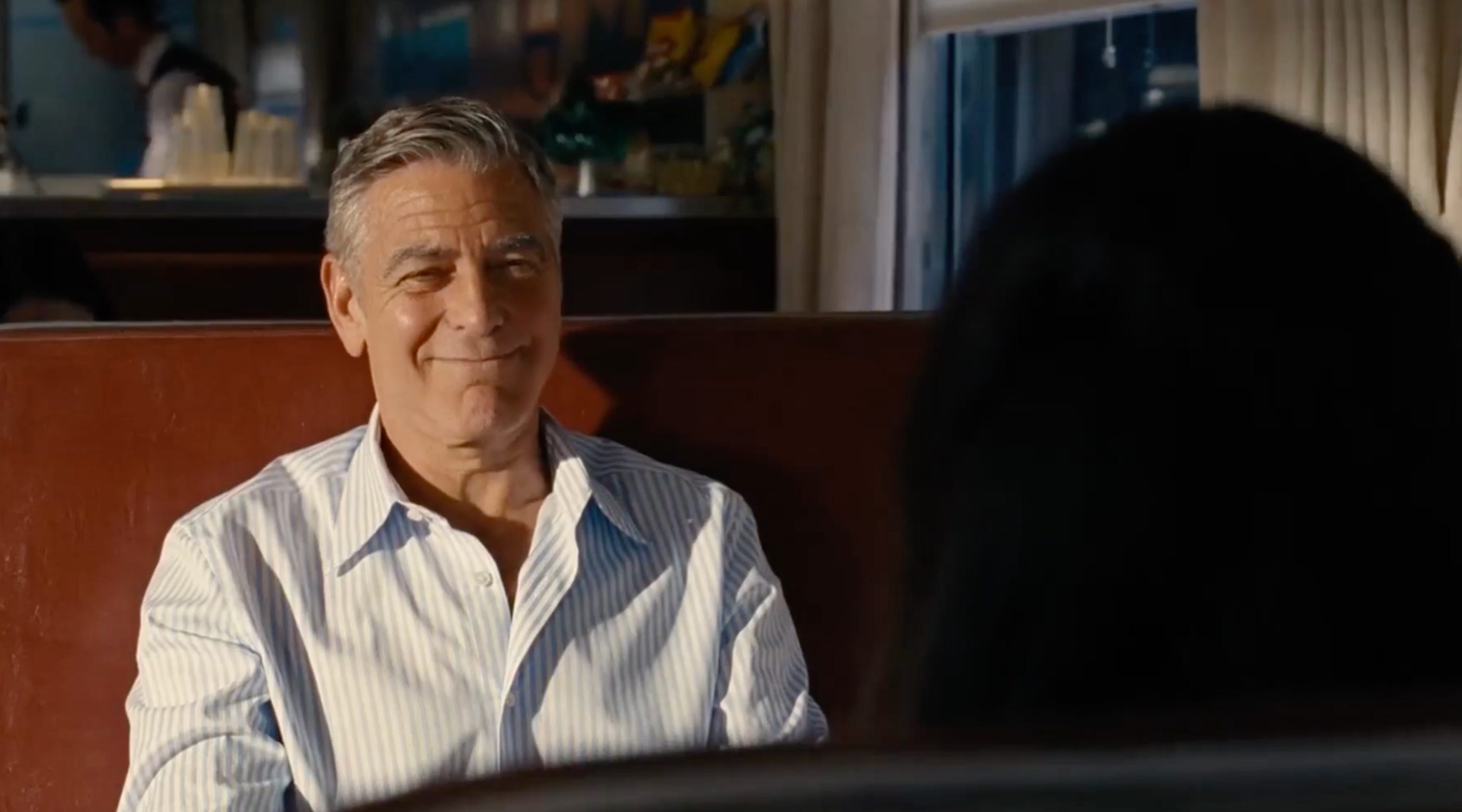
Although not for George Clooney, playing Jay, a veteran who strikes the right balance of being finicky about process (don’t let that dog enter frame so early) and mellow. Jay is uncertain, as he will be throughout the film, whether or not he likes the performance he gave. I never could tell whether that uncertainty resulted from a lightly nagging sense of self-doubt—of impostor syndrome—or from perfectionism, or from the unfocused excitability which the movie star ego produces.
The paean on this soundstage, to the magical experience of shooting a movie, immediately reads as exaggerated, implausible, and not solely for the question of why a production would go to such lengths to recreate an urban waterfront that’s neither inaccessible nor especially stunning (the viewer could argue the recreation is a little stunning). The bigger implausibility is that the movie we find Jay Kelly wrapping is surely an extinct species—a character drama hinging on a A-lister’s top billing, budgeted somewhere in the $50 million range, where care is given by a skilled team to calibrating tight structure and maybe even a competent narrative identity.
But what follows, while mostly being a written movie that happens to feature some directing—some delightful directing!—is a combination of ideas and images made uniquely possible by Baumbach’s behemoth benefactor, Netflix. Baumbach started his career crafting intimate dramas about human fallibility and regret, and he’s still doing that, only now the drama is situated, among a few European settings, within an ostensibly real train car elevated to near-fantastical heights of realism. No act of expression on this train—and it’s figurative expressiveness which Baumbach excels at capturing—is unaccounted for.
The train, which Jay Kelly boards to follow his teenage daughter on her senior trip, is the film’s most important set piece. Because Jay Kelly the movie was developed and produced by Netflix (as opposed to something they bought at a festival, like the newly released Train Dreams or Nouvelle Vague), I had a hard time watching without fearing for an uncanny or queasy lighting rig. And indeed harsh yellows and whites abound aboard this train, caught between simulating a natural golden hour and evoking Golden-Age technicolor artificiality. But elsewhere I thought the film looked wonderful, especially in its haunted last quarter, which brings us to swimming pools of the Tuscan countryside and also the region’s lonely blue-black forests.
It’s almost guaranteed that Netflix gave Baumbach more money than he needed, and maybe that’s why we get those doses of unnecessarily bright light: why not pack every composition with the most expensive tech? Suffice to say Baumbach has pioneered or at least exemplifies a new form, the peculiarly well-endowed iteration of a longtime filmmaker’s bread and butter, an iteration which legacy studios would reject as recklessly indulgent and which would not turn a profit during a theatrical run.
Baumbach’s situation is a feature, a bug, a contradiction, I don’t know, a consequence of the contemporary “content” landscape, which will apparently, in the opinion of every American social-media user and almost as many media outlets, be horribly compromised, even destroyed, by Netflix’s purchase of the Warner Brothers film studio and the TV streamer/producer HBO, a deal announced last Friday.
The Warner empire has cycled through various incompetent owners: AOL, AT&T, now Discovery. As explained last week by Matt Belloni on his podcast The Town, Warner and HBO are considered to be the most mismanaged assets in Hollywood this century, and yet despite the constant corporate chaos the film studio and the prestige TV brand have maintained their reputations as “crown jewels” of creative output and intellectual property.
It’s hard to know, in this fractured, angry, very online age of consumption, what the American public thinks would constitute an irrevocable change for the Hollywood ideal—the triumph of original, considered and unpredictable storytelling, which demands intelligence and trust from its audience. We are, after all, closing out a year when the Warners studio released a mere eleven movies theatrically; five of those were franchise or IP-driven films, and of the rest, only three—Sinners, One Battle After Another, and Weapons—did not totally bomb. At first glance, it seems that this is what’s being (prematurely) mourned: a system whose meager original output the average moviegoer has watched perhaps three times in 2025.
And where did we watch those three films? Paul Thomas Anderson himself complained on the SmartLess podcast in 2022 that multiplexes suck. If you don’t live near a boutique cinema that got revamped by some real-estate capital or a nonprofit, the main-street single-screen you frequented through the late aughts probably went bust. AMC, the country’s dominant exhibitor, charges exorbitant prices for admission and for popcorn and nestles their screens in hollowed-out malls and fronts their content supply with a full half hour of mindless advertisements. I can’t imagine that’s the status quo we’re fighting to protect.
If on the other hand we’re fighting for HBO, we must account for the fact that, as shown by The Economist’s number-crunching, the streamer was always destined for consolidation. HBO is a prestige brand that originated as an add-on in cable TV packages. Amazon and Netflix now behave like cable networks, routed through the “economics of the iPhone,” as Bloomberg columnist Lucas Shaw puts it on The Town. And, because the internet-mourning I’ve witnessed centers images of the water tower on the Warner Bros. studio lot, I’m pretty sure most sensible people can envision a future where HBO—whose shows have never lived anywhere but the small screen—does fine. Ted Sarandos loves HBO. Is it inconceivable that he will let the brand have its own “tile” within the Netflix ecosystem? Is that what’s worth fighting for?
There are so many cultural realities which don’t map onto that Hollywood ideal, realities which have me thinking that this conception of a Hollywood that will be lost is simply made up. We live, after all, in the time of low-brow content being analyzed fastidiously, if cheekily, in the pages of The New Yorker, of the culturati confessing unabashedly to their love of Real Housewives, of Gen Z pop stars gushing over and interpolating Britney Spears circa Crossroads and The Princess Diaries and even Hannah Montana.
We live in a time of speculating that the monoculture died only ten years ago, and that all we have left to conjure a critical mass of engagement is the vestiges of this recently dead monoculture, and so the studios revisit properties as young as Moana—which they revisited twice! Though not popularly, as is evident in the YouTube comments on the recent trailer for Disney’s truly gobsmacking “live-action” rendition of a movie whose sequel arrived one year ago, a sequel itself Frankensteined together from episodes of a scrapped “direct-to-consumer” series. All this bumbling, from a supposed industry titan!
Of course the background problem is the havoc wrought by the real sinister players, the tech giants. Netflix will argue in the inevitable antitrust challenge to the Warners acquisition that it is not a monopoly because it is competing against YouTube, whose content engagement levels dwarf those of any media company, whether old guard or interloper. The algorithms which in-house Netflix relies on to develop shows optimized for passive attention are algorithms comparable to the ones that send weirdo subcultures into the micro-stratospheres of virality. When we complain about AI and about the state of the culture on X or on Substack or on Instagram Reels we tell a lot of heartrendingly, even profoundly funny jokes.
How could real people and their big mouths ever be subtracted from the equation? The cottage communities of amateur punditry—obsession over box office numbers and breaking even or over who’s smearing who in which toxic shadow PR campaign—underline how Hollywood, as a network of signifiers and innuendos, still looms large in the public imagination, as a strange corollary of the functional Hollywood which might be dying. One of the most popular “non-news” New York Times articles of 2024 was a rundown of that year’s Oscar nominations. How many watched the movies?
In contracting with the biggest streamer in the world, I think Baumbach has proved his basest desire, which is to create with minimal friction, i.e. limits on his freedom. No matter how many famous directors proclaim the essential business of watching movies in a theater, we must count those 30 directors (is it fewer?) against the thousands of creatives who will at the end of the day pair the artistry they treasure with whichever beach of code and keywords they’re able to infiltrate. It’s not a pretty picture. And it’s sad, but also predictable, that capitalist interests would stop allowing for the earnest production of popular art.
But everybody who is delusional who writes or thinks of stories isn’t ideating (to borrow a tech buzzword) with the state of the industry top of mind. I’m pretty sure most of them are ideating because they can’t stop, because committing themselves to a concept and to expression is in fact an involuntary compulsion. Artists may be dissuaded by dim job prospects, by contraction or collapse, by the unappetizing transformation of the creative world they assumed they would inhabit. I’m just not convinced that would be enough to make any of them give up.
No posts
Comments
Nothing yet. Say the first thing.
Sign in to join the conversation.