
Fenbendazole Can Cure Cancer presents Case Reports of people who have treated their own cancers along with other articles to help understand how fenbendazole works to treat cancer. Previous articles covering other cancers are in the Archives link. We also present articles designed to help understand how and why fenbendazole works to kill cancers. This is one of those articles.
This article is a General Audience version of a more complex article published under the In-Depth Advanced tab (likely more suitable for researchers, scientists and other experts).
Thanks for reading. This article, and versions of it, will reach over 3M readers across all platforms today. Please consider sharing this article with at least 5 people who you think would be interested. It is all free. Please do your part in turning 3M into 15M. This is how we change things.
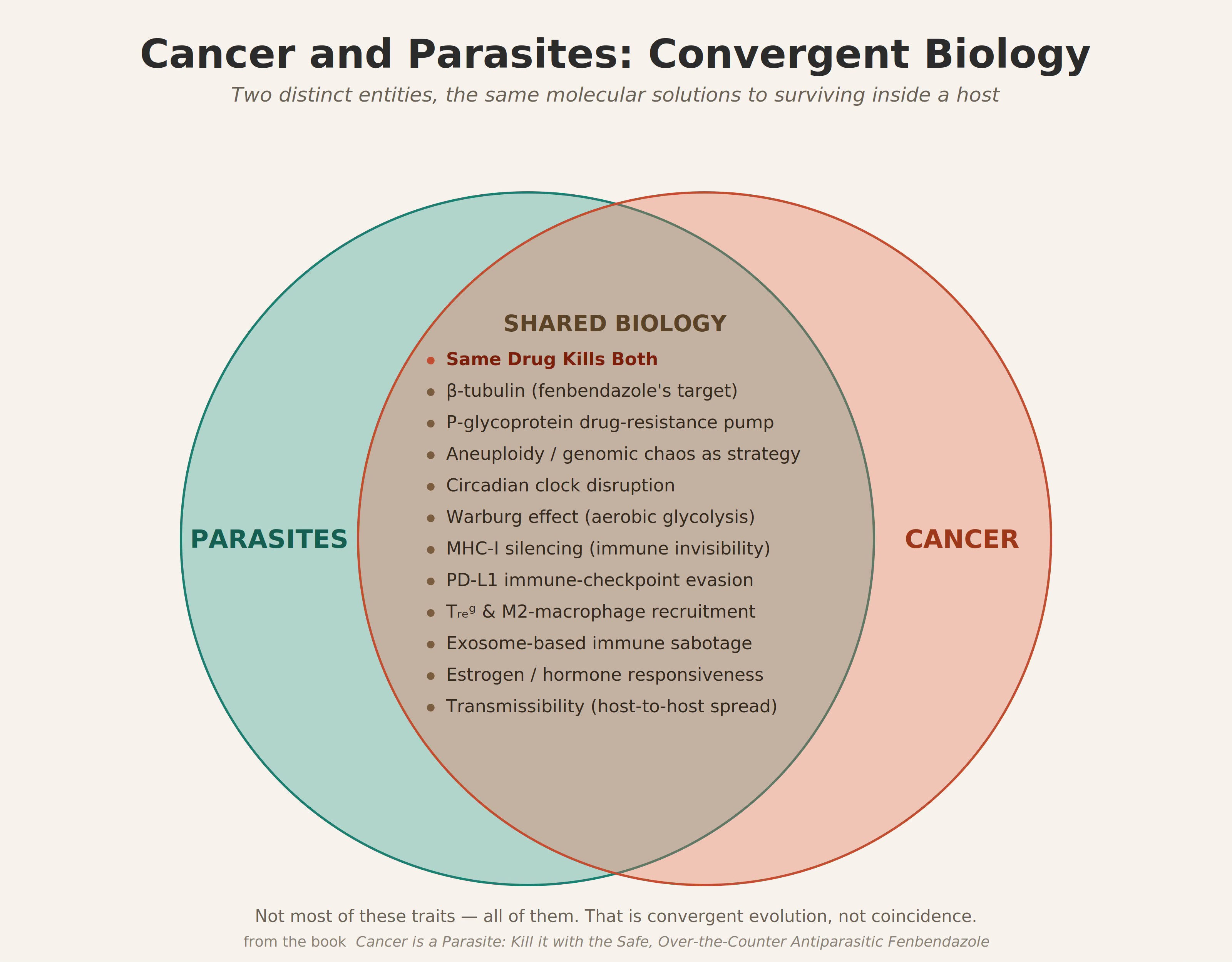
The elephant in the room: fenbendazole is a drug developed to kill parasites. It kills cancer cells by the same mechanism — disrupting tubulin polymerization to block cell division. If cancer and parasites did not share deep biological machinery, this could not happen. What follows is a systematic inventory of everything else they share.
Fenbendazole was developed to kill parasitic worms. It also kills cancer cells, in lab studies and in documented human case reports here and elsewhere, with a consistency that demands explanation.
The explanation — the real one, not the handwaving — is the subject of this article.
The official position of mainstream oncology is that fenbendazole’s anticancer activity is a curiosity and certainly not something to get too excited about without more clinical trials. But it misses something important: the question of why fenbendazole kills both parasites and cancer cells is not just a pharmacological question. It is a question about what cancer fundamentally is.
The answer this Substack has been building toward and my book Cancer is a Parasite — the answer that the published scientific literature now supports — is this: cancer and parasitic organisms are not merely similar. They are convergent solutions to the same evolutionary problem. And they are so similar, at so many levels of biology, that the word ‘coincidence’ stops being available as an explanation.
Fenbendazole did not accidentally kill cancer. It killed cancer because cancer earned that vulnerability by becoming, in every meaningful biological sense, a parasite.
What follows is the evidence. Not selected to make a point — all of it. Every level of biological organization where cancer and parasites do the same things, use the same molecules, and exploit the same pathways. I will start where the argument is most obvious and move to where it gets most interesting.
The Elephant in the Room: The Same Drug Kills Both Parasites and Cancer
Let’s begin with the fact that started this whole inquiry.
Fenbendazole kills parasitic worms by binding to a protein called beta-tubulin and preventing it from forming the cellular skeleton that worms need to divide, absorb nutrients, and survive. That is its mechanism. It was discovered decades ago and has been used as a veterinary dewormer ever since.
It also kills cancer cells. By the same mechanism. It binds to beta-tubulin in cancer cells and prevents them from dividing. This was not designed in. It was discovered by accident — first in laboratory studies, then through a trickle of human case reports that has become a flood.
Now here is the question that oncology has not adequately answered: why does this work?
The standard chemotherapy drugs that target tubulin — the taxanes, the vinca alkaloids — work because all dividing cells need tubulin. They are not selective. They kill cancer cells and normal cells alike, which is why they cause the side effects they do. Fenbendazole should behave the same way. But it does not. Patients take it for months with minimal side effects. Lab studies confirm that it preferentially kills cancer cells over normal cells. It is this selectivity that separates fenbendazole from its side-effect ridden human-version knock-offs.
The most coherent explanation is that fenbendazole is targeting something that cancer cells share with parasites but that normal cells do not — or share to a much lesser degree. The drug was calibrated against parasitic biology. It kills cancer cells because cancer cells have acquired parasitic biology.
And fenbendazole is not alone. Mebendazole, its close chemical relative approved for human use, kills glioblastoma, colorectal, lung, and melanoma cells — and is now in registered Phase I and II oncology trials. Ivermectin, another antiparasitic, has documented anticancer activity through ion channel disruption and signaling pathway inhibition. Niclosamide, used against tapeworms, targets the anaerobic metabolism that both tapeworms and cancer cells depend on. Chloroquine, an antimalarial, inhibits autophagy — a survival mechanism cancer shares with certain intracellular parasites.
A pattern is a pattern. When the entire antiparasitic drug class keeps showing up in cancer research, the explanation is not coincidence. It is shared biology.
There is one more data point worth mentioning here, because it is rarely discussed. In the early 1970s, Janssen Research Laboratories developed a fenbendazole derivative that was so effective at killing cancer cells that they named it oncodazole — literally ‘cancer drug.’ The name was subsequently changed in 1984 to ‘nocodazole’ and the compound was shelved as a research tool rather than developed into a therapy. The taxane drugs — Taxol and its cousins — were developed instead, targeting the same tubulin mechanism but far less selectively, with the severe side effects we now consider normal for chemotherapy. You read that correctly: the safe, side-effect free anticancer drug fenbendazole was replaced in 1976 with expensive, toxic, side-effect ridden copies that only work temporarily, if at all. The book Cancer is a Parasite…explains why.
The Drug-Resistance Problem — And Why Both Cancer and Parasites Solved It the Same Way
One of the most frustrating problems in cancer treatment is drug resistance. You give a patient chemotherapy. It works for a while. Then it stops working, because the cancer has evolved to pump the drug back out before it can cause damage.
The molecular machine that does this is called P-glycoprotein, or P-gp. It sits in the cancer cell membrane like a bouncer at a nightclub, ejecting chemotherapy drugs before they can do their job. P-gp overexpression is associated with treatment failure in pancreatic, ovarian, breast, lung, and blood cancers. It is one of the central obstacles in oncology.
Here is what is not widely known: P-glycoprotein was not invented by cancer. It was invented by parasites.
Parasitic organisms evolved P-gp millions of years ago as a defense against environmental toxins. When hookworms encountered toxic plant compounds in their hosts’ diets, P-gp pumped those toxins back out. When Plasmodium falciparum — the malaria parasite — was exposed to chloroquine, it activated PfMDR1, its version of P-gp, to pump the drug out. When Haemonchus contortus, a sheep roundworm, was exposed to ivermectin, it overexpressed P-gp genes.
Cancer cells have hijacked this ancient mechanism. They took something parasites built to survive toxins and repurposed it to survive chemotherapy. The structural similarity between parasite P-gp and cancer P-gp is so close that drugs originally developed to target parasite P-gp can defeat cancer drug resistance.
Fenbendazole, again, is relevant here. It defeats P-gp through three simultaneous mechanisms: it directly inhibits the pump; it suppresses the NF-κB and PI3K/AKT signaling pathways that instruct the cancer cell to build more P-gp; and it destroys the microtubule network that delivers new P-gp to the cell surface. The cancer cannot replace what is being destroyed, because the replacement delivery system is also being destroyed. This is why multi-mechanism drugs are more durable than single-target drugs against organisms — cancer or parasites — that are highly adaptive.
The Genomic Chaos That Both Use as a Weapon
Here is something that surprises most people when they first hear it: the chromosomal chaos of cancer cells is not just damage. It is a strategy.
More than 90% of solid tumors are aneuploid — they carry the wrong number of chromosomes, sometimes wildly wrong. A normal human cell has 46 chromosomes. A cancer cell might have 70, or 38, or a scrambled combination of fragments, duplications, and translocations that no normal cell would survive. For decades, oncologists understood this as a byproduct of malignant transformation — the chaos that results when cell division goes catastrophically wrong.
It is partly that. But it is also an engine of adaptation. When you have extra copies of some chromosomes and fewer of others, you simultaneously increase the expression of some genes and decrease others. In a tumor with millions of cells, this chromosomal diversity generates a vast reservoir of variation — and under the pressure of immune attack or chemotherapy, the cells with the right combination of gene dosages to survive are rapidly selected. The tumor evolves, fast, in real time, in your body.
The chromosomal chaos of cancer cells is not just damage. It is a strategy — the same strategy certain parasites have been using for millions of years.
Certain parasites have been using precisely this strategy for millions of years. Leishmania — the protozoan parasite responsible for leishmaniasis — maintains what scientists call mosaic aneuploidy as a primary adaptive mechanism. Different individual Leishmania cells within the same clonal population carry different chromosome numbers. When the parasite is exposed to antiparasitic drugs, the cells that happen to have extra copies of drug-resistance genes survive and proliferate. The parasite adapts to drugs through chromosomal variation, not just mutation.
Giardia, Trichomonas vaginalis, and Plasmodium falciparum under drug pressure all show the same phenomenon: variable, unstable chromosome numbers that function as a rapid-evolution toolkit.
And in the transmissible cancers — CTVT in dogs and devil facial tumor disease in Tasmanian devils — the aneuploid karyotype is so stable and distinctive that it serves as the parasitic lineage’s identity. Every CTVT tumor on Earth, from every dog on five continents, carries the same set of scrambled chromosomes. The karyotypic chaos is not the cancer’s disorder. It is the cancer’s signature.
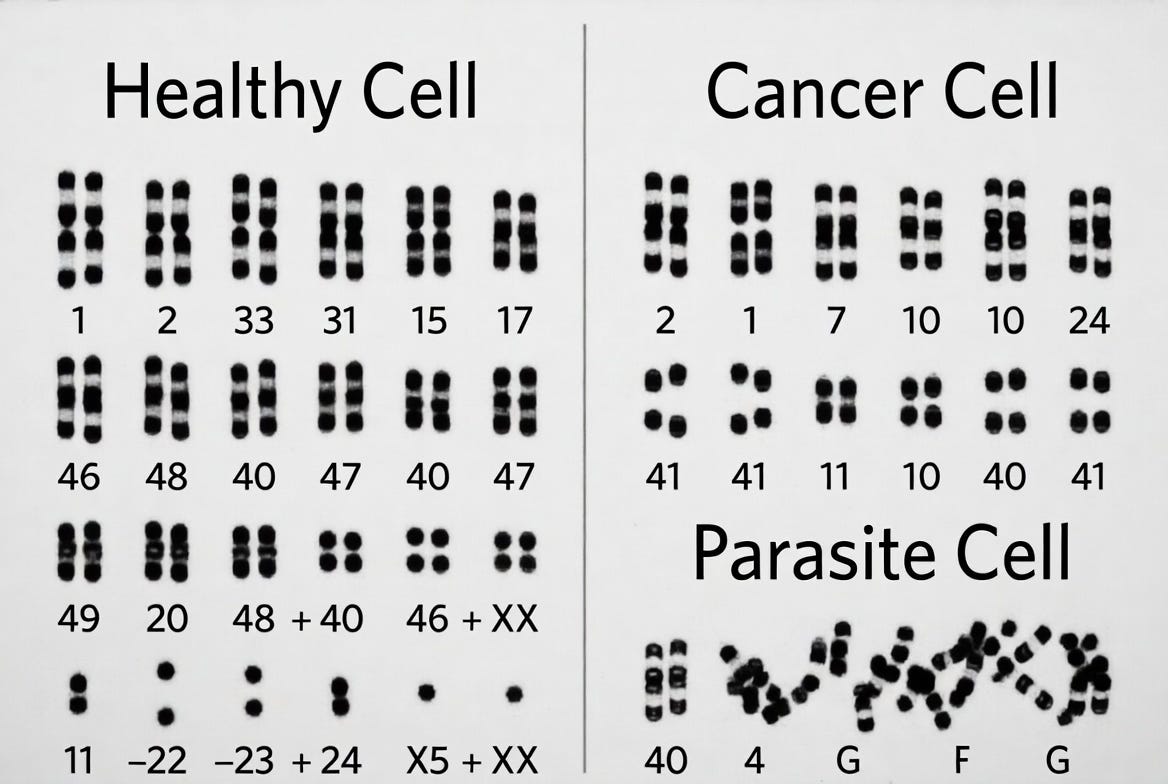
Karyotypes of healthy, cancerous and parasite cells. Healthy human cells have orderly paired chromosomes. Cancer and parasite cells have variable number, unpaired, disordered chromosomes.
The Clock Problem: Cancer Runs on Parasite Time
Every cell in your body runs on a 24-hour clock. Not metaphorically — literally. There is a molecular clock mechanism, built from interlocking proteins (CLOCK, BMAL1, PER1, PER2, and others), that drives rhythmic gene expression in every cell of your body. This clock governs when your cells divide, when they repair their DNA, when they activate immune responses, when they undergo apoptosis. It is one of the most fundamental organizational systems in biology.
Cancer cells break this clock. In virtually every cancer type that has been studied, the clock genes are downregulated or phase-shifted. PER1 and PER2 — two of the key clock proteins — turn out to also function as tumor suppressors: when they are lost, the circadian gating of cell division is removed, and cancer cells divide whenever they want rather than during the windows that the host’s clock designates as appropriate. BMAL1 downregulation has been documented in breast, colorectal, prostate, pancreatic, endometrial, and blood cancers, and it correlates with poorer outcomes.
Cancer cells are not merely disorganized. They are running on their own independent schedule, decoupled from the host’s central clock. This temporal independence is, in a meaningful biological sense, evidence of autonomous entity status — the cancer is not synchronized with the organism it is living inside.
Parasites do this too — but with considerably more sophistication.
Plasmodium falciparum has its own internal 48-hour clock that it synchronizes to the host’s 24-hour circadian rhythm. It times the rupture of infected red blood cells to coincide with peak host body temperature — which is also the time when the mosquito vector is most likely to take a blood meal. The parasite is not just running on its own schedule; it is strategically hijacking the host’s schedule for its own transmission efficiency.
Wuchereria bancrofti, the microfilaria responsible for lymphatic filariasis, concentrates its microfilariae in peripheral blood at night — precisely when its mosquito vector is biting. During the day, the microfilariae retreat to the lungs.
Trypanosoma brucei — the sleeping sickness parasite — actually invades the suprachiasmatic nucleus, the master clock of the mammalian brain, and disrupts it directly. The pathognomonic symptom of sleeping sickness is the destruction of normal sleep-wake architecture. The parasite dismantles the host’s clock to create the chronic, fatigue-dominated state that defines advanced infection. The same cytokines that T. brucei uses to suppress the brain’s clock — TNF-α, IL-6, IFN-γ — are the same cytokines associated with the debilitating fatigue and sleep disruption of advanced cancer.
Same molecules. Same biological target. Two different organisms, independently arriving at the same clock-disruption strategy.
One more thing on fenbendazole: among its documented anticancer mechanisms is the disruption of circadian CLOCK gene expression in cancer cells — interfering with the tumor’s autonomous temporal program while leaving the host’s synchronized cells intact. Whether this is a therapeutic mechanism or a downstream effect of cell death is not yet fully established, but the selectivity is consistent with what the Cancer-as-Parasite framework would predict.
How Both Make Their Energy — and Why It Matters for Treatment
In 1924, Otto Warburg discovered something strange about cancer cells: they prefer to metabolize glucose through a process called glycolysis, even when oxygen is available. Normal cells use glycolysis when oxygen is scarce, then switch to the far more efficient oxidative phosphorylation when oxygen is present. Cancer cells burn glucose through glycolysis all the time — producing energy inefficiently but quickly, generating the building blocks they need for rapid growth, and producing lactic acid as a byproduct. Fun fact: lactic acid actually protects the tumor from immune attack.
This shift to inefficient energy production using glycolysis is called the Warburg effect, and it has been one of the most intensively studied phenomena in cancer biology for a century. What has been less appreciated is that this is also exactly how certain parasites generate their energy.
Trypanosoma brucei, in its bloodstream form, relies on obligate glycolysis in specialized organelles called glycosomes. It cannot switch to oxidative phosphorylation — it is locked into the same metabolic pathway that cancer cells prefer. Both cancer and T. brucei share HIF-1α activation, mTORC1 upregulation, and LDHA-driven lactate production — the specific molecular signatures of the Warburg effect.
Both also produce an acidic microenvironment through lactate export. This local acidosis suppresses T cells and natural killer cells, promotes tissue invasion, and induces the growth of new blood vessels. The tumor microenvironment and the T. brucei infection microenvironment are chemically similar for the same reasons.
Fenbendazole hits this pathway too: it inhibits the expression of GLUT-4, one of the glucose transporters cancer cells use to fuel their glycolytic demand. Starving the cancer of its preferred fuel source while simultaneously destroying its cell division machinery is part of why multi-mechanism drugs like fenbendazole are difficult for cancer cells to develop resistance to.
The Invisibility Trick — And How Both Cancer and Parasites Disappear from the Immune System
The most striking convergence between cancer and parasites is in immunological evasion. Both cancer and parasitic organisms need to survive inside a host that is actively trying to kill them. And they have converged on virtually the same toolkit for doing it.
Making themselves invisible
Every cell in your body displays proteins on its surface called MHC class I molecules. These are the molecular identity cards that tell your immune system ‘I am self — do not attack me.’ When a cell becomes cancerous, or becomes infected with a parasite, immune cells can sometimes detect the abnormality through changes in what those MHC molecules are presenting.
Both cancer and transmissible animal cancers have solved this problem by simply turning off MHC class I expression. The Tasmanian devil facial tumor disease cells — a cancer that has been spreading between devils for decades — silence MHC class I through a reversible epigenetic mechanism: the genes are still there, but they are switched off by histone modification. This makes the tumor cells invisible to the devils’ T cells, which is why the cancer can transmit between genetically different animals without being rejected. Restore MHC expression with interferon-gamma, and the T cells suddenly recognize and attack the tumor. The same finding holds in canine CTVT.
Now here is what makes this more than a zoological curiosity: the same epigenetic MHC class I silencing is documented in 40–70% of human solid tumors. The mechanism is identical. The functional consequence — invisibility to T cells — is identical. This is almost certainly part of why checkpoint immunotherapy, which releases the brakes on T cells, works better in tumors with high mutational burden and MHC expression: the tumors that have not yet fully completed this invisibility trick are the ones that respond.
Hijacking the immune system’s off switch
PD-L1 is a protein that cancer cells put on their surface to engage the PD-1 receptor on T cells — essentially telling the T cell ‘stand down, nothing to see here.’ It is the target of the checkpoint inhibitor drugs that have transformed cancer treatment in the past decade. When you give a PD-1 or PD-L1 inhibitor, you are releasing this brake and allowing T cells to attack the tumor.
What is less commonly known is that Leishmania and Plasmodium upregulate PD-L1 on infected host cells through the same pathway. The mechanism that evolved in parasites to suppress the immune response to chronic infection is the same mechanism cancer has co-opted to protect itself. Checkpoint inhibitors like Keytruda that work in cancer would logically also disrupt chronic parasitic infection — and indeed, this is an active area of research. Same drugs, same mechanism, same biology. Cancer is a parasite.
Recruiting the immune system’s suppressors
Both cancer and parasitic helminths induce expansion of regulatory T cells — specialized immune cells whose job is to suppress other immune cells and prevent excessive inflammation. The molecular signals they use — IL-10 and TGF-β — are identical in both contexts. The net effect is a local zone of immune tolerance: the tumor, like a parasitic worm, builds a bubble of immunosuppression around itself.
Confusing the immune system’s first responders
Macrophages are the immune system’s generalist soldiers — they can recognize and destroy pathogens, orchestrate inflammatory responses, and coordinate the adaptive immune response. There are two broad phenotypes: M1 macrophages are pro-inflammatory and pathogen-killing; M2 macrophages are anti-inflammatory and tissue-repair oriented.
Leishmania, Trypanosoma cruzi, and parasitic helminths all repolarize macrophages from M1 to M2 using the same signals: IL-10, arginase-1, and suppression of IL-12. Tumors use identical signals to convert tumor-associated macrophages into the same immunosuppressive M2 phenotype. The immune cell that should be killing the cancer tumor has been converted into a collaborator.
Remote control
Cancer cells release tiny vesicles called exosomes that carry immunosuppressive cargo — miRNA molecules, heat-shock proteins, and PD-L1 — to immune cells at a distance, paralyzing them before they can even reach the tumor. Leishmania and Plasmodium release exosomes that reprogram macrophages toward the same immunosuppressive phenotype. Same strategy, same delivery vehicle, same outcome.
The Hormone Connection — and a New Finding from a Vermont Lake
Both cancer and parasites are sensitive to the host’s hormonal environment — and both manipulate it.
Schistosoma mansoni and S. haematobium — the blood flukes responsible for schistosomiasis, which infects hundreds of millions of people — express functional estrogen-binding proteins. Host estrogen levels regulate the parasite’s growth, egg production, and reproductive maturation. The sex-differentiated clinical presentation of schistosomiasis — men and women develop different patterns of disease — directly reflects the parasite’s active responsiveness to host sex hormones. This is precisely analogous to estrogen receptor-positive breast cancer and androgen receptor-positive prostate cancer: organisms exploiting the host’s hormonal signaling for their own biology.
The most striking recent data point on this comes from a paper published in Nature three weeks ago — a paper we covered in this newsletter when it dropped. Researchers at the University of Vermont - where I was a neuroscience researcher years ago (small World) - confirmed that brown bullhead catfish in Lake Memphremagog, a drinking water source straddling Vermont and Quebec, have been dying of a transmissible cancer. The cancer spreads between fish. And here is the hormonal detail: the cancer has not been documented in fish younger than reproductive age. The proposed transmission mechanism involves physical aggregation during spawning — when reproductive hormones are known to suppress fish immune responses.
The cancer has found the window of hormonal immunosuppression that opens during reproduction, and it exploits that window for transmission. This is not a metaphor for parasitic behavior. This is parasitic behavior.
The Transmissibility Evidence — Cancer Is Already Doing What Parasites Do
The hardest argument to make for the Cancer-as-Parasite framework — and the one that has become considerably easier to make in the past few years — is transmissibility. Parasites spread between hosts. Cancer does not. That was the categorical distinction.
Except that it does. Under documented conditions. And now in four confirmed species, with evidence in humans as well.
CTVT — canine transmissible venereal tumor — is a single clonal cancer lineage that originated in one dog approximately 11,000 years ago and has since spread to dogs on every inhabited continent. It transmits during sexual contact and direct mucosal contact. The researchers who sequenced its genome described it in these exact words: ‘a cancer that has evolved into a successful parasite of worldwide distribution.’
DFTD — devil facial tumor disease — arose independently, twice, in Tasmanian devils. Two separate cancer lineages, both transmissible, both spreading through biting behavior. The second lineage was only discovered in 2016. Two independent origins of the same phenomenon in the same species.
Bivalve transmissible neoplasia has arisen at least ten times independently across at least ten species of clams and mussels. Ten independent origins. The same parasitic endpoint, reached over and over again by the same evolutionary process.
Brown bullhead catfish melanoma — the Vermont paper from this month — is the fourth confirmed type and the first in any fish species or freshwater ecosystem.
Possible Fifth Instance? - A developing story is the existence of yet another example of transmissible cancer. What is different about this instance is that it appears in humans, and it appears to be happening unrecognized, in plain sight. This will be the subject of an upcoming article.
Separately, in humans: a surgeon operating to remove a sarcoma from a patient in 1996 accidentally inoculated his hand with tumor cells during the procedure. Five months later he developed a tumor at the inoculation site, confirmed by genetic analysis to be derived from the patient’s cancer. It grew in an immunocompetent adult who was not immunosuppressed. Fun fact: Donor-derived cancer via organ transplantation is documented in roughly 0.01–0.05% of recipients.
The pattern is clear: transmissibility is not categorically absent from cancer. It is a latent capacity that cancer can evolve — and has evolved, independently, multiple times, whenever the selective conditions are favorable. The conditions are: low genetic diversity between host and recipient (making immune rejection unlikely), high-frequency physical contact, and a mechanism for cell transfer. These are not exotic conditions. They are the same conditions that favor transmission of any parasite.
Side Note: For me, transmissibility of cancer is both the most scientifically interesting and potentially troubling finding. The power engendered in a theory is that it enables predictions about what should happen. The Cancer as Parasite theory holds that cancer is an evolving entity that is heading toward full obligate parasitism - which would include transmissibility. Cancer changes over its lifespan in a human, adopting defenses and vulnerabilities along the way. Appreciating that a cancer cell on Day 1 is very different from an established tumor on Day 500 will revolutionize cancer treatment through the development of the yet-to-be invented discipline of cancer ontology. That is, the study of the lifespan of the cancer. As potentially terrifying the future prospect of transmissible cancers may be, we already know that this story has a happy ending. Antiparasitic drugs like fenbendazole kill cancer.
The Natural Experiment That 188 Nations Are Running Right Now
Here is the largest-scale evidence for the Cancer-as-Parasite hypothesis: the global natural experiment.
123 of the world’s 188 nations implement routine antiparasitic mass drug administration — periodic, population-wide deworming programs using benzimidazole drugs like albendazole and mebendazole. 61 nations do not. The programs are almost entirely concentrated in lower- and middle-income countries, where parasitic infections are endemic.
Average cancer incidence in nations that deworm: 133.95 per 100,000 population. Average cancer incidence in nations that do not: 268.05 per 100,000. Nations without antiparasitic programs have more than twice the cancer incidence. The difference is statistically highly significant — t(184) = 18.45, p < .0001 — meaning the probability that this result is due to chance is less than one in ten thousand.
All of the above data is from publically available World Health Organization online sources.
Nations without antiparasitic programs have more than twice the cancer incidence of nations that deworm. That number has a p-value of less than 0.0001.
The control analysis: of the 22 nations of the Middle East, only Israel does not implement mass antiparasitic programs. Israel’s cancer incidence is 244.3 per 100,000. The regional average of its neighbors — same geography, similar climate, overlapping dietary patterns — is 121.56 per 100,000. More than twice as high, in the one country that does not deworm.
The economic dimension: nations that deworm have average per capita income of roughly $6,900/year. Nations that do not deworm average roughly $39,000/year — nearly six times higher. There is a strong positive correlation between national income and cancer incidence (r = +0.70, p < .001). The wealthiest countries, with the best healthcare systems, have the highest cancer rates — because they are the ones not using the inexpensive antiparasitic drugs.
There are no viable alternative explanations other than differential population-wide antiparasitic use. The nations showing the reduced cancer burden with antiparasitic use include India, Mexico, Saudi Arabia, Nigeria, Columbia; different in genetics, climate, diet, cultures, access to medical testing yet similar in population-wide antiparasitic use. Antiparasitic drugs appear to prevent cancer as well, although we can debate what “prevent” reflects in this situation, a subject for another day.
Why Don’t Wealthy, Developed Nations Use Population-wide Antiparasitic Drug Programs?
The parasitic infection dimension: more than 60 million Americans are estimated to be chronically infected with Toxoplasma gondii alone — a finding from CDC scientists. A 2002 study of US fecal samples found intestinal parasites in nearly half of participants. A 2017 study in Alabama found soil-transmitted worm infections in 34% of participants. In the United States, we do not have a parasite problem in any clinical sense — we just have parasites, at low levels, chronically, driving the low-grade inflammation that decades of research have associated with carcinogenesis.
The public health implication is direct: routine antiparasitic drug administration in high-income nations — a measure that would cost a fraction of what we spend on cancer screening — might reduce cancer incidence significantly. The data suggest by roughly half.
This epidemiological data is self evident, as easy to find a picking up a sunbaked dinosaur bone in a dried lakebed. To belabor the analogy, these data have been in clear view, baking in the sun for decades, ripe for an epidemiologist to conduct, in my opinion, Nobel Prize winning caliber research, showing the obvious links between population incidence of cancer, antiparasitics and public health policy. The links are much more extensive than I’ve documented here. Finer grain analyses of cancer type incidence track exactly as would be anticipated if antiparasitics were the defining variable. Furthermore, exciting ‘migrant’ studies, where large cohorts of ethnic groups that move from low cancer incidence nations to high cancer incidence nations are underway. Spoiler Alert: Indians that move to the UK adopt the higher cancer incidence of their host UK within three generations. The effect works in the opposite direction as well (Britons that move to India eventually enjoy a lower cancer incidence). The effect holds for many ethnic groups across many low-to-high, and high-to-low cancer incidence locales.
Note: Why hasn’t this public health epidemiological research been done? Because science is captured and restricted at every meaningful level by entities that thrive off of maintaining the status quo. ‘Discovering’ the anticancer signal evident in populations with public health programs using antiparasitics would destroy the market for expensive cancer drugs in the wealthy developed world.
What This All Means
Let me try to state the main argument clearly, because it is easy to get lost in all these individual pieces.
Cancer and parasitic organisms face the same problem: how to survive indefinitely inside a host that is trying to kill them. The molecular solutions available to biological systems facing this problem are finite. There are only so many ways to evade an immune system, only so many ways to hijack a metabolic pathway, only so many ways to disable a clock or manipulate a hormone signal.
Cancer and parasites have found the same solutions. Not most of them. All of them. At every level of biology we have studied — genomic, structural, metabolic, immunological, chronobiological, endocrinological, microenvironmental, behavioral, epidemiological — cancer and parasites do the same things with the same molecules.
This is not coincidence. This is convergent evolution. Two biologically distinct entities, independently arriving at the same strategies because the strategies work.
The therapeutic implication is direct: if the vulnerabilities are shared, drugs that exploit those vulnerabilities in parasites will exploit them in cancer. That is why fenbendazole works. That is why the entire antiparasitic drug class keeps showing up in cancer research. That is why the nations that deworm their populations have half the cancer incidence of the nations that do not.
Fenbendazole did not accidentally kill cancer. It killed cancer because cancer earned that vulnerability — by becoming, cell by cell, mutation by mutation, decade by decade, everything that a parasite is.
Read much more about these fascinating topics in my book, Cancer is a Parasite: Kill it With the Safe, Over-the-Counter Antiparasitic Fenbendazole. Complete peer-reviewed reference lists for all the facts cited above are also in the book.
Key Sources
Supple, W. F., Jr. (2026). Cancer is a parasite: Kill it with the safe, over-the-counter antiparasitic fenbendazole. Skyhorse Publishing / MAHA Books.
Curd, E. E., Hart, S. F. M., Lubkowitz, J., Tracy, K. M., Milazzo, L., Bodnar, M., Jones, T., Henderson, M. J., Emerson, P., & Dragon, J. A. (2026). Brown bullhead catfish melanoma represents a novel transmissible cancer. Nature. https://doi.org/10.1038/s41586-026-10828-6
Dogra, N., Kumar, A., & Mukhopadhyay, T. (2018). Fenbendazole acts as a moderate microtubule destabilizing agent and causes cancer cell death by modulating multiple cellular pathways. Scientific Reports, 8(1), 11926. https://doi.org/10.1038/s41598-018-30158-6
Murgia, C., Pritchard, J. K., Kim, S. Y., Fassati, A., & Weiss, R. A. (2006). Clonal origin and evolution of a transmissible cancer. Cell, 126(3), 477–487. https://doi.org/10.1016/j.cell.2006.05.051
Siddle, H. V., Kreiss, A., Tovar, C., Yuen, C. K., Cheng, Y., Belov, K., Swift, K., Pearse, A. M., Hamede, R., Jones, M. E., Skjodt, K., Woods, G. M., & Kaufman, J. (2013). Reversible epigenetic down-regulation of MHC molecules by devil facial tumour disease. Proceedings of the National Academy of Sciences USA, 110(13), 5103–5108.
Sterkers, Y., Lachaud, L., Crobu, L., Bastien, P., & Pagès, M. (2011). FISH analysis reveals aneuploidy and continual generation of chromosomal mosaicism in Leishmania major. Cellular Microbiology, 13(2), 274–283.
Gartner, H. V., Seidl, C., Luckenbach, C., Schumm, G., Seifried, E., Ritter, H., & Bultmann, B. (1996). Genetic analysis of a sarcoma accidentally transplanted from a patient to a surgeon. New England Journal of Medicine, 335(20), 1494–1496.
Bai, R. Y., Staedtke, V., Aprhys, C. M., Gallia, G. L., & Riggins, G. J. (2011). Antiparasitic mebendazole shows survival benefit in 2 preclinical models of glioblastoma multiforme. Neuro-Oncology, 13(9), 974–982.
Pawłowska, M., Jarek, D., Milanowski, J., & Szewczyk-Golec, K. (2026). Parasitic infections and carcinogenesis: Molecular mechanisms, immune modulation, and emerging therapeutic strategies. Oncology Research, 34(2).
Please share this post. We do not charge any money for our lifesaving work. Please help spread the word by sending this post to as many of your contacts as you see fit. Thank you!
Cancer is a Parasite Book Notes
Cancer is a Parasite is the #1 book in many Amazon categories like breast, lung and prostate cancer! If you buy it on Amazon, please post your reactions and review on Amazon - a few words is all it takes. I think you can post comments on Amazon even if you obtained the book elsewhere. I would also ask that you comment here as well and as always, ask any questions that arise.
We are truly at a moment in time where a legitimate cure for cancer is about to enter the mainstream. The stars are aligned and the time is ripe for a real cure like fenbendazole. The ball is now in the court of the revamped Health and Human Services public health infrastructure. It is my hope that the shackles impeding progress from entrenched interests have been loosened enough to find the political will and courage to act in humanity’s best interests. It is truly a great time to be alive!
Thanks for reading Fenbendazole Can Cure Cancer! Feel free to share this article with someone who could benefit.
Items Included in All Posts
Fenbendazole vs. Mebendazole vs. Albendazole vs. Flubendazole: The benzimidazoles are very similar chemically and they have very similar mechanisms of action with respect to disrupting microtubule function, specifically defined as binding to the colchicine-sensitive site of the beta subunit of helminithic (parasite) tubulin thereby disrupting binding of that beta unit with the alpha unit of tubulin which blocks intracellular transport and glucose absorption (Guerini et al., 2019). If someone asks you how fenbendazole kills the cancer cells, the answer is in italics in the previous sentence.

The class of drugs known as benzimidazoles includes fenbendazole, mebendazole, albendazole and flubendazole. Mebendazole is the form that is approved for human use while fenbendazole is approved for veterinary use. The main difference is the cost. Mebendazole is expensive ~$555 per 100 mg pill, while fenbendazole is inexpensive ~48 cents per 222 mg free powder dose (Williams, 2019). As you may recall, albendazole is the form used to treat intestinal parasites in India and these cost 2 cents per pill. FYI, to illustrate how Americans are screwed by Big Pharma, two pills of mebendazole cost just $4 in the UK, 27 cents per 100 mg pill in India and $555 per 100 mg pill in the US.
While most of the pre-clinical research uses mebendazole, probably because it is the FDA-approved-for-humans form of fenbendazole, virtually all of the self-treating clinical reports involve the use of fenbendazole. Because the pre-clinical cancer studies use mebendazole (ironically the human form of fenbendazole) and humans self-treat their cancers with fenbendazole (the animal form of mebendazole) it is very reasonable to assume that mebendazole and fenbendazole are functional equivalents with respect to cancer. It would be helpful if future pre-clinical and clinical investigations simply used fenbendazole as a practical matter. For the purposes of this Substack, fenbendazole, mebendazole and albendazole are used interchangably.
Where to get fenbendazole
In our experience and the experiences of those that write in, it appears that the three readily available brands of fenbendazole (Panacur-C, FenBen Labs, Happy Healing Labs) are equally effective. Panacur-C can be obtained locally in pet stores, while they all can be obtained from Amazon. The article on Questions & Answers discusses the brands of fenbendazole in detail and shows photos of the various brands referenced.
If you would like to report your experiences with fenbendazole you can do so privately by email myfenbendazole@proton.me or more publicly in the Comments section in any of the articles.
Disclaimer:
Statements on this website have not been evaluated by the Food and Drug Administration. The contents of this website is for educational and informational purposes only and is not intended to be a substitute for professional medical advice, diagnosis or treatment. This website does not provide any kind of health or medical advice of any kind. Always seek the advice of your physician or other qualified health provider with any questions you may have regarding a medical condition. The case reports presented reflect the real-life experiences and opinions of other readers or users of the website. The experiences of those readers or users are personal to those particular readers/users and may not necessarily be representative of all readers/users. We do not claim, and you should not assume, that all other readers/users will have the same experiences. Do you own research, consult with relevant medical professionals before attempting to self-treat for any condition.
Comments
Nothing yet. Say the first thing.
Sign in to join the conversation.