
Fenbendazole Can Cure Cancer presents Case Reports of people who have treated their own cancers along with other articles to help understand how fenbendazole works to treat cancer. Previous articles covering other cancers are in the Archives link. We also present articles designed to help understand how and why fenbendazole works to kill cancers. This is one of those articles.
This article is a General Audience version of a more complex article, some of which are written for peer-reviewed journals, published under the In-Depth Advanced tab (likely more suitable for researchers, scientists and other interested persons).
Thanks for reading. Please share with someone who’d be interested.
Here’s a puzzle. A cancer cell and a Leishmania parasite — one a rebellious cell of your own body, the other a foreign invader from a sandfly bite — share almost nothing. They come from different kingdoms of life. They cause different diseases. And yet, when you look closely at how each one survives your immune defenses, they are running the identical playbook: find the host’s defensive molecule, and enzymatically shred it right where it’s needed. Understanding that shared trick reframes how we might understand and treat some of the most stubborn cancers.
Let me explain it in three moves.
Vitamin D isn’t really a vitamin — it’s the raw material for a hormone, calcitriol, that acts as a genuine anti-cancer signal. Calcitriol docks onto a receiver called the vitamin D receptor (VDR), which most cancer cells still carry, and tells the cell to slow down, mature, or die (Supple, 2026a). So far, so good: your body has a built-in brake on cancer.
But aggressive tumors have found a way to cut the brake line. They crank up an enzyme called CYP24A1, whose normal job is to break calcitriol down. In healthy tissue this enzyme is barely present. In many tumors — colon, lung, ovarian, breast — it’s massively overexpressed, and the more of it a tumor makes, the worse the patient tends to do (Danza et al., 2022; García-Quiroz et al., 2012; Seiler et al., 2022).
The consequence is subtle and important: the tumor creates a local vitamin D deficiency around itself, destroying calcitriol on-site even when the level in your bloodstream is perfectly normal. You can be vitamin D “sufficient” on a blood test while the tumor sits in a self-made pocket of deficiency. As I put it in my book, The Sunlight Solution, the cancer is essentially attacking vitamin D — which is the clearest possible sign that vitamin D was hurting it (Supple, 2026a). An enemy doesn’t bother destroying a harmless weapon.
If the tumor’s trick is to destroy calcitriol, the obvious counter is to stop it — to protect the hormone. And this works, at least in the lab. Block CYP24A1, and calcitriol’s anti-cancer effect comes roaring back: the drug ketoconazole does it in prostate cancer models (Muindi et al., 2010), astemizole does it in breast cancer and even makes resistant tumors sensitive to treatment again (García-Quiroz et al., 2012), and purpose-built blockers like the compound VD1-6 do it cleanly (Alshabrawy et al., 2022).
Elsewhere, I’ve called this class of strategy “vitamin D protectors.” The logic is simple: supply the raw material (keep vitamin D levels up) and disable the destroyer (block CYP24A1). Do both, and you restore a defense the tumor thought it had switched off.
Now the twist. This exact strategy — locally destroying a host defense molecule — is one that parasites perfected millions of years ago.
Consider Leishmania, the parasite behind a disfiguring tropical skin disease. It survives inside the very immune cells sent to kill it, in the skin, where one of your key defenses is a germ-killing molecule (anti-microbial peptide) called cathelicidin — a molecule your body makes because of vitamin D. So how does the parasite survive a weapon vitamin D built? It carries a molecular pair of scissors, an enzyme called GP63, that shreds cathelicidin and related defensive peptides from the host on contact. Strip GP63 away, and the parasite gets killed by those peptides; put it back, and the parasite survives again (Kulkarni et al., 2006). GP63 even slips inside the immune cell and disables its internal alarm systems (Hallé et al., 2009).
Sit with the symmetry for a moment:
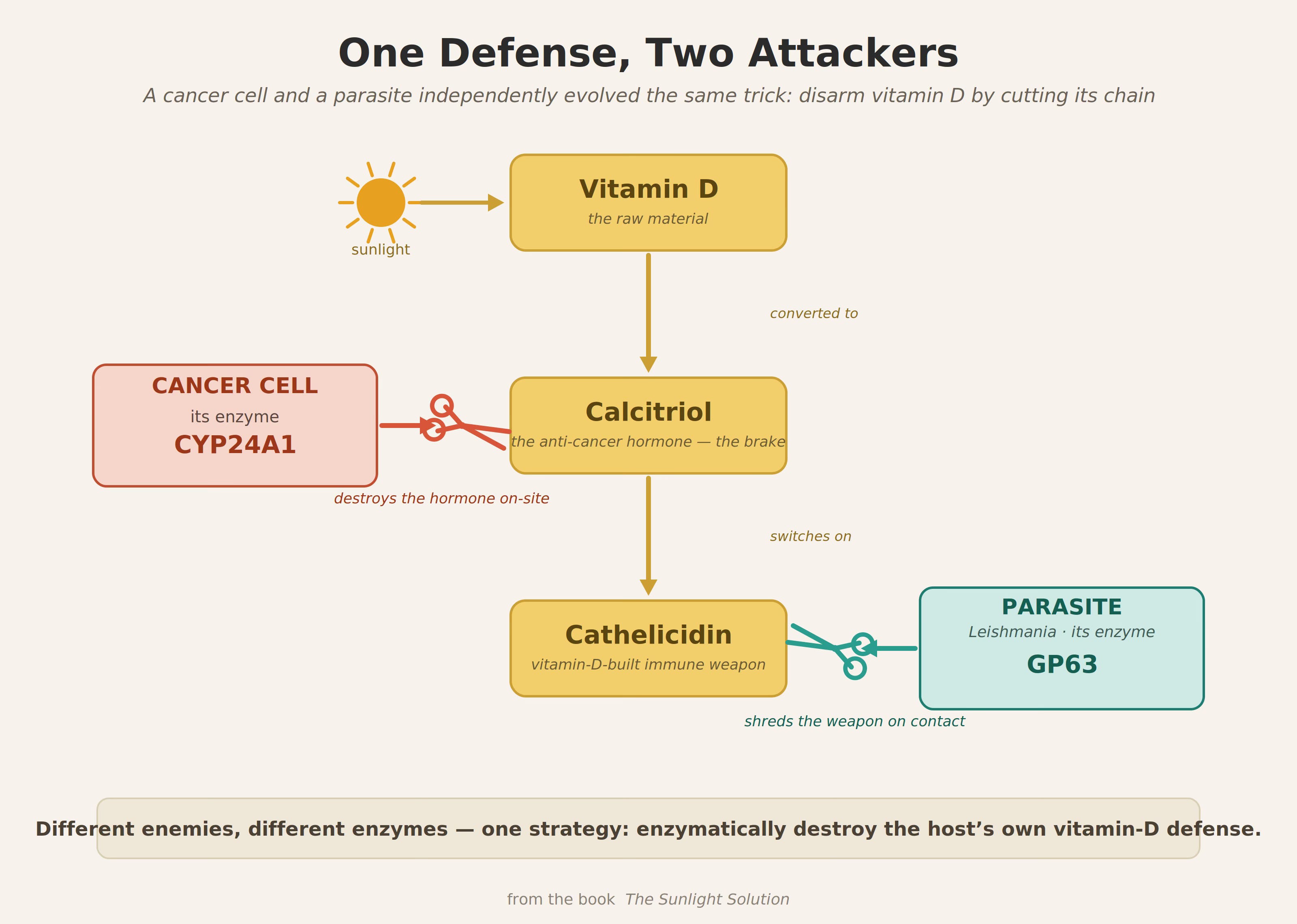
• The cancer cells uses an enzyme (CYP24A1) to destroy the hormone (calcitriol).
• The parasite uses an enzyme (GP63) to destroy the weapon that hormone builds (cathelicidin).
They are attacking the same defensive chain — vitamin D → calcitriol → cathelicidin — just at opposite ends. Different enemies, different enzymes, one strategy: disarm the host by enzymatic destruction of its own defense
.
Here’s why this is more than an interesting coincidence. Scientists have spent decades figuring out how to beat parasite GP63 — and those hard-won lessons port almost directly onto CYP24A1-protected tumors.
• Make the weapon un-shreddable. Against the parasite, researchers redesigned the germ-killing peptides so GP63 can’t cut them — and the redesigned versions kill the parasite that the natural ones couldn’t (Kulkarni et al., 2006). The cancer equivalent already exists in concept: calcitriol look-alikes engineered so CYP24A1 can’t break them down. The parasite work says this approach should pay off specifically in the tumors that overexpress the destroying enzyme.
• Unmask the hidden defense. In parasites, simply removing the shredding enzyme lets the host’s own weapon do the killing — living proof that disabling the destroyer re-arms the defense. That’s the whole rationale for pairing a CYP24A1 blocker with good vitamin D status.
• Restore the whole chain, not one link. Because the tumor attacks the hormone and the parasite attacks the downstream weapon, protecting calcitriol might restore both — reviving not just the “slow down and die” signal but also the cathelicidin-based immune attack on the tumor. That’s a fresh, testable idea.
• Expect a backup plan. Parasites never rely on one trick; they layer several. Cancer does too (destroying the hormone and ditching the receptor). The lesson: a single blocker probably won’t be enough — combinations will.
The reason this parallel matters is that it lands on a single idea: vitamin D is a defense, and successful enemies evolve specifically to disarm it. It also is yet another adaptive strategy used by both parasites and cancer to defeat host defense mechanisms. A tumor and a tropical parasite arrived at the same solution independently — which tells you the defense was worth disarming. It also means the two fields, oncology and parasitology, have been quietly working on the same problem from opposite ends. The parasitologists are further along on the “how do you beat an enzyme that destroys the host’s defense” question. It’s time oncology borrowed their answers.
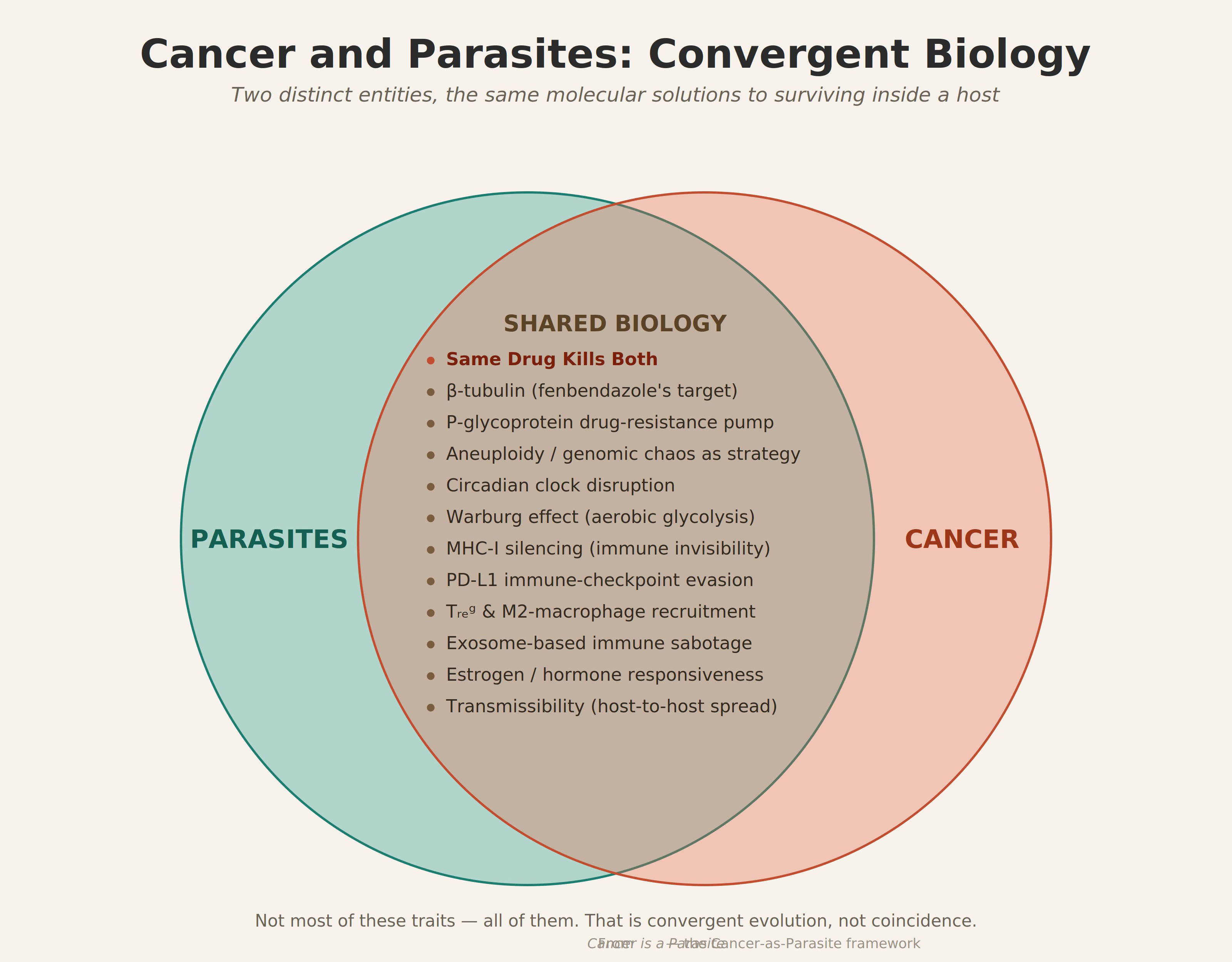
Furthermore, this shared defense mechanism targeting the host’s vitamin D controlled immune response, either by attacking cancer-fighting activated vitD (calcitroil) by increasing the CYP24A1 enzyme that inactivates calcitroil or parasite-attacking anti-microbial peptide (cathelicidin) deactivation by parasite GP63 are yet another instance where cancer cells behave just like parasites. Cancer is a parasite (Supple, 2026).
Alshabrawy, A. K., Cui, Y., Sylvester, C., Yang, D., Petito, E. S., Barratt, K. R., Sawyer, R. K., Heatlie, J. K., Polara, R., Sykes, M. J., Atkins, G. J., Hickey, S. M., Wiese, M. D., Stringer, A. M., Liu, Z., & Anderson, P. H. (2022). Therapeutic potential of a novel vitamin D3 oxime analogue, VD1-6, with CYP24A1 enzyme inhibitory activity and negligible vitamin D receptor binding. Biomolecules, 12(7), 960. https://doi.org/10.3390/biom12070960
Danza, K., Porcelli, L., De Summa, S., Di Fonte, R., Pilato, B., Lacalamita, R., Serratì, S., Azzariti, A., & Tommasi, S. (2022). The ERRα–VDR axis promotes calcitriol degradation and estrogen signaling in breast cancer cells, while VDR-CYP24A1-ERRα overexpression correlates with poor prognosis in patients with basal-like breast cancer. Molecular Oncology, 16(4), 904–920. https://doi.org/10.1002/1878-0261.13013
Dogra, N., Kumar, A., & Mukhopadhyay, T. (2018). Fenbendazole acts as a moderate microtubule destabilizing agent and causes cancer cell death by modulating multiple cellular pathways. Scientific Reports, 8, 11926. https://doi.org/10.1038/s41598-018-30158-6
García-Quiroz, J., García-Becerra, R., Barrera, D., Santos, N., Avila, E., Ordaz-Rosado, D., Rivas-Suárez, M., Halhali, A., Rodríguez, P., Gamboa-Domínguez, A., Medina-Franco, H., Camacho, J., Larrea, F., & Díaz, L. (2012). Astemizole synergizes calcitriol antiproliferative activity by inhibiting CYP24A1 and upregulating VDR: A novel approach for breast cancer therapy. PLOS ONE, 7(9), e45063. https://doi.org/10.1371/journal.pone.0045063
Hallé, M., Gomez, M. A., Stuible, M., Shimizu, H., McMaster, W. R., Olivier, M., & Tremblay, M. L. (2009). The Leishmania surface protease GP63 cleaves multiple intracellular proteins and actively participates in p38 mitogen-activated protein kinase inactivation. Journal of Biological Chemistry, 284(11), 6893–6908. https://doi.org/10.1074/jbc.M805861200
Kulkarni, M. M., McMaster, W. R., Kamysz, E., Kamysz, W., Engman, D. M., & McGwire, B. S. (2006). The major surface-metalloprotease of the parasitic protozoan, Leishmania, protects against antimicrobial peptide-induced apoptotic killing. Molecular Microbiology, 62(5), 1484–1497. https://doi.org/10.1111/j.1365-2958.2006.05459.x
Muindi, J. R., Yu, W. D., Ma, Y., Engler, K. L., Kong, R. X., Trump, D. L., & Johnson, C. S. (2010). CYP24A1 inhibition enhances the antitumor activity of calcitriol. Endocrinology, 151(9), 4301–4312. https://doi.org/10.1210/en.2009-1156
Seiler, J., Ebert, R., Rudert, M., Herrmann, M., Leich, E., Weißenberger, M., & Horas, K. (2022). Bone metastases of diverse primary origin frequently express the VDR (vitamin D receptor) and CYP24A1. Journal of Clinical Medicine, 11(21), 6537. https://doi.org/10.3390/jcm11216537
Supple, W. F., Jr. (2026a). The Sunlight Solution: Reclaiming vitamin D, reversing the chronic disease epidemic, and making America healthy again. MAHA Books/Skyhorse.
Supple, W. F., Jr. (2026). Vitamin D protectors [manuscript in-press].
Supple, W. F., Jr., (2026b). Cancer is a Parasite: Kill it With the Safe, Over-the-Counter Antiparasitic Fenbendazole. MAHA Books/Skyhorse.
Please share this post. We do not charge any money for our work. Please help spread the word by sending this post to as many of your contacts as you see fit. Thank you!
Cancer is a Parasite Book Notes
Cancer is a Parasite is the #1 book in many Amazon categories like breast, lung and prostate cancer! If you buy it on Amazon, please post your reactions and review on Amazon - a few words is all it takes. I think you can post comments on Amazon even if you obtained the book elsewhere. I would also ask that you comment here as well and as always, ask any questions that arise.
We are truly at a moment in time where a legitimate cure for cancer is about to enter the mainstream. The stars are aligned and the time is ripe for a real cure like fenbendazole. The ball is now in the court of the revamped Health and Human Services public health infrastructure. It is my hope that the shackles impeding progress from entrenched interests have been loosened enough to find the political will and courage to act in humanity’s best interests. It is truly a great time to be alive!
Thanks for reading Fenbendazole Can Cure Cancer! Feel free to share this article with someone who could benefit.
Items Included in All Posts
Fenbendazole vs. Mebendazole vs. Albendazole vs. Flubendazole: The benzimidazoles are very similar chemically and they have very similar mechanisms of action with respect to disrupting microtubule function, specifically defined as binding to the colchicine-sensitive site of the beta subunit of helminithic (parasite) tubulin thereby disrupting binding of that beta unit with the alpha unit of tubulin which blocks intracellular transport and glucose absorption (Guerini et al., 2019). If someone asks you how fenbendazole kills the cancer cells, the answer is in italics in the previous sentence.

The class of drugs known as benzimidazoles includes fenbendazole, mebendazole, albendazole and flubendazole. Mebendazole is the form that is approved for human use while fenbendazole is approved for veterinary use. The main difference is the cost. Mebendazole is expensive ~$555 per 100 mg pill, while fenbendazole is inexpensive ~48 cents per 222 mg free powder dose (Williams, 2019). As you may recall, albendazole is the form used to treat intestinal parasites in India and these cost 2 cents per pill. FYI, to illustrate how Americans are screwed by Big Pharma, two pills of mebendazole cost just $4 in the UK, 27 cents per 100 mg pill in India and $555 per 100 mg pill in the US.
While most of the pre-clinical research uses mebendazole, probably because it is the FDA-approved-for-humans form of fenbendazole, virtually all of the self-treating clinical reports involve the use of fenbendazole. Because the pre-clinical cancer studies use mebendazole (ironically the human form of fenbendazole) and humans self-treat their cancers with fenbendazole (the animal form of mebendazole) it is very reasonable to assume that mebendazole and fenbendazole are functional equivalents with respect to cancer. It would be helpful if future pre-clinical and clinical investigations simply used fenbendazole as a practical matter. For the purposes of this Substack, fenbendazole, mebendazole and albendazole are used interchangably.
Where to get fenbendazole
In our experience and the experiences of those that write in, it appears that the readily available brands of fenbendazole (Panacur-C, FenBen Labs, BP Life, Sanare Labs, Resolvx Health, Happy Healing Labs) are equally effective. Panacur-C can be obtained locally in pet stores, while they all can be obtained from Amazon or diectly from the company’s web sites. The article on Questions & Answers discusses the brands of fenbendazole in detail and shows photos of the various brands referenced.
If you would like to report your experiences with fenbendazole you can do so privately by email myfenbendazole@proton.me or more publicly in the Comments section in any of the articles.
Disclaimer:
Statements on this website have not been evaluated by the Food and Drug Administration. The contents of this website is for educational and informational purposes only and is not intended to be a substitute for professional medical advice, diagnosis or treatment. This website does not provide any kind of health or medical advice of any kind. Always seek the advice of your physician or other qualified health provider with any questions you may have regarding a medical condition. The case reports presented reflect the real-life experiences and opinions of other readers or users of the website. The experiences of those readers or users are personal to those particular readers/users and may not necessarily be representative of all readers/users. We do not claim, and you should not assume, that all other readers/users will have the same experiences. Do you own research, consult with relevant medical professionals before attempting to self-treat for any condition.
Comments
Nothing yet. Say the first thing.
Sign in to join the conversation.