
Fenbendazole Can Cure Cancer presents Case Reports of people who have treated their own cancers along with other articles to help understand how fenbendazole works to treat cancer. Previous articles covering other cancers are in the Archives link. We also present articles designed to help understand how and why fenbendazole works to kill cancers. This is one of those articles.
This article is a General Audience version of a more complex article published under the In-Depth Advanced tab (likely more suitable for researchers, scientists and other experts).
Thanks for reading. Please consider sharing this article with at least 5 people who you think would be interested. It is all free. This is how we change things.
Every so often a paper comes along that isn’t from anyone connected to this Substack, isn’t citing anyone connected to this Substack, and still ends up making almost exactly the argument we have been making. That happened in January of this year.
Marek Wagner and Shigeo Koyasu — Koyasu is one of the most respected immunologists alive, a scientist at RIKEN in Japan credited with helping discover an entire category of immune cell — published a paper in The EMBO Journal with the title “Cancer in disguise: a parasite within” (Wagner & Koyasu, 2026). Their argument, stripped of jargon, is this: cancer cells don’t just resemble parasitic worms in some poetic, big-picture way. They resemble worms closely enough, at the molecular level, that your immune system’s dedicated anti-worm defense system gets switched on when it encounters a tumor — the same defense system that evolved over millions of years to expel hookworms, tapeworms, and blood flukes from your body.
Cancer cells don’t just resemble parasitic worms in some poetic, big-picture way. They resemble worms closely enough, at the molecular level, that your immune system’s dedicated anti-worm defense system gets switched on when it encounters a tumor
This matters enormously for the case we have been building as to why antiparasitics like fenbendazole kill cancer. Wagner and Koyasu are immunologists. They didn’t set out to find evidence for a “cancer is a parasite” framework — they arrived at a version of it anyway, from their own discipline, using their own literature, completely independently. When two different fields converge on the same answer without talking to each other, that’s usually a sign the answer is real.
Cancer cells resemble parasitic worms closely enough that your immune system’s dedicated anti-worm defense system switches on when it encounters a tumor.
Meet the Immune System’s Worm Squad
Most people know the basic story of the immune system in broad strokes: white blood cells patrol your body, and when they find something foreign — a virus, a bacterium, a splinter — they attack it. What most people don’t know is that your immune system actually runs several different attack programs, custom-built for different kinds of threats, and it has to correctly diagnose which threat it’s facing before it picks the right one.
Bacteria get one program. Viruses get a different one. And parasitic worms — which are far too large for a single cell to simply swallow and digest, the way it can with bacteria — get an entirely separate, specialized response called type-2 immunity. This is the immune system’s demolition crew, built specifically for large, slow-moving, physically substantial invaders that can’t just be eaten.
Type-2 immunity has three main characters. ILC2s (innate lymphoid cells, type 2) are early-warning scouts that sense tissue damage and kick off the alarm. TH2 cells (a kind of helper T cell) coordinate the broader response once it’s underway. And eosinophils — a type of white blood cell most people have only heard of because a doctor once mentioned their allergy blood test — are the actual foot soldiers. Eosinophils carry toxic granules built to chew through the tough outer covering of a parasitic worm, called its tegument, and destroy it from the outside in.
Wagner and Koyasu’s central claim is that cancer cells provoke this exact three-part alarm system (Wagner & Koyasu, 2026). Tumors show up on the immune system’s radar looking enough like a worm that the worm-fighting machinery gets deployed against them.
The Assassins Built for Worms Turn Out to Kill Tumors Too
Here’s where the story gets genuinely exciting, and where it stops being a hypothesis and becomes something you can point to in an experiment.
Eosinophils carry four different toxic proteins in their granules: major basic protein, eosinophil cationic protein, eosinophil-derived neurotoxin, and eosinophil peroxidase. All four evolved for one purpose — to physically damage the tegument of a parasitic worm until it dies. None of them were “designed” with cancer in mind. Evolution had no way to anticipate that human cells would one day misbehave in ways that resemble a helminth infection.
And yet: researchers studying melanoma found that eosinophils, using this exact worm-killing toolkit, could be recruited to attack and destroy melanoma tumor cells directly (Mattes et al., 2003). A separate study found that human eosinophils exert direct tumor-killing activity against colon cancer cells, using two of their weapons — a signaling molecule called TNF-alpha and a cell-killing enzyme called granzyme A (Legrand et al., 2010). These are not fringe findings. They are exactly what you would expect if cancer really does trip the same biological alarm that a worm infection trips — and if the same weapons built to kill worms can, under the right conditions, be aimed at cancer instead.
The toxic proteins evolved to kill parasitic worms have been shown, in published studies, to kill melanoma and colon cancer cells too.
This overturns something that used to be assumed in cancer research. For a long time, doctors and scientists treated eosinophils showing up in and around a tumor as a bad sign — evidence of inflammation, evidence the tumor was stirring up trouble. Wagner and Koyasu argue this old assumption has it backwards in many cases: eosinophils infiltrating a tumor may often be the body’s anti-parasite defense system showing up to do exactly the job it evolved to do (Wagner & Koyasu, 2026). The tumor isn’t causing the eosinophils to misbehave. The eosinophils may be trying to kill the tumor the same way they’d kill a worm.
Softening Up to Break In — A Shared Physical Trick
Immunology isn’t the only place this convergence shows up. There’s a purely physical, mechanical parallel too, and it comes from an unexpected corner of science: researchers using an instrument called an atomic force microscope, which can measure how stiff or soft a single cell is by gently pressing on it.
When scientists measured the stiffness of cancer cells taken from patients, they found that the most dangerous, most invasive, most metastatic cancer cells were dramatically softer — in some cases, over 70% softer — than ordinary, non-cancerous cells (Cross et al., 2007). Being physically softer lets a cell squeeze through tiny gaps in tissue that a stiffer cell couldn’t fit through — which is exactly what a cancer cell needs to do to break out of its original location and invade somewhere new.
Now here’s the part that connects it to parasites: migrating helminth larvae — the immature form of a parasitic worm, squirming its way through host tissue toward wherever it needs to go — show the same trick. They soften their own bodies to deform and squeeze through tissue barriers, the same way an invasive cancer cell does (Wagner & Koyasu, 2026). Two completely different kinds of organism, worlds apart on the tree of life, independently discovered that going soft is a good way to break in.
Wearing the Host’s Own ID Badge
Long-time readers of this Substack know the basic immune-evasion story: cells display little molecular “ID badges” on their surface called MHC molecules, and your immune system checks those badges to decide whether a cell belongs in your body. Cancer cells, like the transmissible cancers found in dogs and Tasmanian devils, often survive by switching off their own badges — going invisible rather than pretending to be something they’re not.
But there’s an even stranger trick in the parasite world, and it’s worth knowing about because it shows just how far this kind of camouflage can go. Schistosoma mansoni, the blood fluke behind schistosomiasis, doesn’t just hide its own identity markers. It actually reaches out and physically grabs intact MHC molecules directly off the surface of the host’s own cells and glues them onto its own outer coat (Wagner & Koyasu, 2026). It isn’t switching off its badge. It’s stealing yours and wearing it. The parasite quite literally walks around dressed as you.
Nothing in the cancer literature has (yet) documented a tumor doing something quite this audacious. But it’s a useful benchmark for how sophisticated immune camouflage can become when a hundred million years of evolution has had time to work on the problem — and a reminder that we may not yet have found every camouflage trick cancer has developed, only the ones we’ve thought to go looking for.
Note: This is yet another example of how to exploit the vast library of research on parasitic behavior and apply it to oncology. By knowing what the parasite does, we can possibly anticipate what the cancer cell will do as well when challenged similarly.
Why an Outsider’s Discovery Matters More Than an Insider’s
I want to pause on something structural here, because it matters more than any single fact in this article.
If I told you cancer resembles a parasite, and I’m a researcher who has spent years building the case that antiparasitic drugs treat cancer, you’d be right to wonder whether I found what I was looking for because I was looking for it. That’s a completely fair instinct, and good science should welcome that kind of skepticism.
Wagner and Koyasu did not have that motive. They are immunologists, working from the immunology literature, asking an immunology question: why does the body’s anti-worm defense system sometimes show up around tumors? They were not trying to build a case for repurposing dewormers as cancer drugs. They arrived at a structurally similar conclusion — cancer mimics parasites closely enough to provoke real, measurable, overlapping biology — by walking in through a completely different door.
That’s what independent convergence looks like in science, and it’s a far stronger form of evidence than any single research group, however careful, building a case on its own. Two separate paths, starting from two separate disciplines with two separate sets of assumptions, arriving at the same place.
Two separate disciplines, with two separate sets of assumptions and no contact with each other, arrived at the same place. That is what real convergent evidence looks like.
It’s also worth being clear about where their argument stops and where the broader framework this Substack covers keeps going. Wagner and Koyasu’s paper is about helminths — worms — specifically. It doesn’t address the single-celled parasites like Leishmania or Plasmodium (the malaria parasite), whose chromosome instability and internal body clocks resemble cancer just as closely. It doesn’t mention fenbendazole at all, focusing instead on mebendazole. And most notably, it doesn’t touch the transmissible-cancer story — the dog cancer, the Tasmanian devil cancer, and the fish cancer discovered this year — which is some of the most direct evidence that cancer can complete the full transition into something functionally identical to a parasite. Their paper is a serious, independent confirmation of one large piece of this picture. It isn’t the whole picture. But it’s real, rigorous, peer-reviewed, published-in-a-major-journal confirmation of a piece that used to sound like a stretch.
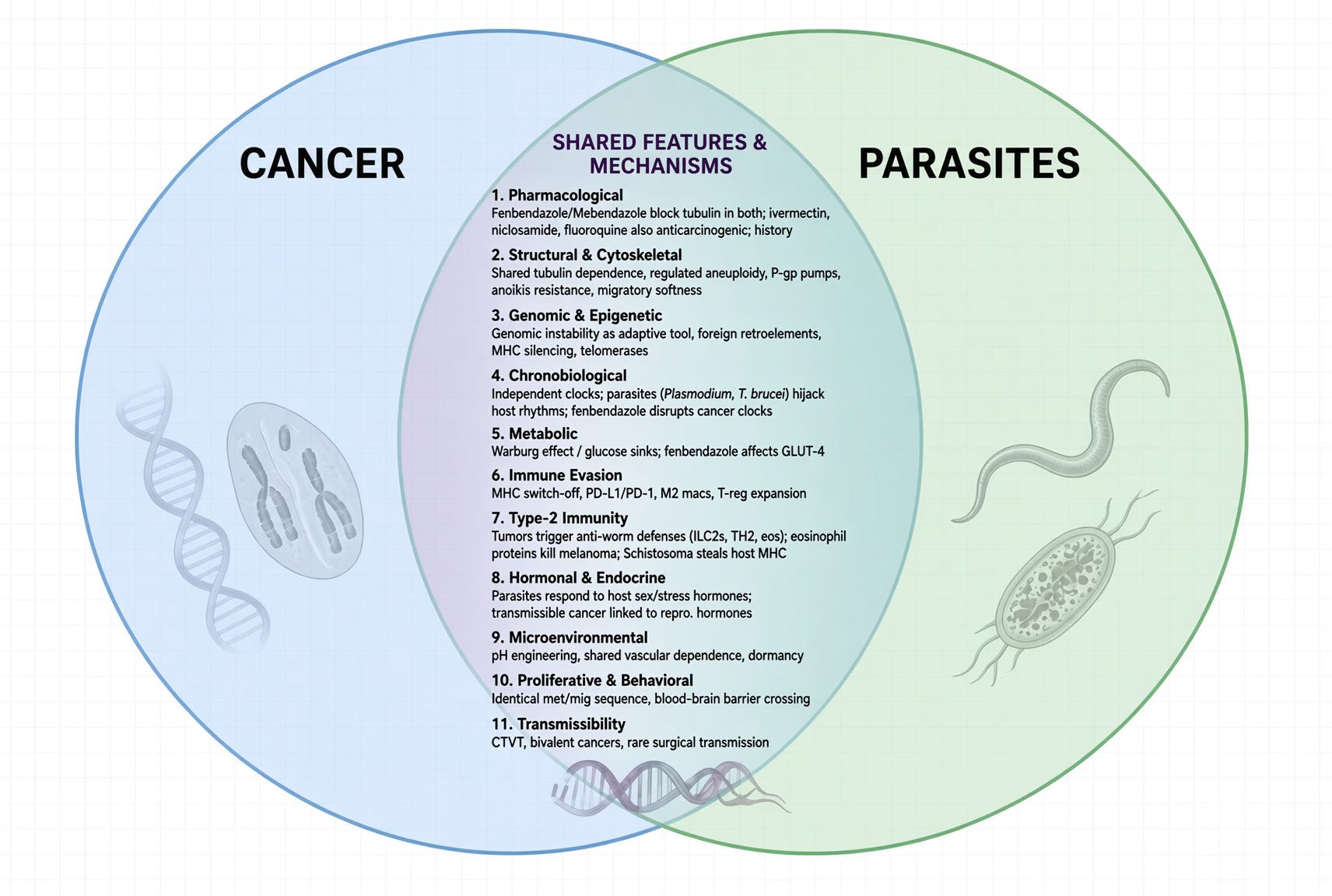
The Running List: Every Cancer–Parasite Similarity Covered So Far
Readers have asked for this in one place, so here it is — the complete, continuously updated inventory of everything we have documented, organized by category, now including the immunological material from Wagner and Koyasu’s paper. This list will keep growing as the science does.
1. Pharmacological
• Fenbendazole kills parasitic worms and cancer cells by the same mechanism: blocking tubulin polymerization.
• Mebendazole, fenbendazole’s human-approved cousin, kills multiple cancer types through identical tubulin-binding and has entered oncology clinical trials.
• “Oncodazole,” a 1970s fenbendazole derivative, was named for its cancer-killing activity before being shelved and renamed nocodazole.
• Ivermectin, niclosamide, and chloroquine — all antiparasitic drugs — show independent anticancer activity through their own distinct mechanisms.
2. Structural & Cytoskeletal
• Both cancer and parasites depend on tubulin polymerization for cell division and structural integrity.
• Aneuploidy (abnormal chromosome numbers) is a regulated adaptive strategy in both cancer and protozoan parasites like Leishmania.
• P-glycoprotein drug-pump machinery, originally evolved by parasites against environmental toxins, has been hijacked by cancer cells to pump out chemotherapy.
• Cancer cells and migrating parasites use the same enzymes (matrix metalloproteinases) to digest through tissue barriers.
• Anoikis resistance — survival after detaching from surrounding tissue — is a shared, necessary first step for both cancer metastasis and parasite dissemination through blood or lymph.
• New: metastatic cancer cells and migrating helminth larvae are both dramatically softer (mechanically) than their non-invasive counterparts, aiding tissue penetration.
3. Genomic & Epigenetic
• Cancer and parasites both use genomic instability as an adaptive tool rather than a mere defect.
• Advanced cancers incorporate foreign genetic material (activated retroelements) not present in normal host cells.
• Both cancer and transmissible animal cancers use epigenetic silencing to switch off immune-identifying MHC molecules.
• Cancer cells and certain parasites both reactivate telomerase for unlimited replication.
4. Chronobiological (Biological Clock)
• Cancer cells decouple from the body’s 24-hour circadian clock, running on their own independent schedule.
• Parasites like Plasmodium maintain their own internal clocks that strategically interact with host rhythms.
• Trypanosoma brucei (sleeping sickness) physically invades the brain’s master clock and disrupts it using the same cytokines associated with cancer-related fatigue.
• Fenbendazole disrupts circadian clock gene expression specifically in cancer cells.
5. Metabolic
• Both cancer and certain parasites (like bloodstream-form trypanosomes) rely on the same inefficient-but-fast glucose-burning metabolism (the Warburg effect).
• Fenbendazole inhibits the GLUT-4 glucose transporter cancer cells rely on for fuel.
• Both cancer and parasites function as metabolic “sinks,” draining the host’s glucose, amino acids, and fat reserves.
6. Immunological — Immune Evasion
• Cancer and transmissible animal cancers both switch off MHC identity markers to avoid immune attack; the same silencing is found in 40–70% of human tumors.
• Cancer cells and parasites both exploit the PD-L1/PD-1 checkpoint pathway to shut down immune attacks.
• Both induce expansion of regulatory T cells that suppress the immune response.
• Both reprogram immune cells called macrophages toward a less aggressive, more tolerant state.
• Both release tiny immune-suppressing vesicles (exosomes) that paralyze immune cells from a distance.
7. Immunological — The New Material: Type-2 Immunity
• New: Tumors appear to provoke the body’s dedicated anti-worm immune defense (type-2 immunity: ILC2s, TH2 cells, eosinophils) (Wagner & Koyasu, 2026).
• New: Eosinophil granule proteins that evolved to destroy parasitic worms have been shown to kill melanoma cells directly (Mattes et al., 2003).
• New: Human eosinophils exert direct tumor-killing activity against colon cancer cells using the same weapons deployed against worms (Legrand et al., 2010).
• New: Schistosoma mansoni physically steals intact MHC identity molecules from host cells and wears them on its own surface — an even more extreme form of the camouflage cancer cells achieve by switching off their own badges.
8. Hormonal & Endocrine
• Schistosoma expresses functional estrogen-binding proteins and responds to host sex hormones, paralleling hormone-receptor-driven cancers like breast and prostate cancer.
• Trypanosoma cruzi manipulates host stress hormones to suppress immune clearance, using the same downstream signals cancer exploits.
• The 2026 discovery of transmissible cancer in bullhead catfish showed the disease striking only reproductively mature fish — tying transmission directly to a hormonal window of vulnerability.
9. Microenvironmental Engineering
• Cancer acidifies its surroundings with lactic acid; hookworms alkalinize their surroundings to protect their own enzymes — both reshape local chemistry to their advantage.
• Fenbendazole and mebendazole both show anti-blood-vessel-growth activity, relevant because both cancer and tissue-dwelling parasites depend on vascular access to survive.
• Cancer dormancy — cells lying inactive for years before reactivating — mirrors the dormant “hypnozoite” stage of the malaria parasite.
10. Proliferative & Behavioral
• Cancer metastasis and parasite tissue migration follow the same basic sequence: breach a barrier, survive in transit, colonize a new site.
• Cancer cells and intracellular parasites use the same molecular machinery (Bcl-2, p53 suppression) to resist programmed cell death.
• Trypanosoma brucei crosses the blood-brain barrier using tactics that overlap with how brain-metastatic cancer cells achieve the same feat.
11. Transmissibility
• Four naturally occurring transmissible cancers are now confirmed: dogs (CTVT, ~11,000 years old), Tasmanian devils (two independent lineages), at least ten bivalve mollusk species, and — as of July 2026 — brown bullhead catfish.
• A 1996 case documented accidental transmission of a human sarcoma from a patient to a surgeon during an operation.
• HeLa, the world’s most widely used cancer cell line, arguably satisfies most criteria used to define a transmissible cancer — it has spread globally for 75 years, contaminating other cell lines and outcompeting them, differing from CTVT and DFTD mainly in how it travels between hosts (lab equipment rather than biological contact).
12. Epidemiological
• Nations with routine antiparasitic deworming programs have roughly half the average cancer incidence of nations without them, across a 188-nation analysis.
• A Middle East regional comparison found Israel, the one nation without mass deworming, had more than double the cancer rate of its deworming neighbors.
• Chronic, often symptomless parasitic infection is far more common in wealthy nations than generally assumed, plausibly contributing to the low-grade inflammation linked to cancer risk.
Twelve categories. Dozens of independent lines of evidence. Contributions now arriving from oncology, parasitology, pharmacology, epidemiology, veterinary genomics, and — as of this year — mainstream immunology. Nobody planned this convergence. It just keeps happening, because the underlying biology keeps pointing the same direction. As of now the overwhelming evidence is that Cancer is a Parasite.
References
Cross, S. E., Jin, Y.-S., Rao, J., & Gimzewski, J. K. (2007). Nanomechanical analysis of cells from cancer patients. Nature Nanotechnology, 2(12), 780–783. https://doi.org/10.1038/nnano.2007.388
Legrand, F., Driss, V., Delbeke, M., Loiseau, S., Hermann, E., Dombrowicz, D., & Capron, M. (2010). Human eosinophils exert TNF-alpha and granzyme A-mediated tumoricidal activity toward colon carcinoma cells. Journal of Immunology, 185(12), 7443–7451. https://doi.org/10.4049/jimmunol.1000446
Mattes, J., Hulett, M., Xie, W., Hogan, S., Rothenberg, M. E., Foster, P., & Parish, C. (2003). Immunotherapy of cytotoxic T cell-resistant tumors by T helper 2 cells: An eotaxin and STAT6-dependent process. Journal of Experimental Medicine, 197(3), 387–393. https://doi.org/10.1084/jem.20021683
Wagner, M., & Koyasu, S. (2026). Cancer in disguise: A parasite within. The EMBO Journal, 45(4), 1051–1059. https://doi.org/10.1038/s44318-025-00691-y
Please share this post. Please help spread the word by sending this post to as many of your contacts as you see fit. Thank you!
Cancer is a Parasite Book Notes
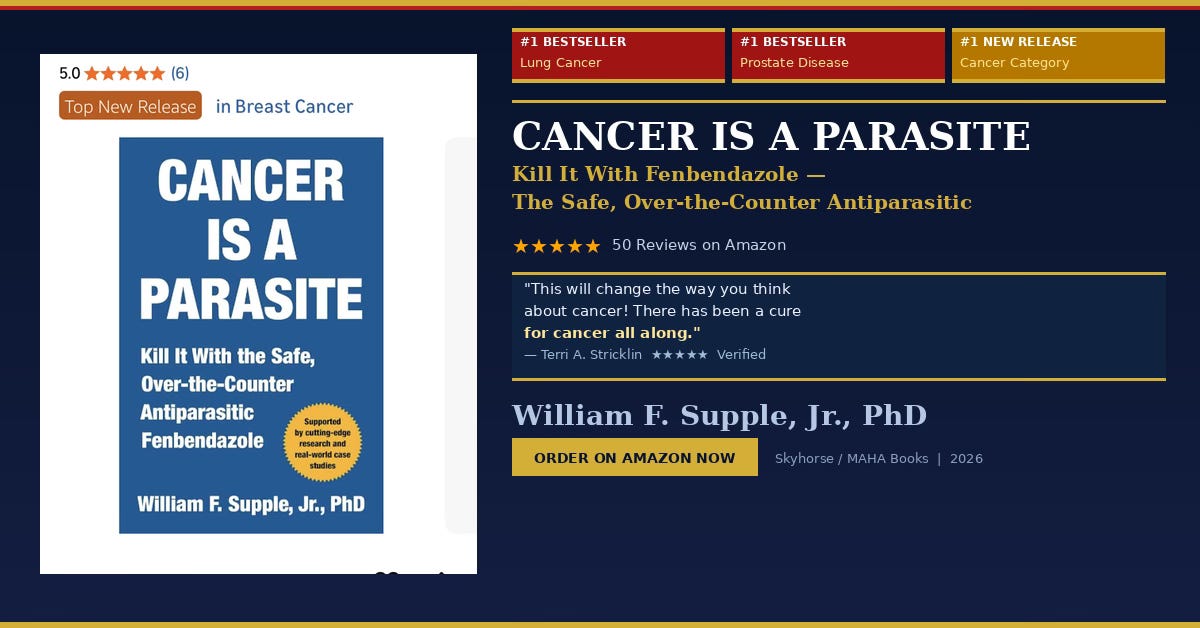
Cancer is a Parasite is the #1 book in many Amazon categories like breast, lung and prostate cancer! If you buy it on Amazon, please post your reactions and review on Amazon - a few words is all it takes. I think you can post comments on Amazon even if you obtained the book elsewhere. I would also ask that you comment here as well and as always, ask any questions that arise.
We are truly at a moment in time where a legitimate cure for cancer is about to enter the mainstream. The stars are aligned and the time is ripe for a real cure like fenbendazole. The ball is now in the court of the revamped Health and Human Services public health infrastructure. It is my hope that the shackles impeding progress from entrenched interests have been loosened enough to find the political will and courage to act in humanity’s best interests. It is truly a great time to be alive!
Thanks for reading Fenbendazole Can Cure Cancer! Feel free to share this article with someone who could benefit.
Items Included in All Posts
Fenbendazole vs. Mebendazole vs. Albendazole vs. Flubendazole: The benzimidazoles are very similar chemically and they have very similar mechanisms of action with respect to disrupting microtubule function, specifically defined as binding to the colchicine-sensitive site of the beta subunit of helminithic (parasite) tubulin thereby disrupting binding of that beta unit with the alpha unit of tubulin which blocks intracellular transport and glucose absorption (Guerini et al., 2019). If someone asks you how fenbendazole kills the cancer cells, the answer is in italics in the previous sentence.

The class of drugs known as benzimidazoles includes fenbendazole, mebendazole, albendazole and flubendazole. Mebendazole is the form that is approved for human use while fenbendazole is approved for veterinary use. The main difference is the cost. Mebendazole is expensive ~$555 per 100 mg pill, while fenbendazole is inexpensive ~48 cents per 222 mg free powder dose (Williams, 2019). As you may recall, albendazole is the form used to treat intestinal parasites in India and these cost 2 cents per pill. FYI, to illustrate how Americans are screwed by Big Pharma, two pills of mebendazole cost just $4 in the UK, 27 cents per 100 mg pill in India and $555 per 100 mg pill in the US.
While most of the pre-clinical research uses mebendazole, probably because it is the FDA-approved-for-humans form of fenbendazole, virtually all of the self-treating clinical reports involve the use of fenbendazole. Because the pre-clinical cancer studies use mebendazole (ironically the human form of fenbendazole) and humans self-treat their cancers with fenbendazole (the animal form of mebendazole) it is very reasonable to assume that mebendazole and fenbendazole are functional equivalents with respect to cancer. It would be helpful if future pre-clinical and clinical investigations simply used fenbendazole as a practical matter. For the purposes of this Substack, fenbendazole, mebendazole and albendazole are used interchangably.
Where to get fenbendazole
In our experience and the experiences of those that write in, it appears that the three readily available brands of fenbendazole (Panacur-C, FenBen Labs, Happy Healing Labs) are equally effective. Panacur-C can be obtained locally in pet stores, while they all can be obtained from Amazon. The article on Questions & Answers discusses the brands of fenbendazole in detail and shows photos of the various brands referenced.
If you would like to report your experiences with fenbendazole you can do so privately by email myfenbendazole@proton.me or more publicly in the Comments section in any of the articles.
Disclaimer:
Statements on this website have not been evaluated by the Food and Drug Administration. The contents of this website is for educational and informational purposes only and is not intended to be a substitute for professional medical advice, diagnosis or treatment. This website does not provide any kind of health or medical advice of any kind. Always seek the advice of your physician or other qualified health provider with any questions you may have regarding a medical condition. The case reports presented reflect the real-life experiences and opinions of other readers or users of the website. The experiences of those readers or users are personal to those particular readers/users and may not necessarily be representative of all readers/users. We do not claim, and you should not assume, that all other readers/users will have the same experiences. Do you own research, consult with relevant medical professionals before attempting to self-treat for any condition.
Comments
Nothing yet. Say the first thing.
Sign in to join the conversation.