
The American research university had made substantial progress through the early decades of the 20th century. However, it was not until World War II that scientific research became inextricably linked to national defense. During the war, American universities were transformed into training, research, and development centers (Abrams 1989). Ph.D. production increased, which helped to facilitate American research for decades to come.
Furthermore, during the rise of fascism in Europe, American institutions welcomed German scholars which bolstered the American research system (Rhodes 2018). Weapons design became a highly coordinated system that involved scientists, engineers, and designers to work together, side by side, to develop an unprecedented number of devices, machines, and systems. Professional boundaries dissolved and the wartime effort revealed the benefits of collaboration among different entities.
Government officials, military officials, industry researchers, production managers, engineers, and universities ultimately collaborated to meet different military needs. This included the creation of ships, planes, vehicles, communication devices, and weapons. The National Defense Research Committee (NDRC), and the Office of Scientific Research and Development (OSRD) worked with approximately 300 research and industrial laboratories on over 200 projects to produce more than 200 more devices.
The MIT Radiation Laboratory devised a system for aircraft detection based on electromagnetic waves (radar). The University of Pennsylvania’s Moore School of Engineering established a ballistic research lab and developed the electronic numerical integrator and computer (ENIAC) to make ballistic calculations (Margolin 2013).

The Harvard University Computation Laboratory, which was run by the Navy, worked on developing the Mark I and Mark II computers (Williams 1999). Six universities were awarded more than $10 million in contracts. These were MIT, Caltech, Columbia, the University of California at Berkeley, Harvard, and Johns Hopkins (Geiger 1992).
Moreover, World War II defense contracts provided a much-needed injection of funds for many universities who had hobbled through the Depression years. Defense contracts with the military, federal government, and defense industries were available and many universities took advantage of them.
A prime example is Stanford University. By the late 1930s, the university’s endowment and tuition income was decreasing. Desperate for tuition dollars, Stanford had lowered its academic standards for admission and had eliminated student expulsion based on poor academic performance (Dorn 2005 ; Lowen 1991). In particular, the physics department was lacking funds for research and was starting to slip behind its rival peers, the University of California Berkeley and the California Institute of Technology. There were only seven faculty members and equipment had to be patched. An earlier, troubled industry partnership in the physics department may have increased the appeal of federal funding.
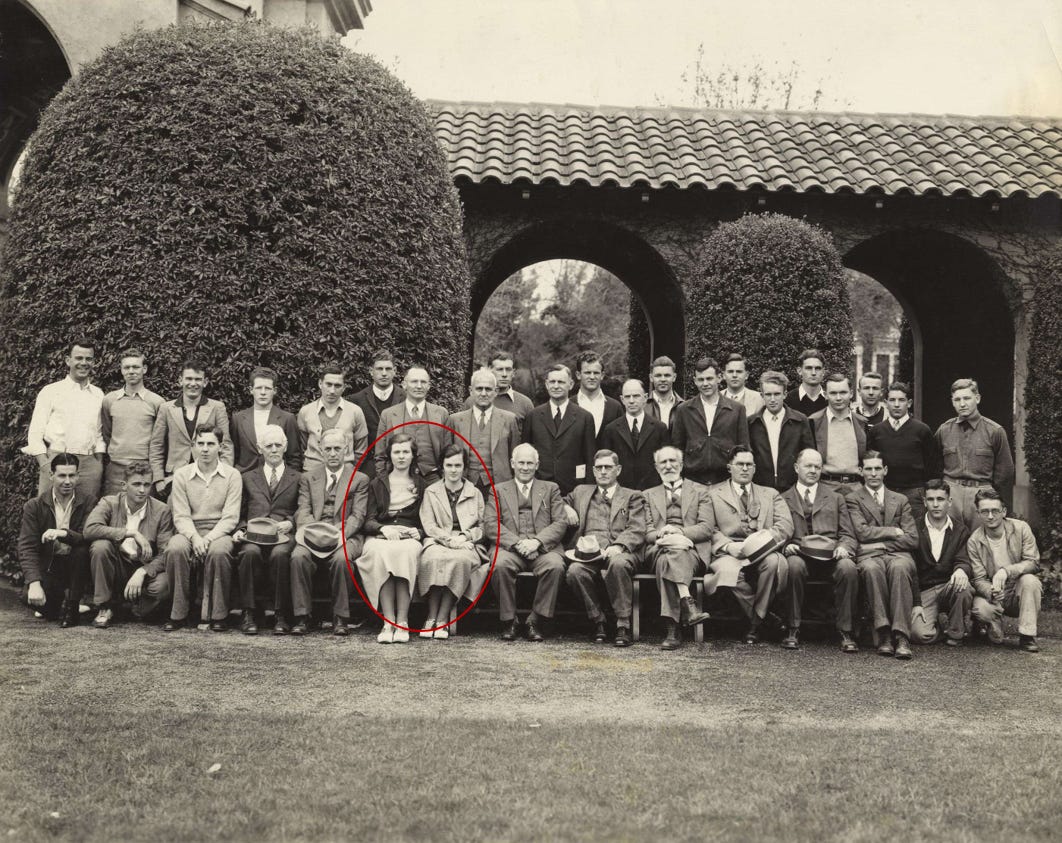
Stanford Student Chapter of the American Society of Civil Engineers, 1936. Mary DeF. Atkins and Margaret Woolverton were seniors.
During the war, some physicists in the department began to aggressively plan for the development of a cutting-edge microwave research laboratory. There was clamor to hire faculty who could boost the department’s research reputation. The university began to solicit more federal and industry contracts during the war and continued to do so after the war. By 1949, the Stanford physics department was thriving. When the microwave laboratory was completed, the department housed fourteen faculty members, ninety staff members and sixteen full-time research associates with no teaching responsibilities. The laboratory also received ONR support (Lowen 1991).
Other universities maintained post-war research facilities. The Applied Physics Laboratory (APL) at Johns Hopkins University remained associated with the university, despite the University’s aversion to weapons production. The Jet Propulsion Laboratory also had an uneasy relationship with Caltech after the war. On the other hand, the Berkeley Radiation laboratory had a more open, productive relationship with the “academic” side of the university. MIT’s Research Laboratory of Electronics (RLE) continued on after the war with support from the ONR, Air Force, and the Signal Corps.
The Research Laboratory of Electronics at MIT was created to continue wartime research. The Korean war would even expand research opportunities (Geiger 1992). The trade-off for these new research opportunities was a change in the research mission. Obviously, there was an increased emphasis on applied research as opposed to basic research. Furthermore, “applied” curriculum and technical training were placed at the forefront during the war years. Research was further required to have a “purpose” rather than for fundamental scientific discovery. During and after the war, scholars voiced concern about this new threat to the humanities, and how the elimination of the humanities was a threat to democracy and peace (Dorn 2005).
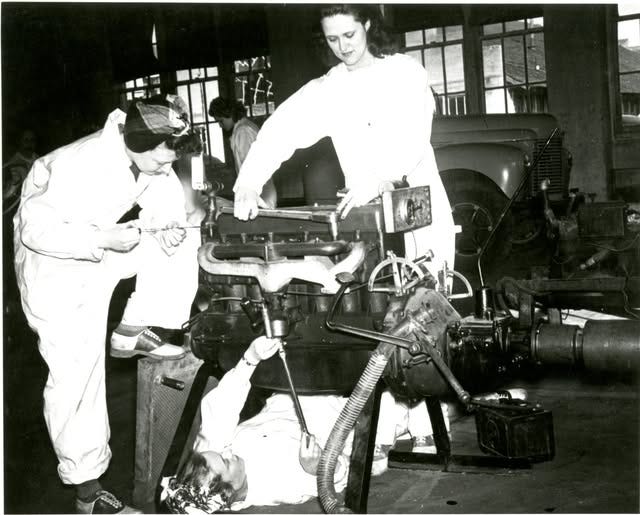
World War II also opened new positions and scientific training programs for women. The number of women scientists doubled during America’s four-year involvement in the war (Rossiter 1995). However, many of these roles were sex-typed as “assistants” or “aides”. Most often, these jobs were “entry level positions” with little chance of promotion. For example, one commonly-held position was making numerical calculations for research projects, which involved little creativity or authority (Margolin 2013).
Engineering, next to medicine, was one of the most in-demand fields during World War II, and provided some opportunities for women, with a few women even becoming engineering instructors at universities. Female enrollment soared. Women enrolled in prestigious engineering schools at colleges such as Columbia University. Moerso, many women took over as STEM instructors—which is often considered to the principle contribution of women scientists to WWII. Even all-male colleges accepted women instructors, the demand for teaching STEM was so high.
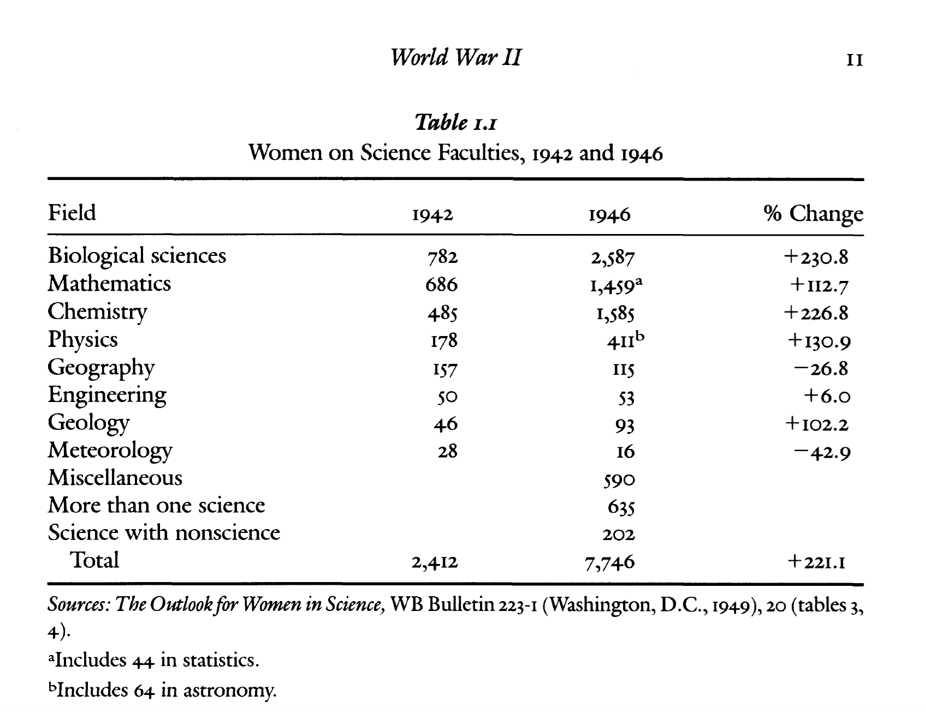
There were large increases of women as faculty members in many STEM fields at American universities including Engineering (6% increase), Biology (231% increase), Physics (131% increase), and Mathematics (113% increase) Rossiter, Margaret W. 1995., page 11.
These efforts, however, did not translate to professional, long-term careers. According to a bulletin from the U.S. Department of Labor, the number of women qualified as engineers in 1947 was less than 1% of the national profession. In 1940, there were 730 women employed as professional engineers in the United States compared to 244,558 men. Women also faced difficulties in progression in the field and were often confined to office work (Schwellenbach and Miller 1948). For example, plant scientist Cynthia Westcott filled in at an extension office in Alabama and was able to assist with an on-going plant epidemic. However, at the end of the war when her male counterpart returned, she had to leave the position with no benefits or pension and had to pursue self-employment.
While a few women had high-ranking roles on classified research projects, overall, women’s STEM were underutilized, except in the realm of teaching, even those with doctorates.
Universities played an important role in training for war-related topics related to the sciences. One of the largest contributions of women in the war-effort was joining university faculty and staff, particularly in the sciences. However, universities delayed tenure and promotion decisions during the war and virtually signaled that these hires would be temporary. Despite labor shortages and the contributions of women to the war effort, deeply conservative, antifeminist attitude prevailed.
Please consider following me on my social media platforms:
Abrams, Richard M. 1989. “The U.S. Military and Higher Education: A Brief History.” The Annals of the American Academy of Political and Social Science 502: 15–28.
Dorn, Charles. 2005. “Promoting the ‘Public Welfare’ in Wartime: Stanford University during World War II.” American Journal of Education 112(1): 103–28. l:
Geiger, Roger L. 1992. “Science, Universities, and National Defense, 1945-1970.” Osiris 7: 229-24626–48.
Lowen, Rebecca S. 1991. “Transforming the University: Administrators, Physicists, and Industrial and Federal Patronage at Stanford, 1935-49.” History of Education Quarterly 31(3): 365–88.
Margolin, Victor. 2013. “The United States in World War II: Scientists, Engineers, Designers.” Design Issues 29(1): 14–29.
Rhodes, Karl. 2018. “Founding America’s First Research University.” Econ Focus: 22–25. f.
Rossiter, Margaret W. 1995. “World War II: Opportunity Lost?” In Women Scientists in America: Before Affirmative Action, Baltimore and London: The Johns Hopkins University Press, 1–26.
Schwellenbach, L. B., and Frieda S. Miller. 1948. The Outlook for Women in Architecture and Engineering.
Williams, Kathleen Broome. 1999. “Scientists in Uniform: The Harvard Computation Laboratory in World War II.” Naval War College Review 52(3): 90–110.
No posts
Comments
Nothing yet. Say the first thing.
Sign in to join the conversation.