
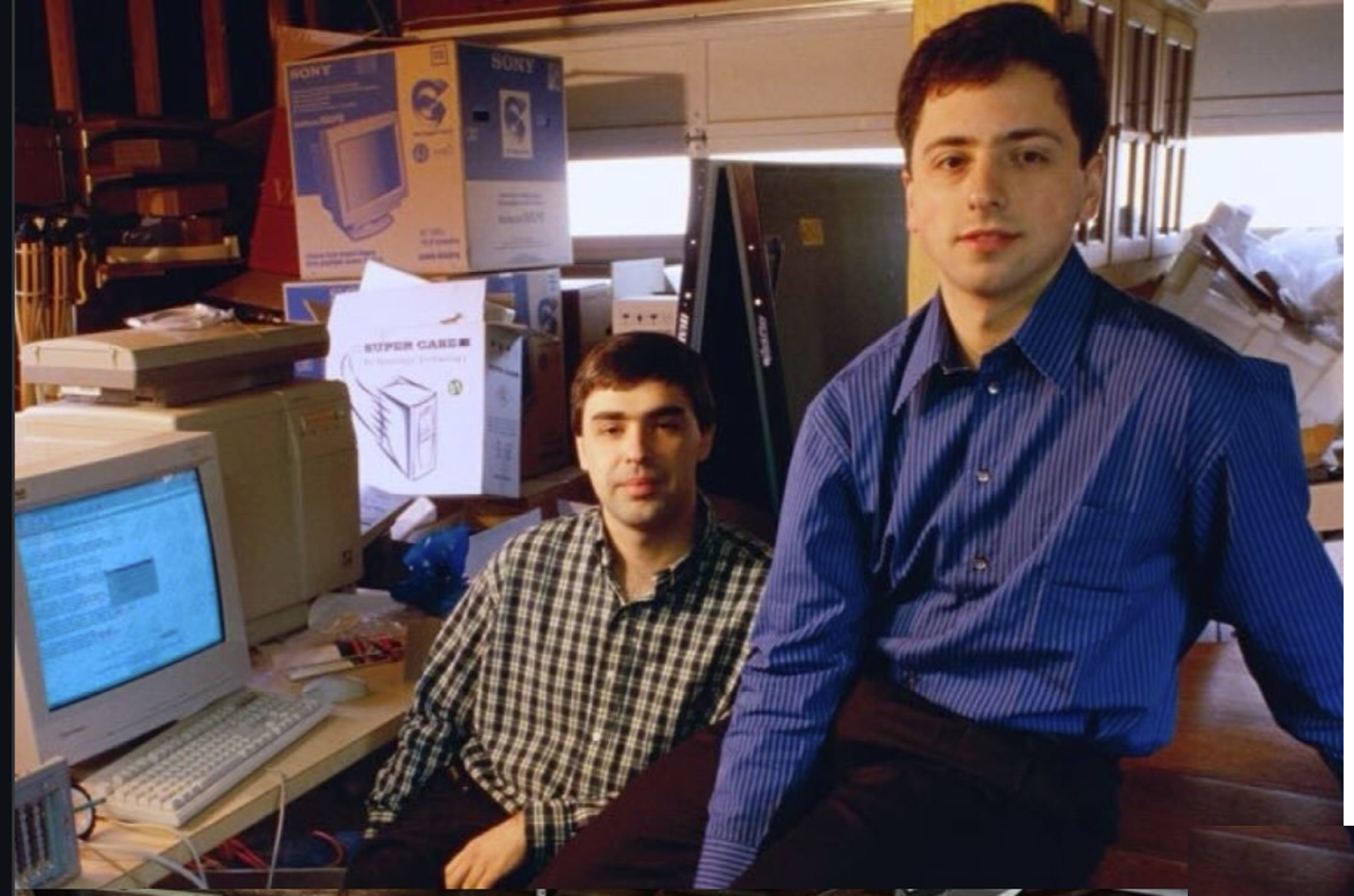
In 1995, future Google co-founder Larry Page visited Stanford University as a prospective grad student, where Sergey Brin was his tour guide
Read Part I—A Science Machine: The Rise of the U.S. Research University
Since the 1980s, the research university has embraced supply-side economic policies to increasingly marketize education and research. Since declining federal funding and state appropriations in the 1970s, universities turned to corporate management practices, entrepreneurial science, and private fundraising.
By 1980, the U.S. economy was experiencing what some economists termed “stagflation”. This was an era of both high unemployment and inflation and characterized by slowed investments and economic productivity. Throughout the 1950s and 1960s, research universities had greatly expanded student enrollment, faculty hiring, and facilities. But during the “Great Inflation” of the 1970s, revenue from alumni donations, endowment returns, and student tuition declined or remained flat (Geiger 2019b).
Furthermore, perhaps as a response to campus unrest in the 1960s, a disillusionment with “basic research” support, concerns of overspending in the 1960s, or a combination of all three, federal R&D funding declined or remained stationary throughout the 1970s. These funds not only had less impact in the inflationary 1970s economy but could not support the tradition of expansion which universities had enjoyed since World War II. R&D infrastructure, graduate training, and science development funds were eliminated or scaled back.
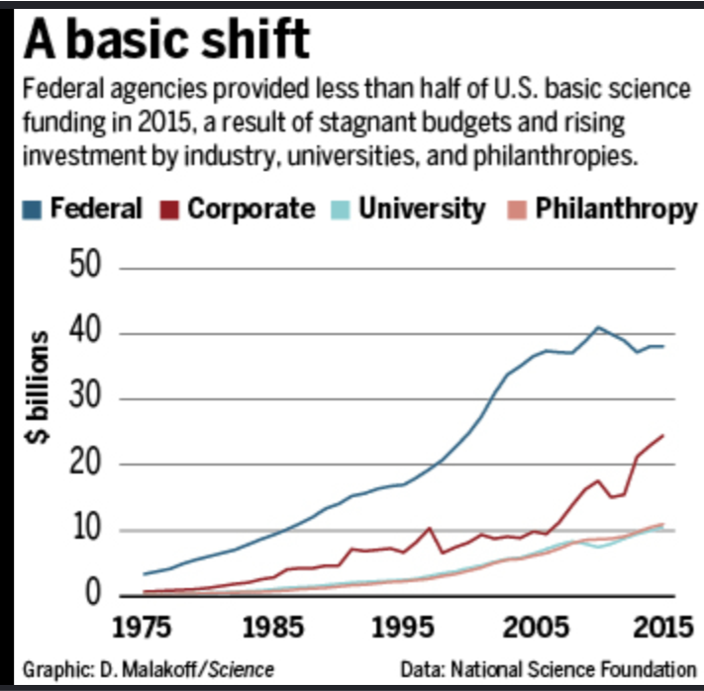
Corporate sponsorship for research increased in the 1980s. By the 2010s, pharmaceutical and biotech were major corporate donors.
Mainly, areas of “applied research”, namely in biotechnology, engineering, computer science, and cancer research received support. Social sciences support was low during the era, foreshadowing a sharper change in research funding priorities in decades to come.
By 1981, MIT had a $7-million-to-$8-million commitment by Exxon to finance MIT’s Energy Laboratory. Du Pont reportedly gave $6 million to Harvard Medical School for genetic research; 10 companies contribute $7.5 million for a new computer center at Stanford; and Control Data, Burroughs and Minnesota Mining and Manufacturing pledged $5 million for computer research at the University of Minnesota.
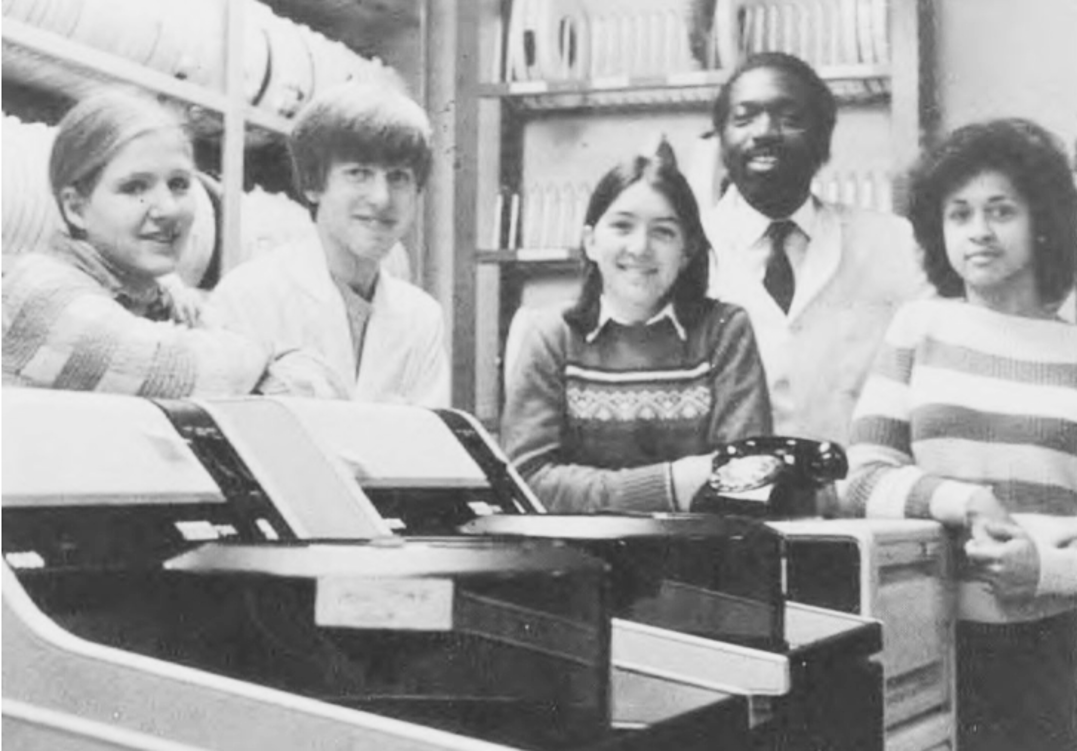
Stanford’s computer lab in the 1980s shifted from main frames to personal computers.
Large fundraising campaigns and the development of foundations, in the millions of dollars, became more commonplace. Universities “competed” for tuition, grants, contracts, solicited private gifts, and other monies (Rhoades and Slaughter 1997). Board appointments were increasingly strategic, made to enhance the university’s wealth and profit (Pulido 2014).
Furthermore, state and federal governments established programs to allow for greater industry-university cooperation. For example, in 1973 the NSF devised their industry-university research centers (IURC) program (Geiger 2019a). The IURC program works to connect industry partners with academic researchers to accelerate the impact of “basic research” (NSF 2022). By 1990, there were over 1000 IURCs operating (Geiger 2019a) and by 2019 the fiscal budget was $8.1 billion and had sponsored projects in a variety of fields from biomedical to agricultural applications (NSF 2022).
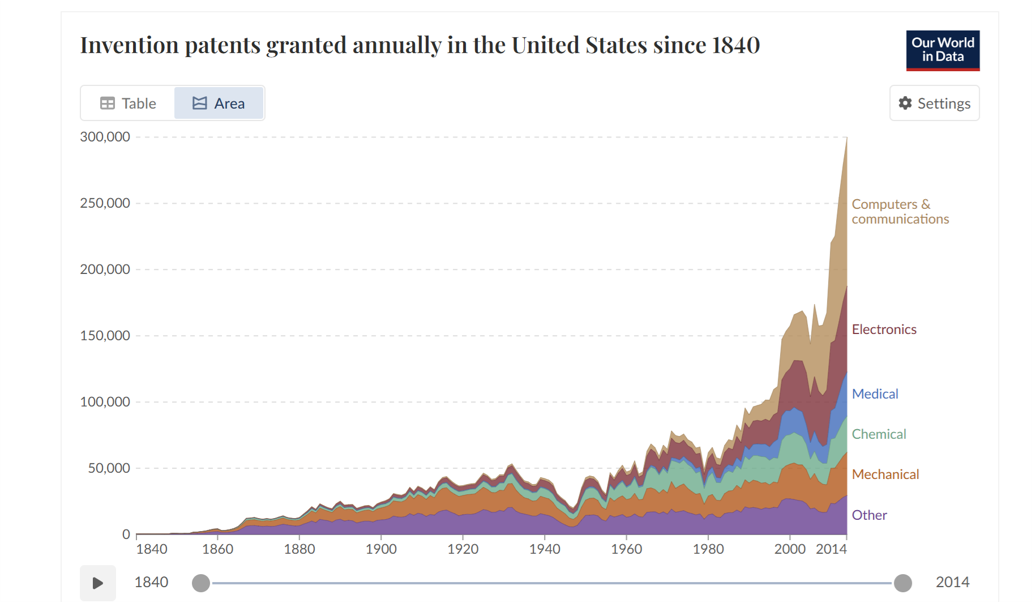
U.S. Patents exponentially increased in recent decades, many in computers and electronics, and medical fields.
Ironically, some attributed economic stagnation to a lack of innovation, which could be remedied through academic research (Bloomstein 1989b). One of the most notable pieces of legislation to revolutionize academic research was the Bayh-Dole Act of 1980. The act allowed and even instructed universities how to patent and license discoveries made with federally funded research.
The emerging biotech industry dovetailed nicely with this new interest in technology transfer (Geiger 2019a), and combined with the Bayh-Dole Act, was a game changer for the commercialization of academic research. Hence, academic research became increasingly applied in the quest for money. Many universities committed to biotechnology research, even if they had not even conducted such research before (Geiger 2019a).
Notably, Stanford and MIT were leaders in commercialization (Geiger 2020). One of the first universities to do so, Stanford had already established their Office of Technology Licensing (OTL) in 1970 (Stanford 2022). By the early 1980s, technology for cancer detection and blood screening had been licensed. By 1995, Stanford’s OTL had 100 active inventions licenses to companies all over the world, with 220 of them earning a $44 million total royalty income. By 1992, MIT had already been awarded 126 patents (Jung 1993).
This streak continued. From 1996 to 2020, at U.S. universities there were 554,000 inventions, 141,000 U.S. patents granted, and 18,000 start-ups formed, contributing $1.9 trillion of U.S. gross industrial output. This was very large impact on Life Sciences where from 1990 to 2005, there were over 200 new drugs and vaccines licensed.
It was estimated that MIT patents added an estimated $1 billion to the U.S. economy (Altschul 1995) and that industry invested 2-5 billion a year to market university innovations by 1995. Technology transfer soon became a new mission of the American research university (Geiger 2020). These offices were ‘money making powerhouses’ for their universities (Bloomstein 1989a). By the 1990s, increases in federal funding, in addition to these new windfalls form industry and patents, permanently secured research as a central mission of the American university system.
With the deregulation of patent law, universities increasingly became stakeholders in faculty members’ start-up companies and became the developers and owners of patents. These so-called academic capitalists faced low risk of failure, since they receive a substantial portion of federal money, and tuition increases which are subsidized by the state (Rhoades and Slaughter 1997).
Despite these large windfalls, many research universities were retrenching expenditures, particularly in the areas of graduate education (Geiger 2019b). This era of “retrenchment” set the stage for greater managerial control, greater alienation between faculty and administration, and adoption of corporate financial strategies.
Ultimately, the labor market in academia was re-framed as something that “naturally” fluctuates with graduate education as the “supply” and the faculty job as the “demand”. Bousquet in How Universities Work, argues that this rhetoric helped normalize the casualization of academic labor and the decline of tenure-track academic job opportunities (Bousquet 2008).
This rhetoric was often used to silence the consciousness of flex workers, by predicting future job expansions, and to soothe the degree holder who was on their fifth year of the academic job search. These changes had substantial impacts on instructional methods, research production and output, student well-being, academic freedom, and diversity. This means lower stipends for huminites graduate students, less funding and maintenance of humanities buildings, increasing competition in the academic job market, increasing reliance on out-of-state students for tuition, and obsession with rankings.
Indeed, the English department building where I went to school had issues with asbestos that the university refused to addressed. This plays into the systemic devaluing of the humanities for patents and computing advances has resulted in the current crises of closing liberal arts colleges, the shuttering of humanities programs, and use of grad students and adjuncts for labor. This has a negative impact on diversity as people of color and women are more likely to be hired in part-time, lower-ranking academic positions.
Please consider following me on my social media platforms:
Altschul, B., 1995. MIT Study Finds University Patents Add Billions. Tech 1,14.
Bloomstein, J., 1989a. Stanford grossing $11.5 million from technology licensing. 1The Stanford Dly. 1,10.
Bloomstein, J., 1989b. Licensing Office has grown into moneymaking powerhouse. Stanford Dly. 1.
Bousquet, M., 2008. How the University Works: Higher Education and the Low-Wage Nation. New York University Press, New York, London.
Geiger, R.L., 2020. Building Knowledge:The Research Mission in American Universities, 1890–2018, in: Engwall, L. (Ed.), Missions of Universities Past, Present, Future. Springer International Publishing.
Geiger, R.L., 2019a. Surviving the Seventies, in: American Higher Education Since World War II. Princeton University Press, pp. 217–265.
Geiger, R.L., 2019b. Dawn of the Current Era, 1980-2000, in: American Higher Education Since World War II. Princeton University Press, Princeton & Oxford, pp. 269–311.
Heidi A. Diefes-Dux, Kamyar Haghighi, 2001. Closing the EC 2000 Loop and Implementing Change, in: 2001 ASAE Annual International Meeting. Sacramento, California. https://doi.org/10.13031/2013.3592
Jung, J., 1993. With 126, MIT is Patent Pick. Tech 1,9.
NSF, 2022. About the IUCRC Program [WWW Document]. IURC. URL https://iucrc.nsf.gov/about/ (accessed 5.21.22).
Pulido, L., 2014. Faculty Governance at the University of Southern California, in: Chatterjee, P., Maira, S. (Eds.), The Imperial University: Academic Repression and Scholarly Dissent. University of Minnesota Press, Minneapolis, Minnesota, pp. 145–168.
Rhoades, G., Slaughter, S., 1997. Academic Capitalism, Managed Professionals, and Supply-Side Higher Education. Soc. Text 51, 9–38.
Stanford, 2022. A History of OTL [WWW Document]. Off. Technol. Licens. URL https://otl.stanford.edu/history-otl (accessed 5.21.22).
No posts
Comments
Nothing yet. Say the first thing.
Sign in to join the conversation.