
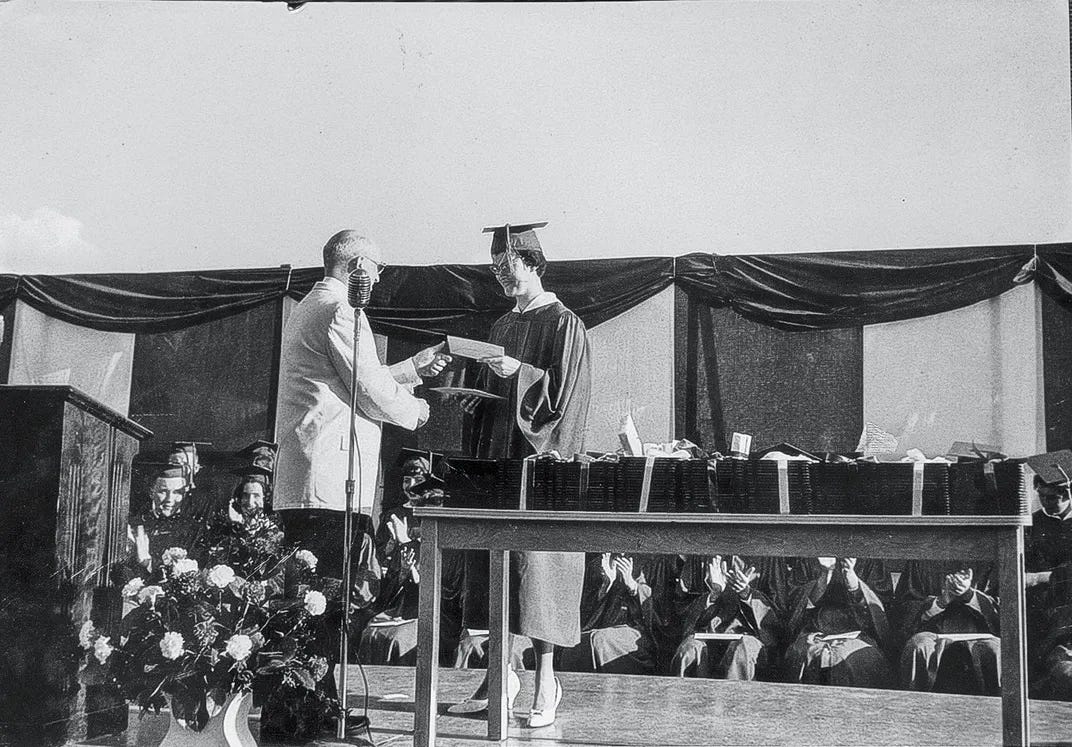
Margaret Rossiter graduating from high school in 1962.
There is no biography book of feminist historian of science Margaret W. Rossiter. She gave relatively few interviews, received less public recognition than her influence warrants, and wrote only one brief autobiographical essay. While her scholarship—especially her recovery of women scientists erased from the historical record—is well known, far less is understood about her own life. This essay draws on university yearbooks, newspaper archives, genealogical records, online memorials, interviews, personal recollections, and Rossiter’s published work to synthesize material that has not previously been brought together, while also addressing the limited critical examination of her methodology. Rossiter pioneered a data-driven approach to historical recovery, yet she is often portrayed simplistically as an archetype of perseverance rather than as a scholar and activist shaped by generational, social, cultural, and institutional constraints.
The available evidence suggests that Rossiter devoted most of her life to her work. She did not marry or have children. Colleagues recall her wide professional network, a dry sense of humor, and a willingness to mentor and assist others. Her social life appears closely intertwined with her academic commitments: she worked late in her office at Cornell, shared archival discoveries with colleagues, took on extensive editing and teaching responsibilities, and wrote and edited prolifically. While the historical record offers little insight into her emotional life, it does hint at periods of stress, discouragement, and isolation common to women working in male-dominated academic fields. Rossiter relied heavily on her family for moral support and outlived her parents and twin brother. She resided in humble apartments for most of her adult life. Together, these fragments suggest a life of extraordinary intellectual dedication—one whose personal dimensions remain largely obscured, even as her work permanently reshaped the history of science and were foundational texts in the emerging field of feminist science studies. In the future, nuanced examination of her personal correspondence might yield further insight into this complex persona. This will be the first of several essays.
Margaret Rossiter’s intellectual achievements were unsurprising given how much her family valued education, writing, and most of all history.
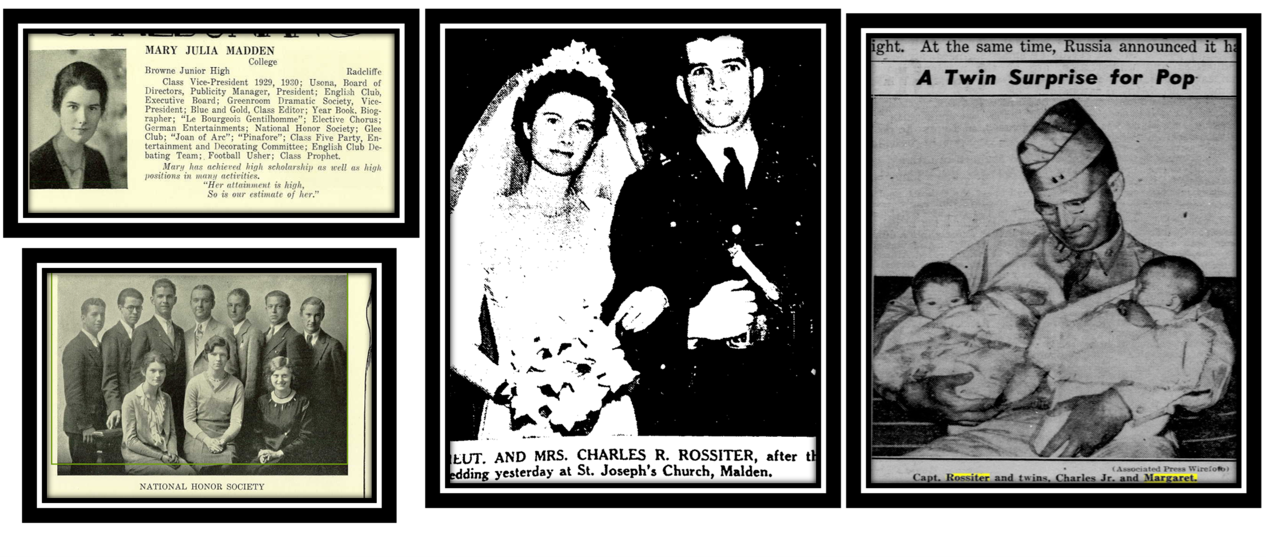
LEFT & Middle: “The bride [...] received her Bachelor’ of Arts degree from Radcliffe in 1934” Boston Globe Dec 28, 1941, page C3. She and her husband were both in the National Honor society at Malden high school in 1930. RIGHT: “A Twin Surprise for Pop”. Capt Rossiter and twins, Charles Jr. and Margaret. 29 Sept 1944 New York Daily News page 3
Margaret Walsh Rossiter and her twin brother Charles were born July 8, 1944, to parents Charles Rossiter (1912-1986) and Mary J. Madden (1914-2005). Her father, Charles A. Rossiter, was high school valedictorian, attended Harvard, and later taught history in Malden. Her mother, Mary Madden attended Radcliffe and pursued social work.
After Pearl Harbor, Mary and Charles married within weeks when it was clear he would be in the Army for an extended period. He was stationed in New Orleans and probably guarded prisoners of war. He did not meet Margaret and Charles until September 1944, something written up in the New York Daily News (Rossiter attributed this publicity to her family’s connection with newspapers). Paternal grandfather David P. Rossiter was a beloved editor of the Malden news a local newspaper, and paternal uncle Francis was a priest.
Records and yearbook accounts indicate that Rossiter’s mother was not only educated but participated in clubs, holding class offices in high school. Later in life, Madden worked outside the home, after receiving a master’s degree. Madden served as an important role model to Rossiter as a living example of female intellectual ambition; after helping her mother with a Radcliffe class reunion she realized that she had “no interest in other places [colleges]”. Rossiter and her mother were close and even took a trip around the world together later in life. Margaret loved travelling and even worked in a travel agency during high school one summer.
In 1951, the family moved to Melrose. Their family was the fifth generation of Malden. Her parents frequently took her to local history lectures and encouraged her love of reading. Later Rossiter would write about how women’s participation in science was affected by wartime and growing she likely observed how intellectual promise could be limited based on gendered expectations growing up in 1950s America. Malden, however, was a bit unusual. It had a history of resistance by being the first town to petition the colonial government to secede from British rule.
Far less is known about Rossiter’s more private twin brother. According to a Boston Globe article, he attended Malden Catholic and planned to follow their uncle Francis to the College of the Holy Cross, which he attended as a member of the class of 1966. He was described as a “ping-pong champion”. In his 1966 Holy Cross yearbook he was referred to familiarly as “young Rossiter.” Public records indicate that he later lived in Stamford, Connecticut, never married, and died in January 2004; he was buried at Holy Cross Cemetery and Mausoleum. Childhood friend Richard Ross wrote on his obituary page:
These familial and social conditions help explain Rossiter’s later scholarly preoccupation with institutional gatekeeping, invisible labor, and the historical exclusion of women from scientific recognition. Her education followed relatively elite educational pipelines—but they were uneven in their rewards.
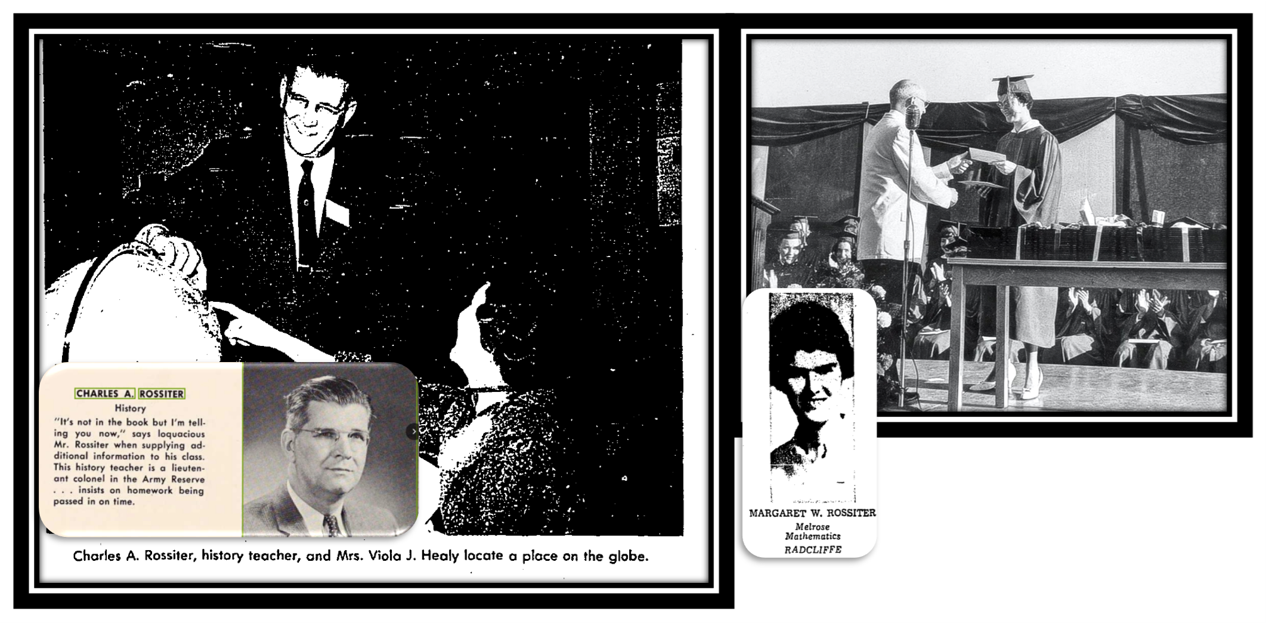
LEFT: Charles A. Rossiter, a history teacher. Boston Globe Jan 6, 1963, page A4; Malden High Yearbook 1966 RIGHT: “17th Century Biography Fan”, Boston Globe May 18, 1962. “Margaret had chosen Radcliffe long before she received word of her scholarship award” Boston Globe May 18, 1962 page 22
Margaret Rossiter graduated from the coeducational Melrose High School in 1962, A National Merit Scholar, where she was an engaged student. Her yearbook records her participation in field hockey, multiple clubs, and the literary staff. Faculty and peers recognized her academic ability early, describing her as a “girl genius”:
Attention! Girl genius at work! (probably doing another crossword puzzle). Intelligent and amiable, especially enjoys basketball, math, reading,
The yearbook also reveals a broader culture of college aspiration among her classmates. Yet despite Rossiter’s strong academic profile, she does not appear in the male-dominated Science Club picture, already foreshadowing science’s structure that would become her career. This contrast underscores how Rossiter’s talents were encouraged and celebrated even as institutional pathways into formal scientific spaces remained implicitly restricted—an early pattern that would later inform her scholarly attention to gendered exclusions within academic disciplines.
For her era, Rossiter was educationally privileged. From an early age she was encouraged, identified as intellectually gifted, and supported in ways often necessary for talented students to access higher education. Her trajectory resembles that of other women scholars such as Matilda Joslyn Gage and Rosalind Franklin, whose early intellectual development was facilitated by family support. Rossiter’s path thus aligns with that of upper–middle-class women educated at the Seven Sisters colleges, where college attendance was expected rather than exceptional. This stands in stark contrast to my own Catholic family history, in which few women attended college and most neither anticipated nor could afford it. Rossiter’s access to Latin instruction (typically reserved for boys) further reflects this privilege, while her mother’s academic and professional example reinforced the expectation that she would pursue a career. As her friend Barbara Cleveland wrote:
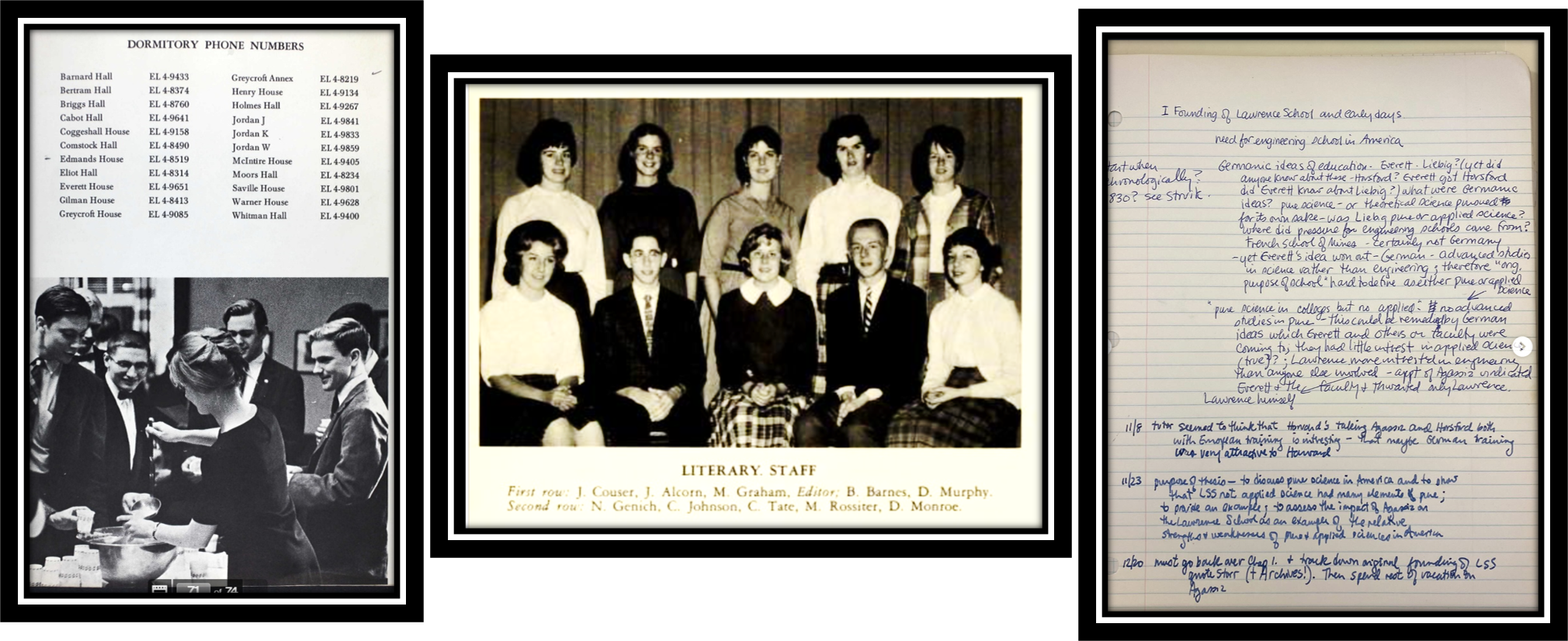
LEFT: Image from the Radcliffe yearbook 1966 showing dorm life curtesy of Ancestry.com; Center Rossiter (back row second from right) Melrose High school Literary Staff curtesy of Ancestry.com ; RIGHT: Rossiter’s thesis notes from Radcliffe (Schlesinger Library)
Rossiter’s academic distinction was already well established by the time she graduated from high school, where she was recognized as both a National Merit Scholar and a “math star” at Melrose High School. Her intellectual seriousness extended well beyond standard curricular expectations, as evidenced by contemporary press coverage:
Radcliffe College, the women coordinate college of Harvard, gave her a first-hand view of a sex-segregated academic system with low expectations for female graduates. Historically, Radcliffe emphasized intellectual seriousness and career preparation over “marriageability.” But by the 1950s, administrators and alumnae increasingly promoted marriage (particularly to Harvard men) as a marker of success.
By 1956, the Radcliffe Alumni Association proudly reported that 86% of the class of 1946 had married (Arnow 2015), compared to 50% of the class of 1910. In 1962, alumna Margaret V. Cobb noted, without alarm that “very few of our daughters have undertaken careers” (Cobb 1962, 44). She argued that Radcliffe’s science curriculum should be reshaped not for professional advancement but to support women’s roles within the home:
Even if a woman is to be a scholar, or to have a career which applies the sciences or the humanities, it is well to keep in mind that she usually will, in these times, be a scholar or a career woman who at the same time maintains a home and brings up a family. This does not necessarily imply courses in home economics, but rather raises the question of the scientific knowledge which supports health, the psychological knowledge that which supports learning and character, and perhaps the economic knowledge which supports wide purchasing and use of resources p 47
Alumni interviews from other women’s colleges of that era shed some light on the atmosphere for aspiring women scientists:
College women at the time indeed felt pressure to be either a career-woman or a wife.
I think it was easy for them [my parents] to encourage my majoring in science [...] I think they saw that as practical because with a degree in biology obviously you can get a job as a technician. You could do something with it [...] I began to look at careers in terms of can I do it all. I insisted on a career, but I also insisted on marriage and a family, and to try and find a way to do both I realized was becoming increasingly difficult. So between the social messages I think I was getting from the nature of the institution I was a part of, but also my own raging hormones, I guess, that led me to think that I wanted [...] to have it all. I never for a moment ever thought of myself as being a single-minded, career devoted spinster Lois Black, Pembroke class of 1953
While Rossiter didn’t articulate this sexism at Radcliffe like she would later do regarding her experiences at Yale, alumni of Pembroke (Brown) revealed that:
there was just plain outright discrimination against women in some classes. [...] Physics 12. It was a continuing physics course and the professor [...] He would never call on a woman to [recite?] and he refused to acknowledge – he did turn in grades for women, but he absolutely refused to acknowledge their presence in his class Lois Black, Pembroke class of 1953
Rossiter, class of 1966, lived in the dormitory known as Moors. Perusing the 1966 Radcliffe yearbook reveals photographs of women and men studying together, suggesting intellectual proximity with men, or more insidiously, that Radcliffe girls were romantically desirable to Harvard men. Unbelievably, there were advertisements for secretarial schools on some pages.
While at Radcliffe, Rossiter switched from math to chemistry after an instructor, Harry Sisler, “made chemistry seem beautiful”. Despite this inspiration, she felt she lacked the aptitude for chemistry because she had not been adequately prepared in high school. She similarly resisted mathematics, not out of inability, but because she saw little value in repeatedly proving theorems without a purpose. And of course, Rossiter has had never met a woman scientist.
There were extremely strict rules for women and sex education was poor at the time. While many female alumni of the 1950s and 1960s have related about their experiences dealing with curfews, dress codes, no boyfriends allowed in dorms, and issues procuring contraception, some were able to combine academic ambitions and dating. For example, Rossiter’s close friend Sally Kohlstedt met her husband in college. Her husband wrote that:
Yet Rossiter devoted herself primarily to study. In her first year, she spent long hours reading Isis, the history of science journal she would later edit, poring over it from a top bunk in her dorm rather than dating. By late sophomore year, inspired by a history of science professor Everett Mendelsohn, she decided to major in the history of science. She wrote a paper on Boston’s Lowell Institute (which she visited frequently as a child) which was later revised and printed in the New England Quarterly. Unsurprisingly, she decided to pursue graduate study.
During the fall of her Senior year, however, she suffered a prolonged case of pneumonia that caused her to miss graduate school information fairs. As a result, she applied to only two programs—Wisconsin and Penn—finding neither compelling but choosing Wisconsin because it offered full-time study.
After graduating from Radcliffe, Rossiter briefly worked at the Smithsonian before moving to Wisconsin. Upon arrival, despite assurances that the department was expanding courses in the history of American science, she found the program inadequate.
She subsequently applied to Yale, Berkeley, and Harvard, though Harvard rejected her on the grounds that she was a “troublemaker”. After visiting Berkely (her father paid for this trip) she decided on Yale.
She earned a second master’s degree and a Ph.D. at Yale in the history of science. Because Yale lacked a formal concentration in American history of science, she pursued independent study, reading voraciously. She contacted historian of American science A. Hunter Dupree, at Brown, whom she consulted with while at Yale.
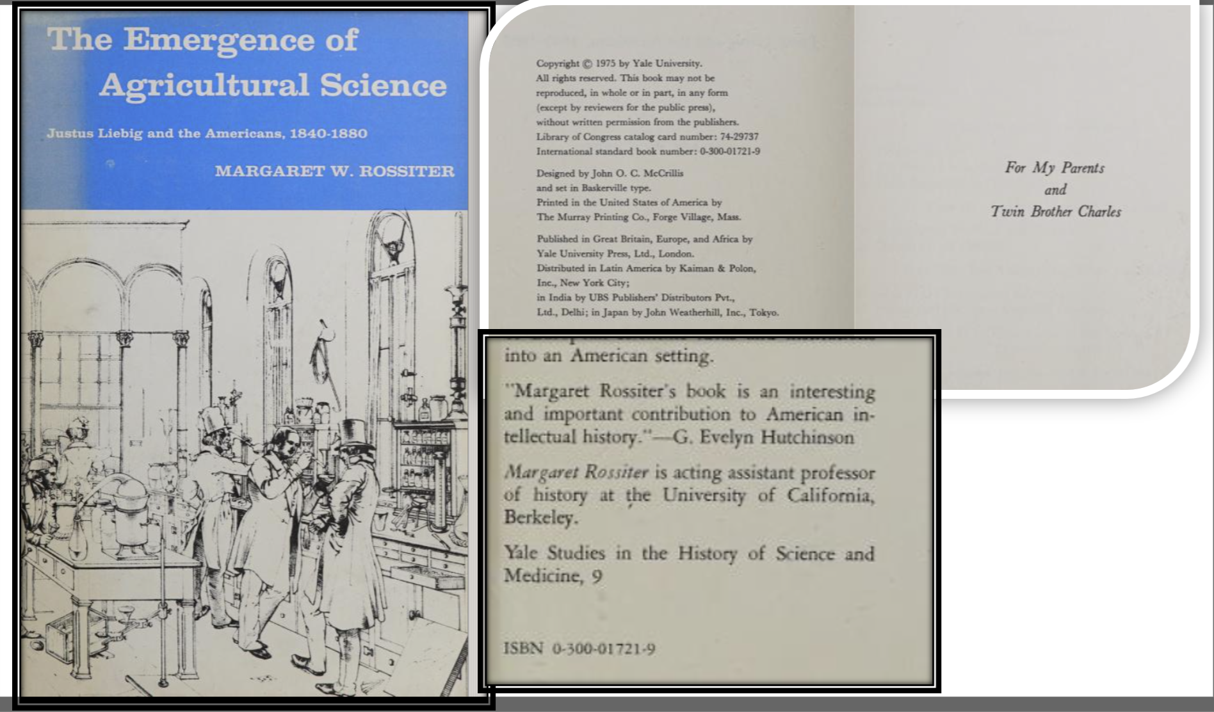
Rossiter’s first book, published in 1975.
At Yale, Rossiter was one of the few women in her graduate program. She was involved in grad student life, serving as the Graduate Student Senate as corresponding secretary and editing the GSS newsletter. Yet her presence in a predominantly male space was socially and intellectually challenging. She steeled herself to attend informal Friday gatherings with faculty and peers, filled with beer, pipe-smoking, and off-color humor. During, one Friday session, she famously asked, “Were there ever women scientists?” The dismissal she received illustrated deep sexism:
The answer she received was absolute: No. Never. None. “It was delivered quite authoritatively,” said Rossiter, Someone did mention at least one well-known female scientist, Marie Curie, two-time winner of the Nobel Prize. But the professors dismissed even Curie as merely the helper to her husband, casting him as the real genius behind their breakthroughs. Instead of arguing, though, Rossiter said nothing: “I realized this was not an acceptable subject.”
Mary Ellen Bowden, a fellow grad student recalled Rossiter, as someone
Rossiter completed her dissertation in 1971 under Frederic L. Holmes, focusing on agricultural science and the transatlantic exchange between American scientists and Germany, later published by Yale University Press: The Emergence of Agricultural Science: Justus Liebig and the Americans, 1840–1880 in 1975. One reviewer praised her narrative skills:
Perusing her thesis, we can glean some insight into her research methods, including the fact that she had a typist for her dissertation:
I was able to complete my studies at Yale without interruption thanks to a traineeship grant from the U.S. Public Health Service. […] Finally, I owe thanks to Miss Christine M. Tattersall of the Yale Department of History of Science and Medicine who has come to my rescue with her efficient (and superb!) typing of this thesis. [Acknowledgements]
Her dissertation totaled 442 pages—unusually long for a Ph.D.—with more than 40 pages of references and extensive footnotes, underscoring the depth and rigor of her research, which drew on sources she often gathered through painstaking, unconventional archival efforts, even visiting personal homes and contending with family drama:
Mrs. Fiske*s stepson, Andrew Fiske, has the other large Horsford collection at the family home, Sylvester Manor on Shelter Island, Long Island. Because of general inaccessibility and illness and a wedding in the family, I was not able to do more than visit Mr. Fiske one day and skim some letters. He is a charming man, full of interesting anecdotes about the family and the Rumford Chemical Works, which Horsford founded and for which Mr. Fiske worked in the 1930’s. Since his collection is uncatalogued and my time with him quite short, I am uncertain just how large it is and what it contains. But it probably has Horsford’s Giessen lecture notes, his diaries and other personal material before 1850 (when the systematic letterbooks at R.P.I. start). 392-393
While she had enjoyed her thesis, she felt like she didn’t have much more to say on the topic matter and wanted to pursue another track. Post-PhD she recalls her classmates getting good job offers, while she obtained temporary academic positions, much like women doctorates of yore (I can relate). Despite having a book with Yale University Press, she described job interviews as disastrous and that committees seemed baffled by her research methods.
What would be her next steps?
Rossiter’s early life exemplifies issues she would later write about: Male-dominated environments, lack of role models, unapproachable pedagogy, and insufficient pre-college preparation can hinder even highly motivated and “genius” female students.
The irony is that this shift to the humanities would not free Rossiter from institutional resistance. Although the history of science was housed within the humanities and social sciences, her later feminist examinations of scientific institutions was met with skepticism and discouragement.
Her early years exemplify how women scholars were often redirected in their career rather than excluded outright, a pattern that Rossiter would later document and theorize in her own historical work.
Please consider following me on my social media platforms:
Arnow H. College Women in the 1950s: Complicating the Ideal. Tufts University; 2015.
Meyerowitz J. Beyond the Feminine Mystique: A Reassessment of Postwar Mass Culture, 1946- 1958. J Am Hist 1993;79:1455.
Cobb M V. Bless and Praise We Famous Women. The Radcliffe quarterly. [Internet] Cambridge, MA; 1962;44–7. Available from:
No posts
Comments
Nothing yet. Say the first thing.
Sign in to join the conversation.