
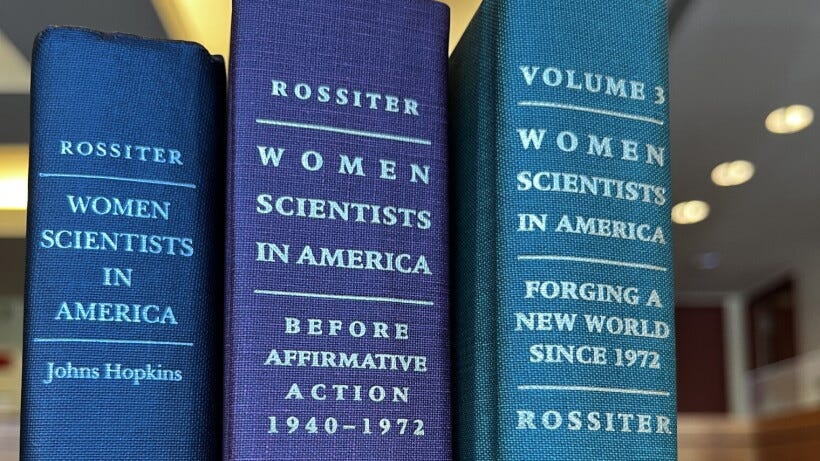
3 volumes of her books “Women Scientists in America”.
A well-told story of Rossiter’s inspiration for exploring women scientists in America is how she kept finding photographs of women in the Yale University Archives—but no names, no publications, no contributions. After her curt dismissal from Yale faculty, the evidence seemed too overwhelming. Rossiter, however, was not satisfied by this dismissal. Her skepticism was reinforced by her discovery of brief, often marginal entries on women scientists in James McKeen Cattell’s American Men of Science (1906), which contradicted senior scholars’ insistence that no such figures existed beyond Marie Curie.
There were women who were thanked in acknowledgements not as co-authors, women who were passed over for faculty positions and awards. It was a consistent pattern that was widespread, not an accident, but how the system was structured, what she would later deem as the “Matilda Effect”. The story is more complex, and tedious then often portrayed.
First, she had to do the research and dig up the data and evidence. She needed money. She needed a car (she used her family’s Volkswagon) and she needed access to archives. Supported by a National Science Foundation postdoctoral fellowship at Brown University (1971–72) and a fellowship at Harvard’s Charles Warren Center for Studies in American History (1972–73), Rossiter began to systematize these findings. Her first article on the subject, published in American Scientist in 1974, ended with this note:
The article generated an unexpectedly large response: more than 200 requests for reprints, many accompanied by additional evidence of overlooked women scientists. This outpouring of material confirmed that the phenomenon she had identified was neither anecdotal nor isolated.
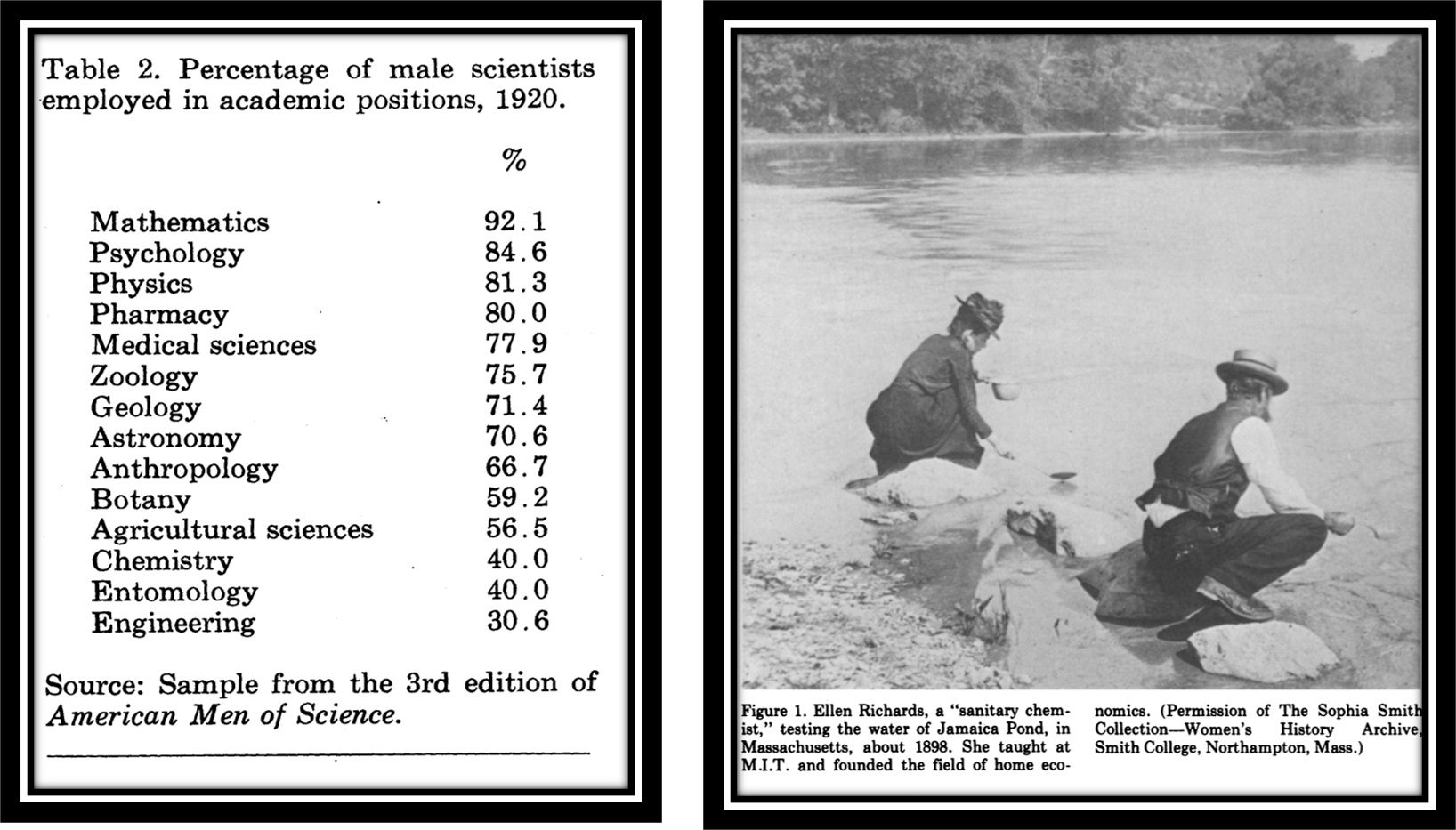
In “Women Scientists in America before 1920” Rossiter used a mix of images and tables, making use of university archives.
As her sources multiplied (often through chance discoveries) Rossiter recognized that the scope of the problem exceeded a single article or monograph. Over the next decade, her research expanded, resulting in the three-volume series Women Scientists in America, published by Johns Hopkins University Press in 1982, 1995, and 2012. By 1974, Rossiter was already serving as Acting Assistant Professor of History at the University of California, Berkeley, marking the institutional recognition of a research agenda that fundamentally reshaped the history of science.
During this time, she grew especially close to Sally Gregory Kohlstedt, who is acknowledged in most of her work and in her 2025 obituary. Apparently, Kohlstedt, deeply inspired Rossiter:
who in a conversation in a basement lunchroom at Simmons college, where she was teaching in the 1970s, suggested that I expand an article on women scientists in the United States before 1920 into a larger study, even if it took two volumes”
Kohlstedt would go on to read and critique all the subsequent manuscripts and was often mentioned in the footnotes of Rossiter’s books. However, Rossiter struggled to get funding to support further research. During the Gerald Ford years, she subsisted off of unemployment benefits which allowed her to convert her dissertation into a book. A Guggenheim Fellowship in 1981 supported the completion of this work.
When Rossiter began her work, Xerox was a relatively new technology, and personal word processors belonged to science fiction. She relied on handmade index-card systems, crammed boxes of paper, and typewriters. Traveling from archive to archive around the US, she combed through newspapers, college records, bibliographies, obituaries, payroll records, and government employment data, documenting women across a wide range of fields—including astronomy, botany, biology, chemistry, engineering, geology, physics, and zoology.
The acknowledgements and bibliography of Volume I offer insight into Rossiter’s research process, which she described as largely “serendipitous.” Rossiter began her research by consulting the limited encyclopedic and biographical reference works on women in science, then expanded to manuscript collections and oral histories. Her archival work focused primarily on elite institutions, especially the Seven Sisters colleges, the Ivy League, Stanford, MIT, and a few smaller universities such as the University of Akron. Why archives at Historically Black Colleges and Universities (HBCUs), particularly the all-women’s Spelman College, were not consulted remains unclear. Although Rossiter generally encountered few barriers to access, many collections were poorly indexed, requiring her to rely on intuition —often following a “hunch” through unorganized materials to locate significant documents.
Sometimes she spent an entire day reading obituaries trying to find a mention of a woman in STEM. She also drew on the growing body of feminist scholarship emerging in the 1970s, which she acknowledged as an important resource in shaping and supporting her work. She obtained a Guggenheim fellowship and through an arrangement with the National Science Foundation, since she as unaffiliated in a university, she was able to continue her work.
There was so much material, Rossiter realized that it would have to be included in a second book.
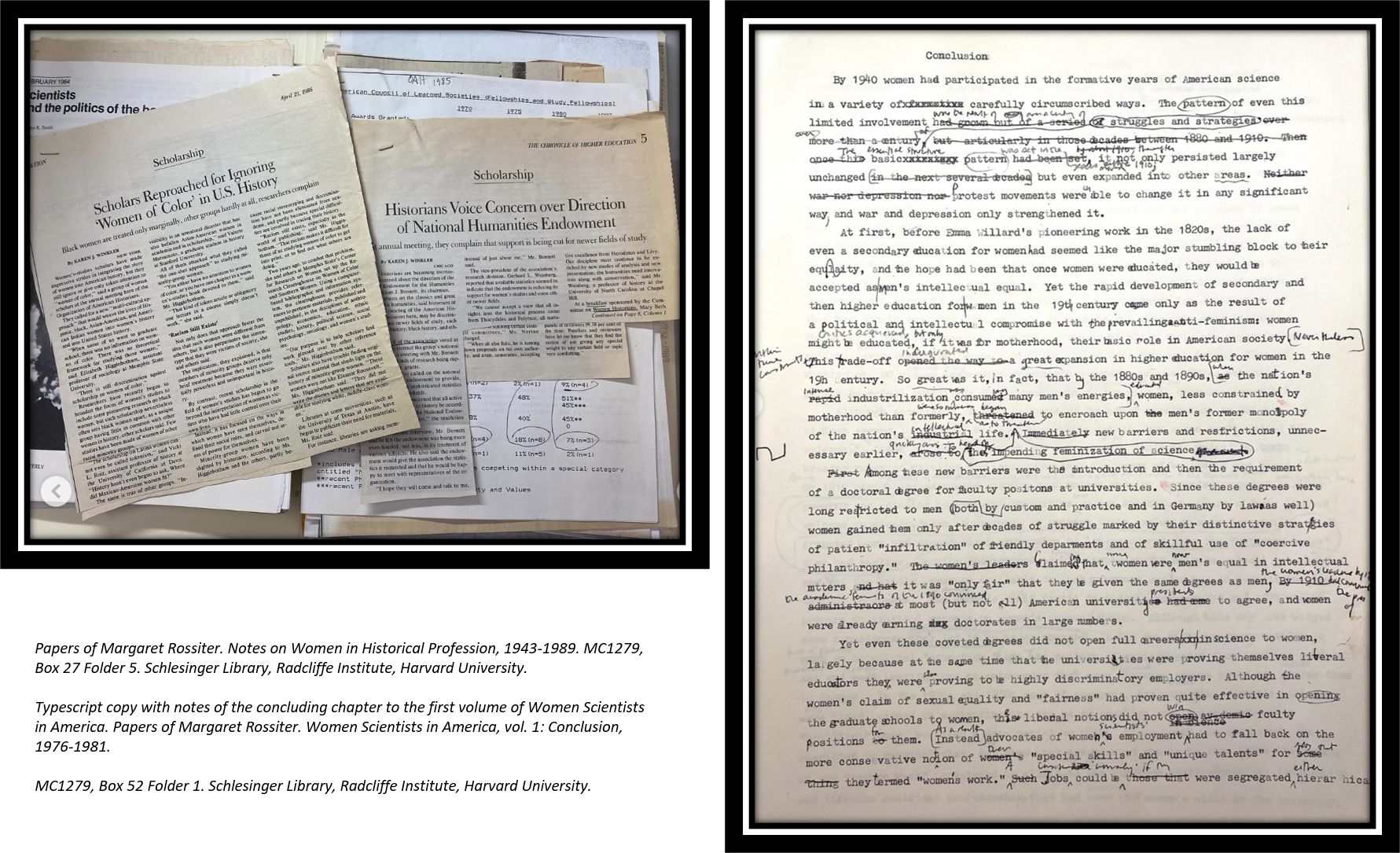
Schlesinger Library is home to the papers of Radcliffe alumna and historian Margaret W. Rossiter. Notes and drafts for Women Scientists in America.
In the acknowledgements, she thanks her twin brother and parents for providing moral support. She lists a long list of friends that she stayed with while visiting archives. The only hint at emotional turmoil during this process is the line “Ann and Arthur Norberg also cheered me on when the future looked bleakest” (xiii). The Norberg and Rossiter’s time likely overlapped at the University of California when he was directing the History of Science Office and conducting oral histories and collecting archives on science and technology.
Technological improvements between the 1970s and 1990s facilitated the research for Volume II, for which she transitioned from a typewriter to word processer in 1991. In the book’s acknowledgements, Rossiter notes that
although the libraries—at first the University of California at Berkeley, then Harvard, and finally Cornell—have all undergone great technological changes in the past decade, a scholar still needs (perhaps now more than ever) knowledgeable reference and other librarians to find his or her way.
Despite covering the more recent period of 1940–1970, Rossiter observes in the bibliography that much of the relevant information remained difficult to locate. She also notes in the Volume II bibliography that The Story of Spelman College, privately printed in 1961, was among her sources (p. 543), and she references the Spelman archives. Nevertheless, her research continued to rely predominantly on well-established institutional archives, reflecting the uneven visibility and accessibility of historical records across institutions.
However, she preferred using paper documents. According to one colleague:
She published rough chapters as manuscripts along the way. In 1980, she also published “Women’s Work” in Science, in Isis (Vol. 71, No. 3 pp. 381-398) which would be a chapter in the book. Rossiter was not shy in using data. All 3 volumes of her work are filled with graphs and tables, a revolutionary inclusion in historical data. In 1978 she published Sexual Segregation in the Sciences: Some Data and a Model Signs, Vol. 4, No. 1, Women, Science, and Society (Autumn, 1978), pp. 146-151 (6 pages)
Foro volume II, she published articles that focused on federal funding in US science post-World War II. Yet, Volume II focuses again on systemic and deliberate exclusion of women in STEM, especially how they were pushed out of positions after WWII. It even touches on more controversial topics of how women colleges started preferentially hiring men over women. However, the book is primarily a book with a lot of data and numbers within fields. The books were influential in revealing how much Catholic nuns had contributed to science.
A reviewer of her second volume Schiebinger wrote that Rossiter had once again produced ay leaving ‘‘aside many aspects of gender studies of science,’’ including ‘‘scientific attitudes toward women, how science might have been done differently, or how traditional disciplinary boundaries hamper certain types of scientific inquiry” […] ‘‘highly readable and exquisitely informative’’ account, but she had not done enough to challenge more fundamental sex- and gender-typed assumptions about the nature and practice of science.
Despite its foundational status, the first two volumes of Women Scientists in America have notable limitations. They devote little sustained attention to the experiences of women of color or women with disabilities, or class constraints, focusing instead largely on white women educated at elite institutions. The first volume, in particular, centers on the “Seven Sisters” colleges, which primarily served affluent white women. The second volume broadens its scope to larger, coeducational universities as women’s participation increased, yet it still largely frames inclusion in institutional terms rather than through intersectional analysis. There is almost no mention of HBCUs until volume III, published in 2012.
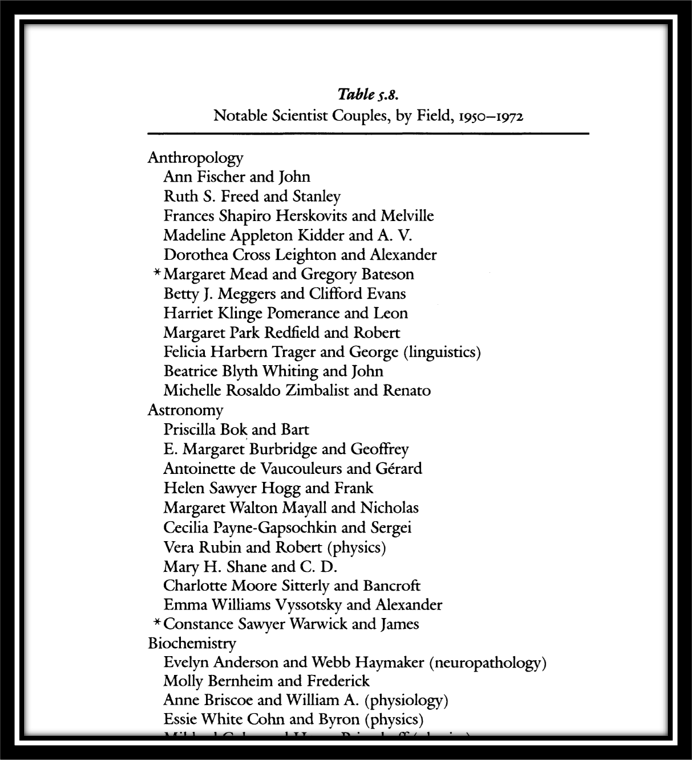
Table 5.8 in Volume II spans 5 and a half pages listing scientific couples per field.
While these omissions reflect biases of the era, it nonetheless leaves unexplored the personal and affective costs of sustained marginalization. These gaps have since become key areas for expansion in feminist and intersectional histories of science, building upon Rossiter’s pioneering framework. In the Year 2000, for example, Black Women Scientists in the United States by Wini Warren was published by Indiana University Press.
Leaping forward to Volume III, published in 2012, Rossiter was supported by a National Science Foundation grant as well as support and sabbaticals from Cornell, where she was a professor by that point. In the acknowledgements, she writes movingly:
“Last but far from least are the three ‘without whoms,’ those without whom this book and much more—a life and career—would have been very different: my late mother, Mary Madden Rossiter (1913–2005), who was always there, always understood, and always supported me, even and especially in tough times; Sally Gregory Kohlstedt, who for more than forty years has believed in me and this long project […] and of which she has since read every page; and Patricia Carey Stewart, longtime vice chairman of the Cornell University Board of Trustees, who made sure I did not leave Cornell in 1991, when a temporary post ended, even if it meant that the College of Arts and Sciences had to create a new department, its first in twenty-five years.”
With the publication of the third volume, Rossiter could finally claim to have reached “the goal I set almost four decades ago of reaching the ‘recent past’” (xvii).
The third and final volume of Women Scientists in America, Forging a New World Since 1972, published in 2012, reflects yet another major shift in both feminist science studies and the broader landscape of women in STEM. By this point, women scientists had attained senior academic and administrative positions, and debates about gender inequality in science had moved into the public mainstream. High-profile controversies, most notably Larry Summers’s remarks at Harvard, had sparked widespread moral outrage and contributed to a broader acknowledgment of structural bias in STEM fields. Initiatives supporting women in STEM were no longer marginal but increasingly normalized and even culturally valorized.
Reflecting these changes, the third volume adopts a more expansive and inclusive scope than its predecessors. Rossiter incorporates discussions of the role of HBCUs in recruiting women to STEM and offers a more diverse portrait of women scientists working across multiple institutional contexts. This broader lens aligns the series more closely with developments in intersectional and institutional analyses that had reshaped feminist science studies in the decades since the publication of the first volume. However, the volume to Rossiter, seemed
The thesis of this book is that creative activism and recruitment strategies by women in STEM, focusing on such organizations as Purdue’s Women in Engineering Program, federal legislation, and economics, were often drivers for the inclusion of women into male-bastions. Though this did not mean equity. The book has a more modern feel, noting new terms like chilly climate, “mommy track”, “glass ceiling”, the stagnation of tenure-track jobs, and the segregation of women in STEM by field, focusing on the lack of gains in computer science. “Women Scientists in America,” won the best book award from the History of Science Society (HSS) in 1997 (an award that would be renamed in Rossiter’s honor).
One of the major limitations of Volume I besides its focus on predominately white institutions, is its lack of personal inquiry into any of the women’s lives. The women in science are often treated as a monolith, which serves some purpose to highlight broader trends. However, according to the time period it was taboo to investigate the personal lives of their subjects:
Additionally, Rossiter’s account gives limited attention to the psychological tolls of continuous exclusion. The emotional tolls, personal sacrifices, coping strategies, and inner lives of the women she documents are rarely explored in depth, with perseverance and stoicism often presented as their primary means of survival. The death of Denice Denton, for example, was one line, for ‘unknown’ reasons.
Rossiter, in interviews, has rarely spoken about the psychological toll her own years of exclusion, financial hardship, and onerous workload had taken on her emotionally, mentally, or physically, and instead, emphasized her perseverance (Rossiter: “Good heavens. I persisted”.).
Another subject that Rossiter did not touch was assault and sexual harassment of women, something brought up in a recent interview with the Smithsonian:
Her fellow student Mary Ellen Bowden had experienced sexual harassment at Yale,
While Rossiter includes numerous graphs, figures, and tables across all three volumes, she does not employ formal statistical testing. This omission may reflect the extremely small number of women relative to men in many fields, which could have rendered some tests uninformative.
Daniel Kevles argued that statistical analysis might have strengthened distinctions between social constraints (such as marriage) and sexist barriers internal to scientific institutions, though it remains unclear how such factors could have been reliably quantified, or whether appropriate methodologies were available at the time. Still, statistical testing could have helped identify significant changes in women’s participation over time in specific STEM fields. Kevles ultimately faulted Rossiter for failing to compare sexist double standards ‘‘internal to the scientific system’’ versus the ‘‘cultural standards that did so much to shape the self-expectations of women, as well as their behavior.’ Kevles himself, was no feminist, but an extremely influential historian during his era. The old ‘not enough data’ ‘not enough stats’ argument was often used to dimmish the pernicious effect of sexism.
So how would these books impact her career?
Please consider following me on my social media platforms:
No posts
Comments
Nothing yet. Say the first thing.
Sign in to join the conversation.