
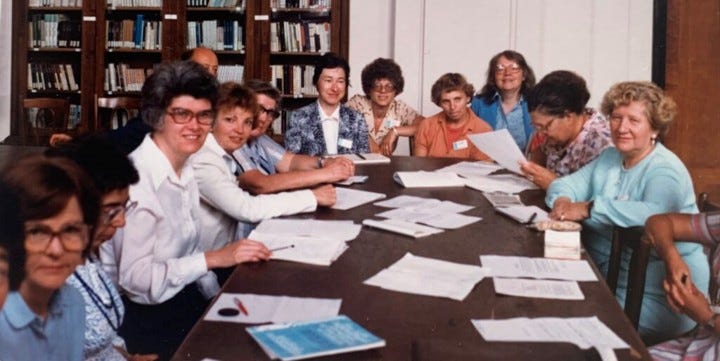
Founding members of the Commission at a meeting held during the XVIth International Congress held in Bucharest, Romania, in 1981. Margaret W. Rossiter, first president, is seated third from left.
Read Part I and Part II here.
The central thesis of Women Scientists in America—that women’s exclusion from scientific recognition, advancement, and mobility was deliberate and systemic:
It is important to note early that women’s historically subordinate “place” in science (and thus their invisibility to even experienced historians of science) was not a coincidence and was not due to any lack of merit on their part; it was due to the camouflage intentionally placed over their presence in science in the late nineteenth century. This arrangement, worked out by both
The NYT book review while praising the book (and referring to her as “Miss” not “Dr”) was also pointed out its dismalness:
While the book received significant acclaim (“an indispensable reference, the standard source, the new classic in the literature of higher education”), it also generated puzzlement and resistance, even among sympathetic readers. According to reviewer Ellen More in 2000 there was still “some resistance to the idea that science could have been so riddled with irrational prejudice as Rossiter’s tales of the late nineteenth century strongly suggest”.
This skepticism underscored the very problem Rossiter identified: the reluctance to accept that scientific institutions could be structurally biased. It would take nearly two additional decades of sustained scholarship to fully substantiate and normalize the arguments Rossiter advanced. The book’s publication history reflects this initial resistance as well. Rossiter later noted that mainstream publishers declined the manuscript, which was ultimately accepted by Johns Hopkins University Press.
A patronizing sentence in The New York Times Review MISS ROSSITER’S tone in recounting this struggle is never strident not only drops her title of ‘Dr.” but assures, us that she is not a ‘strident’ feminist.
Despite early doubts, the book’s scholarly importance was quickly recognized. The first volume of Women Scientists in America won the Berkshire Prize in 1983, appeared in The Women’s Review of Books, and received the book award at the Berkshire Conference that same year. Together, these honors signaled that Rossiter’s work had not only challenged prevailing assumptions but had begun to reshape the historical understanding of science itself.
More importantly, Women Scientists in America became a foundational text in science and technology studies (STS), even if its significance was not fully recognized at the time of its initial publication. Volume 2, Before Affirmative Action, 1940–1972, took another decade to research and write and was not published until 1995. In the intervening years, feminist STS developed rapidly, most notably with Sandra Harding’s influential The Science Question in Feminism (1986), which adopted a more skeptical stance toward the possibility that historical investigation alone could meaningfully transform current scientific culture.
In 1986, a successful NSF VPW program application sent her to Cornell, where L. Pearce Williams had read her book on Liebig and sponsored her. She stretched the money over 2 years. She then accepted a position at Cornell in 1986. Rossiter was still not a permanent faculty member at Cornell by 1989 when she won the MacArthur Genius Grant. After local publicity, and an offer from another college, Cornell University appointed her to a permanently endowed professorship (the Marie Underhill Noll Professor of History of Science). They created the Department of Science and Technology Studies to accommodate her. She remained there until her retirement in 2023. The Science and Technology department was the first of its kind in the Ivy Leage, merging history and philosophy of science programs with a social science and technology studies initiatives.
While at Cornell, she remained in the same-one bedroom apartment which was a ‘dazzling maze’ of papers, books, jigsaw puzzles, and crosswords.
Yet the period between 1982 and 1990 demonstrates that Rossiter’s influence extended well beyond written work and publication. During these years, she and her collaborators helped catalyze a wave of organizational and scholarly activity that institutionalized feminist critique within STS and related fields. In 1983, she attended a conference at Veszprém and delivered a foundational statement to mark the creation of the Commission on Women and Gender in the History of Science, Technology, and Medicine. The Commission was formed to advance research on women’s roles and gender perspectives within the history of science. Other groups co-founded by Rossiter successfully lobbied for formal recognition.
She was an early participant and founding member of the Women’s Caucus of the History of Science Society and the international Commission on Women in the History of Science, Technology. In fact, the Society of Women in Philosophy devoted much of its 1991 Midwest meeting to feminist critiques of science, signaling the field’s growing intellectual legitimacy.
These developments culminated in broader recognition. Rossiter was asked to direct un the National Science Foundation’s (NSF) program on the History and Philosophy of Science from 1982–1983. Her research provided the “intellectual foundation” for n NSF initiatives in the 1980s aimed at increasing female participation in STEM. Concerned with Reagan in office, Rossiter believed:
women have made some progress during the early 1980s in their fight for recognition, but she [Rossiter[ worries that the momentum has been lost. She blames the Reagan administration’s attitudes toward women and minorities, a growing complacency about what has been achieved, and the burdens of family. Rossiter also worries that women themselves seem resigned to the existence of an old boy’s network. The same old mentality is running these places
From 1984-1985 she was a research associate at the American Academy of the Arts and Sciences. She was also a visiting scholar at the department of the History of Science at Harvard. Volume 1 of Women Scientists in America was reprinted in paperback in 1984. Together, these developments suggest that, even as feminist scholars debated the limits of her historical investigations, Rossiter’s work played a crucial role in reshaping both the intellectual and institutional foundations of feminist science studies.
In 1985, Sally Kohlstedt and Margaret Rossiter brought together a group of their colleagues
This resulted in Kohlstedt and Rossiter’s book, Historical Writing on American Science: Perspectives and Prospects.
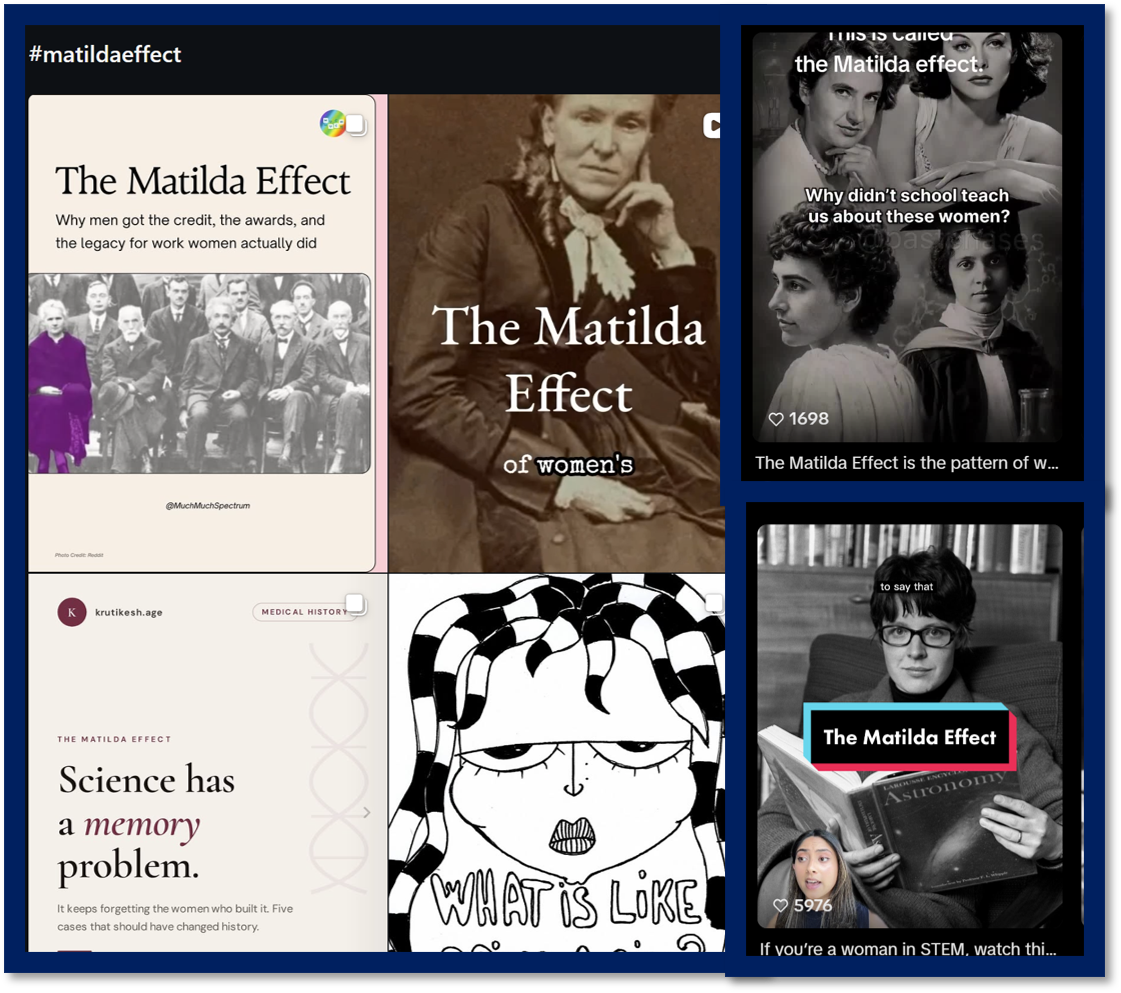
#matildaeffect is a popular hashtag on TikTok and Instagram
Rossiter is probably best known for articulating the “Matilda Effect”—the systematic under recognition of women’s contributions in STEM—rather than for the Women Scientists in America trilogy. In part, this is because the series lacked mainstream commercial visibility: it was published by an academic press, never appeared on bestseller lists, and was not nominated for major awards like the National Book Award. As a result, the trilogy remains largely unknown outside academic circles. This limited reach reflects a broader structural problem: feminist science studies and “women in STEM” initiatives have rarely been fully integrated into public scientific discourse, allowing concepts like the Matilda Effect to circulate widely while the deeper historical scholarship that produced them remains comparatively obscure.
One former graduate student who met her during a committee meeting in 1999 at Newham College, said:
She became a fellow of the American Association for the Advancement of Science in 2013.
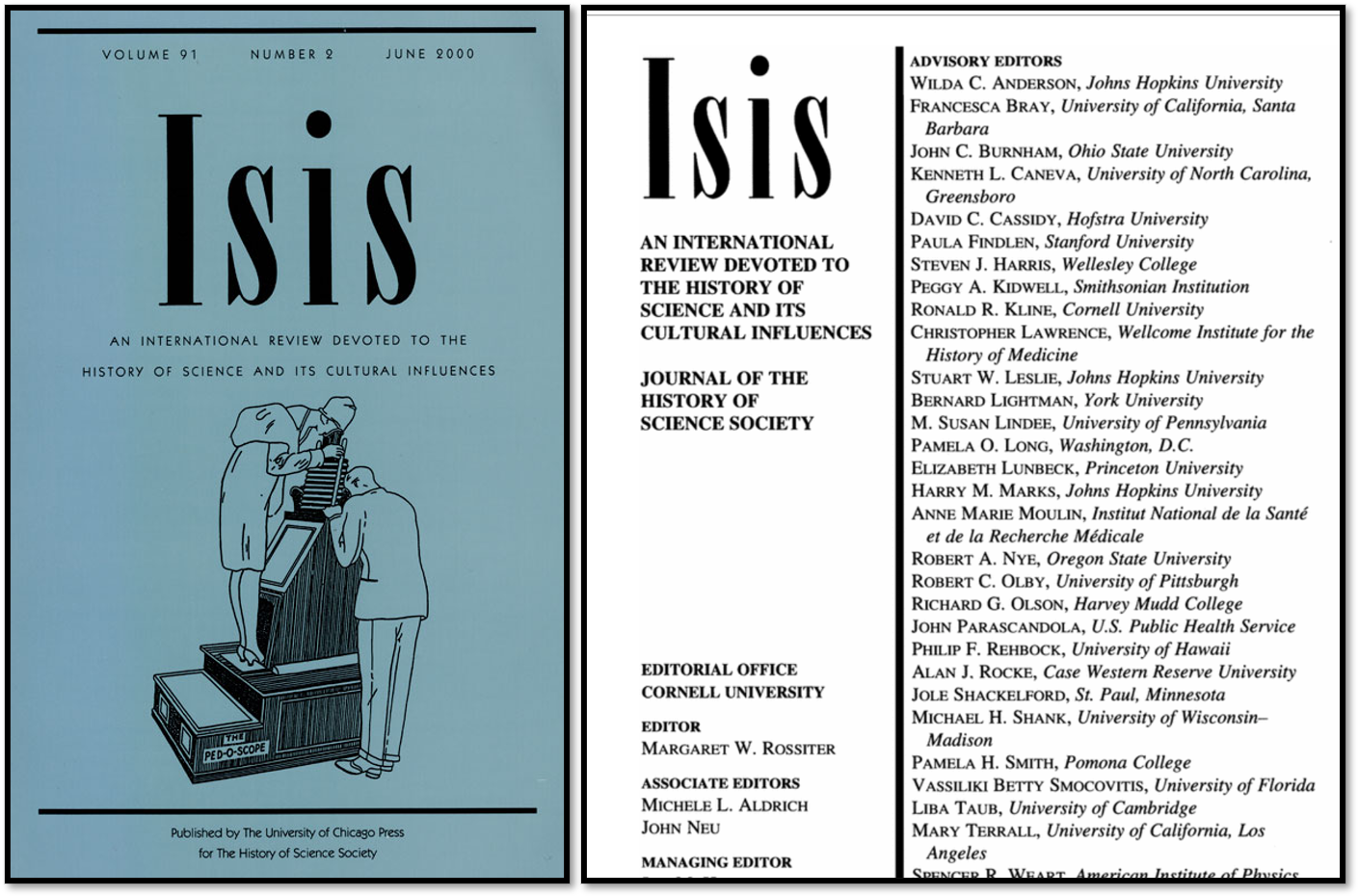
2000 Isis cover and 1998 front matter.
She chose to describe her editorship of Isis (1994-2003) (the official journal of the History of Science Society) in terms of “midwifery” rather than “gatekeeping”. In her final editorial, she wrote that they generally received about 600-700 books to review a year, and 60-70 manuscripts a year, accepted about 3 and told 30 to revise and resubmit. “About half did, and when they got it right I got (and still get) a thrill of delight”. Each year, Isis published 848 pages a year, and shifted from paper to electronic record keeping during her tenure:
emphasizing the cultivation of new authors and submissions rather than simply filtering them. During her tenure, she significantly increased the number of book reviews to provide international authors not writing in English a better chance at reaching an English-speaking audience. She also served as an editor for Osiris, the companion publication to Isis. She paid assiduous attention to people who had new ideas, or books that needed reviewing. While she avoided confrontation, she could take a stand. She was very hands-on. Her colleague Jon Harkness recalled that people usually found her to be initially intimidated but was thoughtful and supportive.
Dan Bouk, as a graduate student said about Rossiter:
Stephen Weldon wrote that:
Several articles about women in STEM were published under her tenure including:
Dec 1998 Intimate Inmates: Wives, Households, and Science in Nineteenth-Century America by Debra Lindsay
March 2001 Women in the Early History of Genetics: William Bateson and the Newnham College Mendelians, 1900-1910 by Marsha L. Richmond
March 2003 Portrait of a Discovery Watson, Crick, and the Double Helix By Soraya de Chadarevian
Dec 1997 Marcella O’Grady Boveri (1863-1950): Her Three Careers in Biology Margaret R. Wright
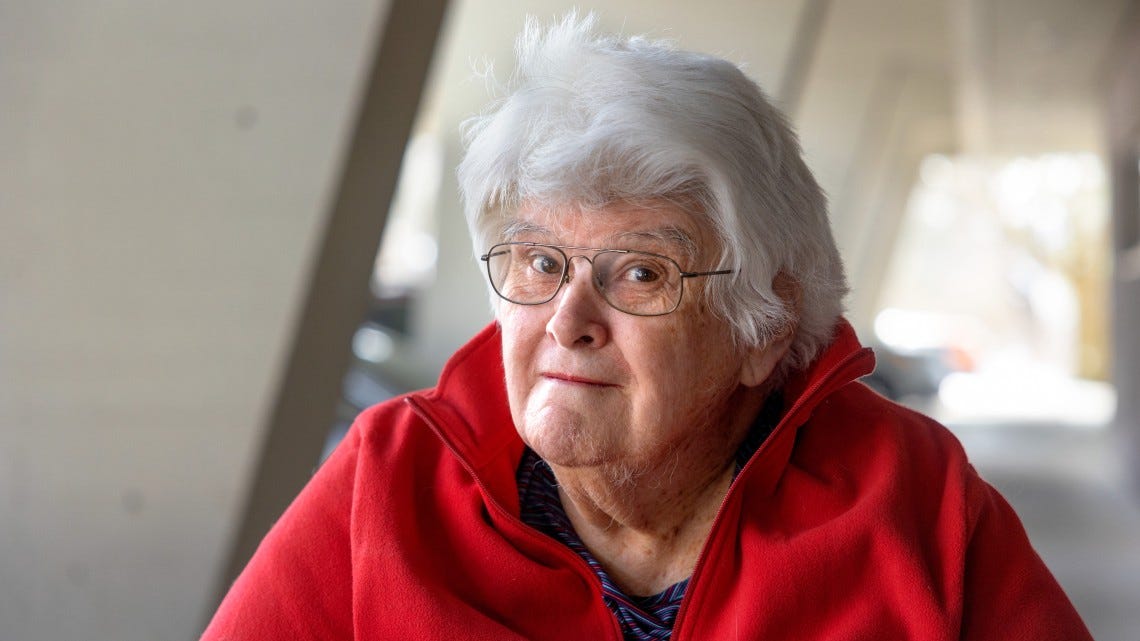
In 2022, Rossiter won an extremely high award—the George Sarton Medal—in recognition of her distinguished, lifetime scholarly achievement. She traveled to Chicago to accept the award in person.
Her former department now gives a Margaret W. Rossiter Women in Science award each year to a rising senior for an essay related to women in science.
Rossiter was profiled by the Smithsonian Institution in 2019. Her three-volume work, “Women Scientists in America,” won the best book award from the History of Science Society (HSS) in 1997, which was later renamed for her in 2004 as the Margaret W. Rossiter History of Women in Science Prize.
After her death in 2025, her friends Sally Gregory Kohlstedt and M. Susan Lindeewrote that:
Please consider following me on my social media platforms:
No posts
Comments
Nothing yet. Say the first thing.
Sign in to join the conversation.