
Content warning: discussion of suicide
Math tracking or “lane-ing” (selecting some students for advanced math classes above grade level) is controversial. It determines if a student can take AP Calculus in high school, something which can provide an advantage to college-bound students, especially those aiming for higher ranked schools (many students who pass this class do get into higher ranking schools). However, there is not much evidence that taking AP calculus in high school confers any advantages to bachelor's degree completion or life-long earning potential.
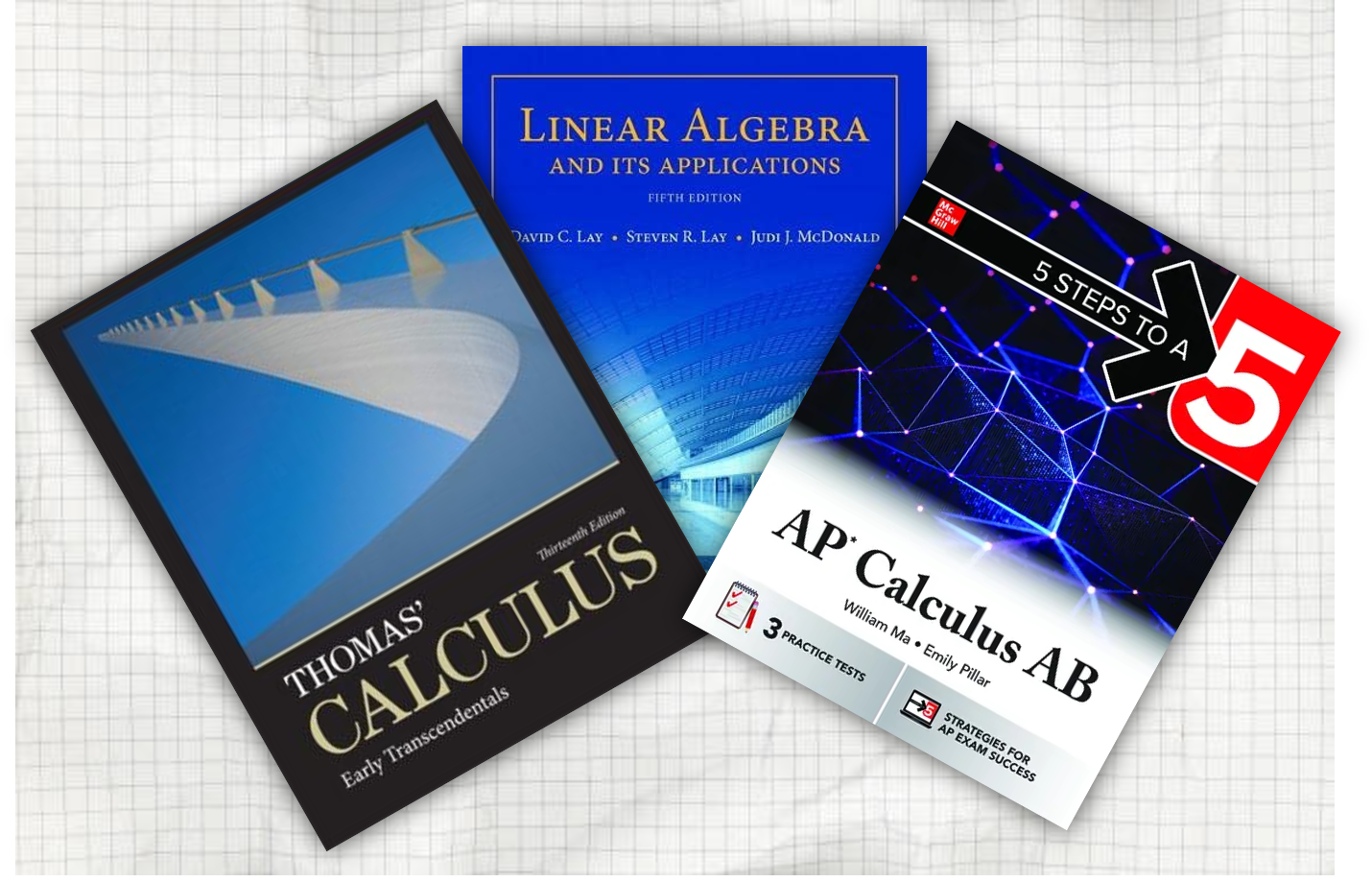
Critics argue that tracking systems disadvantage socioeconomic groups and calculus should be offered to everyone (1/2 of high schools in the US don’t even offer calculus). Now, the Palo Alto Unified School District (PAUSD) has made headlines for not only offering AP Calculus and Statistics in their school, but college-level linear algebra and multivariable calculus (sophomore-level college classes) for the 2026-2027 school year. Previously, students interested in these offerings, had to take these classes at local community colleges without receiving high school credit.
I must say, I was stunned by this. Are these students clamoring for Math PhDs? AP Calculus, in fact, has 2 separate exams and Classes known as — “AB” (Calc I and partially Calc II) and “BC” or (both Calc I and Calc II). Some districts Squeeze Calc I and II into 1 year, others spread them out over 2 school years. While taking calculus can give STEM students and edge in admissions, it is technically not required by Ivy Leage schools (presumably schools these students are vying for) for admission.
Are parents panicking? Are we pushing kids too hard? Are we leaving kids behind? What is going on?
This is how math tracking worked in my school district. Starting in 5th grade, we were tracked into Honors math and regular math. Half our grade was in regular, and half in honors. By 7th grade, we had a class of 30 students, taking Honors Pre-Algebra. In 8th grade, again the same 30 students took Honors Algebra I (technically a high school class). By 9th grade, there were about 40 students taking Honors Geometry, in 10th grade 2 classes of about 40 students taking Honors Algebra I, then down to 1 class of 20 in Honors PreCalc/Trig in 11th grade, and then down to 15 for AP Calculus in 12th grade. As we moved through the systems, the classes became smaller and smaller, so of our graduating class of about 300 students only 15 took AP Calculus.
Now, yes, I do see this as a bit concerning, there was such attrition in the system. This is NOT an issue at PAUSD. Students are apparently driving miles a day to access their local college to take sophomore-level math classes. The demand is so high that they are now offering them in the school district. This can be quite surprising, since the media keeps say that US students are struggling to read and do basic math, let alone calculus.
This is the ‘normal’ honors track for math (I did this and many school districts do this)
7th grade: Honors pre-algebra
8th Grade: Algebra I Honors
9th Grade: Geometry Honors
10th Grade: Algebra II Honors
11th Grade: Pre-calc & Trigonometry Honors
12 Grade: AP Calculus
Freshmen Year: Multivariable Calculus (Semester Fall) /Differential Equations (Spring Semester)
Sophomore year: Linear Algebra (Fall Semester)
This was the accelerated track. I was one year ahead of the other math students who did pre-algebra in in 8th grade and took Algebra I in 9th grade, ect. Plus, the math classes I took were more rigorous than the non-honors classes. This is called ‘laning’ students. PAUSD decided that everyone would follow this advanced track in 2020—they also implemented something called ‘skip tests’ so that students could skip a year of math. Under current PAUSD policies as of late 2025, students can reach college-level courses like Calculus in high school through two primary methods:
Moving every student onto the accelerated track (“de-laning”) in 2020-2021 and having every student take Algebra I in 8th grade. The default middle school curriculum in PAUSD is “compacted,” allowing students to finish four years of Common Core math in three years.
Skipping grades+ accelerated curriculum. Students can choose to take “skip tests” at the end of 5th, 6th, or 7th grade. If they pass, they can accelerate one additional year, allowing them to take Algebra 1 in 7th grade and Geometry in 8th grade.
On an Instagram post, I had many parents argue with me that this was a perfectly normal, healthy thing for their child to do—advance to Algebra I in 7th grade. Of course, their child slept 8 hours a night, only spent a few hours a night on homework (I call bullshit here) performed in ballet recitals, and did sports.
Given that I’ve been in the trenches of juggling advanced math with my other AP classes, and doing ballet, and science fairs, and science Olympiads, I literally know the stress of constant tests, quizzes, and memorizing theorems and solving problems. High school and college admissions stress still gives me nightmares 2 decades later. And yes, I did get the coveted Ivy League and Stanford acceptances (more on that later), so I feel qualified to speak on this topic. I also teach and tutor high school students aiming for elite colleges, work in academic environments, so I’ve been on both sides.
While I’m not in that particular classroom, and maybe the classes in Palo Alto are less demanding than the ones I took at my midwestern public high school, or maybe I just can’t handle stress as easily as GenZ can, I don’t believe this is the case.
Not everyone agrees with these changes. The district’s shift toward “de-laning” (putting students of all abilities in the same classes) and the use of “skip tests” sparked intense debate. Many people felt that by giving everyone an advantage, the gifted kids would lose out on opportunities. Many people were outraged that these classes would no longer hold the title “honors” —everyone would be accelerated to take Algebra I in middle school. Nobody was being ‘held back’. They even went to argue it would “harm” the gifted kids’ mental health by being forced to do repetitive coursework.
However, the de-laned math sequence was still ABOVE grade level. EVERYBODY is now taking above grade level math.
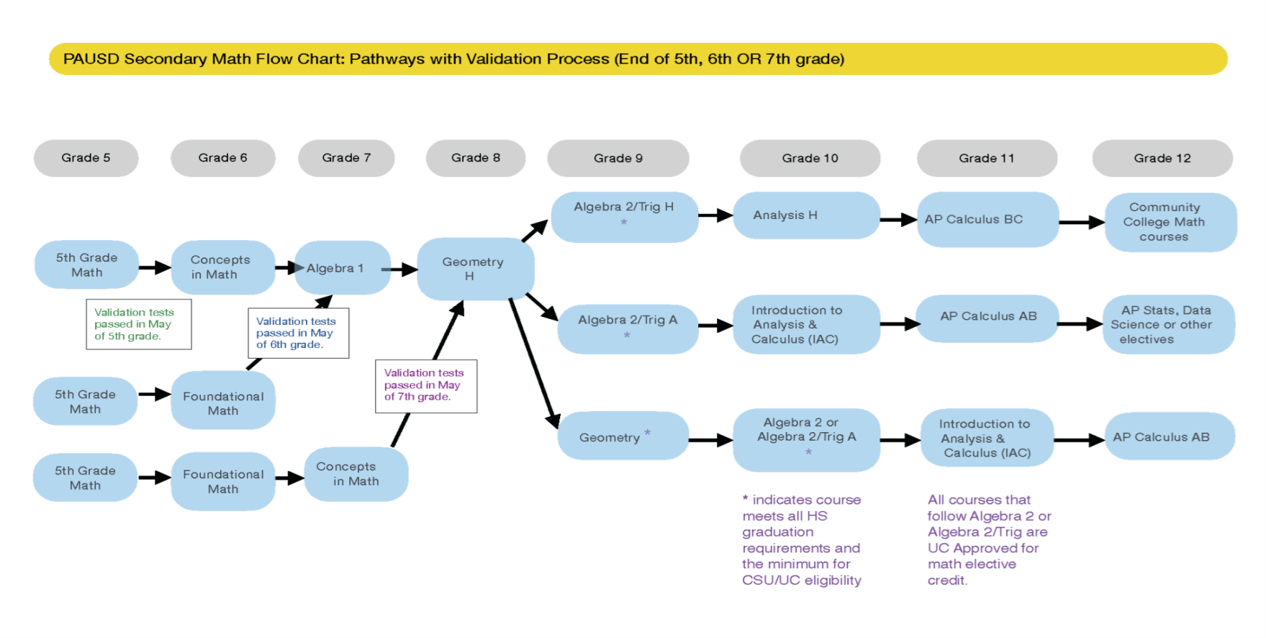
Accelerated Sequence (as of Dec 2025) at PAUSD. I don’t care what anyone says AP Calculus is a very difficult class.
For the most advanced students, the pathway now looks like this:
7th Grade: Algebra 1 (after passing a validation test)
8th Grade: Geometry Honors
9th Grade: Algebra 2 / Trigonometry Honors
10th Grade: Analysis Honors (Pre-Calculus)
11th Grade: AP Calculus
12th Grade: Multivariable Calculus / Linear Algebra
However, similarly, many complained that the “skip/validation tests” were opaque and designed to restrict advancement of certain groups. In 2023, A Santa Clara Superior Court judge ruled that PAUSD’s placement policies violated the California Mathematics Placement Act of 2015.
The Calculus controversy raged on in the Spring of 2026. Some teachers continued to oppose these classes citing concerns about excessive pressure and student wellness. Meanwhile, the teachers in the school district were struggling to survive on their salaries (Palo Alto has a very high cost of living) and were demanding raises.
In April 2026, Palo Alto High School principal Brent Kline announced a partnership with a local college to bring multivariable calculus (“MVC”) and linear algebra onto campus. Due to teacher protest, through the spring of 2026, MVC was temporarily cancelled. Gunn High school and Palo Alto High school decided to offer Introduction to Proofs Honors as a 12th grade math option. However, by June 2026, the Proofs class was ‘cancelled’ due to lack of student interest and MVC was back on. In 2026-27, students who have passed the AP Calculus exam can enroll. However, these classes will count towards college credit only and are not officially in the high school catalogs.
However, perusing the district’s catalogue online, district offers other math-related courses including AP Statistics, and Introduction to Data Science in addition to computer science classes.
Kids need to do other things like sports and music and art in school. I took ballet classes and art classes and photography and gardening and learned to cook when I was a teenager, I did not study math 24/7. It served me well. My point though is that there is no reason any high school kid (unless maybe they are a genuine math prodigy which would be very rare) should be going above AP Calculus in high school. It’s too much pressure, it’s too advanced, and creates an insanely high bar for college admissions that didn’t exist before.
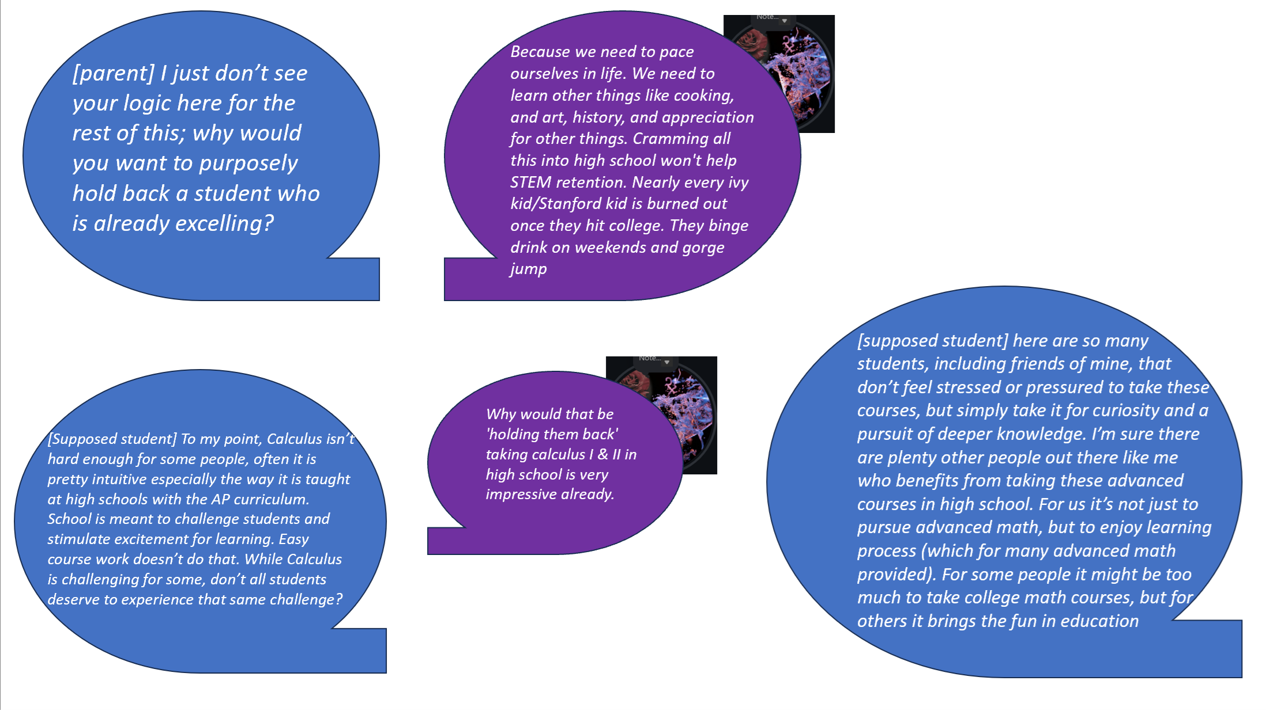
My conversation online about these offerings
Many parents on the Instagram thread I looked at were under the illusion that these classes were required for admission to top engineering collages. They are not. Many don’t require calculus or any AP credits/college credits for admissions.
Since the 1980s, PAUSD has been shaped by ongoing controversy. In 1983, the National Commission on Excellence in Education’s report A Nation at Risk attributed the United States’ declining economic competitiveness to a perceived “rising tide of mediocrity” in public education. This critique spurred federal reform efforts, including President George H. W. Bush’s 1991 America 2000 initiative, which emphasized the development of national education standards—an approach later codified in the No Child Left Behind Act of 2001. By compelling educators to prioritize specific content and benchmarks, standardization laid the groundwork for renewed cultural and ideological conflicts within schools.
According to Jennifer DiBrienza, former math teacher and member of the PAUSD Board of Education, kids are often portrayed as the problem, instead of the system itself, and this change serves to boost student self confidence. “Something that we as a district have missed is that if scores were low, we say ‘let’s get some extra help’” DiBrienza said. “Instead of acting like there’s something wrong with a kid, let’s change our system so that all kids feel a part of the system. I think that they are going to do better now, and the district is starting to take that approach and look at the systemic inequities that exist.”
Despite this, many kids were apparently clamoring for Multivariable Calculus (apparently 69-70 non-senior high school students are eligible) and Linear Algebra which was only available via community college (dual enrollment) or after-school programs. It did not appear on high school transcripts for credit or impact GPA, which led to intense community pressure and the eventual December 2025 board approval to bring it on-campus. At meetings, many students held up signs saying “MVC please”
Not all community members were in favor of the new course. PAUSD parent Uzma Minhas questioned the intent behind offering multivariable calculus and urged the district to prioritize initiatives that make “a tangible difference,” such as supporting marginalized and underrepresented students. Given the abundance of external opportunities like math clubs and Olympiads, she said that the district could reasonably limit such offerings.
Advocacy groups have raised concerns about a persistent 2:1 male-to-female ratio in the accelerated math track. Students who haven’t skipped generally aren’t in a position to take MVC in high school. For students who are a year ahead in math, however, MVC can ‘complete’ 4 years of math classes in high school. Gunn junior Ayush Agarwal said:
"It's very difficult to be in PAUSD and skip classes and get to whatever the highest level is without any outside tutoring, without parents helping you out, without a peer network," Ravi said.
As a result, for two students with different access to resources, even if they had the exact same amount of academic commitment and put in the same amount of effort, they likely still wouldn't get to the same place. Throughout PAUSD, and at Gunn in particular, there is a heavy emphasis on STEM courses, Ravi said.
"I have definitely felt that there is an uneven allocation of resources between humanities and math, Ravi said. And of course, that's because of demand and that totally makes sense. But I wonder what would happen if we gave students a chance to take advanced courses that are not in math or not in STEM."
Focus on STEM fields, Ravi said, may be because some people never take an arts or humanities elective, and therefore can't realize it's something they could enjoy or pursue. Community members also look down on the humanities and treat it with less respect, further demotivating people from taking such classes.
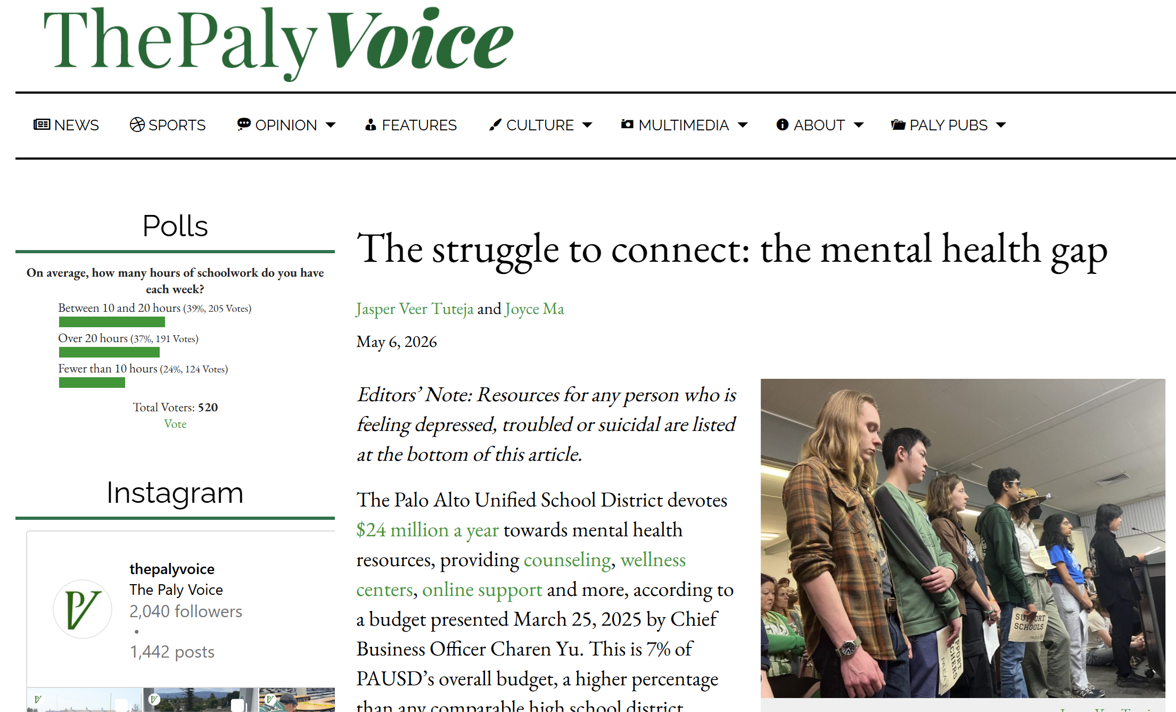
According to the student newspaper, 191 people reported spending over 20 hours a week on homework.
STEM students in American colleges are at higher risk for anxiety and depression symptoms. Substance abuse, study drugs, engaging in risky behaviors (like gorge jumping—jumping off a cliff into a lake) are not uncommon coping mechanisms for pressured students and can lead to life-long health issues or death. There was a 2015 suicide cluster in Palo Alto that made headlines. Another suicide cluster was reported at Cornell University from 2009-2010. The typical response from university administration is to “airbrush” the deaths and point out that statistically, their campus suicide rates are consistent with other educational statistics (Epstein 2010; Bernstein 1994). However, the public manner of these deaths and their frequency should not be airbrushed or ignored.
In February 2026, students in Palo Alto were petitioning for suicide prevention after a student’s death by suicide by train. In 2025, several students from Gunn High school (grotesquely nicknamed ‘Train school’) also died by suicide. In the 2010s, Santa Clara County underwent an epistemological study by the CDC, since its teen suicide rate was 4 times the national average. Pressure to improve mental health led to PAUSD devoting 7% of their budget to student wellness, more than any other school district in the country. Despite this, current students still feel it is not meeting their needs, and the wellness resources are overwhelmed.
This subject just makes me angry because I’ve seen so many kids suffer under parental expectations. Too many kids of my generation (Millennial) committed suicide from academic pressure, burnout, or bullying. I made it to the other side, now in my mid 30s and living out my life. They didn’t make it.
This has to stop. Balance needs to be achieved. Parents think they know what their kids are up to but having lived most of my adult life in college towns they have no idea.
Nobody thinks they their child are at risk until they are.
Please consider following me on my social media platforms:
Bernstein, Richard. 1994. “Another Fatal Plunge Has Cornell Asking Whether Its Gorges Inspire Student Suicides.” The New York Times.
Epstein, Jennifer. 2010. “A ‘Suicide School’?” Insider Higher Ed.
No posts
Comments
Nothing yet. Say the first thing.
Sign in to join the conversation.