

The 2026 Commonwealth Prize sparked a scandal when The Serpent in the Grove by Jamir Nazir was flagged as 100% generated by AI. This was, unfortunately, entirely predictable. Many find AI writing more appealing and “understandable” than human-generated writing.
With the inclusion of the essay “Ghosts” in Best American Essays 2022 (edited by Alexander Chee—there’s also a delightful essay focusing entirely on a man’s penis issues in that collection), the elite literary world has been tacitly embracing AI.
As my followers will know, I submit over 300 creative writing pieces (5% get accepted) to small literary magazines per year. Nearly every journal I submit to explicitly prohibits AI use or otherwise requires disclosure.
A watershed moment was the acceptance of Ghosts in Best American Essays-2022. The essay had gone ‘viral’ when it was originally published in Believer Magazine on Aug 9, 2021. Notably, this essay was celebrated rather than reviled by the elite literary community.
One lone review noted’ the essay’s “Disturbing Authorship” and expressed concern that the ChatGPT text was literally copy and pasted into the essay—and that a minimal amount of text was human-written:
‘Ghosts’ – in The Best American Essays – wasn’t disturbing because of its subject matter, its tragic nature notwithstanding. What troubled me was her co-author, responsible for the bulk of the text. Vara’s prose was printed in bold. The rest was written by GPT-3, the artificial intelligence system developed by OpenAI.
I accidently stumbled on this essay earlier this year reading a copy of Best American Essays 2022 I had picked up on sale over the holidays. I had completely missed the ‘viral’ moment the story had online years previously.
Vauhini Vara, the author of Ghosts, is a tech writer who received an early version of ChatGPT and immediately experimented with it as a creative writing tool. She has become more well-known for her opinions of LLM use in creative writing. She also has embraced LLMs as a tool in her writing, with her editor (Lisa Lucas) instructing her to seek feedback on her writing via LLMs.
In an Adroit interview and a recent podcast interview (Art of Citizenry) Vara has likened ChatGPT use in writing to a ‘communal’ type of writing akin to oral traditions in storytelling. However, these LLMs merely train on and regurgitate copyrighted material and merely skirt the law by scanning and destroying physical book copies.
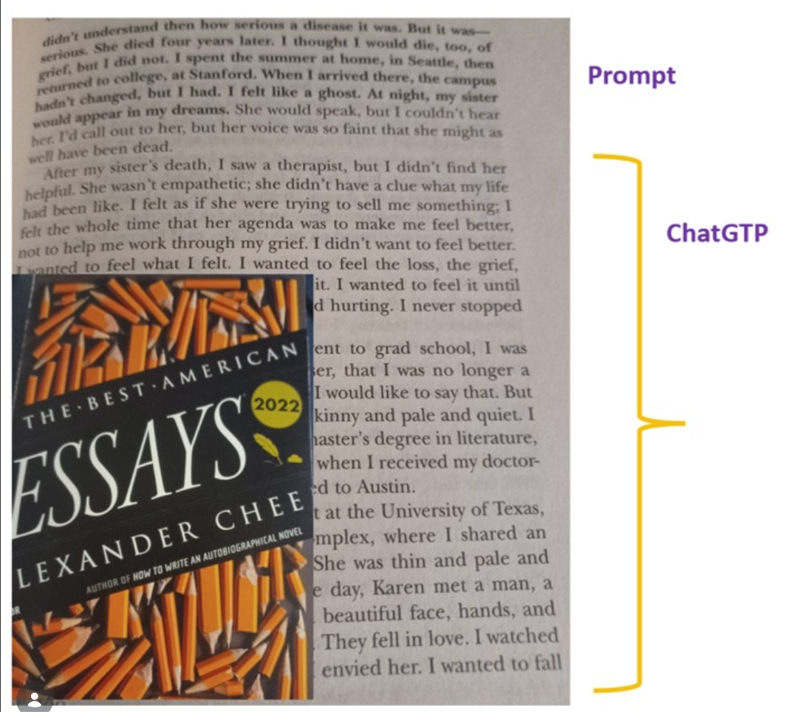
“Ghosts” in Best American Essays 2022. I could see this essay as being a showcase at how bad ChatGPT was but clearly there was not enough here to qualify as BEST American essay when the author did not write the majority of it? The author only wrote the prompts which were repeated through the entire story. Author makes no meta commentary or analysis of the accuracy of ChatGPT's responses in the essay.
At first, I assumed Ghosts would comment on the ineffectiveness of ChatGPT as a writer—I assumed she would point out what events from her past it sanitized/distorted. Instead, we had no scholarly commentary woven in the essay—it was literally a prompt then pasting what the chatbot spit out. Vara is a well-known and widely published tech journalist, a Pulitzer Prize finalist, and graduate of one of the most prestigious creative writing programs in the country—The Iowa Writers Workshop, so she clearly knows how to write. But in the essay, she or the editor disclosed the LLM’s capacity to hallucinate. By not providing commentary on this, she fundamentally treats this LLM technology as “neutral”, which is dangerous.
I felt betrayed reading this essay, which centered on her sister’s death as a teenager from cancer. The model hallucinated large swaths of details about her sister’s death decades ago (something I found deeply disrespectful to her sister’s memory).
Yet, the success of Ghosts parked laudatory congratulations and interviews from very established literary mags like LitHub and Longreads (Vara: “In my opinion, GPT-3 had produced the best lines in “Ghosts”):
Vara describes an invented yet profound AI-generated memory of her sister taking her hand while they drove home from the beach where, Vara has told GPT-3, she had wanted her ashes spread. Vara marvels, “Here was as nuanced and profound a reference to embodiment as I’d ever read. Artificial intelligence had succeeded in moving me with a sentence about the most devastating experience of my life. If it could write that sentence, what else could it write?”
I could see the essay being published as a sort of cautionary tale, or gimmick, or demonstration of this new technology, but its tacit acceptance by the prestige literary community is more disturbing. NOBODY pushed back on this essay, and it head-scathingly won one of the most prestigious essay prizes in the US.
In 2023, Vara was Pulitzer Prize finalist for “The Immortal King Rao” which she did not use AI-assistance on. She did, however, use ChatGPT to generate large swaths of her next book (Searches) which received laudatory profiles in prestige lit mags like Electric Lit, and was named “Best Book of the Year” by Esquire, Slate, Scientific American, Vox, Electric Literature, Book Riot, Culture Study, Publishers Weekly, Kirkus, Library Journal,. Vara rather disingenuously suggests in her recent December 2025 New Yorker article, that readers might actually like AI-Generated Fiction.
As a novelist and a journalist covering A.I., I’ve tended to dismiss the threat it poses to authors. I won’t enlist A.I. to write on my behalf for the same reason that I won’t enlist a robot to do other hard stuff—hike a mountain, argue with my husband. But, lately, I’ve been pushing up against the limitations of that logic. I can write a book for my own reasons, but I can sell the book only if readers like it more than what they can get from, say, a chatbot. If readers prefer A.I.-generated fiction, then authors won’t be able to stop it.
Yet pursuing the book’s Goodreads reviews many people expressed disappointment and boredom over the sections of Searches that had been written by LLMs and preferred the sections Vara wrote herself.

Anne O’Hare McCormick, Edith Wharton, Gwendolyn Brooks, Zona Gale—Previous Pulitzer Prize winners. No AI used!
Currently, AI-assistance is not a DISQUALIFER for Pulitzer Prize consideration. The Pulitzer Prize is one of the most prestigious literary awards in the US that most writers can only achieve of dreaming. The prize has awards for nonfiction and reporting—one would expect it to embrace truth and honesty.
In 2024, two Pulitzer winners disclosed using AI in their reporting 2024. However, they were not using LLMs but classification-based machine-learning tools (I hope ethically trained) to sort through large swaths of data and make conclusions. Not necessarily the worst application, and not as bad as using LLMs to generate or edit the text but details were lacking on how the tools were trained by the journalists and their accuracy in classification. Poorly trained machine learning models could introduce further bias into the reporting.
“We used machine learning to parse through the text in police misconduct records, specifically the document types that had narratives living within them,” said Trina Reynolds-Tyler, the data director at the Invisible Institute, who shared the Pulitzer with City Bureau reporter Sarah Conway.
In 2025, this “AI-use” crept up. The Pulitzer Prizes recognized these stories among its winners and finalists across 15 different journalism categories. They did require that entrants disclose whether they relied on AI technologies, which was not disqualifying. According to this article, it is unclear if the journalists were using AI to generate text, or merely as a research tool.
As of 2026, the Pulitzer Prize committee has explicitly asked for disclosures on AI in photography (which seems to the antithesis of good journalism) but it is unclear if this is disqualifying. Despite the focus of pieces on exposing Big Tech and AI, 5 winners and 3 nominees in 2026 disclosed AI use. Generative AI was indeed used to sort and summarize document data dumps. Administers of the Pulitzer Prizes, Marjorie Miller:
To state the obvious, perhaps, AI is here to stay […] The industry [used to be] far more apprehensive about AI tools than it is today, with a clearer understanding now of what uses might be appropriate — data collection and analysis, for example — and when it might not, such as in writing and editing stories in any format that might be considered for a Pulitzer Prize
While Miller assured us that the actual pieces that won were not generated by AI (as far as they could tell) she noted that authors will need to “ensure and reassure” that submissions are indeed produced by human beings. However, this erosion of the AI boundaries could ultimately, result in increasing use of AI—for editing, for fact-checking, and maybe for writing.
In 2023, The Booker Prize website proudly stated in a tongue-and cheek article. “Why AI will never supplant human novelists – or win the Booker Prize”. By 2026, the tune was changing, with The Observer speculating “Can AI write a Booker prize-winning novel?” :
If you asked Claude today to write an entire novel – or even a short story – it’s clear it couldn’t do so convincingly. Budding McCarthys are safe for now. But in four years? Ten? It’s not outrageous to think that by 2030, even a Booker prize judge may struggle to distinguish a literary novel penned by a human from one generated by AI.
Outraged by this disruption to their 6,000-year-old industry, publishers and authors seem to be directing their anger too narrowly.
Are we too angry over generative AI use? By nature, I am a rule follower. I work hard to be detailed, truthful, honorable and correct in my work. I find ChatGPT use to generate large swaths of text irresponsible and “cheating”. It’s obvious that many graduate students where I work are using ChatGPT—it weirdly abbreviates certain terminology, erases grammatical errors, and provides vague unsubstantiated, ramblings. I spend hours revising these manuscripts, remaking figures, re-running calculations, while the graduate student still retains first authorship.
The 2026 National book awards offered no guidance for AI-use in submissions. The only disqualifying criteria are:
AI use could easily not be disclosed or fly under the radar. Hopefully, the $135 submission fee on Submittable might dis-incentivize people from flooding submissions.
AI usage is also infiltrating major literary organizations; the Association of Writers & Writing Programs (AWP) has posted this video in which published authors openly discuss their use generative AI tools, including ChatGPT, to assist with their writing
AWP in the past several years has held several panels on AI usage one titled:
“Beyond ChatGPT: How Human Beings Are Creating Subtle Literature with AI”. Approached in the spirit of combinatory literature, bespoke AI tools can produce surprising and affecting texts.” (Mar 27, 2025).
Of course, at AWP 2026, Vara appeared—alongside Karen Hao. Hao investigated and reported on OpenAI, exposing the rampant unethical and illegal practices within the company. Her book, Empire of AI, is amazing and deservedly won the National Book Award for Nonfiction.
PEN glowingly reported about this panel. Lurking on Bluesky, I was able to find more candid takes from someone in the audience who suggested Vara played the devil’s advocate during the panel, equating AI use not being different from an editor. That the future of the AI workforce is already here or coming, so students should be prepared.
In another concerning 2026 panel on AI, where many argued against AI use, while one author despite acknowledging the ethical issues associated with AI:
AI-generated romance books are growing. The romance genre has long embraced and been on the forefront of technological changes in publishing, from early adoption of data analytics in marketing, to advertising on the Internet, to selling ebooks, to social media, now AI.
Surprising, AI use is a disqualifier for prize consideration by The Romance Writers of America. The organization actually provides some guidance on acceptable AI use that seems to be sorely lacking:
While the romance genera seems to be the most disrupted by LLM use, at least national organizations are coming out against its use.
Other countries have mixed response to AI in writing. For example, AI-generated book covers caused 2 books to be disqualified from New Zealand literary prizes. But in January 2024 author Rie Kudan won a major literary prize in Japan for her novel Tokyo-to Dojo-to (“Sympathy Tower Tokyo”), self-reporting that approximately 5% of her novel was generated verbatim using ChatGPT.
Among survey respondents, about 45% are currently using generative AI to assist with their work. This means there is more LLM usage in any stage of the process, from brainstorming to copy-editing, that is flying under the radar. Even, Ajay Chowdhury an award-winning crime author who reports AI for brainstorming. The lack of guiltiness on AI use, the lack of accountability, and the lack of oversite are ripe to disrupt creative writing.
The Author’s guild offers contract language for AI protections
Petition your local library not to purchase AI-generated books both print and ebooks
Stop rewarding authors that use LLMs with attention and accolades
Expose corrupt practices by AI companies, like copyright violations, destroying books, poor oversight, and exploitation of marginalized workforces.
What hope is there for the rest of us struggling writers if AI-generated slop is winning major prizes??
No posts
Comments
Nothing yet. Say the first thing.
Sign in to join the conversation.