
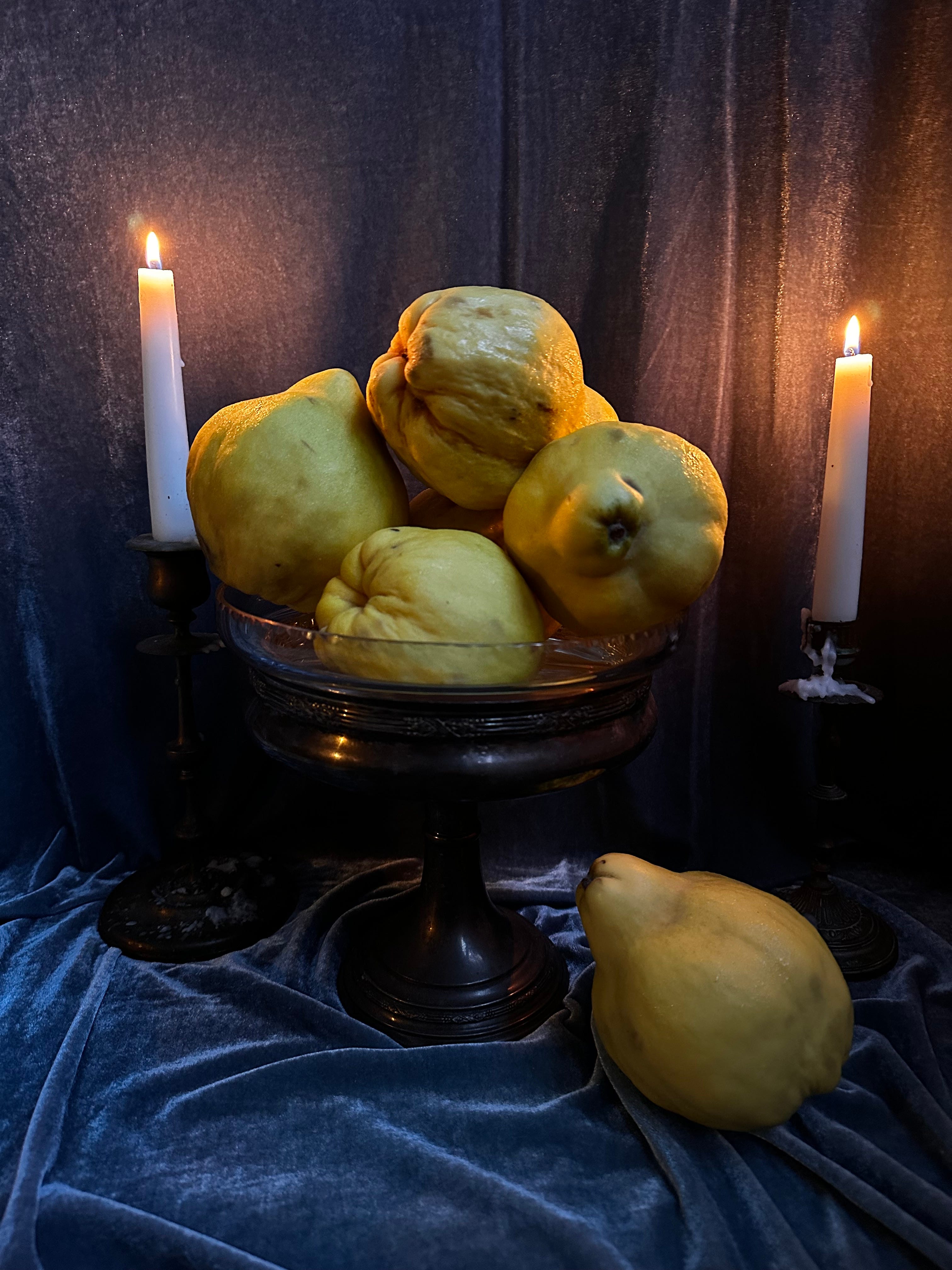
A knobbly and rustic golden yellow fruit that resembles a cross between an apple and a pear, the quince comes from the same family, the rosaceae.
Never heard of quinces? Well, where have you been! Quinces were first domesticated about five thousand years ago in Mesopotamia, modern day Iraq. Their sweet and sour flavour when cooked made them a wonderful addition to rich meat dishes, and they were very popular as a sweet paste cooked with honey and spices throughout Antiquity. More popular than apples, they were prized for medicinal properties in Ancient Greece and the pips were also used in perfumes in Ancient Rome.
Their Latin name, Cydonia Oblonga, comes from the Cretan city of Cydonia where they grew in abundance. They were often referred to as the golden apple which explains the long standing belief that they were the real star in many myths throughout history, such as the trials of Hercules or the forbidden fruit in the Garden of Eden.
The first trace of them in the UK seems to be when King Edward I ordered quinces to be planted around the Tower of London in 1275, although they were already widely eaten in France and around the Mediterranean. They were especially popular as a sweet paste eaten before a meal to aid digestion or simply as a treat. This sweet paste is still commonly consumed in Portugal, Spain, France and Italy.
It is fair to say that apples now safely claim the crown of popularity, perhaps because quinces cannot be eaten raw. They contain high levels of tannins which make them incredibly astringent and their texture is extremely hard. But trust me, it is a whole other story once they are cooked. Apparently some varieties grown in South America and Central Asia can be eaten raw and taste slightly like tropical fruit.
The term marmalade comes from the Portuguese word marmelada which means quince paste. Nothing to do with oranges.
While they grow and ripen, the knobbly fruit are covered with a soft duvet that protects them from the weather, a bit like a little ugly duckling. When ripe, the fruit no longer have this covering, but if they do when you buy them simply wash it off.
Gosh, I was spoilt for choice with greek mythology on this one! I will spare you the full monologue and focus on just one. We all know about Troy, something about a horse? As a reminder, the Trojan Horse was used by the Greek army to sneak past the tall protective walls of Troy and attack during the night. Why were they fighting in the first place? Because the most beautiful woman in Greece left her husband, a king, for a Trojan prince. Of course! And it all started because of a quince. During a wedding feast among the gods, a goddess was rudely left off the guest list. As revenge she gatecrashed and threw a quince into the crowd engraved with the words “for the most beautiful goddess”. Naturally Athena, Aphrodite and Hera all jumped to claim it. To end the argument, Zeus asked Paris, prince of Troy, to decide which of the three goddesses was prettiest. Each one bribed him with an attractive prize, but he chose Aphrodite who offered him the love of the prettiest woman on Earth. The goddess received the quince, Paris won over Helena, and war began. From then on quinces became one of the symbols of Aphrodite and therefore of desire and fertility. They have often been included in wedding ceremonies and still are in Greece, with some folklore claiming they were given to brides to sweeten their breath before nuptials. Bit strange. You might even remember that during their wedding, even the Owl and the Pussycat dine on mince and slices of quince.
It would be far too simplistic to say quinces taste like a blend of apples and pears, but they definitely sit in that range. They have their own distinct flavour with floral and honey notes. I grew up eating quince as it is a very popular companion to cheese in the south of France, so I never really questioned the flavour or how to describe it. When a friend from the Philippines first tried it she exclaimed “I love this so much, finally an equivalent to tamarind out here!” It made me laugh but she was right. New perspectives are wonderful. When cooked simply they do have a sweet and sour characteristic very similar to tamarind.
Cooked: start by washing quinces and peeling them with a veg peeler.
Cube and cook on the hob or in the microwave with a little water and honey to make a delicious compote.
Roast wedges in the oven until tender. I love these as a side to meat dishes or with yoghurt.
Make jam or quince paste to serve with cheese boards or in a cheese toastie.
Flavour pairings: Quinces pair very well with apples, pears and peaches; meat and especially game or lamb; hard cheeses; and warming spices such as cinnamon, cardamom and vanilla.
I know quinces are not the easiest to come by in the UK. But if you do see them, I hope you grab a few and give these recipes a try.
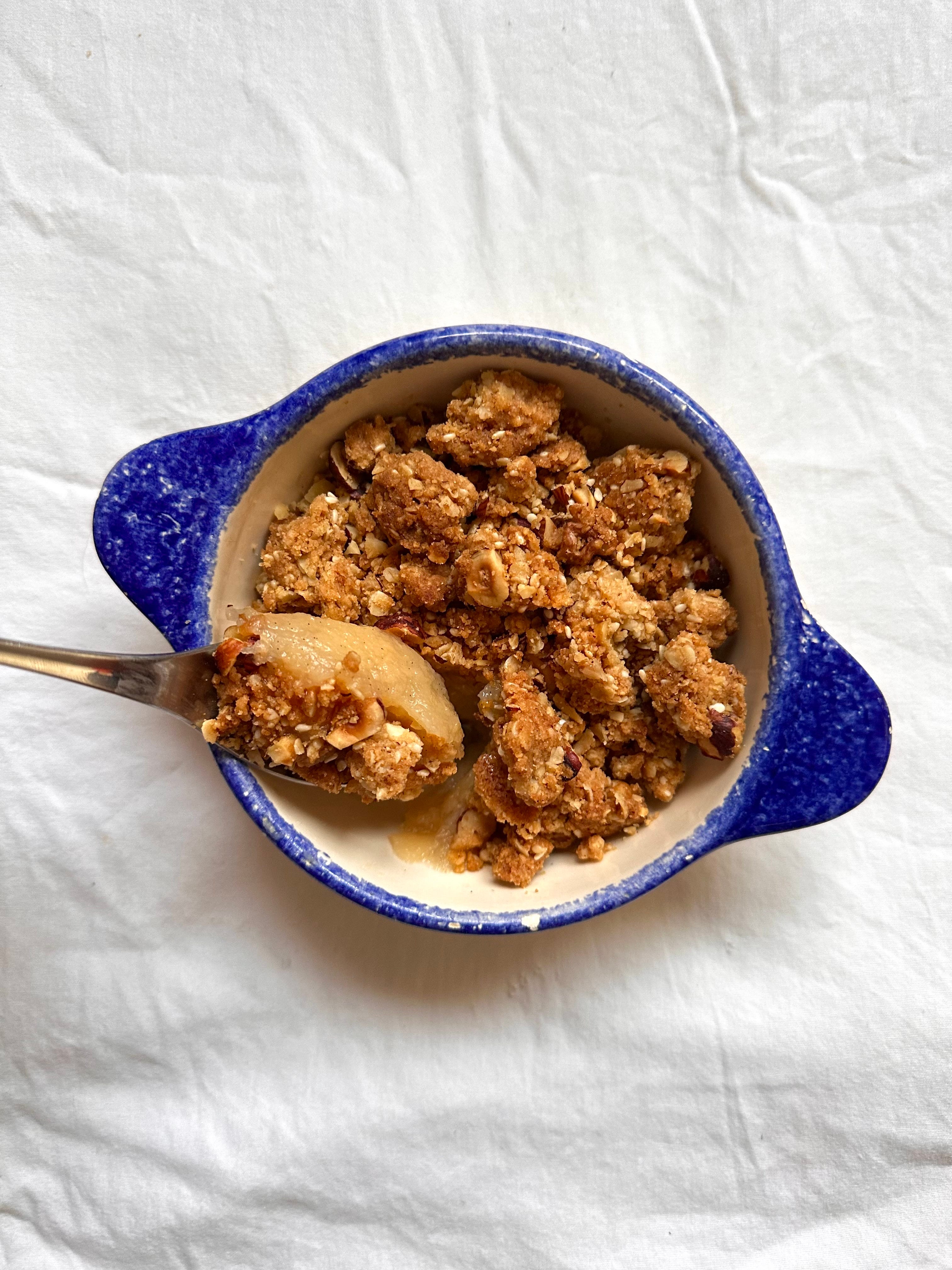
Ingredients (6 portions):
125 g self raising flour
125 g brown sugar
125 g salted butter
50 g ground almonds
60 g rolled oats
30 g sesame seeds
30 g chopped walnuts
60 g chopped hazelnuts
Sea salt
3 apples
2 quinces
1 vanilla pod
1 tbsp honey
3 tbsp water
Method:
Peel and core the quince and apples then cut into large chunks. Place in a saucepan with the honey and a few tablespoons of water. Cook on a low heat with the lid on until the fruit has softened and you can easily mash it with a fork. Alternatively do this in the microwave, it takes about 6 to 8 minutes on full power.
Halve the vanilla pod and scrape out the seeds. Add these to the quince compote and stir.
Cut the butter into cubes.
Roughly chop the walnuts and hazelnuts.
Add the butter, flour, sugar, ground almonds, oats and sesame seeds to a mixing bowl. Rub the mix between your hands, pressing down on the butter cubes until you get a breadcrumb texture. Create some lumps by pressing the mixture together, then gently break them into clusters. Gently mix in the chopped nuts.
You can bake this as a traditional crumble by layering the compote into a baking dish and topping with the crumble mix. Bake at 180°C until golden brown on top, about 30 minutes. Alternatively bake the crumble mix on its own by spreading it out on a tray and cooking for 15 minutes at 180°C, then flip it with a spatula and bake for a further 5 minutes so it is golden and crispy all over. Use it like granola on top of the compote with a spoonful of yoghurt.
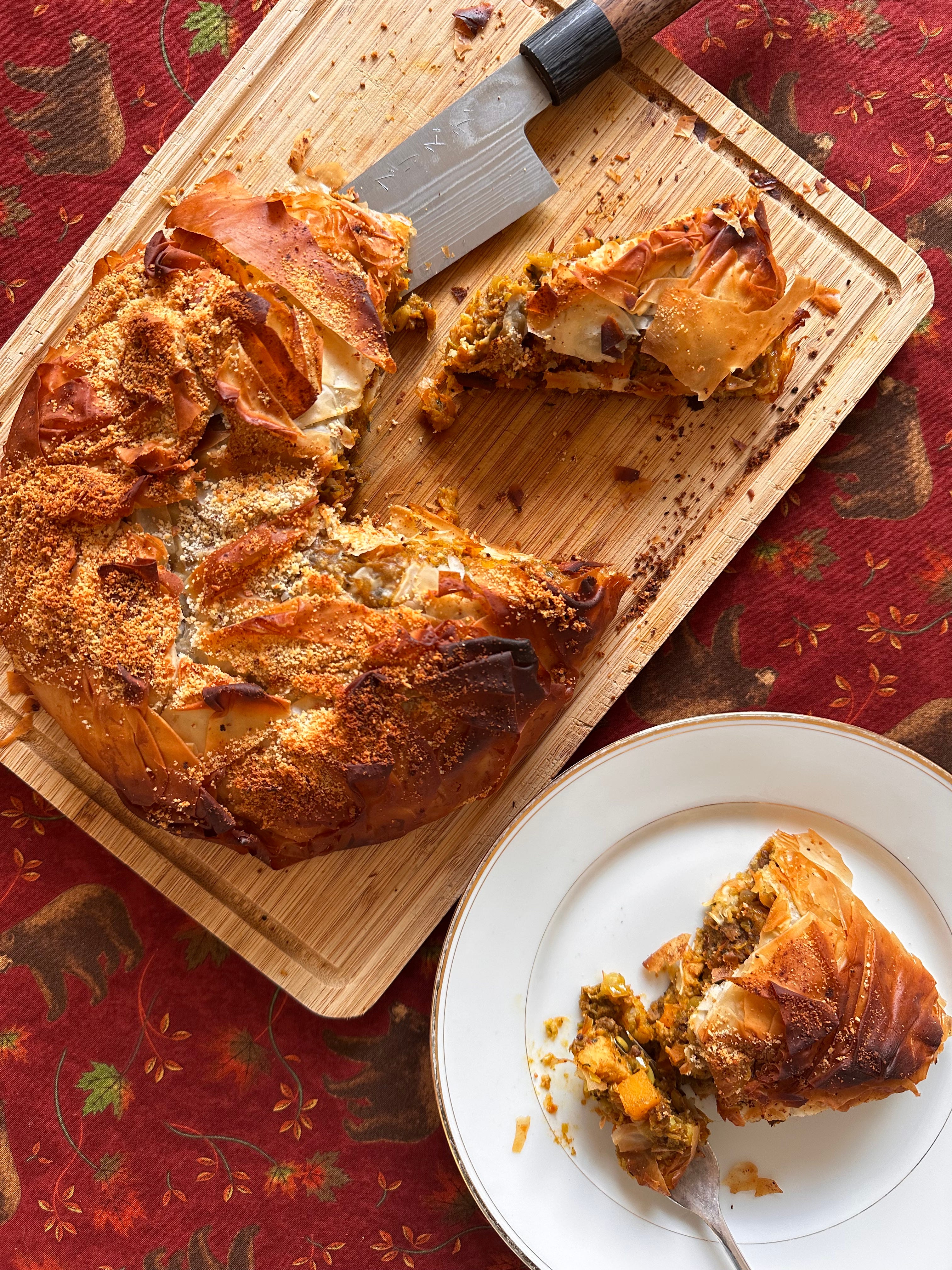
Ingredients (4 portions):
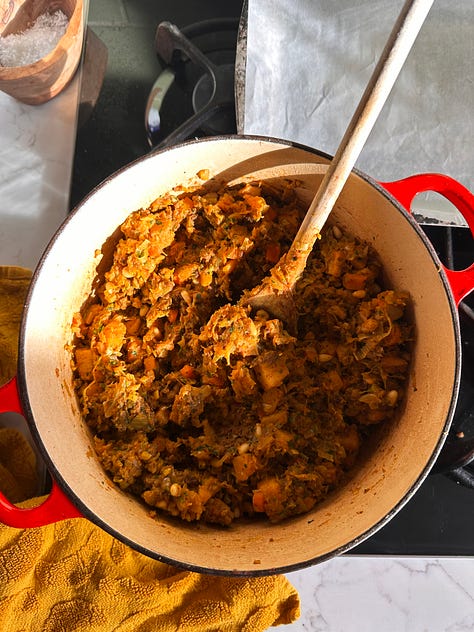
300 g mince (lamb, beef or venison)
2 tbsp vegetable oil
1 white onion
1 leek
Half a butternut squash
1 carrot
3 garlic cloves
1 quince
1 tbsp harissa
2 tbsp cinnamon
2 tbsp ras el hanout
1 tbsp cumin
1 tsp ground ginger
1 cardamom pod
25 g parsley
30 g pine nuts
270 g filo pastry
2 tbsp extra virgin olive oil
2 tbsp ground almonds
Method:
Prep the vegetables: peel and dice the onion, carrot and butternut squash. Peel and core the quince before chopping it into rough chunks. Slice the leek in half, rinse under cold water to remove any grit between the layers, then thinly slice. Crush the garlic cloves.
Finely chop the parsley, including the stems.
In a deep saucepan heat the vegetable oil then brown the mince on a medium heat, breaking it up into small clumps. When it is nicely browned and starting to catch on the bottom, add the vegetables and a few generous pinches of salt. Reduce the heat and sweat the vegetables for 15 minutes, deglazing with a little water if it catches too much. Once softened, add the harissa, pine nuts, parsley and all the spices, stir well and cook for two minutes. Turn off the heat and leave to cool.
Preheat the oven to 190°C.
On a lined baking sheet start layering the filo pastry, brushing a generous amount of olive oil between each sheet. Layer the sheets so half sits in the centre while the other half rotates around the tray to create a rough circle. Keep two sheets aside to top the pie.
Spoon the filling into the centre and top with the last two sheets of filo. Fold the edges over so everything is covered. You can fold the filo roughly to create some nice crispy edges.
Sprinkle the ground almonds and a dusting of cinnamon on top.
Bake for 40 minutes or until golden brown.
Enjoy warm with a spoonful of plain yoghurt.

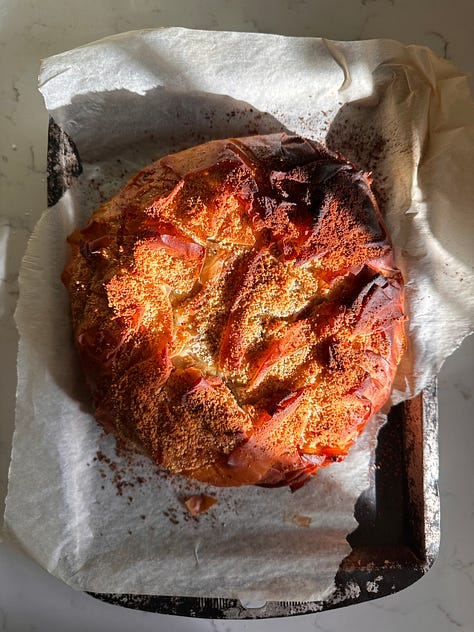
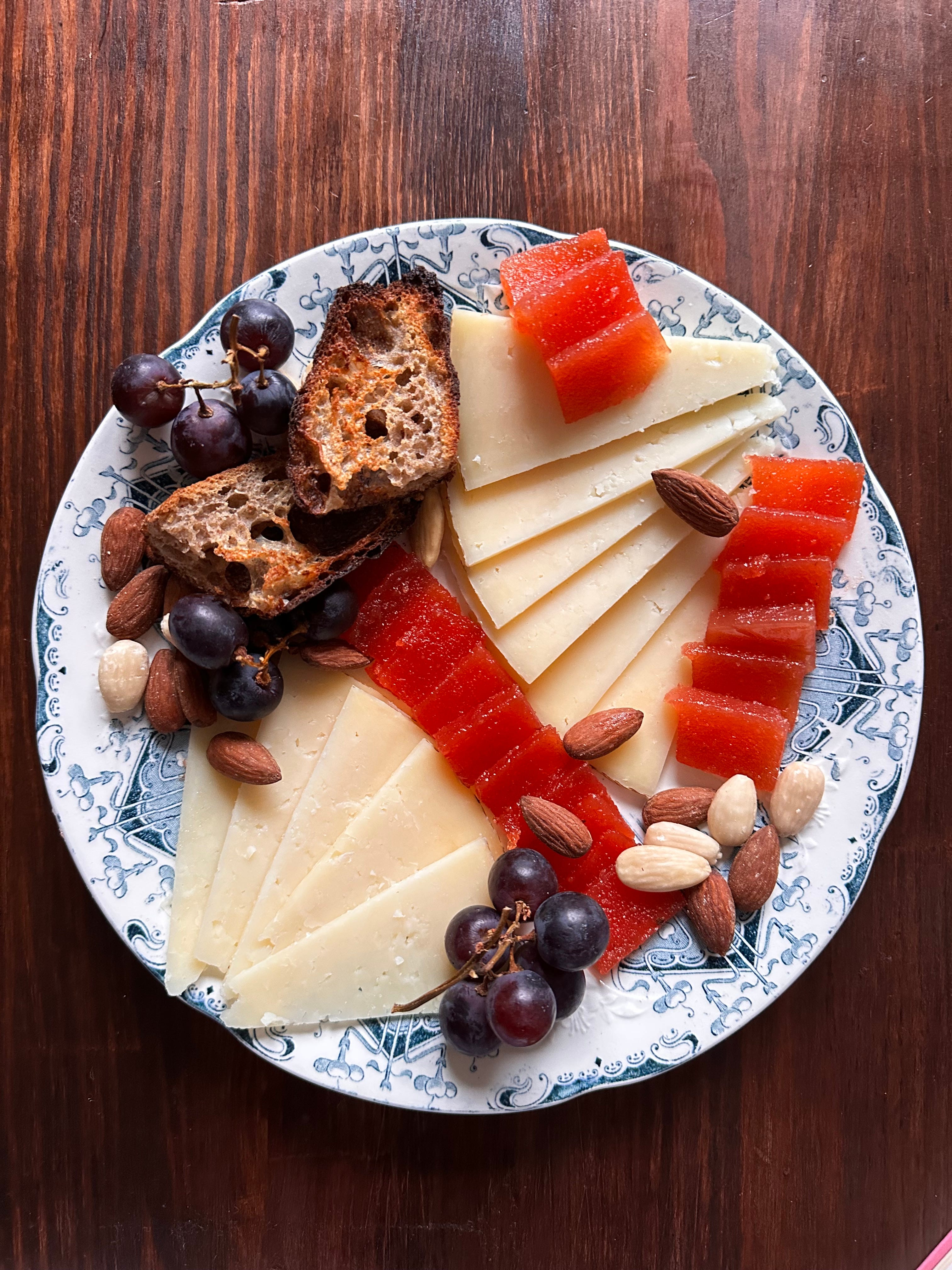
No real method needed. If you find or make quince paste, also called membrillo in Spanish, add it to any hard cheese. It is particularly delicious with manchego and almonds.
As always, if you have any questions about method, substitutes etc. feel free to send me a message!
Comments
Nothing yet. Say the first thing.
Sign in to join the conversation.