
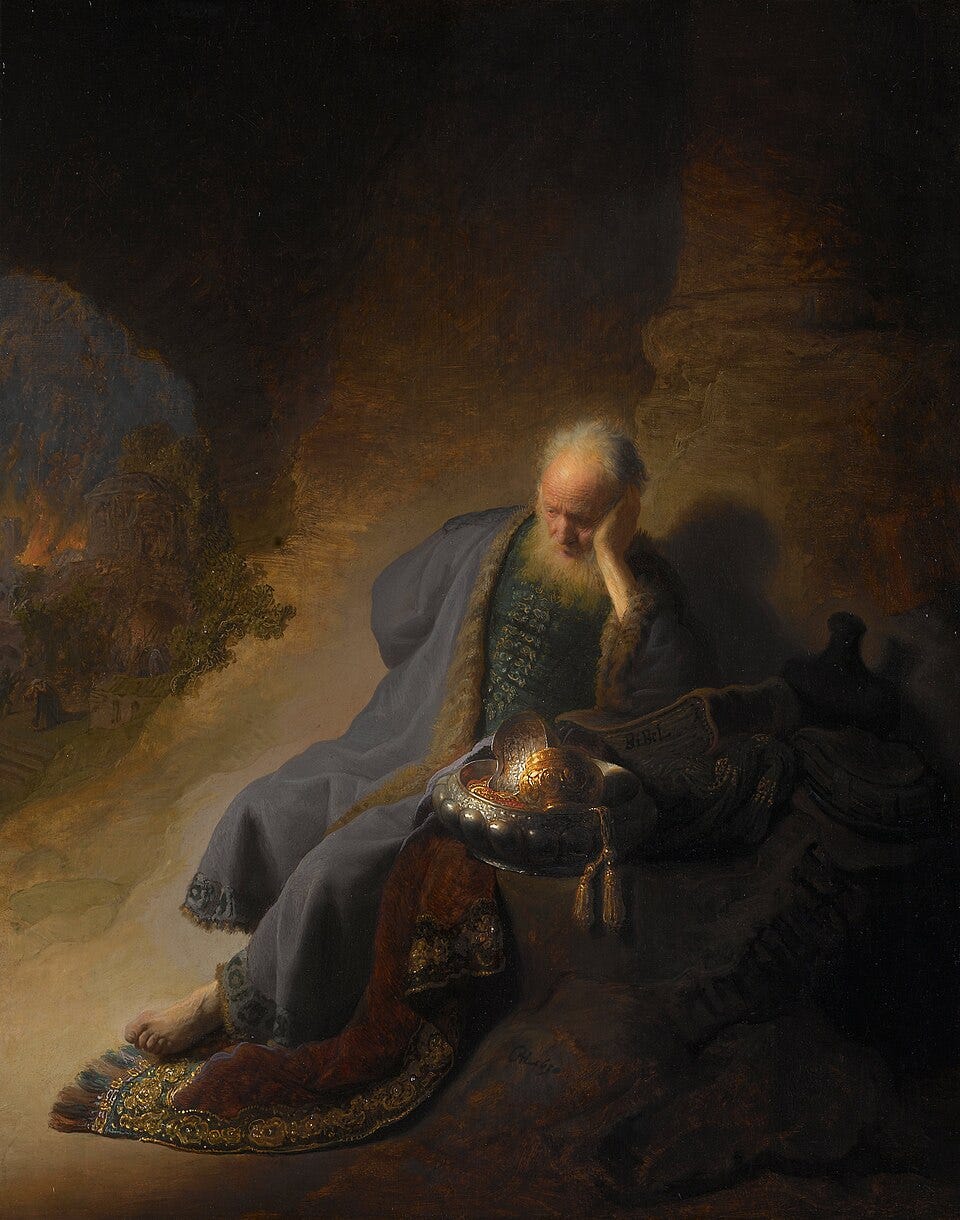
Above: Rembrandt, Jeremiah Lamenting the Destruction of Jerusalem. Netherlands, 1630.
How lonely sits the city that was once full of people! How like a widow has she become, who was once great among the nations! The princess of provinces has become a slave.
Lamentations 1:1
In today’s readings we begin the short book of Lamentations. In English Bibles, Lamentations comes after Jeremiah and before Ezekiel. It is thus categorized with the prophetic rather than the literary books (the “Writings”). This is because tradition (wrongly) asserts that Jeremiah himself wrote Lamentations.
In reality, Lamentations was written by an anonymous author sometime after the destruction of Jerusalem (586 BC) but probably before its restoration (538 BC). It is a good example of a well-known genre from ancient West Asia: City Lament. There are examples of Mesopotamian City Lament texts dating to as far back as 2,000 BC. Such texts mourn the destruction of great cities, often through war, and attribute the destruction to various gods.
The poetry of Lamentations is very meticulously crafted. Most of the chapters of Lamentations each consist of one Hebrew acrostic poem. Verse 1:1 begins with the Hebrew equivalent of “A,” 1:2 begins with the equivalent of “B,” down through the 22 letters of the Hebrew alphabet ending in 1:22. This pattern repeats, with one significant change, in chapters 2, 3, and 4, before breaking down in chapter 5. To understand the meaning of Lamentations as a whole, we will need to explore this acrostic structure in more depth.
To make it easier to comprehend, I will describe the structure of Lamentations in a chart:
• Chapter 1: An acrostic poem, each letter receiving 1 verse, totaling 22 verses.
• Chapter 2: An acrostic poem, each letter receiving 1 verse, totaling 22 verses.
• Chapter 3: An acrostic poem, each letter receiving 3 verses, totaling 66 verses.
• Chapter 4: An acrostic poem, each letter receiving 1 verse, totaling 22 verses.
• Chapter 5: Structure breaks down. No longer an acrostic poem, but still 22 verses.
The structure of the poem itself carries significant theological meaning. Chapters 1 and 2 are a theological lament over the destruction of Jerusalem. Chapter 1 describes Judah as a woman, and she calls people to reflect on her sin and God’s punishment of it. Chapter 2 then continues to describe the violent defeat of Judah, placing the blame on the Judeans themselves for their sins.
The structure changes in chapter 3. That chapter is three times longer, since each letter of the acrostic receives three verses. In the chapter, the voice changes to that of a single Israelite man, as a representative for the whole nation. This model Israelite complains about the harsh punishment that God has meted out (3:1-18), but places it in the larger context of God’s love and forgiveness (3:19-33). He claims that the destruction was God’s punishment for the Israelites’ sins, but waits with hopeful expectation for God to forgive and restore the nation (3:34-66).
Chapter 4 then returns to the standard, one-verse-per-letter acrostic. The chapter describes the horrific experience and aftermath of the siege of Jerusalem. The text, while somewhat stereotyped and reminiscent of other biblical wartime scenes, is still powerful (4:7-10).
The structure of the text breaks down in chapter 5. Though the poem is still divided into 22 chapters, it is no longer an acrostic poem. The verses instead begin with random Hebrew letters. This is meant to symbolize the breakdown of the cosmic order. The text continues with descriptions of the suffering of the Judeans, highlighting some especially horrifying scenes (5:8-18).
The culmination of the breakdown of the natural order then comes in 5:19-22. In that passage, which concludes the book, the author wonders whether God would ever forgive the Israelites. He begs God to restore them but leaves open the possibility that God may still be “exceedingly angry.” If so, the author worries, God may just “utterly reject” Judah. He leaves open the possibility that God would not forgive again—that God would never again restore Judah, as indeed he never restored the northern kingdom (Israel) after their destruction in 722 BC.
And on that plaintive, depressed note, the book of Lamentations ends. The author hoped in God’s mercy, but was prepared to hear that God’s condemnation was final. As we all know, however, God did indeed begin to forgive Judah in 538 BC—when Persia allowed them to return to Judea—and ultimately at the birth of Jesus Christ.
No posts
Comments
Nothing yet. Say the first thing.
Sign in to join the conversation.