
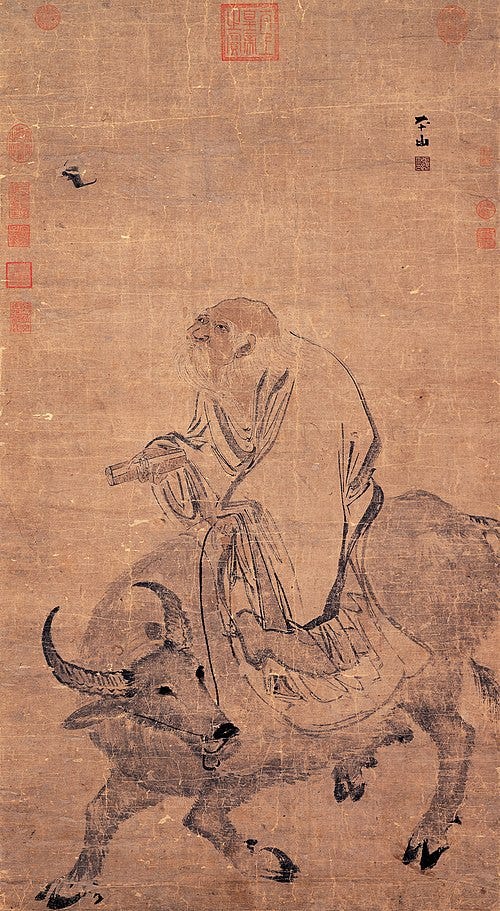
Above: Zhang Lu, portrait of Laozi. China, 15th-16th century. Tradition claims that Laozi wrote the Dao De Jing, a foundational Chinese philosophical text that advises us to engage in productive “non-action” (wuwei 無為). This is very similar to the Christian doctrine of divine sovereignty, with some important theological (rather than practical) differences.
Yahweh is good to those who hope in him; to the soul who seeks him. It is good to wait quietly for Yahweh’s salvation. It is good for a man to bear the yoke in his youth.
Let him sit alone in silence when it is laid on him. Let him put his mouth in the dust; there may yet be hope. Let him give his cheek to the one who strikes; let him be filled with insults.
For my lord will not cast off forever, But, though he causes grief, he will have compassion according to the abundance of his steadfast love. For he does not afflict from his heart, or grieve the sons of men.
Lamentations 3:25-33
In today’s reading we continue in the book of Lamentations, which was originally composed as a dirge for the destruction of Jerusalem. We discussed the background and overall message of Lamentations yesterday.
Today it will be valuable to reflect on the theology of suffering that Lamentations presents. Because the Judeans wrote this text in exile after the destruction of their kingdom, they were intimately familiar with suffering. The horrors that they experienced during the siege of Jerusalem and its aftermath are memorialized in the book. These experiences led the Judeans to reflect deeply on their theological assumptions and practices, leading some of them to develop what we now call “ancient Judaism” out of the materials of ancient Judean state-sponsored religion.
Now, we must say first that the author of Lamentations claims that the suffering of Judah was punishment from God for their sins. This is clearly stated throughout the book. And, indeed, we have no reason to doubt this. As we have seen, the Judeans had worshipped foreign gods like the “queen of heaven” from the days of the Exodus right up to, and even beyond, the end of the Judean kingdom. From God’s perspective, that amounted to 600 years of adultery—borne patiently long enough. So, theologically speaking, we have no reason to doubt that the kingdoms were destroyed because they did not faithfully obey the single most important religious command. God was finally ready to “divorce” them because of their betrayals.
But as we learn from Jesus, not all suffering in life is punishment for one’s sins (John 9:3). Sometimes we suffer because God has a higher purpose for us to fulfill (Gen. 50:20). Sometimes we suffer so that God can reward us for suffering well (2 Sam. 16:10-12). And sometimes we suffer for reasons that only God himself knows.
Thankfully the author of Lamentations does not only describe the Judeans’ suffering as well-deserved punishment by God. Especially in chapter 3, the author provides interpretations of their suffering that we Christians can learn from. Note, for example, the discussion of suffering in the verses quoted above. This model Israelite gives some helpful, still applicable advice on how to suffer well.
The author claims that “it is good to wait quietly for Yahweh’s salvation.” That is, when we suffer, we should place our hope for rescue in God. We should pray that God would change our circumstances and give us strength to endure. We should trust that God, who is in control of the universe, will act compassionately toward us. We believe this because, as the author says, God “does not afflict from his heart.” That is, God does not cause us to suffer simply because he likes seeing us in pain. Rather, when we suffer, we can trust that God is allowing it in order to fulfill some greater and higher plan.
That is why the author gives his admonitions. He says that sometimes we will bear a yoke, and that we must be strong under it (3:27-28); that sometimes we may be thrown down to the dust (3:28); that we may be beaten and insulted (3:30). The author advises us to be strong in such circumstances, when we are hurt and left with no recourse. Why? Because “my lord will not cast off forever” (3:21). Though God causes us grief, he will one day have compassion (3:32). That is why we can, as Paul said, wait for God to avenge us rather than taking vengeance on our enemies ourselves (Rom. 12:19-21).
The author is not saying that suffering is good, nor that all suffering is caused by God for a clear and discernible reason. Rather, the author accepts that suffering will sometimes happen and advises us to be prepared for it. We must suffer with strength and resolve, with patience and presence of mind, waiting for God to avenge us rather than taking vengeance for ourselves.
In this way, the biblical principle of divine sovereignty and the Daoist principle of wuwei (無為) meet. We are not called to control the world around us. We are called instead to live gracefully and wisely within the world God created, and to flow effortlessly in the direction that God’s Spirit blows. If we live with this strength and wisdom, we will remain “in step with the Spirit” (Gal. 5:25) in our pursuit of “effective non-active.”
No posts
Comments
Nothing yet. Say the first thing.
Sign in to join the conversation.