
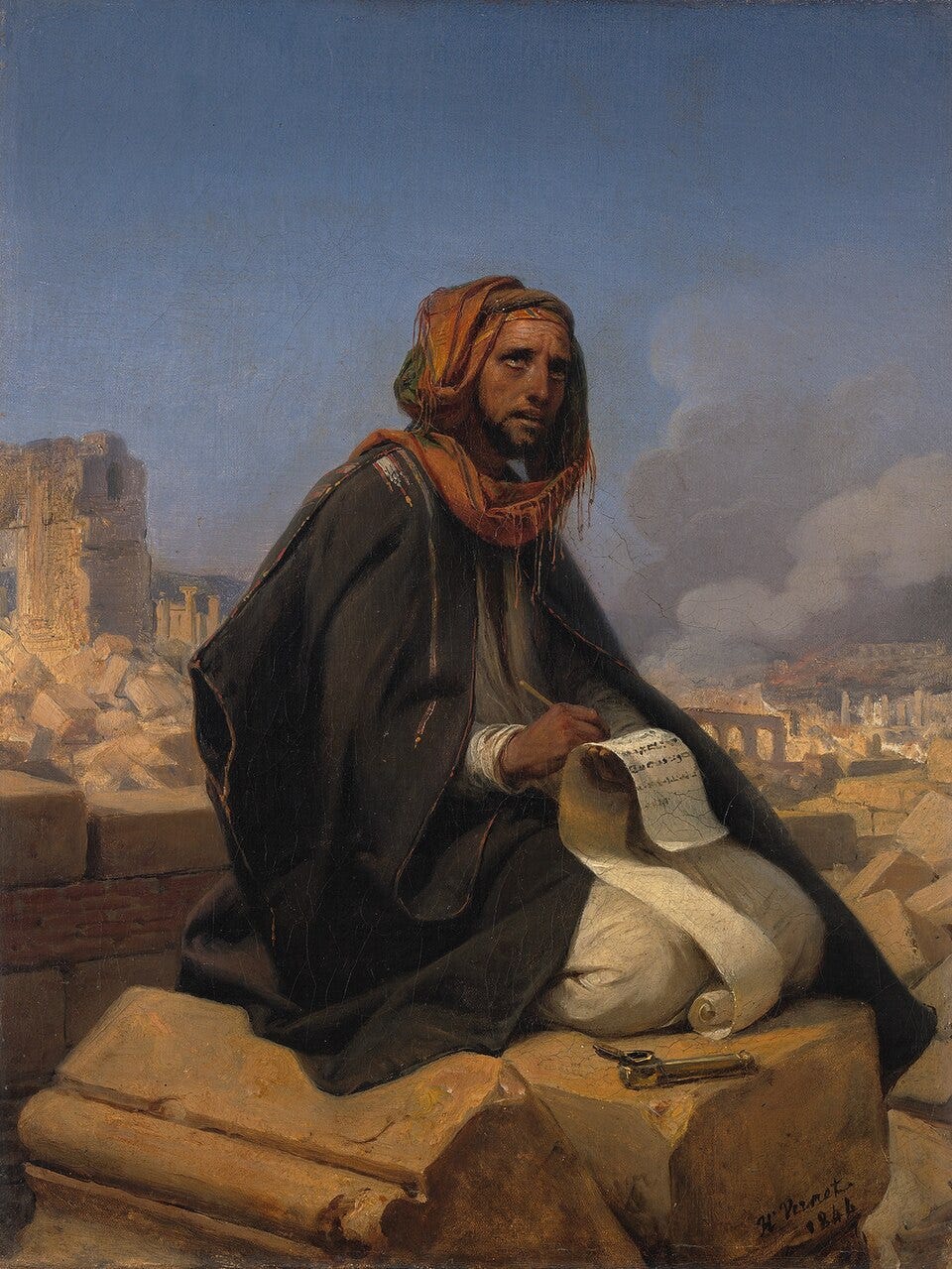
Above: Horace Vernet. Jeremiah on the Ruins of Jerusalem. France, 1844.
“When you finish reading this book, tie it to a stone and throw it into the Euphrates and say, ‘Thus shall Babylon sink to rise no more, because of the disaster that I am bringing upon it, and they shall be exhausted.’” The words of Jeremiah end here.
Jeremiah 51:63-64
In today’s reading we will conclude the book of Jeremiah by exploring the final section, relating to the destruction of Jerusalem by Babylon in 586 BC. It begins with a long prophecy (50-51) and then ends with a historical narrative (52). These two texts together prepare us for the upcoming book of Lamentations, a poem about the destruction of Jerusalem traditionally (but falsely) ascribed to Jeremiah.
The prophetic section begins with a prediction of Babylon’s downfall. It claims that a nation “from the north” would destroy the Babylonian empire (50:3). This would then lead to a restoration of the Israelites, who would return to their land and establish a new covenant with God (50:4-5). This promise was fulfilled in history. The Babylonians were eventually defeated by the ascendant Median-Persian empire (cf. 51:11, 28), which culminated in Persia’s bloodless capture of the city of Babylon in 539 BC. And indeed, just as Jeremiah predicted, the Persians then let the Judeans return to their homeland the following year.
Jeremiah then reflected on the role of Babylon in salvation history. God had himself raised up Babylon as a “hammer” and a “weapon of war” (51:20). God had used Babylon to “break nations in pieces” and “destroy kingdoms.” But the Babylonians themselves would not escape God’s wrath. Once the Babylonian Empire had shaken up West Asia, God would punish it for its own violence and crimes (51:24). One day the Babylonians would die by the sword, just as they had lived by the sword (51:49).
After Jeremiah gave the prophecy discussed above, he wrote it into a book and gave it to a Judean official named Seraiah (51:59-60). The prophet knew that Seraiah would soon be headed to exile in Babylon, after Jerusalem’s destruction in 586, so Jeremiah gave him the book to bring with him. When he arrived in Babylon, the official was instructed to read the prophecy aloud to the other Judean exiles and then throw the book into the Euphrates river (51:61-63). This was to symbolize that, as the prophecy had claimed, Babylon would one day “sink, to rise no more” (51:64).
This was the most important of Jeremiah’s prophecies, explaining why it is appended here at the end of the book. As the prophet had claimed many times over his career, Judah would be punished and then restored. This would happen when God sent the Babylonians to destroy Judah in 586 BC, and then when he raised the Persians to destroy Babylon in 539 BC. According to biblical theology, the successful culmination of this prophecy is what vindicates Jeremiah as a true prophet (Deut. 18:21-22). We know that Jeremiah was a real prophet of God because the Babylonians did indeed destroy Jerusalem, and the victory of Persia did indeed allow the Judeans to return home. This even happened on roughly the time-scale that Jeremiah had predicted (29:10-11).
Chapter 52 then tells of how the Babylonians captured and destroyed Jerusalem in 586 BC. The narrative continues until 562 BC, but offers few substantive details (52:31-34). This was only 9 years before the revolt of Cyrus against the Median Empire, which initiated the process of the decline and collapse of Babylon, and thus the fulfillment of Jeremiah’s prophecy.
No posts
Comments
Nothing yet. Say the first thing.
Sign in to join the conversation.