
The first point to make is that the amount of savings consumers accumulated over Covid seems to differentiate between how resilient the economy has been since. The resilience of consumer spending in the face of cost-of-living pressures and rising interest rates has largely been determined by the level of savings. The countries where excess savings have run down to about 15% or less are starting to see their labour markets crack:
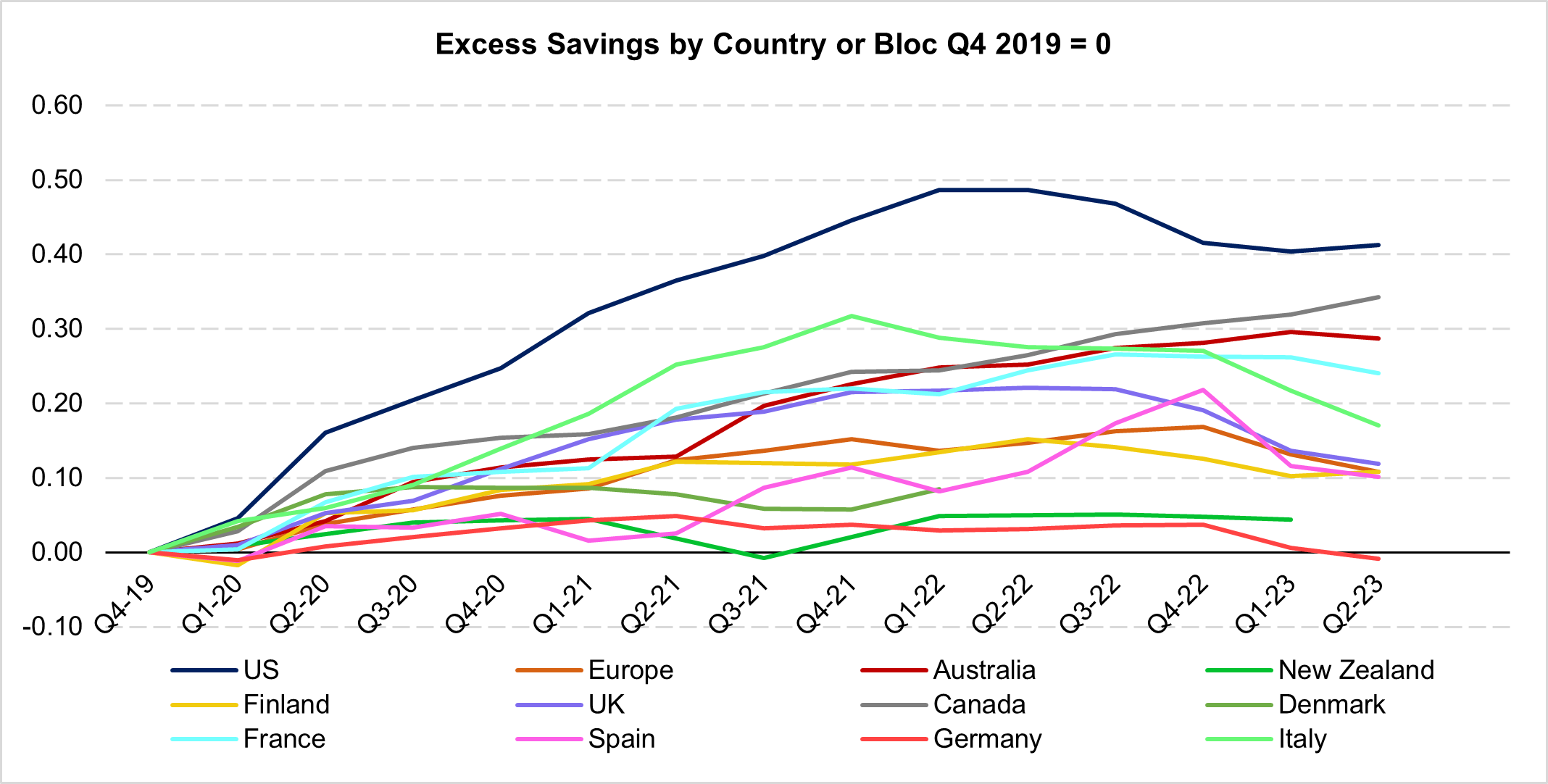
Based on the above chart, it’s become quite clear that Germany, New Zealand, the UK, Spain and some Nordic countries have labour markets that are starting to crack. At the far end of the spectrum are New Zealand and Germany. Their governments spent less and gave out less transfers during the pandemic leaving consumers with less savings. Given this deficit, higher interest rates have impacted these economies like we’d expect based on history.
Out of the two, we’d expect the New Zealand economy to feel the impact of higher rates the most. This is because (1) the central bank started to raise rates earlier and faster than others, (2) NZ has a very low level of excess savings and (3) mortgages usually reset quickly within 2 years. How has the NZ economy evolved?
The labour market has cracked:
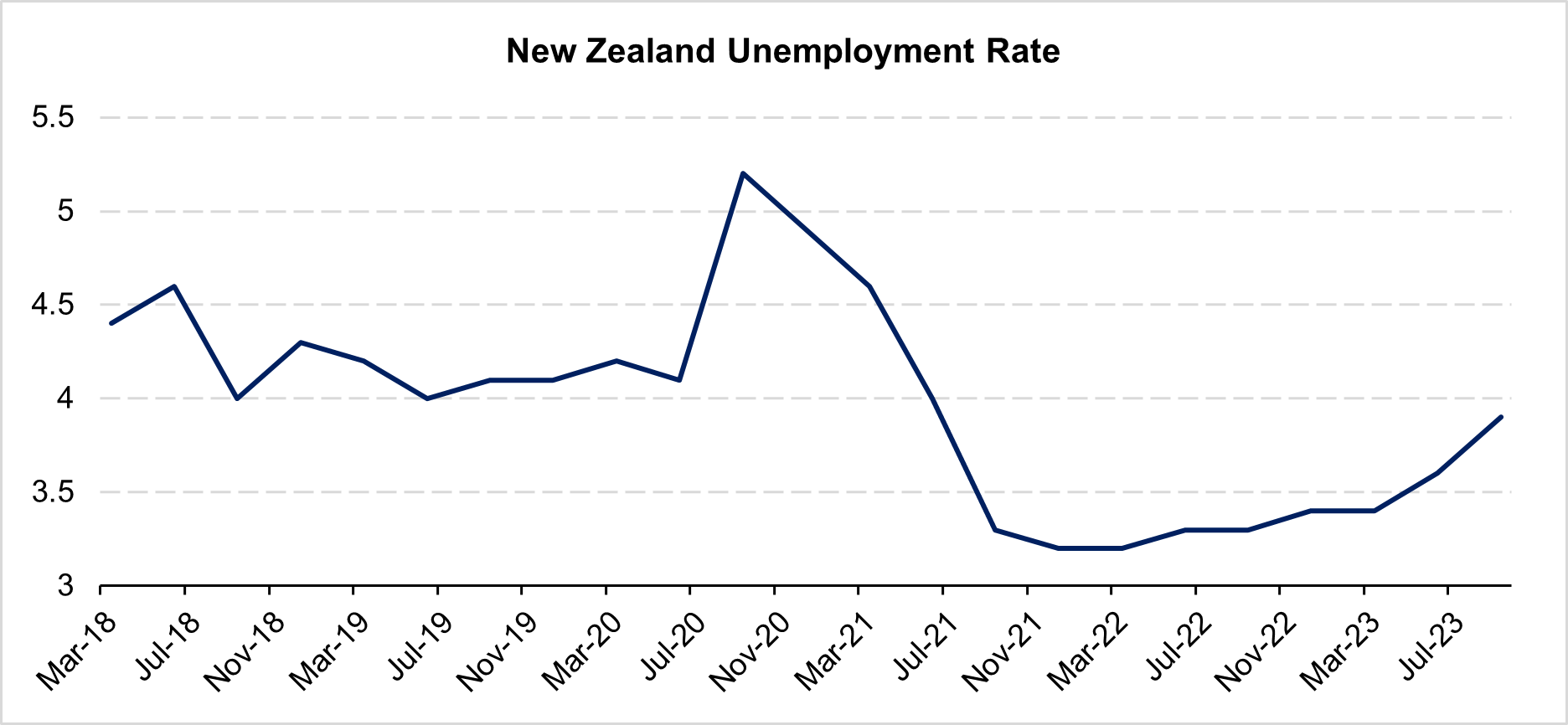
In the last 6 months, New Zealand has seen a sizeable rise in the unemployment rate from 3.4% to 3.9%. Once an economy sheds jobs, an external force is usually needed to reverse it. This external force throughout history has been interest rate cuts and fiscal stimulus.
The services sector has also been in a sustained decline:
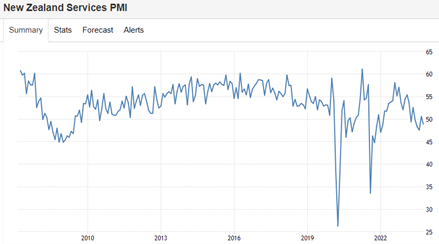
A similar story can be found in Germany. Interest rate rises have worked their way through the system and caused the unemployment rate to rise from 5% to 5.8% over the last year or so. The latest German services PMI print was also in contractionary territory (approximately 48 – note, a PMI reading below 50 indicates a contraction).
Lacking excess savings, the New Zealand and German economies have responded to rate hikes in a similar way to prior cycles. These economies could be the canary in the coalmine for what’s to come when savings are exhausted in other countries.
********
Like at the end of last year, US consumer spending has begun to decline:
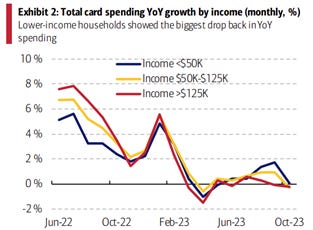
At the start of 2023, consumer spending bounced rapidly. Will the same occur this time? It’s a difficult question to answer, but we suspect it’s more likely than not. This is because the reason we got the bounce last time is also present this time. Last time, we got the bounce because of wage increases over the new year period as well as higher indexation of social security benefits, which alone affected 60 million people. While the indexation of social security benefits to inflation will be less than the 8.7% of last year, many states have legislated sizeable minimum wage increases and private sector pay raises often occur over year-end. Consumers are also increasingly waiting to spend their money at after-Christmas sales. These factors are likely to support spending over the new year period.
But more broadly, what’s happening to the economy? According to Bank of America data, wage growth has already returned to pre-Covid levels of around 2-3% y/y. At the same time, the US consumer continues to spend at a nominal growth pace of around 2-3% y/y. Interest rates have risen from 0% to 5.5% and this is starting to sap spending power. As a result, savings have been falling by around 20% per year, or about $400 billion per year:
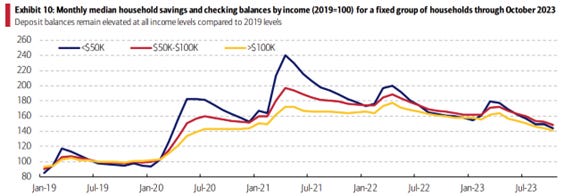
When spending declined in April of this year, it stabilised thereafter around 0% y/y per household. Given that household formation is running around a couple of percent per year, overall nominal spending growth continued to grow around 2-3% y/y. The US consumer was able to dip into their savings pool to offset the rise in interest rates and preserve their standard of living.
The current decline in consumer spending growth to around 0% y/y per household has been a little different to the one before. The circumstances that surround this decline are more ominous.
For a start, travel spending remained strong during the previous decline in consumer spending. This time, however, travel spending growth has stalled. Aside from Booking.com which is benefitting from a rise in Chinese tourism since their reopening, y/y spending growth rates of American tourism have fallen to close to 0%. This is compared to fast travel spending growth of 30% y/y during the spending decline earlier this year:
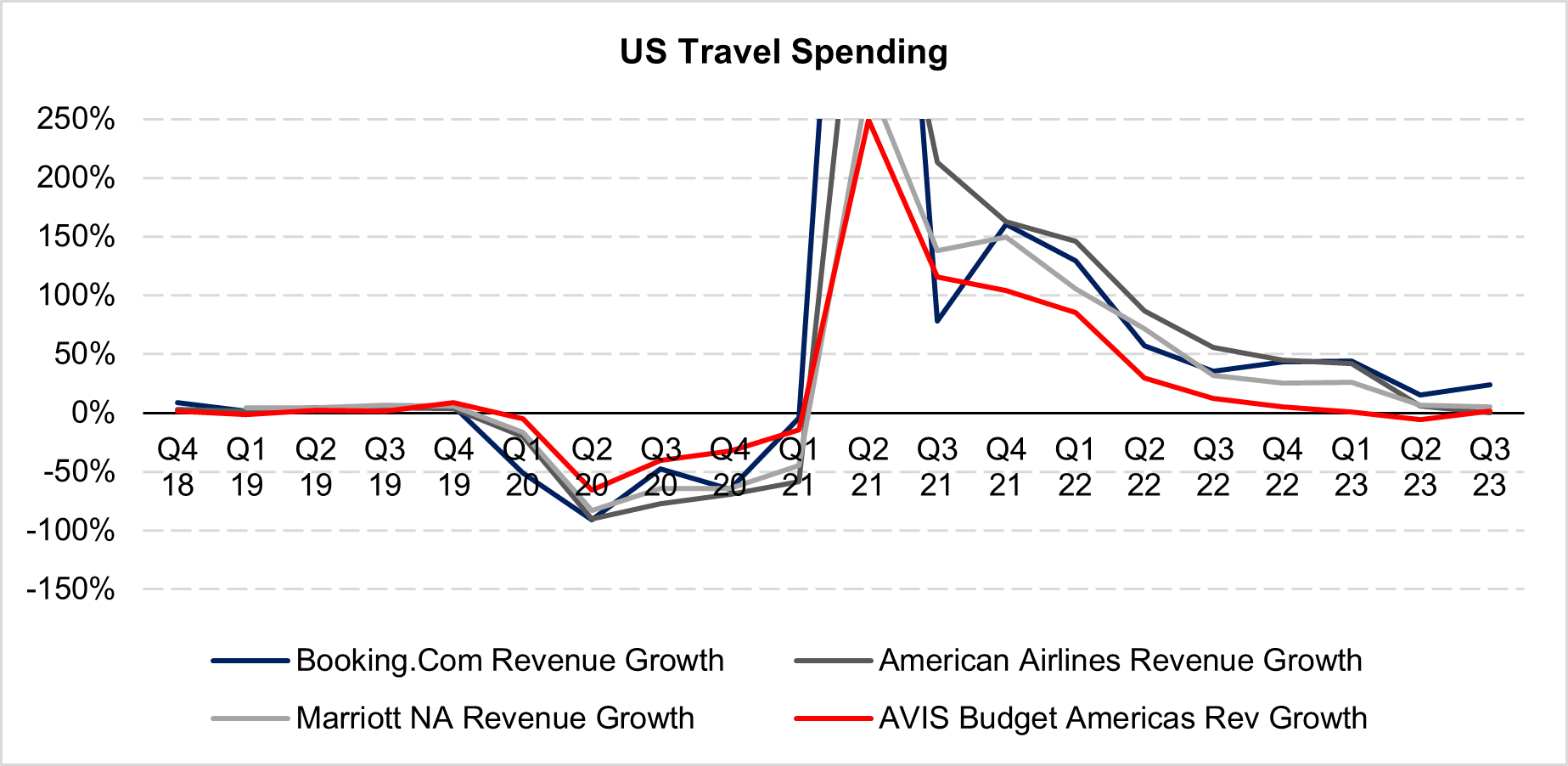
Despite the supply chain issues preventing the speedy normalisation of airline capacity, American Airlines has begun cutting ticket prices for the first time since the pandemic began.
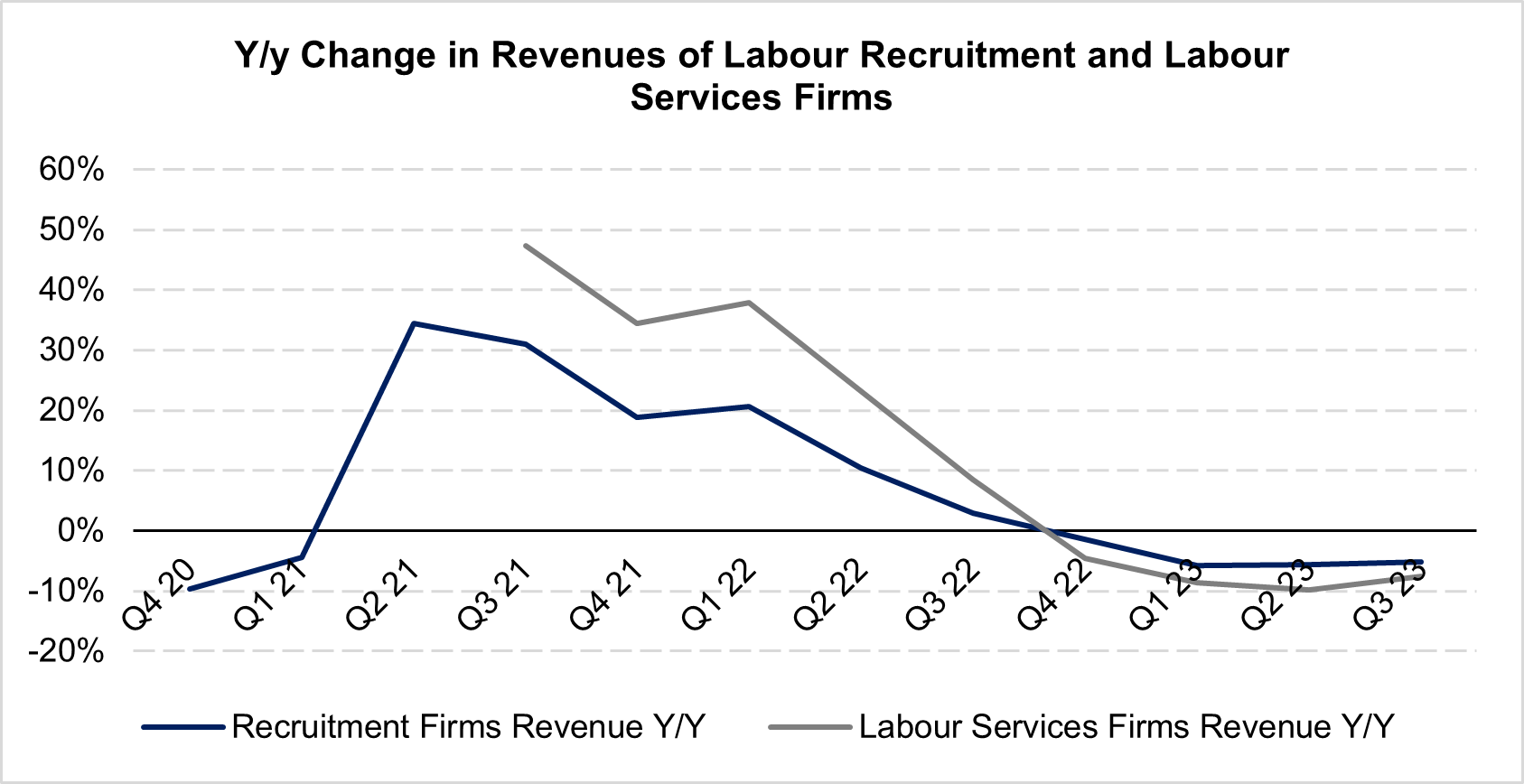
Today’s decline in spending has also occurred when the labour market has experienced more sustained and prolonged weakness. Labour recruitment firms tend to experience the first reductions in revenues since external providers of labour are the first to go during tougher times:
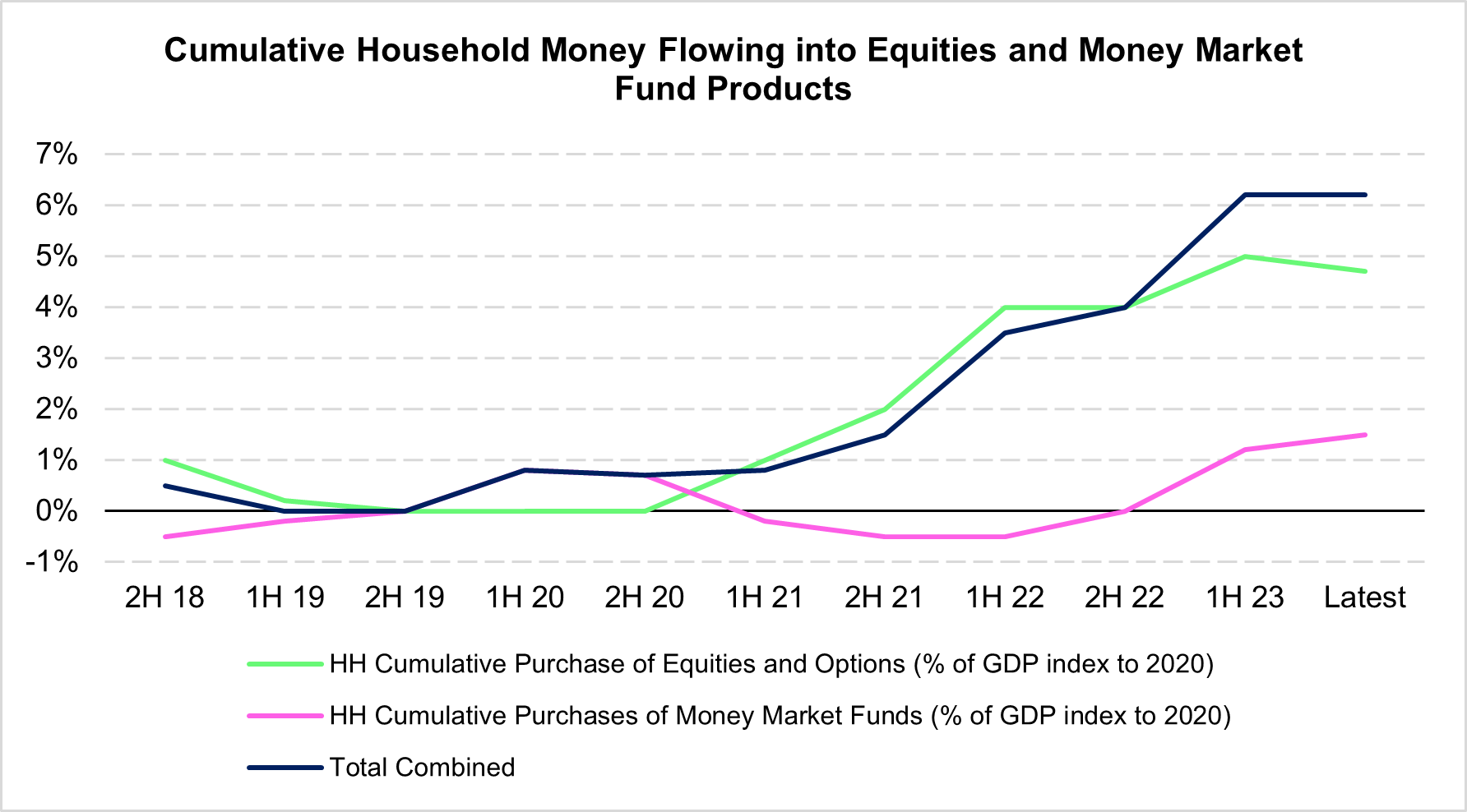
Today’s decline in spending and savings has also occurred during a period when households have stopped putting money into stocks and money market fund products. In the previous decline in spending and savings earlier this year and throughout last year, consumers were still buying stocks and investing in term deposits at a rapid clip. Now, though, the reduction in savings is occurring independently of financial assets purchases:
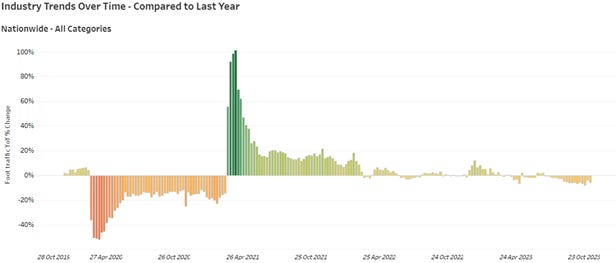
Today’s reduction in spending has also come within the context of a more sustained reduction in foot traffic at spending outlets. The following measures y/y foot traffic growth at beauty and spa outlets, clothing shops, department stores, drugstores and pharmacies, electronics stores, fast food outlets, fitness venues, grocery stores, home improvement stores, hotels and casinos, office supply stores, restaurants, shopping centres and superstores:
We don’t know for certain how the consumer will respond. The consumer’s propensity to further draw down on savings is not the easiest thing to predict. But the US consumer still has a decent amount of buffer to go. At the current trajectory, it’d take another two years to run the buffer down to the levels of other economies with labour markets that are cracking.
On top of this, the US consumer has excess financial assets that they can sell down if needed. We estimate that the US consumer has accumulated around 6.5% of GDP in excess financial assets that can be sold to raise money if required. This is equivalent to around $1.5 trillion. If the consumer so chooses to, savings and financial assets can be drawn down to sustain the current regime of 2-3% nominal spending growth for some time yet.
But there are signs that the consumer’s propensity to spend is waning (stalling travel spending, lower levels of hiring, reduced foot traffic, stalling investments). If the US consumer chose to save precautionarily, then this would likely speed up the forthcoming recession and job losses. Additionally, other economies where savings are already low (many parts of Europe, the UK, New Zealand and China) are expected to continue to weaken or remain weak with potential follow-on consequences for the US economy.
In the short-term, it’s more likely than not that the US consumer will receive a boost over the new year. Thereafter, events become cloudy. We continue to watch the choice the US consumer makes.
Fed policy is undoubtedly dampening growth and reducing consumer savings. If the Fed is able to get inflation back to its 2% target and wages/spending growth has already reverted back to 2-3%, then a 5.5% interest rate can only be sustained while there are excess consumer savings. Once savings have been largely exhausted, we’d surmise that a 3% interest rate would be a much more likely equilibrium.
No posts
Comments
Nothing yet. Say the first thing.
Sign in to join the conversation.