
GigaCloud (GCT) sits within the “bargain issues of various types” section of Graham’s The Intelligent Investor. My main enquiry in this research piece will be into (1) how GCT generates an economic return, (2) whether those returns are sustainable and (3) whether the price of the stock represents asymmetric risk-reward.
GCT is a cross-border broker of furniture. Specifically, it connects Chinese furniture manufacturers with end customers in the West through its online platform, logistics and marketing services.
Furniture-making has largely moved to Asia because labour and inputs are cheaper. This is particularly the case for mass-manufactured furniture. For instance, IKEA makes the large majority of its furniture in Asia.
But these, largely, Chinese furniture manufacturers don’t have the skills to sell their wares directly to the Western consumer. For one, they struggle to communicate in English, the language used on Western platforms. Secondly, these manufacturers are unable to shake off the low-quality reputation of Chinese manufacturers because they don’t know how to brand or market to a Western audience. For instance, Alibaba through its Taobao subsidiary, struggled to expand into Western markets because Western consumers didn’t trust their Chinese brand. And when Alibaba tried to re-brand in France, it was unsuccessful. GCT adds significant value for these manufacturers by undertaking this marketing service.
Empirically, we know that this cross-border brokerage model for furniture makes sense. Taobao, for instance, connects Chinese furniture manufacturers to consumers in south-east Asian countries. It’s unlikely Alibaba would expend resources on the furniture segment if it didn’t think there was a significant profit opportunity available.
GCT can win in this niche because the two major players that would ordinarily link Chinese furniture manufacturers to Western consumers, being Alibaba and Amazon, are uninterested in competing in this segment. We’ve discussed why Alibaba has chosen to concentrate its resources in south-east Asia. Amazon recognises that it doesn’t have a competitive advantage in moving bulky goods. Unlike parcels, the benefits of scale and pooling are smaller in bulky goods because the turnover is less consistent, its harder to automate warehouses for large items and time is less of the essence. Even Amazon and Alibaba primarily use third party transport providers for the movement of bulky goods. GCT has filled the space.
Wayfair was created to try and cut out the excess re-sellers within the furniture industry and enable furniture manufacturers and retailers to sell directly to consumers. Wayfair, like Amazon, created efficiencies. To capture customers quickly, Wayfair also slashed prices and delivery costs. Instead of accepting the 35-40% gross margin that retailers were accustomed to, Wayfair accepted 25-30%. This is putting enormous pressure on furniture resellers and retailers in the US. But the problem for Chinese furniture manufacturers remained – they didn’t know how to sell effectively on Wayfair or other platforms. GCT is pooling these sellers together.
Another value that GCT adds for its customers is that it handles logistics and inventory management. It can do this as efficiently as Amazon in the bulky goods space, and more efficiently than other furniture wholesalers in the industry. One reason it can achieve a lower cost base is because the company sponsors Chinese logistics employees to operate their warehouses. Another reason is because of its logistics software that makes the pooling process efficient. These factors allow GCT to reduce its wage bill by about a third relative to competitors.
Being able to get furniture more cheaply to the end consumer is an advantage because delivery costs are very high within the industry (typically 30% of value within the mass-market segment).
We can see these advantages reflected within GCT’s financial statements. The numbers here merely reflect or tell the story of the underlying causes described in the section below:
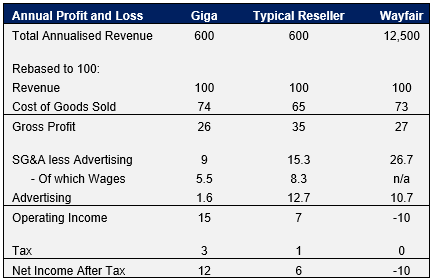
Initially, we started to radically doubt how GCT could generate 12% net income margins when many re-sellers in the industry were struggling. After speaking to management, ex-employees, current sales staff and industry contacts, we have narrowed down three significant advantages that GCT has over peers.
We’ve already highlighted the first advantage which is a lower cost base. We believe this advantage partly comes from sponsoring overseas staff to run their warehouses and partly from having a culture of cost control. We see this in the accounts above whereby GCT enjoys a 30% lower wage bill. GCT is leaner and enjoys a lower cost of doing business compared to others.
The second advantage GCT enjoys is a significantly reduced cost of advertising. While the company pays platform fees to access the end consumer, the cost of advertising is borne by the reseller. The reseller needs to advertise to the world at large, whereas GCT only needs to advertise to a much smaller number of major customers.
Because GCT transacts a lot of volume, it derives a third advantage. This volume data has value because it allows GCT to know what stock is moving before others. It can better identify forthcoming trends in the furniture industry. GCT can then order a significant number of the items that are moving for their own account and sell them direct to the consumer. When GCT buys these units in bulk from one of the manufacturers that they have a relationship with, they are provided with a discount for volume. This discount is what forms GCT’s gross profit margin.
GCT can run a low gross profit margin because it has lower operating costs than others. The company doesn’t have to advertise, it’s learner, and it knows what the end customer wants before its competitors do.
It’s been these combined advantages that have allowed the company to generate an above-normal economic return. We believe that the company’s advantages are durable because: (1) the industry is consolidating with the less efficient being priced out and (2) Alibaba and Amazon, for the reasons stated before, won’t compete in this niche. Additionally, GCT is building out its platform economics by capturing a mass of Chinese furniture sellers, as well as Western buyers. As it grows both sides of its platform, the incentive for others to compete reduces.
This has allowed GCT to grow rapidly:
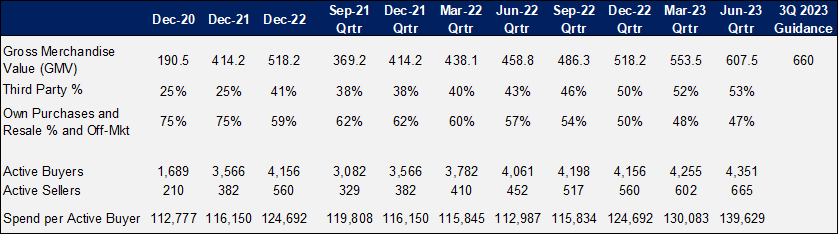
The company has been able to grow the volume of merchandise traded through its platform quickly over the last few years. As an ex-employees told us, the US consumer wants what GCT sells: cheap furniture delivered direct to their door.
GCT has been able to grow its revenues even when other furniture retailers are de-stocking their inventories:
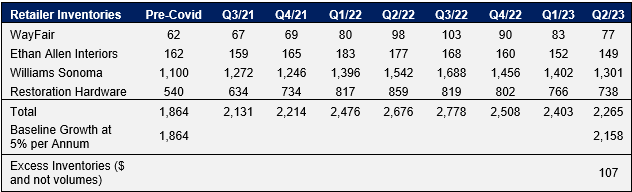
Given that excess inventories have fallen so much, the destocking process following the Covid Splurge is likely to be nearly over. The ability of GCT to grow revenues when others can’t implies to us that it has something that others don’t. As a reflection of this growth, the company has recently increased its warehouse space by around 15%.
GCT’s platform also allows furniture re-sellers to connect directly with Chinese manufacturers. This allows the buyer to customise a piece of furniture, or make custom pieces of furniture. Increasingly, we’re seeing a trend towards customised furniture in parts of Asia, particularly in Singapore. Taobao allows a customer to connect directly with a Chinese furniture manufacturer. It’s possible to simply send a photo or magazine image of a piece of furniture and the manufacturer can replicate it to the desired specifications. This allows the consumer to purchase designer furniture at a fraction of the cost. Given that Wayfair lacks the network of relationships with the mass of Chinese furniture manufacturers that produce custom furniture, this is a unique offering of GCT’s.
GCT has recently closed the acquisition of a competitor, Noble Home. We would expect that, since Noble was under Chapter 11 Bankruptcy protection, GCT will be able to purchase the assets that it wants and rescind the contracts it doesn’t want. We can deduce that Noble had a higher cost base than GCT and couldn’t survive the liquidity crunch when inventories were mismanaged following the Covid Splurge, and the cost of logistics transport spiked during the spending boom. Higher, one-off logistics costs was the same force that obscured GCT’s true, underlying earnings power.
I believe that the stock of GCT trades cheaply. Part of the reason it trades cheaply is because of a recent short seller report that research house, Culper Research released to the market. We initially reduced our position size in the company following the report to de-risk and preserve capital while we carried out further due diligence to assess the various claims. Following this, our conviction in the business has increased and we believe we have a good understanding of why each of the short-seller’s claims is misguided. While we won’t go through each point here as it would take too long, we’re very happy to discuss these further with those interested. The other reason GCT trades cheaply is because market participants believe it’s making a mistake in acquiring Noble Home. We disagree, believing that Noble’s misfortune and mismanagement is GCT’s opportunity.
When we assess the risk-reward at which the company’s stock trades, the potential outcomes vs. the risks appear highly asymmetric.
The company trades at a market capitalisation of around $400 million. By the end of 2023 and post-acquisition, GCT will likely have around $125 million of excess cash. With no debt, an enterprise value of around $275 million represents a free cash flow multiple of around 3x, or a starting yield of around 33%.
When we consider the valuation equation in one year’s time, things get interesting. If the company continues to grow its revenues around 25-30% y/y that it has guided, then it’s likely that it will have around $240 million of excess cash by the end of 2024. An enterprise value at the end of next year of $160 million and annual free cash flow of around $115 million equates to a yield of around 70%. Notably, GCT has started to buy back its own shares.
There are certainly risks involved in this investment. The company could face a competitor that tries to copy them. There’s the risk that its earnings power and margins are overstated because they reflect the Covid Splurge (though its margins have improved more recently because of lower transport costs). The company is relatively small. There’s a risk that the avenues GCT sell through to reach the end consumer increases prices. There’s the risk of a recession. In our view, though, the price is compensating one for taking these risks.
Additionally, in our assessment, we believe that management is extremely capable and, given their significant ownership of the shares outstanding, have interests that are highly aligned to shareholders. There’s a risk that management tries to expand the business too quickly through acquisitions. Again though, we believe the price is compensating one for taking this risk.
We continue to monitor how the company progresses and developments in the industry. Our judgment, however, leads us to believe that the potential rewards from investing in GCT’s stock far outweigh the risks.
No posts
Comments
Nothing yet. Say the first thing.
Sign in to join the conversation.