
StealthGas (GASS) owns ships that transport liquified petroleum gas (LPG). LPG is often a combination of propane and butane. Most common to us all, it’s the energy which fuels our barbecues. LPG is also used as a fuel source to run commercial and industrial applications, as well as to power vehicles and cooking.
LPG is formed over millions of years a fair way beneath the earth’s crust. Today, the US has become the largest exporter of LPG in the world, accounting for just under half of global trade (45%). Largely, this is because LPG is a captured byproduct of the growing US shale oil industry. The gas is transported and processed at facilities at the Gulf of Mexico. Because LPG is a byproduct of producing oil, the US doesn’t have enough demand for the product domestically, so they export it. The other major exporter of LPG is Saudi Arabia, accounting for about one-third of global trade (36%).
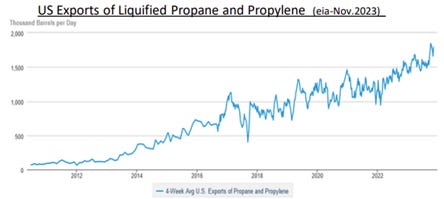
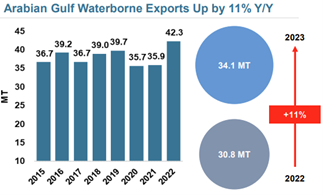
From producing virtually no LPG a decade ago, the US has now become the dominant global exporter. Accounting for nearly half of all global trade, the countries that import the bulk of LPG are based in Asia (South Korea, China, Japan and India). While it’s normally imported as a fuel, China is increasingly importing LPG to turn it into propylene. This is done at a propane dehyrogeneration plant (PDH plant). From there, the resultant propylene can be used for various other commercial processes.
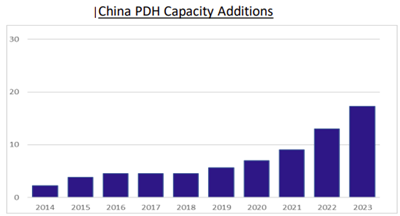
With these trends in place, around one-third of the world’s LPG is transported via ships from the Gulf Coast of the US, through the Panama Canal, to Asia. This route, one-way, would normally take around 30 days. But, since October 2023, the Panama Canal Authority (PCA) has reduced the number of crossings allowed each day. Normally, around 36-40 ships transit through the Panama Canal each day. By February 2024, the PCA will restrict the number of transits to 16 per day.
The reason for the restriction is because the water level in the surrounding dam catchment areas, which feed freshwater into the locks of the Canal, are at unsustainably low levels. The water level at the Gatun Lake (which feeds the millions of litres of water necessary to operate the Canal’s locks each time a ship passes through) would normally be around 87.5 feet above sea level at this time of the year (being the end of the rainy season):
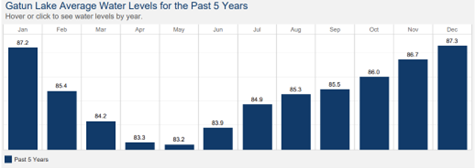
Today, though, at the end of the rainy season, the water level sits around 81 feet above sea level. This water level is below where Lake Gatun would normally be after the end of the dry season. In the 150 years of keeping weather records at the Panama Canal, the water level has never been this low before at this time of year.
In explaining this result, the PCA has pointed to the fact that ocean temperatures are around 1.5 degrees Celsius above their averages on both sides of South America (far higher than normal), that we’ve had a moderately strong El-Nino system develop and because there’s been a lack of wind.
The restriction on Panama Canal transits has an outsized impact on LPG shipping in particular. The reasons are because (1) such a large part of the total worldwide LPG trade (approximately 33% and growing) is from the Gulf Coast of the US to Asia and (2) the demand for LPG is inelastic, (3) LPG can’t be sent via alternative methods of transport (such as over land) because the infrastructure hasn’t been built and (4) LPG ships have last preference through the canal. Unlike container or LNG ships, LPG ships tend not to reserve slots in advance. This is primarily because the cost of reservation is relatively high compared to the value of LPG cargo.
The trip between the US Gulf Coast and Asia normally takes around 30 days, one-way, via the Panama Canal. But, with this route blocked, the alternative trip usually takes around 45 days, one-way, through the Suez Canal and even longer around the Cape of Good Hope (southern tip of Africa). Therefore, we estimate that around one-third of global cargoes are now travelling 50% further. As a result, the supply of LPG ships will have been reduced by around 17%.
The question for us to consider is how long the Canal might be disrupted. The significant 20% increase in demand for container shipping during the Covid Splurge was a cycle that lasted about 18 months, resulting in a major uplift in the stocks of the shipping lines. The 8% reduction in supply of tankers has, so far, lasted about 18 months and is ongoing because of the war in Ukraine. The stocks of tanker and container companies traded at least 6x earnings and 1.25x book value.
Clearly, the weather is something that’s extremely difficult to predict. But, as we’ve learnt, this particular situation affecting the Canal is unique and lends itself to analysing the chance that the disruption will last into 2025. We spoke to some engineers very familiar with the operational dynamics of the Panama Canal and Gatun Lake and have analysed various research papers to build on our understanding. The following table presents our best understanding of how the water from the Lake Gatun is allocated in an ordinary year:
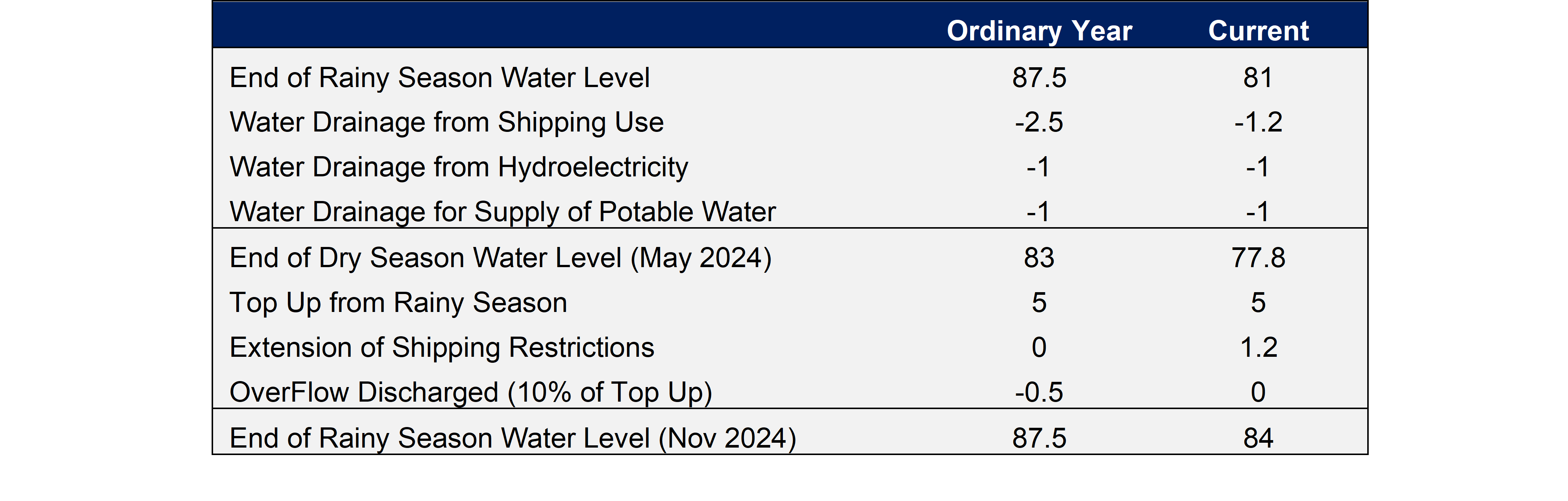
If the Lake Gatun water level is 84 feet above sea level by the end of the next rainy season, then the disruptions to the Canal are likely to last well into 2025.
One of the methods to check forecasts that Richards Heuer presents in his Psychology of Intelligence Analysis is to observe how sensitive a prediction would be to a change in assumptions. The two main assumptions at work here are (1) how much water is drained during this forthcoming dry season and (2) how much the water level is topped up during the rainy season.
On assumption (1), we have assumed that the PCA keeps to its plan in halving the amount of transits through the Canal through to March 2024. As a result, the water drainage from the Gatun Dam from shipping halves as well. Further restrictions are likely to completely cut out the one or two LPG ships likely to transit the Canal throughout the dry season and lift freight rates somewhat higher. It’s possible, if not likely, that the PCA restricts throughout the next rainy season. As a result, we’ve assumed that a further water saving occurs equal to roughly the same saving as during the dry season (i.e. -50% transit restrictions remain in force during the wet season). Combined, even more restrictions than we’ve assumed on Canal transits could take us up to 85 feet above sea level by the end of the 2024 rainy season, which is probably not enough to sustainably return shipping operations back to normal.
On assumption (2), we can’t predict how much rainfall the catchment area will receive during the rainy season. But what we can say is that it would take 60% more rain than the average rainfall to get us back to normal. This kind of result, while not impossible, is exceedingly rare. But the chances work both ways, and it’s not impossible we get another dry rainy season as a result of the lingering impacts of the El-nino.
It’s within this context that we come across StealthGas, an owner of 27 small to medium-sized LPG carriers. The company has a market cap of around $220 million but an estimated book value of around $600 million by the end of the forthcoming dry season. Notably, recent sales of certain vessels have resulted in recognition of gains upon their sale, suggesting that the book value doesn’t currently reflect the market value of this ships. Additionally, the company is set to earn around $65 million in net income this year, before the impact of the Canal restrictions are fully felt.
Our assessment of the risk-reward in this investment is asymmetric but not unimaginably great. If the transit restrictions remain in place into 2025, then we’d estimate that the company will earn at least another $75 million of net income next year. Its book value backing, along with the ability to fix term charters for longer periods of time when freight rates are high and the recent decision to begin a share repurchase program, likely limits the downside of the stock. If the canal restrictions remain in place to create an 18-month cycle, then we could easily see the stock trading at 1.25x book value and 6-8x net earnings, as many tankers and container line stocks did. The risk-reward isn’t a trip to Charlie Munger’s pie store, and so we’re not seeking to take out a very large serving, but it is acceptable for us.
We’re reminded by Soros’ words in The Alchemy of Finance on probability, “Scientists are interested in timeless generalisations and statistical probabilities; participants need to focus on the one particular case in which they are participating. Probabilities and generalisations can be useful, but they are misleading if they are based on the viewpoint of the outside observer.” Given the observable nature of the output we’re interested in, we can continue to monitor the situation, and compare how events unfold relative to our expectations.
No posts
Comments
Nothing yet. Say the first thing.
Sign in to join the conversation.