
The Yemeni Houthis, backed by Iran, declared war on Israel on or around the 1st of November. So far, the Houthis have been one of the only militant groups to formally declare war against Israel after the ground invasion of Gaza. Their goal is to support Hamas and the Islamic cause more broadly (the Quran, for example, places a duty on Islamic states to support a fellow Islamic state whose territory has been invaded) by trying to encourage Israel to stop their invasion of Gaza.
Initially, the Houthis tried to achieve their goal by firing long-range drones and missiles at Israel from Yemen. Quickly enough, they discovered that the long distance with which these projectiles had to travel meant that they were easily intercepted either by Israel’s Iron Dome defence system or by US vessels. So the Houthis changed tack.
Iran backs the Houthis in the ongoing civil war ravaging Yemen. This backing includes financial help as well as the supply of weapons. Iran, for many years now, has also been threatening crude oil tankers in the Strait of Hormuz. From what we learnt, on a near daily frequency, Iran tries to board or damage oil tankers near their coastline through drone attacks or via small, high-speed vessels. Is it any wonder that the Houthis have started to do the same in the Red Sea?
So far, the Houthis have boarded a vessel by landing a helicopter on it, hijacked another vessel and damaged around 10 commercial vessels transiting through the Red Sea via missiles or drones. Their attacks have stepped up in frequency and size with time. It’s very likely the Houthis sought Iran’s blessing to carry out the strikes, as well as a promised supply of weapons to continue them.
The Houthis and Iranians have a significant vested interest in causing disruption to global trade. In the Yom Kippur War in 1973, the Saudis embargoed the supply of oil to the West in an attempt to stop the support and supply of weapons to Israel. While it wasn’t determinative in the end, the Saudis did all they could to help their Arab neighbours. In a similar way, the attack on commercial vessels in the Red Sea is one way the Houthis can try to disincentivise further Israeli aggression in Gaza. The Houthis are incentivised to try and force the Western consumer to pay more at the pump or for their goods due to supply chain disruptions. A disgruntled Western consumer is incentivised to complain against their government’s foreign policy. Instead of an oil embargo, the Houthis are attempting to effect a Red Sea shipping embargo.
The prevailing view of market participants since the start of the strikes was to ignore them because Western firepower would sort the Houthis out. Being able to place more destroyers in the Red Sea would discourage and prevent further attacks. But after further due diligence, including speaking with an expert on the matter, we’re not so sure this will be the case.
The expert we spoke to has served in the Australian Army for decades. As part of his duty, he completed multiple tours of Afghanistan and the Middle East. After he’d climbed the officer ranks of the Army, one of his remits when he was based in the Al-Minhad Airbase in the UAE was Australia’s participation in the International Maritime Security Construct (IMSC).
The IMSC is a group of like-minded countries that provide military vessels or other support to one another to protect commercial vessels transiting through the Middle East. Current members include Albania, Bahrain, Estonia, Jordan, Latvia, Lithuania, Romania, Saudi Arabia, Seychelles, the UAE, the UK and the US. Australia, from time to time, has played a supporting role. From what we’ve been told, the IMSC currently has around 4-5 naval vessels that have strike power with the US providing most of them. The IMSC operates to prevent attacks at both chokepoints in the Arabian Peninsula:
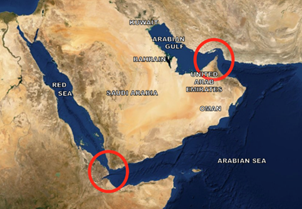
From the research we’ve gathered, even if the US and UK can gather more naval assets to defend both corridors, it won’t necessarily stop the Houthis from effectively attacking commercial vessels. There are multiple reasons why this is the case:
The expanse of water around the Yemeni coastline is too grand. The expanse of water is much larger than it appears on the map, and it’s not possible to see from one side of land to the other. It would be practically impossible to defend the entire stretch of sea (described to us as like playing whack a mole – you can’t be everywhere all at once).
The small boat traffic in the Red Sea is too prolific for there to be airtight security of all vessels.
The sheer number of vessels transiting the Suez Canal is too large for protection of each ship. In peak periods, up to 110 vessels transit the Suez Canal each day.
The situation in the Red Sea has been compared to Israel trying to defend against all the rocket attacks from Hamas and Hezbollah. It’s impossible to be airtight and some missiles will, inevitably, slip through the cracks.
The politics aren’t simple either. Egypt doesn’t want to be seen as the enabler of the West’s support of Israel’s invasion of Gaza. It’d be a bad look on the Egyptian government if its citizens discovered that they allowed US warships to transit through the Suez Canal. The US also likely wants to ensure that relations with Egypt, one of its key allies in the area, doesn’t become strained.
It’s unlikely the US or any other nations with naval assets in the region want a ground war in Yemen. Saudi Arabia explicitly cautioned the US not to fire back at the Houthis, and likely warned of potential consequences if the West did. There are many reasons for the West to refrain from escalating the situation:
The US has shown that it doesn’t want to risk further widening the conflict. If the US strikes the Houthis, it would amount to a declaration of war. The unintended consequences of such an action are unpredictable. It may, for instance, cause Saudi Arabia to finally let Houthi soldiers through their territory to join the war in Gaza, or it may cause Hezbollah to take a more active role in the war.
The US electorate and other developed nations don’t have the stomach for another ground war in the Middle East.
At the moment, the Houthis are only targeting commercial vessels. Firing missiles at the Houthis, either to take out its leadership or to destroy their rocket-launching capabilities, would result in the West’s naval vessels becoming sitting ducks. Without ground forces, it will be hard to project power through naval assets alone. It’s extremely difficult to take out mobile rocket sites, as the Israelis have learnt. As the expert we spoke to explained, in order to effectively take out the rocket-launching infrastructure, you need to know where the infrastructure actually is. There’s also no point in trying to strike the Houthi leadership as deterrence, because it’s very hard to track them down. If it were easy, the Israelis would’ve already killed Hamas’ top leadership.
It's for these reasons that the US and UK are struggling to gather a coalition of willing partners to provide naval assets to the region. A few weeks ago, after the first missiles the Houthis launched hit commercial vessels, the US said that it was gathering a group of 30-odd nations together to defend commercial interests in the region. Weeks have passed, and so far, no extra navy assets have moved into the region. Even Australia, one of the US’ closest military partners and signatory to AUKUS, declined the request.
There are many reasons for the reluctance. For a start, the US navy is becoming more and more stretched with geopolitical interests in the South China Sea and the Red Sea. Now more recently the US needs to also factor in a potential sea and land-based war between Venezuela and Guyana. Secondly, as our expert explained to us, given the wide expanse of ocean, these naval vessels which take lots of money and years to build become sitting ducks. The third reason is because if a naval vessel of a participating country gets hit, they will be forced to strike back at the Houthis. This could drag the country into a foreign war it doesn’t want.
Unlike other market participants, we don’t think this situation can be resolved easily. And even if more naval assets were gathered together in the Red Sea, the reasons we’ve presented explain why it will be hard to provide effective security regardless.
There’s a simple solution or path of least resistance to solve this problem. That path is to let commercial ships sail around the Cape of Good Hope rather than through the Suez Canal. The cost associated with taking the alternative path for Western societies as a whole is unlikely to be that great. One consequence of this path would be that no extra navy assets would need to defend the Red Sea, and the risk of a broader war would be avoided.
As at the time of writing, the seven largest container lines have stopped moving ships through the Suez Canal. We believe it’s likely that others will follow suit as the Houthis continue to fire rockets indiscriminately. At the moment, with the oversupply following the Covid Splurge, these container shipping lines have an incentive to go the long way around. On Friday the 15th, a whole swathe of container ships u-turned on either side of the Suez Canal. If the cartel all goes the long way around, using the danger in the Red Sea as the reason, then they’ll all end up better off.
Restrictions on transit through the Suez Canal is likely to have two outsized impacts on the shipping industry. The first is on the container shipping segment of the industry, which moves around 30% of its total global fleet through the Suez Canal. Such a large throughput is because Asia exports, mainly, to the major developed world blocs of Europe and the US. It takes around 30 days for a container ship to carry its goods from Shanghai to Rotterdam via the Suez Canal. It takes around 43 days for a container ship to go around the Cape of Good Hope. If 30% of the world’s container fleet is taking the longer journey, then it would effectively result in a 15% reduction in the supply of container ships. To put this into context, we believe the freight rate boom during the Covid Splurge was due to a 20% increase in demand.
The second impact is on the oil tanker segment, with around 9 million barrels per day (or about 9% of total daily global consumption) moving through the Suez Canal (either via ship or the pipeline next to the Canal because the largest crude oil carriers can’t fit through). We estimate that around 70 million barrels of oil are transported by sea each day. In effect, around 13 percent of all seaborne oil movements will be disrupted if all these tankers were diverted. Nearly all of these barrels are from the Middle East and destined for Europe. If a tanker went the long way around, it would more than double the distance and time of the journey to Rotterdam. As a result, we’d likely see a 13% increase in demand for tankers if all of them were forced to go the long way around.
It's more likely, however, that container ships will go the long way around than tankers. The reasons are because the cost to build a container ship is far higher, and so insurance costs will rise significantly relative to the extra fuel cost and time cost associated with rounding the Cape of Good Hope. Additionally, the Houthis may not attack tankers as much since many are owned by other Islamic nations.
Either way, it’s a unique situation. Not even in the Ukraine War did either side attack commercial ships transiting the Black Sea in any meaningful scale.
If rocket attacks continued, then the shipping industry would be in an unprecedented situation. From the records we can find, we’ve never had both the Panama and Suez Canals materially impaired at the same time. Needless to say, both canals reduce the transit times of LPG, tankers, dry bulkers and container ships in a significant way. It’s why they were built in the first place.
As we discussed in our previous note, we don’t expect the Panama Canal restrictions to end anytime soon. We believe it’s also unlikely that the West will be able to prevent effective Houthi attacks on ships transiting the Red Sea for as long as the Israeli war against Hamas continues.
There are risks involved in predicting meaningful disruption at both canals for an extended period of time. For one, as the situation gets more dire, the more pressure there will be on the US and UK to act. But even if they’re able to gather some more destroyers, it’d take too long to escort ships individually through the Suez Canal and be too difficult to provide airtight security for the entire Red Sea. For two, there’s a future state of the world where the US may be able to effectively dissuade Iran from supporting the Houthi attacks. For three, we’re open-minded that our expert’s judgment might not be perfectly correct. But we’re mindful of how going the long way around is in the best interests of the shipping lines, creating a new paradigm of covert co-operation. We’re cognisant of the risks we’ve mentioned but we believe we can express our view through certain stocks and instruments where the rewards on potential offer far outweigh the risk of misjudgement. We believe one example of the highly skewed risk-reward nature of some individual stocks would be best characterised by ZIM Integrated Shipping. We continue to monitor the situation.
No posts
Comments
Nothing yet. Say the first thing.
Sign in to join the conversation.