
Graphite is a crystalline form of the element carbon. It consists of stacked layers of graphene. Natural graphite is formed by high temperatures within the earth’s crust, which pressures carbon atoms to rearrange themselves into tight hexagonal sheets.
Graphite can also be produced synthetically. Carbon-rich materials such as petroleum coke are heated to very high temperatures (2,500 to 3,000 degrees Celsius), causing the hexagonal rearrangement of carbon atoms.
In terms of natural graphite, the material tends to be categorised by the size of its flakes. Coarse, or larger, flake graphite is rarer, and finer mesh (size) graphite is more common but also more widely used. Fine flake graphite is increasingly being used as the anode material in lithium-ion batteries. Within these batteries, electrons flow from the lithium cathode to the graphite anode due to the laws of chemical attraction. It’s this flow of electrons that powers electric vehicles (EVs).
Already, according to Benchmark Mineral Intelligence (BMI), around 30% of global graphite supply is used to produce EV batteries. BMI’s forecast is for this to grow to around 45% within the next 6 years.
Both natural fine flake graphite and synthetic graphite are used to create anodes. But the raw material must be heavily processed before it can be used in a battery anode. The raw graphite must needs to be turned into uncoated spherical graphite. The graphite must first be micronized (made one-sixth the width of a human hair), rounded (required so that the spheres can be spread thinly and uniformly) and purified (from 94% to 99.95% purity through hydrofluoric and sulphuric acid) to produce uncoated spherical graphite.
One of the reasons China is dominant in the production of batteries (c.70% market share) is because it can complete this wet chemical purification process for one-third of the cost compared to the West. We surmise that this advantage largely comes from scale efficiencies, a lower cost of energy and cheaper raw materials.
After purification, the spherical graphite is coated. This involves coating the spheres with a thin layer of pitch or asphalt and baked at over 1,200 degrees Celsius. The coating process protects the sphere from exfoliation and degradation when the battery is charged and discharged. It also makes the battery last longer because it inhibits the ongoing reaction of the electrolyte with the active graphite inside the sphere itself.
So, the Chinese produce the uncoated high-purity spherical graphite (90% global market share), and then hand it over to the Japanese and South Korean conglomerates to do the coating and heat treatment. Thereafter, the Chinese complete the final assembly of the battery, using the coated spherical graphite as the anode material.
The story of graphite is largely a political one. As we’ve written about before, the US wants to preserve its global hegemony. But, fuelled by its decades of growth, China is now challenging the old-world order.
As far as this note is concerned, the US has two ambitions. It wants to restrict the transfer of cutting-edge technology to the Chinese and it wants to build its own EV supply chain. Along with the EU, the US wants to make electric vehicles and their components domestically rather than importing them from China. The problem is that China dominates the production of many critical rare earth minerals that go into an EV battery, as well as their refining.
The US passed the Inflation Reduction Act with the aim of encouraging the domestic production of EVs. It provides subsidies for building a domestic manufacturing plant. The law also provides up to $7,500 in tax credits for consumers who buy an EV with a certain percentage of battery parts sourced domestically, or from friendly nations.
Currently, the Treasury’s requirements are not stringent, and most EV models are eligible for the entire tax credit. But with the aim of weaning EV production off Chinese materials, the requirements step up over time. By the end of 2024, in order to claim half of the total credit, (1) an eligible clean vehicle may not contain any battery components that are manufactured by a foreign entity of concern, and (2) an eligible clean vehicle must not contain any critical minerals that were extracted, processed or recycled by a foreign entity of concern. China is a foreign entity of concern. It's clear that the US administration’s intention is to ensure that no Chinese graphite is used within American-made EVs.
But to understand the change in the graphite market, it helps to understand the changes in the semiconductor market. Regarding its other goal of restricting China’s technological progress, the US began banning high-tech semiconductor exports to China in October 2022. Cutting-edge semiconductor chips that had a bidirectional transfer rate of 600 gigabytes per second or higher and aggregate TOPS x bit length of 4,800 (measure of processing speed) or more were banned.
In response, China imposed licensing requirements for exports of gallium and germanium, citing “national security” concerns. Gallium and germanium are gases used within the semiconductor manufacturing process. China has dominant market shares in the production of both.
Recognising that the American export restrictions lacked teeth, though, the Chinese government granted licences to domestic exporters of these gases shortly after imposing the requirement. The Chinese restrictions lacked teeth because NVIDIA tweaked their latest generation H100 GPUs by lowering the bidirectional bandwidth and processing speeds to ensure they fell below the limits. Everything else about the chip was kept the same. While each individual unit was slower than the unmodified version, the Chinese could simply buy a greater number of modified chips and connect them together to achieve the desired processing power.
Given the export restrictions weren’t achieving their intended goal, on the 17th of October 2023 the Biden administration closed the loophole. The interconnect bandwidth restriction was set to 0. The following diagram illustrates the change:
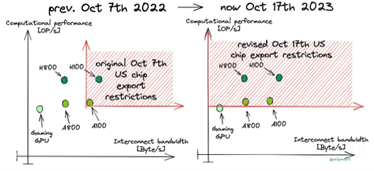
As Dylan Patel of SemiAnalysis writes, not only did this restrict exports of the H800, it also restricted exports of NVIDIA’s A800, Intel’s Gaudi2 CPU, Intel’s Gaudi3 CPU, AMD’s MI250X GPU, and AMD’s MI300 GPU. In addition, the US government also added in another performance density restriction to ensure that multiple chips connected together couldn’t create high levels of bandwidth.
Taken together, this new regulation is incredibly strict. Unlike before, there’s no way NVIDIA can customise a chip to skirt around the rules. To give you an idea, the last GPU that could be exported to China under these rules would be NVIDIA’s V100 which was produced 6 years ago. In the tech industry, 6 years is a long time.
Whereas the old restrictions lacked bite, the new restrictions have plenty. In response, China imposed a licensing requirement for the export of high-purity spherical graphite and natural graphite.
We surmise that the previous Chinese gallium and germanium export restriction lacked teeth because the US semiconductor restrictions also lacked teeth. But now that the new US restrictions have plenty of bite, we judge that the chances China will respond proportionately are very high.
It’s becoming clear now that neither the Chinese nor the Americans want Chinese graphite in American-made batteries. The Americans don’t want Chinese graphite in their EV batteries because they don’t want to be reliant on China for their critical minerals, and because they want to build their own EV supply chain. The Chinese don’t want Chinese graphite in American EV batteries because they want to stop the Americans building out their own EV supply chain dead in its tracks.
Neither does it seem like the Europeans want to lose their market share in car manufacturing. Currently, the EU is conducting a review of Chinese EV and battery exports.
The decision to restrict these particular exports of graphite serves the Chinese in a couple of ways. Given they dominate the supply of global natural (70%) and synthetic graphite (>90%), an export restriction will lower the price of Chinese batteries. Highly-purified, coated spherical graphite makes up about one-third of the weight and one-quarter of the cost of an EV battery. With a significant cost advantage, China can outcompete the West in battery making (like they did in solar panel manufacturing).
Secondly, in the same way that the West is pushing Chinese semiconductor technology back many years, China is setting the West’s ambition to build cost-competitive EVs back several years. This is because China is responsible for refining 90% of the world’s graphite, and mining 70% of the world’s natural graphite. The US, EU, Japan and South Korea, between themselves, import around 30% of the world’s total natural and synthetic graphite supply, much of it from China. It takes around 3.5 years to go from final investment decision to first production in a major graphite mine. It takes around 2.5 years to build a new synthetic graphite facility. It takes even longer to ramp up volumes. It takes another year or two to test the product. If cut off from Chinese battery supply (70% of global production), it would take the West many years and a lot more graphite supply to build the batteries needed to satisfy domestic EV demand.
The race for global supremacy is producing palpable change in the world. In the market for graphite, a political equilibrium is evolving towards ensuring that there’s no Chinese graphite in Western-made EVs. Neither America nor China want Chinese graphite in American EV batteries. The increasingly likely consequence is a bifurcated graphite market.
The West has work to do. There aren’t many graphite mines located in nations friendly to the West, hence their currently large imports of natural and synthetic graphite. While there are quite a few mines near final investment decision, they lack funding and will take at least three years, but most likely longer, to reach meaningful amounts of production. The new political equilibrium we’ve reached may cause the price of non-Chinese graphite to rise significantly due to the ensuing shortage. If the West wants to build all of its EVs (c.40% of global supply) with their own materials and China wants to respond to the US semiconductor restrictions with a proportional amount of bite, then it’s likely the West won’t have enough non-Chinese graphite for years to come.
No posts
Comments
Nothing yet. Say the first thing.
Sign in to join the conversation.