
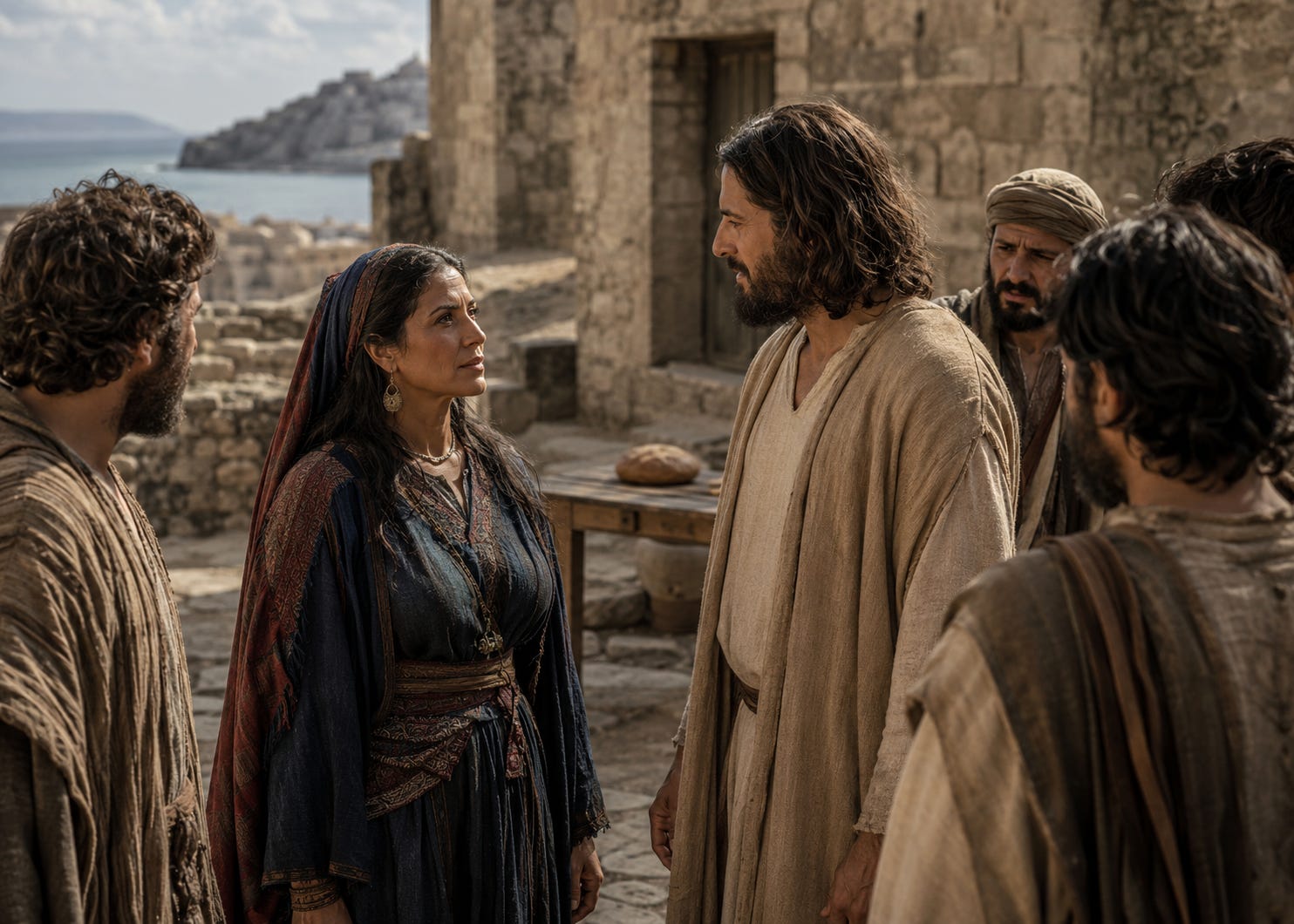
The disciples saw a nuisance woman wailing at the edge of their camp.
Jesus saw great faith standing right in front of them.
This week, Pope Leo XIV said something I want to echo as clearly as I can: the Sunday assembly “cannot be substituted by a solely virtual presence.”
He is right.
I love you all, and serving you through Message From the Margins is one of the great honors of my life. Every week, you trust me with your faith and your questions and your wounds and your hope. Together, we can enter the mysteries of Scripture. We can pray. We can learn. We can wrestle with difficult questions. We can recover treasures of the Christian tradition that someone may have hidden beneath fear, shame, or bad theology.
I can serve as an adjunct to your spiritual life. I can accompany you as you listen for the voice of Christ in his Word.
But I cannot place the Bread of Life into your hands.
A screen cannot gather the Body of Christ into one room. It cannot replace the sound of other people praying beside you, the hand extended in peace, the child making noise three pews away, the person who notices you have not been there lately, or the grace of receiving Christ in the Eucharist.
If you have access to a safe, loving, faithful parish, please consider going to Mass. Go even if the music is not your taste. Go even if the homily is less interesting than this one, which, of course, is unlikely. Go because Sunday Mass gives us what no newsletter, podcast, livestream, or even the most beautifully written reflection can provide: Christ gathering his people around the table and feeding them with his own life.
Some of you cannot go. You are homebound or ill or caring for someone who cannot be left alone. Some of you work on Sundays. Some live far from a welcoming parish or live in communities where politics are too often confused with the Gospel. Some have been wounded so badly by a church that walking through the doors still feels impossible. I will never use the Eucharist to shame you for circumstances God understands far better than I do.
Until you can return, or until we can find a community where you will be safe and loved, let this ministry serve you. Let us pray together and open the Scriptures together. If you would like help finding a parish near you, write to me. I will gladly help.
But let us remain honest about what this can be and what it cannot be. I can bring you into the mysteries of the Word. I cannot give you the Bread of Life.
And the Christian life needs both.
Your Brother in Christ,

Lectionary: 118
Isaiah 56:1, 6–7
Thus says the LORD:
Observe what is right, do what is just;
for my salvation is about to come,
my justice, about to be revealed.
The foreigners who join themselves to the LORD,
ministering to him,
loving the name of the LORD,
and becoming his servants,
all who keep the sabbath free from profanation
and hold to my covenant,
them I will bring to my holy mountain
and make joyful in my house of prayer;
their burnt offerings and sacrifices
will be acceptable on my altar,
for my house shall be called
a house of prayer for all peoples.
Psalm 67:2–3, 5, 6, 8
R. O God, let all the nations praise you!
May God have pity on us and bless us;
may he let his face shine upon us.
So may your way be known upon earth;
among all nations, your salvation.
R. O God, let all the nations praise you!
May the nations be glad and exult
because you rule the peoples in equity;
the nations on the earth you guide.
R. O God, let all the nations praise you!
May the peoples praise you, O God;
may all the peoples praise you!
May God bless us,
and may all the ends of the earth fear him!
R. O God, let all the nations praise you!
Romans 11:13–15, 29–32
Brothers and sisters:
I am speaking to you Gentiles.
Inasmuch as I am the apostle to the Gentiles,
I glory in my ministry in order to make my race jealous
and thus save some of them.
For if their rejection is the reconciliation of the world,
what will their acceptance be but life from the dead?
For the gifts and the call of God are irrevocable.
Just as you once disobeyed God
but have now received mercy because of their disobedience,
so they have now disobeyed in order that,
by virtue of the mercy shown to you,
they too may now receive mercy.
For God delivered all to disobedience,
that he might have mercy upon all.
Cf. Matthew 4:23
R. Alleluia, alleluia.
Jesus proclaimed the Gospel of the kingdom
and cured every disease among the people.
R. Alleluia, alleluia.
Matthew 15:21–28
At that time, Jesus withdrew to the region of Tyre and Sidon.
And behold, a Canaanite woman of that district came and called out,
“Have pity on me, Lord, Son of David!
My daughter is tormented by a demon.”
But Jesus did not say a word in answer to her.
Jesus’ disciples came and asked him,
“Send her away, for she keeps calling out after us.”
He said in reply,
“I was sent only to the lost sheep of the house of Israel.”
But the woman came and did Jesus homage, saying, “Lord, help me.”
He said in reply,
“It is not right to take the food of the children
and throw it to the dogs.”
She said, “Please, Lord, for even the dogs eat the scraps
that fall from the table of their masters.”
Then Jesus said to her in reply,
“O woman, great is your faith!
Let it be done for you as you wish.”
And the woman’s daughter was healed from that hour.
A few months ago, I had the enormous privilege of attending the Outreach Conference at Georgetown University in Washington, D.C. It is organized by the wonderful people at Outreach, a ministry of America Media and the Jesuits, and it brings together LGBTQ Catholics, their families, allies, supportive clergy, theologians, pastoral ministers, and a fascinating assortment of people who love the Church enough to keep wrestling with her.
We talked about Scripture, theology, family life, parish ministry, mental health, and the experience of LGBTQ people in the Church. We prayed together. We worshiped together. We celebrated the Eucharist together. I met several of you there, which was one of the great joys of the weekend.
The high point came when the Cardinal Archbishop of Washington, His Eminence Robert McElroy, joined us to celebrate Mass and told the people gathered in that room that it was his privilege to be with us.
His privilege.
I watched those words move through the room. Some people smiled. Some cried. Some sat a little straighter. Some jaws were dropped open. When you have spent years being spoken about as a problem to be managed, hearing a prince of the Church say that your company is a privilege lands differently. It did not solve everything. One sentence cannot repair every injury the Church has caused. But it told hundreds of people, in the clearest possible language: I see you. I am glad you are here. Your presence and witness is a gift to the Church.
Now, my own arrival at this holy gathering was rather less dignified.
I was running late, predictably. At this stage of my life, “running late” is less an occasional mishap and more a personal liturgical season. I was hurrying toward this magnificent stone building at Georgetown when I noticed a group gathered outside. They were holding signs and singing the Salve Regina.
Well, I heard the Salve Regina, and naturally I stopped and joined in. You do not just rush past people singing to Our Blessed Mother. I may be late, but I am not an animal.
So there I was, happily singing along, when I began to look at the signs.
It took my brain a few seconds to catch up with my mouth. This was not a welcoming committee. These people had gathered to protest the conference I was attending. I had accidentally joined my own protest.
Honestly, this is the sort of thing that could only happen to me.
I detached myself from the group, which is difficult to do gracefully when you have already committed yourself to the second verse, and continued inside. I will leave you to draw whatever conclusions you wish from the fact that the LGBTQ Catholics and the people protesting them are difficult to tell apart.
But once the comedy wore off, I kept thinking about those signs. These people had taken time out of their day, traveled to Georgetown, found parking in Washington, D.C., which itself requires heroic levels of commitment, and stood outside to protest a group of people gathering to pray in the name of Jesus the Christ.
Why?
I am sure they could give us a thousand reasons, some more contrived than others. Beneath all of them was a judgment they believed they had the authority to make: These people do not belong. They should not be gathering in Christ’s name. There is no place for them at his table.
And I assure you, they were and are wrong.
They were wrong for the same reason the disciples are wrong in today’s Gospel.
Jesus has withdrawn to the region of Tyre and Sidon. He appears to be looking for some distance from the crowds and the constant demands of ministry. I understand this. There are days when even Jesus seems to want to turn off His phone and go somewhere no one knows his forwarding address.
Unfortunately for him, a rather persistent Canaanite woman finds him.
Matthew does not merely call her a foreigner. He reaches back into Israel’s ancient vocabulary and calls her a Canaanite. That is a loaded word. She comes from the people on the wrong side of Israel’s oldest boundaries. She is a woman, a Gentile, a religious outsider, and a descendant of the people Israel had learned to regard with suspicion. She does not meet anyone’s job description for a proper disciple.
She also absolutely refuses to go away.
“Have pity on me, Lord, Son of David! My daughter is tormented by a demon.”
We don’t want any!
“Lord, Son of David!!!!!!”
Sorry, Nobody’s Home!
But she keeps calling out.
Notice that she knows who Jesus is. She calls him “Lord” and “Son of David.” The disciples, who have front-row seats for everything Jesus says and does, routinely misunderstand him. This woman enters from outside the covenant and sees him with astonishing clarity.
Jesus says nothing.
She continues calling out. The disciples become annoyed and ask Jesus to send her away. Their concern is not her daughter. Their concern is the noise. She has pain they do not want to hear, a need they do not want to address, and a voice that refuses to become less of a nuisance for their comfort.
There are people who will tolerate your suffering provided you suffer discreetly. This woman has declined to cooperate.
When Jesus finally speaks, the exchange does not become easier. “I was sent only to the lost sheep of the house of Israel.” She comes closer, does him homage, and reduces her entire prayer to three words: “Lord, help me.”
His response is one of the hardest sayings in the Gospels: “It is not right to take the food of the children and throw it to the dogs.”
There it is. I wish I could soften it for you. The best I can do is tell you that the Greek word Matthew uses, Kynaria, is the diminutive, so “little dogs,” possibly even pet dogs or puppies.
We all love puppies.
Unfortunately, that does not make the sentence all that much more comfortable.
I wish Matthew had given us stage directions: Jesus smiles knowingly at the woman. The disciples look increasingly uncomfortable. He does not. The Gospels almost never tell us Jesus’ tone, and here that absence is maddening.
Christians have argued for centuries about precisely what Jesus is doing. Is he testing her faith? Is he drawing out the disciples’ prejudice and speaking it aloud so they can hear how ugly it sounds? Is Matthew showing us the mission to Israel reaching the boundary across which it will soon expand to the nations? Faithful people have reached different conclusions.
I’m pretty sure it’s actually the last option, but your guess is good as mine.
Anywho, I cannot tell you which inflection Jesus used. I can tell you what happens next.
The woman will not allow the people around Jesus to decide how much mercy Jesus possesses.
“Please, Lord, for even the dogs eat the scraps that fall from the table of their masters.”
What an answer.
She does not storm off. She does not beg the disciples to approve of her. She does not waste her breath producing a résumé of spiritual qualifications. She takes the image placed before her, turns it in her hands, and finds an opening large enough for grace.
Even the scraps are enough, Lord, because I know the bounty that is on your table. I know who you are. I know there is more mercy in you than these men standing around you have imagined.
That is faith.
Faith is not polite agreement with the people who already have seats. Sometimes faith is the holy audacity to keep calling out from the fringe when religious people wish you would disappear. Sometimes faith is trusting the abundance of Christ more than the narrowness of some of His followers.
And Jesus answers her: “O woman, great is your faith! Let it be done for you as you wish.” Her daughter is healed from that hour.
Do you see what has happened? The person everyone expected to be the theological problem has become the model of faith. The disciples want her removed. Jesus holds her up before them and says, in effect, You should be paying attention to her.
Matthew’s Gospel repeatedly describes the disciples as having little faith. This Canaanite woman, this outsider, this interruption, is told that her faith is great.
The first reading has already prepared us for her. Isaiah sees foreigners joining themselves to the Lord, ministering to God and loving God’s name. God promises, “Them I will bring to my holy mountain and make joyful in my house of prayer; for my house shall be called a house of prayer for all peoples.”
All peoples.
Then the psalm makes the congregation sing it several times in case anyone in the back was not listening: “O God, let all the nations praise you!”
All nations.
Paul speaks directly to Gentiles, people who were once the outsiders in Israel’s story same as the Canaanite woman, and declares that “the gifts and the call of God are irrevocable.” He concludes that God has allowed everyone to know disobedience so that God “might have mercy upon all.”
All. The readings are not particularly subtle today.
Pope Francis put it memorably at World Youth Day: “Todos, todos, todos.” Everyone, everyone, everyone.
Now, everyone does not mean discipleship costs nothing. It does not mean the Church has no teaching, sin is imaginary, conversion is unnecessary, or every decision we make is automatically blessed. All of us are called to conversion. All of us have parts of our lives that still resist the Gospel. All of us arrive at this table needing mercy.
The trouble begins when one group of sinners appoints itself to the seating committee and decides that another group of sinners must remain outside until they become less objectionable.
Paul writes in Galatians, “There is neither Jew nor Gentile, neither slave nor free, nor is there male and female, for you are all one in Christ Jesus.” Our histories and differences do not evaporate in Christ. They cease to be a ranking system for human worth and Christian belonging.
We love ranking systems. We draw circles around ourselves and drop others into labeled boxes: acceptable and suspicious, faithful and troublesome, respectable and embarrassing, us and them. We behave as though the kingdom of God were a lifeboat separated by class.
God is under no obligation to honor the seating chart we made for his banquet.
Here is the part the Church forgets most often: when the people we excluded are welcomed, they do not merely receive something from us. They bring gifts without which the Church is poorer.
The Body of Christ needs all its members. Inclusion reaches far beyond politeness and diversity offers far more than a lovely photograph. No single group sees the whole of Christ. Each of us carries some glimpse of him that the rest of the Church cannot afford to lose.
We need the faith of the Canaanite woman and the witness of LGBTQ Catholics who kept loving the Church after the Church made loving her painful, and the parents who stood beside their children when their parishes would not, and the bishops, priests and religious who understand that accompaniment is not weakness and listening is not surrender.
The Church needs Democrats and Republicans and independents and people who have given up trying to explain what they are. It needs cradle Catholics and converts and the people returning after twenty years away and the people sitting in the last pew who have not yet decided if they’re staying or not. It needs feminists and traditionalists and questioners and mystics and skeptics and theologians and people who could not define eschatology if Saint Paul offered them three guesses.
It needs scientists and artists and teachers and nurses and mechanics and servers and sanitation workers and business owners and laborers and politicians, God help us. It needs immigrants and refugees and people whose families have lived on the same patch of land for generations. It needs people of every race and culture and language because Pentecost did not make everyone sound the same. Pentecost made it possible for everyone to hear the mighty works of God in their own tongue.
The Church needs addicts and people in recovery and people who relapsed last Tuesday and are trying again today. It needs people without homes and people coming home from prison and people carrying convictions that follow them long after their sentences have ended. It needs the wealthy and the working poor and the people one medical bill away from disaster and the people who have learned to smile when the collection basket passes because there is nothing in their pocket to give.
It needs the elderly and children and screeching babies and teenagers asking the questions adults learned to avoid. It needs people with disabilities and people living with depression and bipolar disorder and schizophrenia and anxiety and minds that work in ways the rest of us have been too impatient to understand. It needs the surviving families of those who died by suicide, people carrying grief and anger and questions no tidy theology can answer.
It needs people in pressed suits and people in work boots and people covered in tattoos. It needs the married and the single and the divorced and the widowed and the celibate and the lonely and the person who does not know which of those words can hold the life they are living.
It needs the people who know every response at Mass and the people who always come in one beat late and people with the missalette upside down. It needs the ones who sing beautifully and the ones who make a joyful noise with a generous interpretation of both joyful and noise. It needs the certain and the doubtful and the wounded and the recovering and the angry and the hopeful and the exhausted and the ones hanging onto faith by one stubborn thread.
And the Church needs you. Exactly as you are. It needs your history and your wounds and your thoughts and your questions. It needs your passions and your frailties. It needs your presence.
The Church does not become holy by sanding people down until everyone looks respectable. The Body of Christ becomes visible when all its members are allowed to be present, including you.
Especially you.
And people from the margins often see Christ with a clarity that those comfortably seated near him have lost. The Canaanite woman sees what the disciples cannot: there is more mercy in Jesus than his followers have made room for. The people at the boundary keep teaching the Church the size of the kingdom.
At Georgetown, I heard no heresy. I witnessed no plot against Jesus or his Church. I met people who, after centuries of mistreatment, still wanted to belong to the Church they love and remain close to the Christ they adore.
That filled me with wonder as they screamed “Lord, Son of David!”
After everything some of them had endured from the Church, they still came to Mass. They still sang. They still prayed. They still reached for the Eucharist. They still believed there was bread enough for them on Christ’s table.
Outside, people sang to Mary while holding signs against her children.
Inside, Mary’s children gathered around her Son’s table.
And when Cardinal McElroy stood before that congregation and called it his privilege to be among them, I thought about the disciples and the Canaanite woman. I thought about how often the people guarding the boundary misunderstand what Christ is doing there. I thought about the extraordinary faith required to keep walking toward the table while someone outside is holding a sign explaining why they think you should leave.
Then the bread was blessed. The cup was raised. The Body of Christ was given to the Body of Christ.
The people whom others had ordered to survive on scraps were gathered for the feast.
“O woman, great is your faith! Let it be done for you as you wish.”
The reign of God is for all. God’s house is a house of prayer for all peoples. God’s mercy is mercy for all. Whenever the Church forgets, Christ meets us again at the boundary, points toward the person we tried to send away, and says, Look again. There is great faith standing right in front of you.
Todos, todos, todos.
Everyone.
Pull up a chair and tell me what this Gospel awakens in you.
Have you ever encountered great faith in someone the Church taught you to overlook?
Have you ever been made to feel that you were permitted only the scraps of Christian belonging?
What history, wound, question, passion, or hard-won faith do you carry that the Church needs from you?
I would especially like to hear from those who kept loving the Church after the Church made loving her difficult. What kept you reaching for Christ? If you were at the Outreach Conference, tell us of your experience!
If someone you love has been told there is no place for them in the Church, please send them this homily. They deserve to hear that Christ still sees their faith and that there is bread enough at his table.
Tomorrow morning, something new begins.
The Message From the Margins podcast premieres with “The Wondrous Story of How the Bible Became the Bible.”
The Bible did not fall from heaven already bound in leather, divided into chapters, and printed in red letters wherever Jesus speaks. Its formation is a remarkable story of faith and memory, argument and discernment, human hands and divine providence.
In our premiere episode, we will follow that story from oral tradition and ancient manuscripts through the long process by which the Church received the collection of books we now call the Bible.
Look for it tomorrow morning. I cannot wait to begin this journey with you.
May the God whose house is a house of prayer for all peoples gather you, sustain you, and remind you that your presence is needed in the Body of Christ.
Lord Jesus Christ,
you heard the woman others wanted to send away
and recognized great faith where your disciples saw only an interruption.
Forgive us for the boundaries we have mistaken for holiness,
for the people we have asked to survive on scraps,
and for the gifts we have refused because we did not recognize the person carrying them.
Give us the persistence of the Canaanite woman,
the humility to learn from those at the boundary,
and the courage to make your Church a house of prayer for all peoples.
Gather the certain and the doubtful,
the wounded and the recovering,
the joyful and the exhausted,
until every member of your Body is present
and every child of God knows there is bread enough at your table.
Amen.
If Message From the Margins helps you encounter Scripture, recover your faith, or believe again that there may be a place for you in the Church, I invite you to become a supporting subscriber. Nearly everything I publish remains open to everyone, without political advertisements, absurd internet advertising, or a salesman following you down the center aisle. Paid subscriptions make that possible and sustain the work behind every homily, essay, podcast, and pastoral resource.
Whether or not you can contribute, I am grateful you are here.
Comments
Nothing yet. Say the first thing.
Sign in to join the conversation.