
Hello friends,
Yesterday we followed St. Maximilian Kolbe into one of the darkest places human beings have created. Today, the Church calendar leads us directly from his death on August 14 to the Assumption of Mary on August 15. The connection between those days is almost too beautiful to miss: one system tried to reduce Kolbe’s body to something disposable, and the next day the Church proclaimed that the human body belongs within God’s promise of eternal life.
Today’s feast gives us room to breathe, wonder, laugh a little at our need to explain everything, and recover a Christian hope much larger than the survival of an invisible soul.
Before we begin, thank you to everyone who has supported Message From the Margins this week through a paid subscription, a gift, a share, a comment, or a prayer. We still have a way to go before this ministry becomes financially stable, but we are closer, and we are building it together.
On Monday, that work enters an exciting new chapter when the Message From the Margins Podcast premieres with “The Wild Story of How the Bible Became the Bible.” Most Christians were never taught how Scripture became Scripture. The Bible did not descend from heaven bound in leather, printed in English, with the words of Jesus helpfully marked in red. Its books emerged across centuries, circulated among different communities, survived arguments over what belonged, and were gradually gathered into the collection we now call the Bible. We will explore who wrote and preserved these texts, why some books were included while others were left out, and how understanding this complicated history can strengthen our faith rather than threaten it.
If you have the financial room to become a supporting subscriber, your contribution helps make programs like the podcast possible while keeping carefully researched pastoral work available to everyone. If subscribing would create hardship, remain here without guilt. Read, pray, comment, and share. You belong here too.
Become a Supporting Member Today
Your Brother in Christ,

The Assumption is strange, beautiful, difficult to explain, and very good news for anyone whose body has ever felt like a burden.
Catholics have a feast for almost everything.
We bless throats, candles, homes, boats, animals, fields, Easter food, and, in some places, beer. Give us enough time and a willing priest, and we will eventually arrive with holy water.
Still, the Assumption of Mary can feel unusual even by Catholic standards.
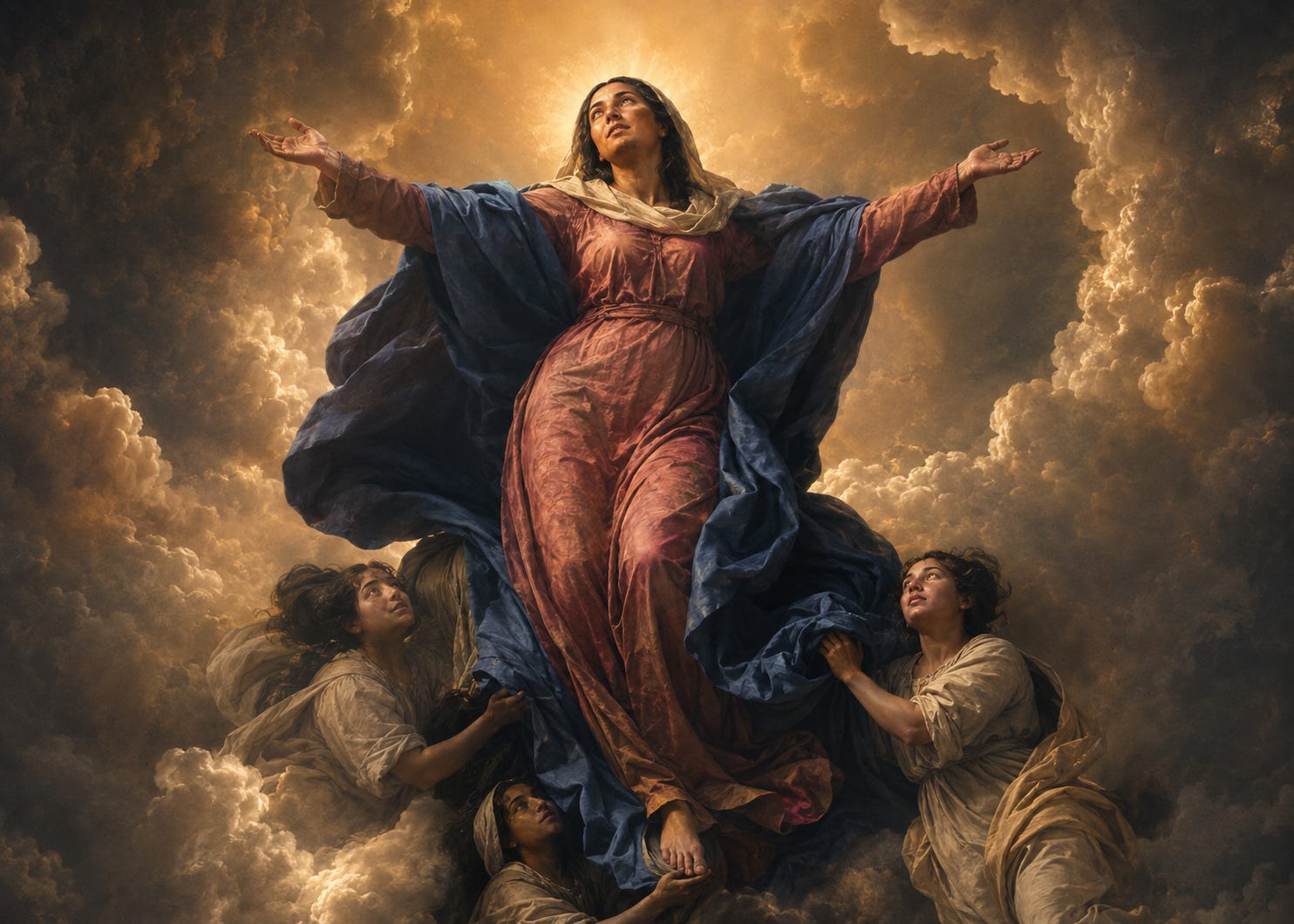
Every August 15, the Church announces that, at the end of her earthly life, Mary was taken body and soul into heavenly glory. There is no biblical scene describing it. We do not know who was present, what anyone saw, or precisely how it happened. The Church does not even require us to believe that Mary died first.
We know what was accomplished. We are rather hazy on the logistics.
For Western Christians, this can be intolerable. We prefer our mysteries with as little mystery as possible. They should include diagrams, definitions, supporting documentation, and perhaps a small informational pamphlet available in the vestibule: Assumption Into Heaven: A Five-Step Guide. We want to know exactly what happened, in what order, whether Mary’s sandals went with her, and how the entire matter was processed at the celestial border.
The Church, to its credit, refuses to invent answers merely because we have run out of patience with mystery.
It gives us something better: a promise.
Mary’s Assumption tells us that God does not abandon the human body. Not Mary’s body. Not the body growing older in your mirror. Not the body lying in a hospital bed. Not the body carrying scars, illness, disability, exhaustion, or shame. Not the bodies our politics and economics would prefer to sort into useful and useless.
God intends to redeem the whole person.
And once you begin to understand that, the Assumption stops feeling like an obscure bit of Marian trivia and starts looking like remarkably good news.
The Church calendar sometimes makes theological connections without explaining them.
Yesterday, August 14, we remembered St. Maximilian Kolbe, the Franciscan priest killed at Auschwitz after taking another prisoner’s place in the starvation bunker.
Kolbe had loved Mary since childhood. He later told his mother that as a boy he had a vision of Mary, and had seen her holding two crowns. One was white, representing purity. The other was red, representing martyrdom. She asked which he would accept.
Kolbe, apparently never one to choose the less demanding spiritual option, accepted both.
Decades later, he received that red crown on the vigil of the Assumption.
On August 14, a regime built upon the power to number, degrade, starve, and discard human bodies killed Maximilian Kolbe. On August 15, the Church proclaims that the body belongs within God’s promise of eternal life.
The contrast is almost too precise to miss.
Auschwitz claimed Kolbe’s body as something it could destroy. The Assumption announces that no human body offered to God is finally lost.
But to understand why, we need to clear up a few things about Mary, sin, death, and what Catholics actually believe happened at the end of her life.
Do not worry. There will not be a quiz… or will there?
The language matters here.
Jesus ascends into heaven. Mary is assumed into heaven.
Jesus acts by his own divine power. God acts upon Mary. She does not become a goddess, discover a hidden supernatural ability, or launch herself bodily into the clouds like a first-century superhero.
Mary remains entirely human. Everything she receives comes through the saving work of Christ.
The Church teaches that, after completing the course of her earthly life, Mary was taken body and soul into heavenly glory. Her bodily glorification, which the rest of us await in the resurrection, has already taken place.
This makes Mary a glimpse of where redeemed humanity is headed. She is not standing at the finish line to make the rest of us feel inadequate. She is there as evidence that Christ intends to bring human beings all the way home.
Nothing genuinely human must be thrown away to enter the life of God.
Here we encounter one of Catholicism’s most persistent vocabulary problems.
The Immaculate Conception does not refer to Jesus being conceived in Mary’s womb. It refers to Mary being conceived in the womb of her mother, St. Anne.
If you have confused those teachings, you are in excellent company. I suspect a substantial portion of the people sitting in Catholic pews on the Feast of the Immaculate Conception are celebrating the wrong conception. God understands. The parish secretary probably does too.
So anyway, the Church teaches that Mary was preserved from original sin from the first instant of her existence. This was not something Mary accomplished through superior moral effort. She did not arrive spiritually precocious and immediately begin outperforming the neighbors.
It was grace.
Mary still needed a Savior. She says so in the Magnificat: “My spirit rejoices in God my Savior” (Luke 1:47, NIV). Christ saved her in a unique way, with the grace of his death and resurrection reaching her preventively.
One person is rescued after falling into a pit. Another is caught just before falling in. Both owe their safety to someone beyond themselves.
St. Paul writes that “the wages of sin is death” (Romans 6:23, NIV). Death and bodily corruption belong to the rupture sin introduced into human life. Since Mary was preserved from original sin and remained free from personal sin, Christians came to believe that corruption should not have the final claim upon the body that carried Christ.
That reasoning is beautiful. It does not settle every question.
Here is the official Catholic answer: we do not know.
Pope Pius XII chose his words carefully when he defined the dogma in 1950. Mary, “having completed the course of her earthly life,” was assumed body and soul into heavenly glory.
Completed how?
The definition does not say.
Many Catholics believe Mary died. Eastern Christians have long celebrated August 15 as the Dormition of the Theotokos, meaning the “falling asleep” of the Mother of God. John Paul II also taught that Mary likely experienced death before her bodily glorification, following the path of her Son.
Her sinlessness would not make that impossible. Jesus was without sin and still freely entered death. Mary may also have passed through it in profound union with him.
Other Christians have believed that Mary moved directly from earthly life into heavenly glory without dying.
The Church allows us to wonder.
This may be frustrating for those of us who would like the Magisterium to operate like an information desk for the afterlife. We have submitted a very specific question and would appreciate a very specific response.
Instead, the Church tells us what we need to know: whatever happened at the end of Mary’s earthly life, death did not keep her.
That may be the wiser answer.
Western Christianity has a remarkable ability to take a mystery, place it beneath bright fluorescent lighting, and make it submit to labratory testing.
Precision has genuine value. It helps us distinguish Mary from Christ, grace from human achievement, and Christian hope from wishful thinking. Good theology protects the mystery from becoming nonsense.
But precision can become the illusion of control. When we force precision beyond what God has revealed simply because uncertainty makes us uncomfortable, we arrive at another kind of nonsense.
We start believing that if we define enough terms, draw enough distinctions, form seemingly logical conclusions, and answer enough questions, God will eventually fit inside our diagram.
Eastern Christianity often carries a healthier comfort with the unfinished sentence. In traditional icons of the Dormition, Mary lies upon a bier surrounded by the apostles. Behind her stands the risen Christ, holding a small figure dressed in white, representing Mary’s soul.
At Bethlehem, Mary held Jesus as a child. At her Dormition, Jesus holds Mary.
That image gives us theology without pretending to provide phone camera footage. It invites prayer before it invites argument.
Of course, Eastern Christians can be every bit as theologically exacting as Western Christians. Anyone who has wandered innocently into a discussion about icons, councils, or the procession of the Holy Spirit can confirm this. The point is not that the East thinks and the West does not, or vice versa.
The East has simply preserved a valuable instinct: we can know something truly without knowing it completely.
We know enough to venerate the event. We do not know enough to explain everything.
Mystery is not a polite church word for gobbledygook. It describes a reality we can genuinely encounter but cannot exhaust. Love is a mystery. Consciousness is a mystery. Grief is a mystery. Every human person you have ever loved remains a mystery, even after decades of shared life and arguments over the thermostat and who ate the other’s leftovers.
Why would we expect the inner workings of eternal life to be easier?
The Assumption tells us that Mary is with God, body and soul. It tells us that Christ’s victory has reached the whole of her humanity. It tells us that her destiny points toward our own resurrection.
We do not know precisely what happened in the final hours of her earthly life. We cannot describe the physics of a glorified body. We have not been given a floor plan of heaven.
Some questions will be answered only in eternal life. Christian faith allows us to say that without embarrassment.
We know enough to hope. The rest can remain with God.
The woman assumed into heavenly glory was not an empress, military leader, wealthy patron, or religious celebrity.
Mary was a Jewish woman from Nazareth. She belonged to an occupied people living under Roman imperial power. She knew pregnancy, labor, displacement, domestic work, fear, grief, and the devastation of watching her child be tortured and killed by the state.
Even the Apostles had their doubts about the situation.
Nathanael said to him, “Can anything good come out of Nazareth?” Philip said to him, “Come and see.” ~ John 1:46
Roman historians had little reason to record her life. Empires notice conquerors, wars, monuments, and men who believe the world depends upon their decisions. Poor Jewish women from Galilee rarely make the official account.
God keeps a different history.
The first human person shown sharing fully in Christ’s risen glory is someone imperial power would have considered almost entirely unimportant.
Mary had already told us this was how God works. In the Magnificat, she sings that God “has brought down rulers from their thrones but has lifted up the humble” and “has filled the hungry with good things but has sent the rich away empty” (Luke 1:52–53, NIV).
Those are not the words of a porcelain figure gazing sweetly from a Christmas display. They are the words of a Jewish woman who believes God is rearranging the world.
The Assumption confirms her song.
The rulers do not remain upon their thrones forever. The hierarchies we defend do not survive eternity. The people history overlooks are seen by God, and the lowly are lifted up.
Including Mary.
Many Christians were taught to imagine the body as temporary packaging around the soul.
The soul is our real self. The body is the unruly container causing all the trouble. Salvation, in this telling, means the spiritual part finally escaping the physical part and heading somewhere less humid.
Christianity tells a much richer story.
God creates matter and calls it good. The eternal Word becomes flesh. Jesus develops in a womb, is born through labor, grows hungry, becomes tired, touches people others consider unclean, feeds bodies, heals bodies, suffers in a body, dies bodily, and rises from the grave.
The risen Christ still has wounds. He eats with his friends. He does not return as a vague spiritual mist dispensing inspirational advice near the Sea of Galilee.
Every Sunday, Christians profess belief in “the resurrection of the body.” We do not merely expect an invisible portion of ourselves to survive indefinitely. We await the redemption of the whole person.
The Assumption shows that hope already fulfilled in Mary.
God does not save a spiritual copy of her while discarding the body that carried Christ, fled into Egypt, worked in Nazareth, stood beneath the Cross, embraced friends, shed tears, and grew older.
Her embodied history belongs within eternal life.
So does ours.
(I assume resurrection includes a competent tattoo-removal service. Otherwise, a considerable number of people will enter eternal glory still carrying Pikachu, mistranslated Chinese wisdom, and the names of ex-boyfriends who absolutely did not deserve that kind of permanence... But I digress)
Now, this is where the Assumption becomes very personal.
Jokes about tattoos aside, many people live in bodies they find difficult to love.
Your body may no longer move as it once did. Illness may have changed your energy, appearance, memory, or independence. You may carry scars from surgery, violence, self-harm, childbirth, or an accident. You may have spent years fighting your weight, grieving infertility, managing chronic pain, or watching age alter the face in your mirror.
Perhaps your body has been discussed by doctors more than it has been enjoyed by you. Perhaps religious teaching made you suspicious of it. Perhaps someone violated it, mocked it, rejected it, or convinced you that it was the reason you could not be loved.
The Assumption does not ask you to pretend bodily life is easy. Mary’s body knew strain and sorrow. Christian hope has no interest in denying pain. The wounds of the risen Christ prevent that kind of dishonesty.
Nor does resurrection mean God erases our history and replaces us with conventionally attractive, spiritually airbrushed versions of ourselves. Jesus retains his wounds, but crucifixion no longer controls their meaning. The marks of violence become testimony to love’s endurance.
Your body may carry a history you would never have chosen. It remains part of the person God created, loves, and refuses to discard.
Your body is not a problem God regrets creating.
The feast also places a moral demand upon the Church.
We cannot celebrate Mary’s body in heaven while degrading vulnerable bodies on earth.
Our culture sorts bodies constantly. Some receive admiration because they are young, strong, thin, wealthy, productive, or desirable. Others are treated as burdens because they are disabled, elderly, chronically ill, poor, incarcerated, homeless, queer, foreign, or unable to generate enough profit.
Political rhetoric turns immigrant bodies into an invading mass. War turns slaughtered children into casualty estimates. Economic systems reduce people to labor value. Religious institutions have sometimes tried to control people’s bodies while showing far less interest in their voices, health, safety, and freedom.
Eventually, a person disappears and a category takes their place.
The Assumption reverses that disappearance. Mary’s glorified body reveals a dignity no government, market, institution, diagnosis, or public opinion can confer or remove.
This does not mean every public question has a simple answer. It means no Christian answer may begin by treating a human body as disposable.
We cannot crown Mary in heaven while stepping over the people Christ has placed before us on earth.
Mary received Christ into her body. She carried him into the world. She followed him through a life she could not possibly have understood in advance. She stood near him in suffering. At the completion of her earthly life, he received her wholly into his.
Her Assumption is singular, but it is not a private reward locked away from the rest of us. Mary is the image of the Church as God intends it to become. Her destiny is the first light of a future Christ intends to share.
Death is real, but it is not final. The body is wounded, but it is not worthless. Creation is broken, but God has not abandoned it.
Yesterday we remembered Maximilian Kolbe. As a child, he believed Mary had offered him a red crown. He accepted it without knowing where that yes would lead. He died on August 14 after a regime attempted to reduce his body to a number, a punishment, and finally ash.
Today the Church celebrates Mary, whose own yes carried her through a life she could not have understood in advance, and who was finally received into glory, body and soul.
Auschwitz could kill Kolbe. It could not remove him from the life of God. Rome could overlook Mary. It could not determine her eternal significance. Death could approach them both. It could not claim the final word.
There are details we cannot explain. There are questions the Church wisely leaves open. We know enough to worship, enough to hope, and enough to entrust the rest to God.
The Assumption is God’s refusal to abandon the human body: Mary’s body, Kolbe’s body, your body, or mine.
Which part of the Assumption gives you the most hope: the promise that God redeems the body, the Church’s willingness to leave some questions unanswered, or Mary’s witness that the people history overlooks remain precious to God?
I would also love to hear what questions the feast still leaves you carrying. Mystery does not forbid questions. It simply keeps us humble about the answers.
Share your thoughts in the comments!
And if this helped you understand the Assumption differently, send it to someone who has ever wondered what Catholics believe about Mary, heaven, and the resurrection of the body.
God of life,
you received Mary into heavenly glory,
body and soul,
and revealed in her the future
you are preparing for all your people.
Teach us to honor the bodies you have created,
including the bodies we struggle to accept
and the bodies our world treats as burdens.
Remain close to those living with illness,
disability, chronic pain, age, exhaustion,
or memories carried in the flesh.
Protect every person whose body is controlled,
exploited, feared, or treated as disposable.
When we demand answers you have not given,
grant us humility before the mystery.
When death frightens us,
return us to the promise of resurrection.
When shame separates us from our own humanity,
remind us that you took flesh
and called the human body worthy of redemption.
Through the intercession of Mary,
help us trust that nothing genuinely human
must be abandoned to enter your life.
Receive all that we are,
heal what has been wounded,
and lead us into the fullness of life
revealed in Jesus Christ.
Amen.
Mary, assumed into heaven, pray for us.
Pius XII asked the world’s bishops before defining the dogma. In 1946, he consulted Catholic bishops about whether the Assumption should be formally defined. Of 1,181 responses, only six expressed reservations about its revealed character.
The dogma was proclaimed on All Saints’ Day. Pius XII formally defined the Assumption on November 1, 1950, rather than on August 15.
Eastern Christians prepare with a two-week fast. In the Orthodox tradition, the Dormition Fast runs from August 1 through August 14 and prepares the faithful for the feast.
Flowers and herbs have long been blessed on August 15. The custom survives in parts of Eastern and European Christianity, where the summer harvest becomes a sign of creation sharing in God’s promise of renewal.
The Assumption is one of four Catholic Marian dogmas. The others are Mary’s divine motherhood, her perpetual virginity, and her Immaculate Conception. Each ultimately protects something Christians believe about Christ, grace, or redeemed humanity.
Thank you for spending part of this feast with Message From the Margins. Reflections like this require time for research, writing, theological care, and the occasional attempt to keep ancient doctrine from sounding like spiritual tax law. We are still working toward financial stability, but every new supporting subscription brings us closer while helping keep this work open to everyone for years and decades to come.
If you have room to become a paid subscriber, I would be grateful to have you help carry this ministry. If you do not, remain here without guilt. Your prayers, comments, shares, and presence are also part of what we are building together.
Support Message From the Margins
With enormous gratitude,
Fr. V
Comments
Nothing yet. Say the first thing.
Sign in to join the conversation.