
Hello friends,
Yesterday, we found a little spiritual wisdom in a pair of six-dollar sandals and a handbag shaped like a lobster. Today’s story takes us somewhere far more sobering.
Faith belongs in both places. It helps us laugh at the strange ways we measure our worth, and it teaches us how to defend that worth when institutions deny it altogether.
Before we begin, I want to thank everyone who has supported Message From the Margins over the past several days. Some of you became paid subscribers or upgraded your subscriptions. Others shared the publication, left encouraging notes, prayed for this ministry, or told someone why this community deserves a future. Every part of that response has helped.
We still have considerable ground to cover before this work becomes financially stable, but we are closer than we were, and I am increasingly hopeful about what we can build together.
If you have the financial room to become a supporting member, your subscription helps preserve the time required to research, write, pray with people, and keep work like today’s reflection available to everyone. If subscribing would strain your finances, remain here without guilt. Read, pray, comment, and share. You belong in this community.
Our podcast premieres Monday, August 17, and I am tremendously excited for the next chapter of this ministry.
For today, however, I want to share the story of a priest, a condemned stranger, and one of the most demanding sentences Jesus ever spoke.
Become a Supporting Member Today
Your Brother in Christ,

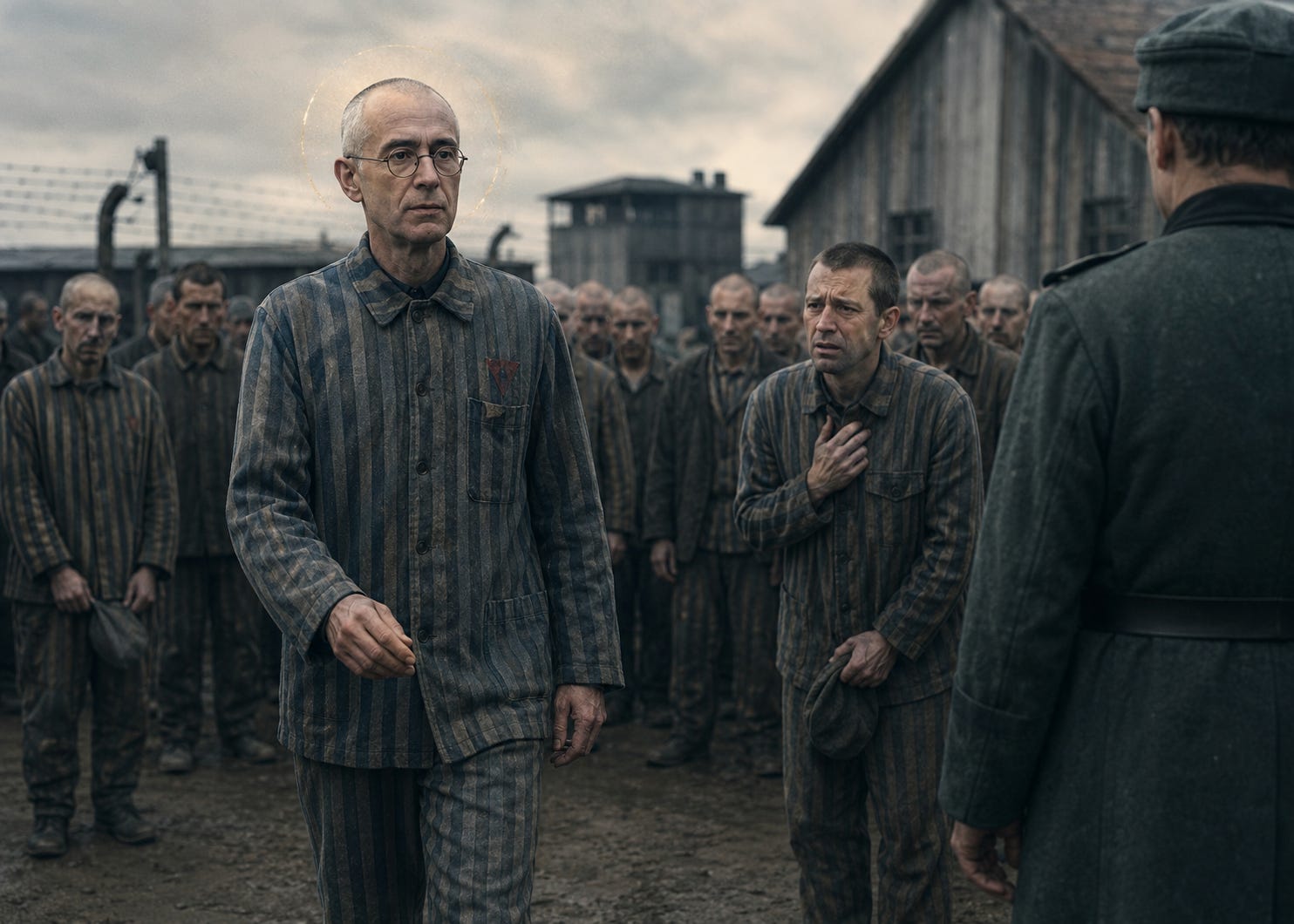
In a place built to erase human dignity, one priest stepped forward and refused to let hatred make the final decision.
Near the end of July 1941, the prisoners of Auschwitz were ordered to stand in formation.
A man had escaped. As punishment, the deputy camp commandant selected ten prisoners who would be locked in a bunker and starved to death. It was a method of terror as much as execution. The Nazis wanted everyone watching to understand that one person’s resistance could bring death upon someone else.
One of the men selected was a Polish army sergeant named Franciszek Gajowniczek.
When he heard his fate, Gajowniczek cried out for his wife and children.
Then another prisoner stepped out of line.
His name was Maximilian Kolbe. He was a Polish Franciscan priest, although Auschwitz had attempted to replace his name with a number: 16670.
Kolbe approached the commandant and asked to die in Gajowniczek’s place. He explained that he was a Catholic priest and that the other man had a family.
For reasons we still cannot fully explain, the commandant agreed.
Kolbe joined the other condemned men in the starvation bunker. Witnesses later described him praying with them and helping them face death. After more than two weeks, he remained alive. On August 14, 1941, a camp executioner killed him with an injection.
Gajowniczek survived Auschwitz. More than four decades later, he stood in St. Peter’s Square when Pope John Paul II canonized the man who had stepped forward for him.
At Kolbe’s canonization, John Paul II began with the words of Jesus from John’s Gospel:
“Greater love has no one than this: to lay down one’s life for one’s friends.”
John 15:13, NIV
There is an obvious problem with applying that verse to Kolbe.
Franciszek Gajowniczek was not his friend.
They had not grown up together. They had not shared meals, celebrated birthdays, or accumulated the ordinary history from which friendship usually grows. Gajowniczek was simply the terrified man standing nearby, crying out for the people he loved.
He was a stranger.
He was also a neighbor.
Elsewhere in the Gospels, a man asks Jesus, “Who is my neighbor?” The question is an attempt to locate the boundary of moral obligation. Jesus responds with the story we now call the Good Samaritan. The neighbor is not defined by tribe, religion, nationality, affection, or familiarity. The neighbor is the wounded person placed within reach of our compassion.
Maximilian Kolbe brought these teachings together. He saw a stranger, recognized a neighbor, and loved him as a friend.
He refused to allow the distance between those words to determine how much love the man deserved.
Auschwitz depended upon distance.
The camp stripped people of their clothing, possessions, family relationships, privacy, health, and names. Human beings became numbers and categories. Once that transformation had been imposed, cruelty could be administered as procedure. A person could be counted, sorted, exploited, starved, or killed while the system pretended that no one of consequence had been harmed.
The Holocaust was the systematic, state-sponsored persecution and murder of six million Jewish people by Nazi Germany and its allies and collaborators. Roma people, disabled people, Polish civilians, Soviet prisoners of war, queer people, political opponents, clergy, and others whom the regime classified as dangerous or inferior were also persecuted and murdered.
We cannot tell the story of a Christian martyr at Auschwitz while allowing Jewish suffering to become scenery behind him. Kolbe was a Polish Catholic prisoner. He was not sent to Auschwitz because he was Jewish. His witness occurred within machinery built above all to remove Jewish people from the human family and erase them from Europe.
Care for our Jewish sisters and brothers is therefore inseparable from any responsible remembrance of Maximilian Kolbe. So is resistance to antisemitism, including the old conspiracy theories and suspicions that continue to reappear in political speech, religious media, and online life.
This point requires honesty from Christians. Interwar Polish Catholic culture, including parts of its press, was not immune to anti-Jewish stereotypes and conspiracy thinking. Historians continue to debate how particular elements of Kolbe’s publishing legacy should be judged. Sainthood does not require us to flatten history, and reverence does not excuse us from examining the prejudices religious people absorb from their culture.
That examination makes Kolbe’s final act more demanding, not less. Christian faith must keep moving us beyond the boundaries our culture teaches us to defend. Holiness is found in allowing Christ to enlarge our capacity to recognize and love the person before us.
The language of dehumanization rarely begins with an announcement that cruelty is coming. It begins with repetition.
A government or political movement calls a group of people invaders, looters, criminals, vermin, or threats. It repeats those words until a diverse population becomes a single frightening mass. Individual stories disappear. Evidence becomes optional. Fear performs the work that facts cannot.
Once enough distance has been manufactured, policies that would otherwise offend the conscience begin to feel reasonable. Families can be separated. People can be detained without meaningful recourse or due process. Neighbors can disappear. Civilian deaths can be treated as regrettable abstractions. Citizens learn to look away because the person suffering has already been placed outside the circle of concern.
Historical precision is essential here. Every unjust policy is not Auschwitz, and careless comparisons can trivialize the singular horror of the Shoah. We do not need to claim that two situations are identical before recognizing a recurring moral danger.
When power demands that we fear an entire population without credible evidence, Christians have a duty to resist the manufactured distance. We ask for facts. We learn names. We listen to the people being discussed. We defend due process and human dignity. We refuse to repeat language designed to make cruelty easier.
This responsibility applies when Jewish people face antisemitism, when immigrants are portrayed as an invading force, when refugees become political props, when queer people are described as a contamination or threat, and whenever a community is presented as disposable.
Language manufactures the distance that oppression requires. Christian love refuses to maintain it.
Kolbe’s life has another striking connection to our own time. Before he became known as the martyr of Auschwitz, he was among the most ambitious Catholic media figures of the twentieth century.
He founded a publishing center at Niepokalanów, near Warsaw. The Franciscan community there grew to more than 600 members. Its monthly magazine reached a circulation of roughly one million, and its daily newspaper reached hundreds of thousands. Kolbe explored radio and dreamed of using film and emerging television technology for evangelization.
He understood that media does more than transmit information. It forms imagination. It influences which people we trust, which suffering we notice, and what kind of world appears possible.
The Nazis understood that too.
They used newspapers, radio, film, posters, schools, and relentless repetition to turn neighbors into enemies. Propaganda prepared ordinary people to tolerate what many would once have considered intolerable.
Our technology has changed. Human vulnerability has not.
Every Christian with a microphone, camera, newsletter, pulpit, podcast, or social media account faces a moral choice. Will our work help people encounter one another as human beings, or will it feed suspicion because fear performs well? Will we correct falsehoods, including the ones that benefit our preferred political side? Will we remember that attention is not the same as truth and virality is not evidence of grace?
A platform is never morally neutral. It can shorten the distance between strangers or make that distance profitable.
Kolbe’s media legacy should therefore inspire us and unsettle us. Religious intention does not automatically sanctify religious communication. Christian creators remain responsible for the people our words teach an audience to fear.
Most of us will never be asked to make the decision Kolbe made. Admiration can become a safe place to hide if we treat his courage as a supernatural achievement unrelated to ordinary life.
Kolbe did not become capable of self-sacrificial love only when Gajowniczek cried out. His final act completed a long pattern of prayer, discipline, service, risk, and sacrifice. The decision in the prison yard had been rehearsed through thousands of smaller decisions made before Auschwitz.
We are rehearsing too.
We rehearse courage when we interrupt a degrading joke. We rehearse it when we correct a lie shared by someone on our own side. We rehearse it when we learn about a community before forming an opinion about them. We rehearse it when we risk social discomfort to defend someone who has been reduced to a stereotype.
Nobody can guarantee how they will behave when history becomes dangerous. We can decide what kind of people we are becoming before that day arrives.
The Nazis selected Franciszek Gajowniczek as though his life were interchangeable with any other. Kolbe heard him cry out and recognized a husband, a father, a neighbor, and a life worth saving.
The camp commandant retained the power to accept Kolbe’s offer. The executioner retained the power to kill him. The system could control the bunker, the food, the syringe, and almost every visible condition of his life.
It could not compel Kolbe to agree that another man was disposable.
This is why his story remains powerful eighty-five years later. Oppressive systems exercise terrible power, but they no power over our souls except for what we give them. Human beings can still refuse the lies those systems require. A stranger can still be recognized as a neighbor. A neighbor can still be loved as a friend.
Jesus said, “Greater love has no one than this: to lay down one’s life for one’s friends.”
In a place designed to prove that hatred would have the final word, Maximilian Kolbe answered with his life.
Love still had something to say.
Who is being described as a threat or treated as disposable in our public life right now? What would it require for you to move closer, learn a name, hear a story, or defend that person’s dignity?
Share your thoughts in the comments. Please approach one another with the seriousness and care this subject deserves.
If this reflection helped you see Kolbe’s witness differently, share it with someone who believes Christian courage still has a place in public life.
God of every human life,
you created each person in your image
and entrusted us to one another.
Forgive us for the distance we preserve
when another person’s suffering becomes inconvenient.
Free us from the language that turns neighbors into enemies
and makes cruelty appear reasonable.
Protect our Jewish sisters and brothers from antisemitism.
Protect immigrants, refugees, and every community
used as an object of suspicion or political fear.
Give us wisdom to recognize propaganda,
humility to correct what we have repeated falsely,
and courage to stand beside those whose dignity is denied.
Teach us to see the stranger as our neighbor
and to love our neighbor with the faithfulness of a friend.
Through the intercession of St. Maximilian Kolbe,
form us through the small decisions of each day
so that we are prepared to follow Christ
when love becomes costly.
May hatred never have complete possession of our hearts.
May fear never determine the boundaries of our compassion.
May our lives bear witness
that oppression does not receive the final word.
We ask this through Christ our Lord.
Amen.
St. Maximilian Kolbe, pray for us.
As a child, he said he had a vision of Mary offering him two crowns. One was white, symbolizing purity, and the other red, symbolizing martyrdom. According to the account he later gave his mother, he accepted both.
He and his brother crossed a militarized border hidden in a haycart to enter the Seminary. Poland was still partitioned when the boys decided to enter the Franciscan seminary, so they secretly crossed from the Russian-controlled region into the Austrian partition.
He earned two doctorates while living with serious illness. Kolbe completed doctorates in philosophy and theology in Rome, despite suffering from tuberculosis, which affected him for much of his adult life.
The friary he founded in Nagasaki survived the atomic bombing. Kolbe established Mugensai no Sono, “The Garden of the Immaculate,” on a difficult hillside because the land was inexpensive. A mountain ridge shielded it from the bomb’s direct blast in 1945. A later legend claimed Kolbe had foreseen the bombing, but archivists say there is no evidence for that story.
His Japanese publishing mission is still alive. The friary in Nagasaki continues to house Franciscans and publish the Japanese edition of Knight of the Immaculata, the magazine Kolbe established there in 1930.
His patronages extend well beyond journalists. Because of the circumstances of his life and death, Catholics also invoke him as a patron of families, prisoners, political prisoners, people struggling with addiction, and amateur-radio operators.
Thank you to everyone who has stepped forward this week to support Message From the Margins. We still have a way to go before this ministry becomes financially stable, but we are closer, and we are doing it together. Your support makes carefully researched, pastorally grounded reflections like this one possible while keeping them available to everyone.
If you have the financial room, please consider becoming a supporting subscriber today. If subscribing would create hardship, remain here without guilt. Read, pray, comment, and share. Every part of this community helps carry the mission forward, including the new podcast premiering Monday.
Become a Supporting Member Today
With enormous gratitude,
Fr. V
Comments
Nothing yet. Say the first thing.
Sign in to join the conversation.