
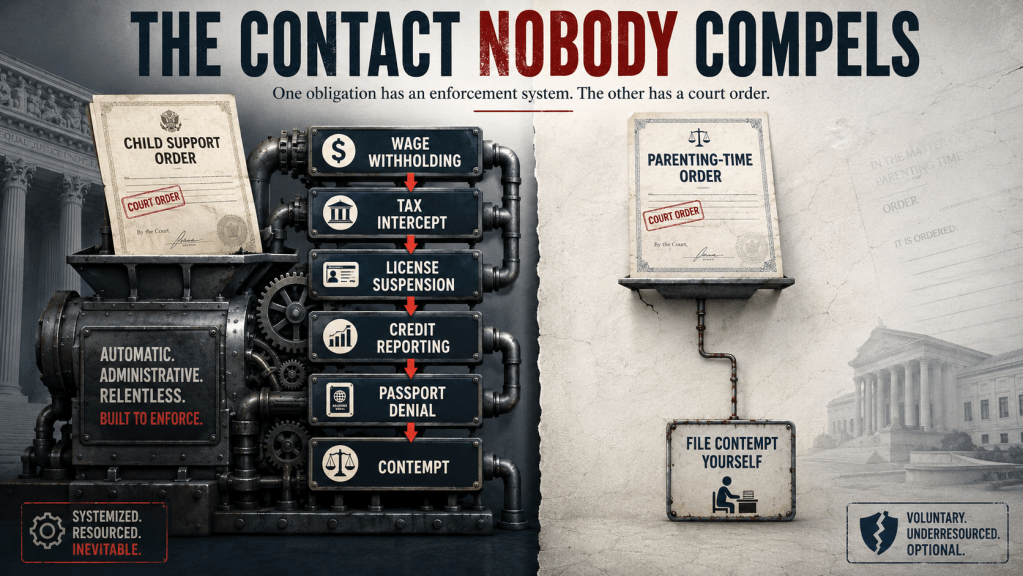
In August 2026, a Georgia court ordered Minnesota Timberwolves guard Anthony Edwards to pay $14,000 a month in child support for a son he has testified under oath he has never met — on top of a $2.6 million life insurance policy and $21,000 in his ex’s legal fees, calculated against a monthly income of roughly $4.8 million. It’s the kind of case that reads as a morality tale about a specific man’s choices. It isn’t one. It’s a case study in a structural design decision the federal government made fifty years ago, one that has nothing to do with Edwards and everything to do with why American family courts can calculate a support obligation to the dollar while having almost no comparable mechanism to compel a parent’s presence.
The reflex is to read stories like this as being about a man who won’t show up. The more useful — and less comfortable — question is why the machinery that got him to pay $14,000 a month has no counterpart that could have gotten him to a visitation calendar.
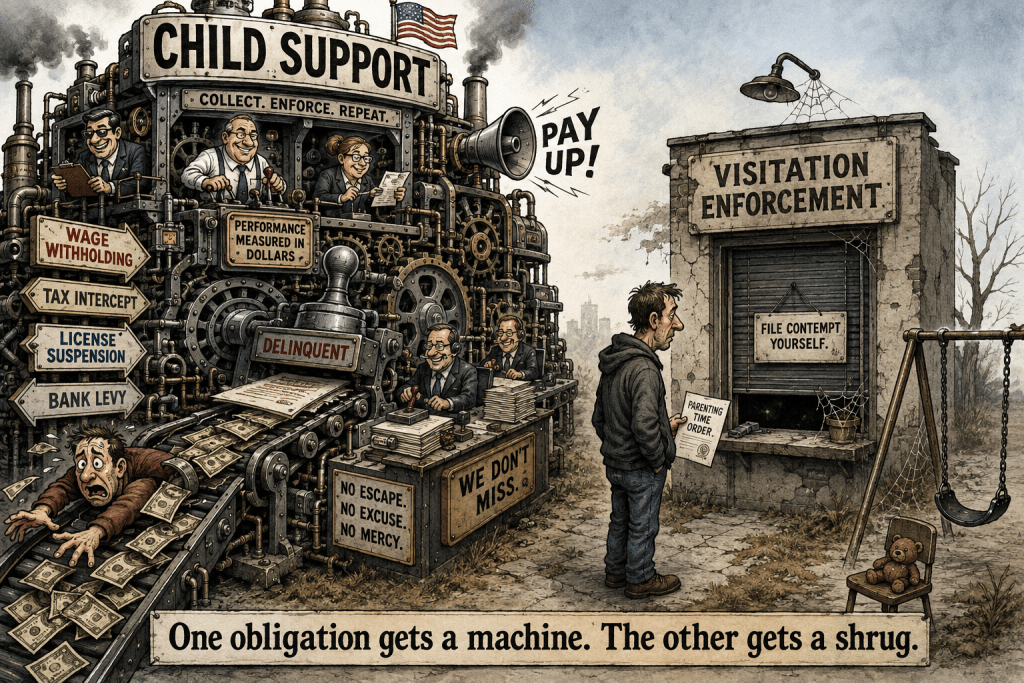
“The machinery that got him to pay $14,000 a month has no counterpart that could have gotten him to a visitation calendar.”
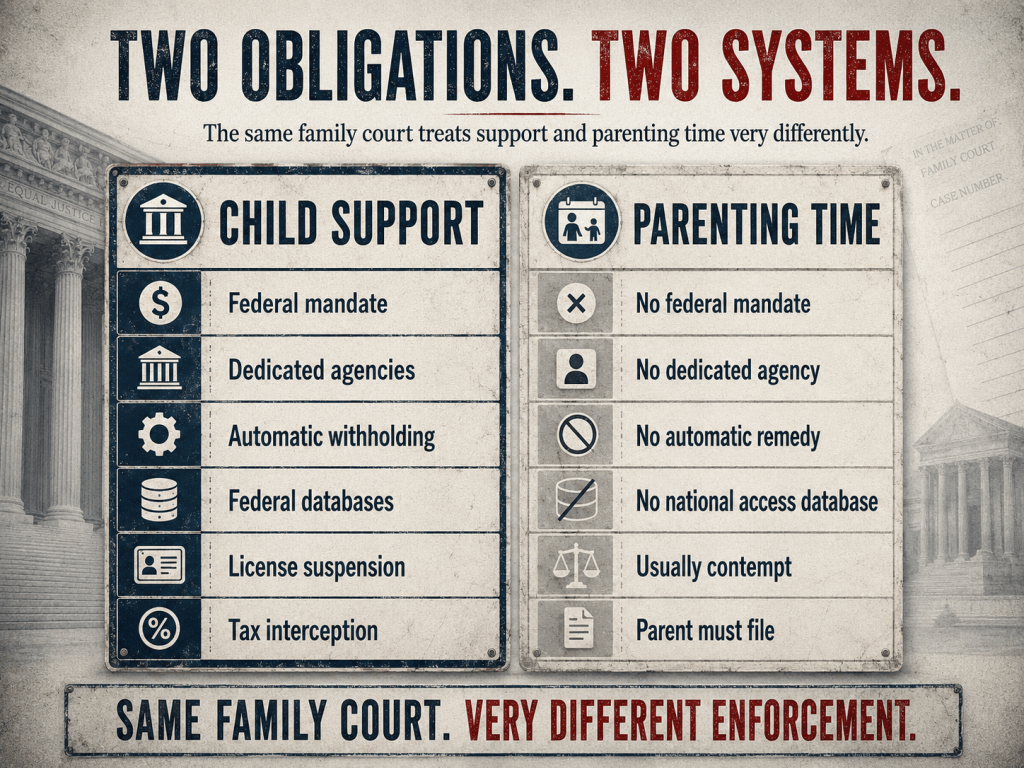
Start with where the asymmetry actually comes from, because it isn’t fifty separate state legislatures independently arriving at the same design. It’s one federal law.
Title IV-D of the Social Security Act (42 U.S.C. §§ 651–669b), enacted in 1975 and substantially rebuilt by the Personal Responsibility and Work Opportunity Reconciliation Act of 1996 (PRWORA), requires every state to operate a conforming child support enforcement program as a condition of federal funding. States that want their share of Temporary Assistance for Needy Families money have to build — and keep building — the enforcement architecture Congress specified: automatic income withholding transmitted to employers within two business days of an order, uniform federal formats for the withholding notice itself, mandatory participation in interstate enforcement databases, and license suspension, tax refund interception, and passport denial as standardized tools available in every state.
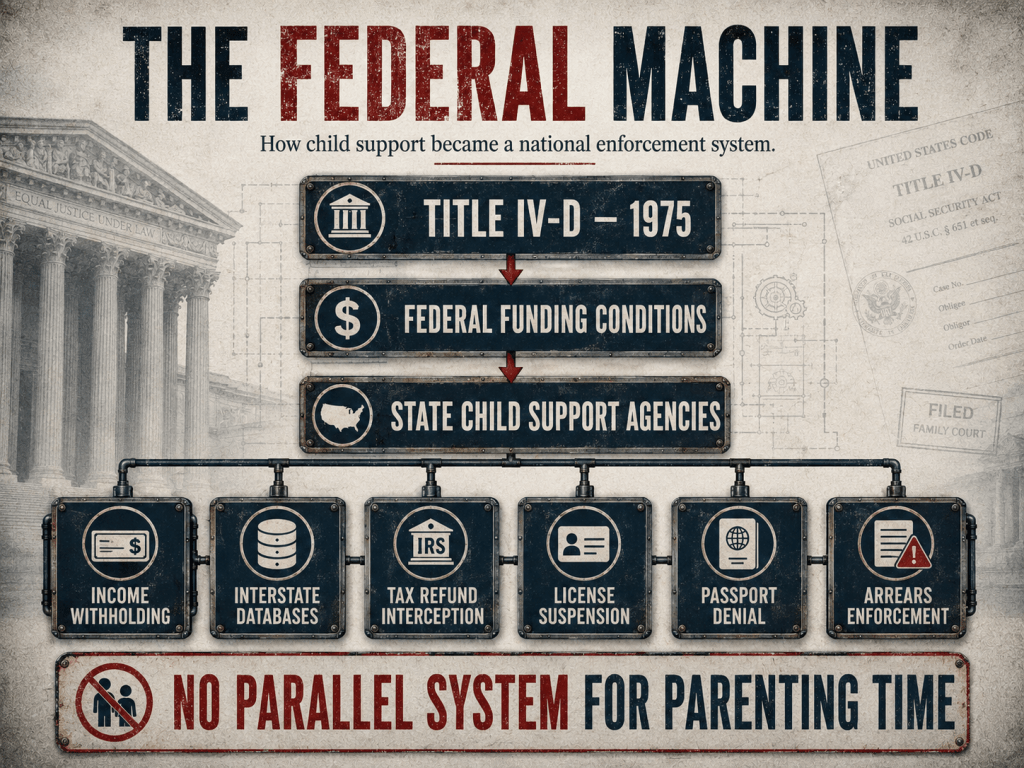
Layered onto that is the Bradley Amendment (42 U.S.C. § 666(a)(9)), which permanently bars any court — state or federal — from retroactively reducing or forgiving child support arrears once a payment comes due. Miss a payment while unemployed, incarcerated, or simply unaware an order existed, and the debt is fixed from that date forward. Only future payments can be modified; the past is untouchable.
“No Title IV-D for access.”
None of this is a state choosing to be tough on deadbeat parents. It’s a state complying with a federal funding condition, using federally mandated tools, in a federally standardized format, under a federally imposed rule about what can never be forgiven.
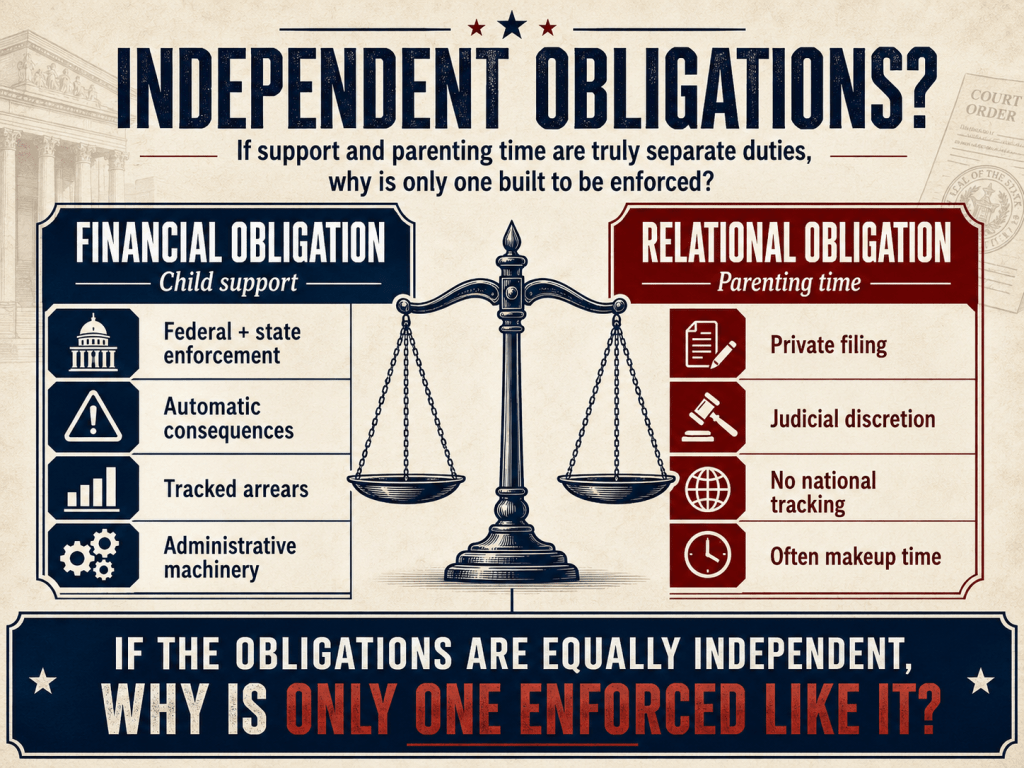
There is no equivalent statute for parenting time. No Title IV-D for access. No federal funding is conditioned on a state building automatic enforcement for denied visitation, no federal office collects data on custodial interference the way the Office of Child Support Enforcement tracks arrears, and no amendment forecloses judicial leniency toward a parent who blocks contact the way the Bradley Amendment forecloses leniency toward a parent who doesn’t pay. Access enforcement was left entirely to the states, discretionary from the ground up. That’s not an oversight nobody noticed for fifty years. It’s the predictable result of Congress deciding, in 1975 and again in 1996, that one parental obligation warranted a national enforcement infrastructure and the other didn’t.
“One parental obligation warranted a national enforcement infrastructure and the other didn’t.”
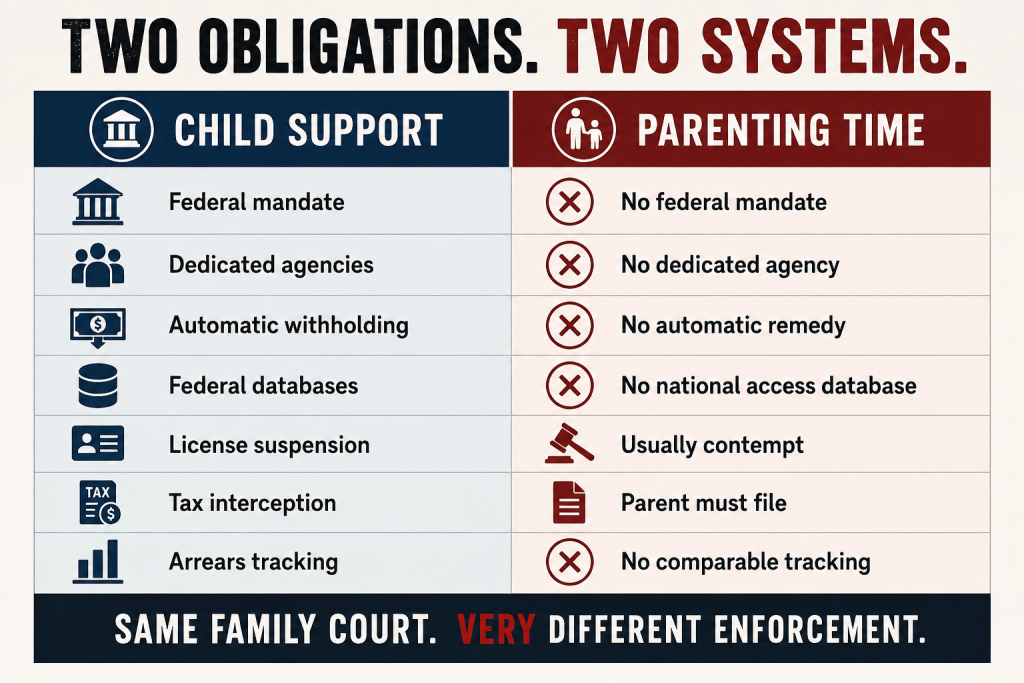
The clearest way to see the federal fingerprint is to look at how similar the money side looks across states that otherwise have almost nothing in common procedurally — and how differently the access side is built, because access was never standardized at all.
Virginia. Every initial support order must include a provision for immediate income withholding (Va. Code § 20-79.2), with no separate action required. The Division of Child Support Enforcement can suspend a professional license once a parent hits 90 days or $5,000 in arrears (§ 63.2-1937) or a driver’s license on the same threshold (§ 46.2-320.1), and can refer the case for contempt — up to twelve months in jail (§ 20-115) — only after the administrative tools are exhausted.
Parenting time gets one sentence. Va. Code § 20-124.2(E) gives courts “continuing authority... to punish as contempt of court any willful failure” to comply with a custody or visitation order. That’s the entire statutory toolkit. No agency initiates it. No 90-day or $5,000 threshold triggers it automatically. The denied parent has to personally file, personally prove willfulness, and the available remedies — rescheduled time, modified terms, shifted fees — carry no financial teeth resembling license suspension or a bank levy.
Maryland. The Judiciary’s own enforcement materials lay out a tiered, largely automatic schedule: mandatory earnings withholding past 30 days, credit-bureau reporting at 60 days, and — as of a law that took effect October 1, 2025 — both driver’s and professional license suspension at 120 days. (Before that reform, driver’s license suspension triggered at 60 days; the legislature extended it after finding that reflexive suspensions were costing people their jobs, and with them their ability to pay support at all.) Contempt is explicitly the last resort, deployed only after the administrative machinery has already failed.
The access side is a single code section. FL § 9-105 lets a court reschedule missed time, modify the order, or assess fees — “in addition to any other remedy available to the court and in a manner consistent with the best interests of the child.” No agency. No threshold. No license, no lien, no financial consequence beyond fees a court may or may not choose to award.
Georgia — the state that actually entered the Edwards order. O.C.G.A. §§ 19-6-30 through 19-6-33 mandate income deduction orders on every new support case; O.C.G.A. § 19-6-28.1 authorizes administrative license suspension for noncompliance, implemented through Ga. Comp. R. & Regs. 290-7-1-.12; contempt under O.C.G.A. § 19-6-28 is, again, the fallback once administrative enforcement has already failed.
Access enforcement in Georgia runs through that same § 19-6-28 — the identical contempt statute used for support, applied here with none of the administrative machinery layered on top: no agency, no threshold, filed privately, typically resolved with makeup time.
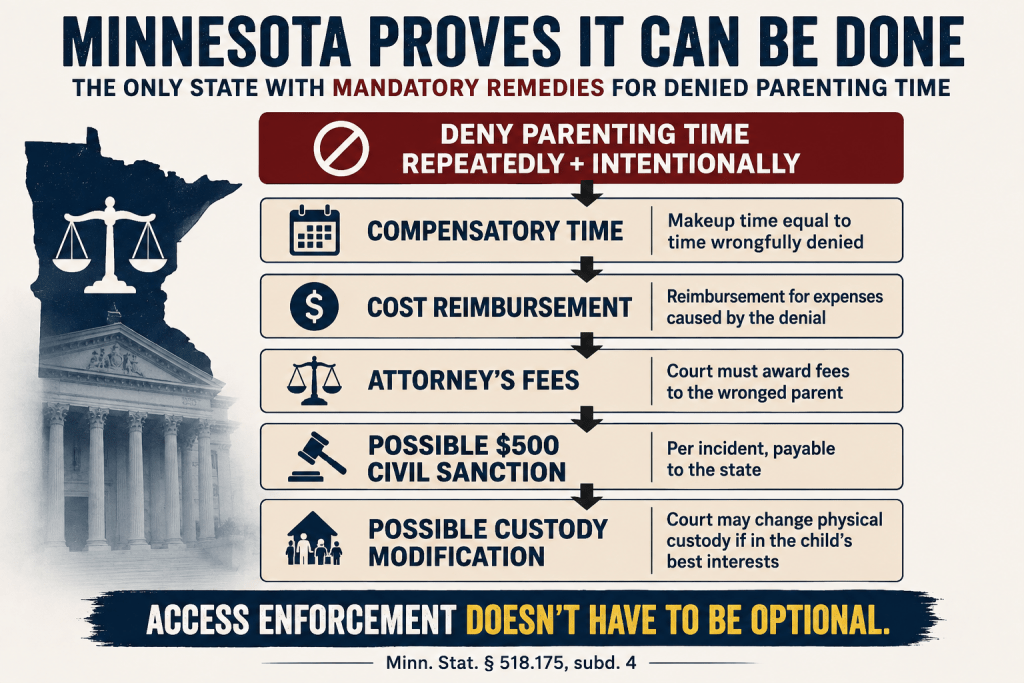
Minnesota is instructive precisely because it breaks the pattern — and shows the asymmetry isn’t inevitable. The support side is the familiar federal-driven architecture: automatic wage withholding (Minn. Stat. § 518A.53), license suspension keyed to arrears thresholds (§§ 518A.65–68), contempt once arrears reach three times the monthly obligation. But Minnesota built real enforcement into the access side too. Minn. Stat. § 518.175, subd. 6 doesn’t just authorize a court to act — for repeated, intentional denial of parenting time, it requires compensatory time, cost reimbursement, and attorney’s fees, the same mandatory language that governs support enforcement elsewhere. A parent can also face a $500 civil sanction and, in serious cases, a custody modification.
Minnesota’s legislature didn’t need a federal mandate to build that. It just decided access denial deserved the same seriousness as nonpayment. Every other state in this comparison had that same option and didn’t take it — because nothing was pushing them to.
“Minnesota’s legislature didn’t need a federal mandate to build that. It just decided access denial deserved the same seriousness as nonpayment.”
The instinct to separate these two obligations isn’t arbitrary. The majority rule nationwide — codified explicitly in Texas, applied as settled doctrine in California and Minnesota, and generally accepted across most of the country — holds that support and access are independent duties: nonpayment is never a defense to denying access, and denial of access is never a defense to nonpaying. The stated rationale is protective. Support answers a child’s material needs; access answers a child’s relational ones. Link them, and either parent gains a lever to use the child as leverage against the other — withhold contact to punish nonpayment, or withhold payment to punish denied access. Courts that hold this line are trying to keep children out of that crossfire.
But it isn’t the only rule this country has tried, and the alternative is instructive precisely because it was built to answer the asymmetry this piece has been tracing. Missouri writes the opposite policy directly into statute: RSMo § 452.340 declares it the state’s public policy that courts “shall enforce visitation, custody and child support orders in the same manner,” and gives courts express authority to abate a support obligation, in whole or in part, when a parent has — without good cause — denied the other parent court-ordered access. New York courts have reached a narrower version of the same conclusion judicially: in Matter of Coull v. Rottman, 131 A.D.3d 964 (2d Dept. 2015), the Appellate Division found a documented pattern of parental alienation and reversed a lower court’s refusal to suspend a father’s support obligation. New York’s standard for this remedy is demanding — courts require the interference to rise to “deliberate frustration or active interference,” not simple denial — but it exists, and it exists because a legislature and a judiciary each looked at the same independent-obligations doctrine and concluded that it only protects children from being used as leverage if both obligations are actually being enforced. When one side of that bargain collapses, treating the other as untouchable stops protecting the child and starts protecting the system’s own asymmetry.
That’s the real question underneath the Edwards case, and underneath every enforcement-gap comparison above: not whether support enforcement is too aggressive — the federal architecture behind it reflects a legitimate judgment that a child’s financial security shouldn’t depend on one parent’s goodwill — but whether that same judgment can survive being paired with an access side that has almost no comparable machinery. Congress built a national enforcement infrastructure for one parental obligation and left the other to fifty separate legislatures, most of which built nothing beyond the contempt power courts already had. Missouri’s legislature and New York’s courts are the exceptions that prove the point: when a state decides the asymmetry has gone too far, it has tools to fix it. Most haven’t reached for them. Swap the genders in every case above — a mother denied access to her children by a father facing none of the enforcement machinery he’d face for withholding support — and the structural claim holds exactly the same way, on either side of this doctrinal split. This isn’t about who withholds what from whom. It’s about whether “independent obligations” is a principle this country actually enforces symmetrically, or a rule that only ever runs one direction.
Sources: 42 U.S.C. §§ 651–669b (Title IV-D); 42 U.S.C. § 666(a)(9) (Bradley Amendment); Va. Code §§ 20-79.2, 20-115, 20-124.2, 46.2-320.1, 63.2-1937; Md. Code, Family Law § 9-105; Md. Code, Family Law § 10-119 & Transportation § 16-203 (as amended eff. Oct. 1, 2025); O.C.G.A. §§ 19-6-28, 19-6-28.1, 19-6-30–33; Ga. Comp. R. & Regs. 290-7-1-.12; Minn. Stat. §§ 518.175, 518A.53, 518A.65–68; Mo. Rev. Stat. § 452.340; Matter of Coull v. Rottman, 131 A.D.3d 964 (2d Dept. 2015); TMZ reporting on court documents in the Edwards–Desroches Georgia child support matter (Aug. 2026), corroborated by Yahoo Sports, Yardbarker, and EssentiallySports.

Father & Co. offers non-legal document review and organization for people representing themselves. This includes clarity, structure, neutral tone, and timeline organization — not legal advice or representation.
Submissions are reviewed with care and discretion. We respect privacy and handle sensitive information responsibly.
Comments
Nothing yet. Say the first thing.
Sign in to join the conversation.