
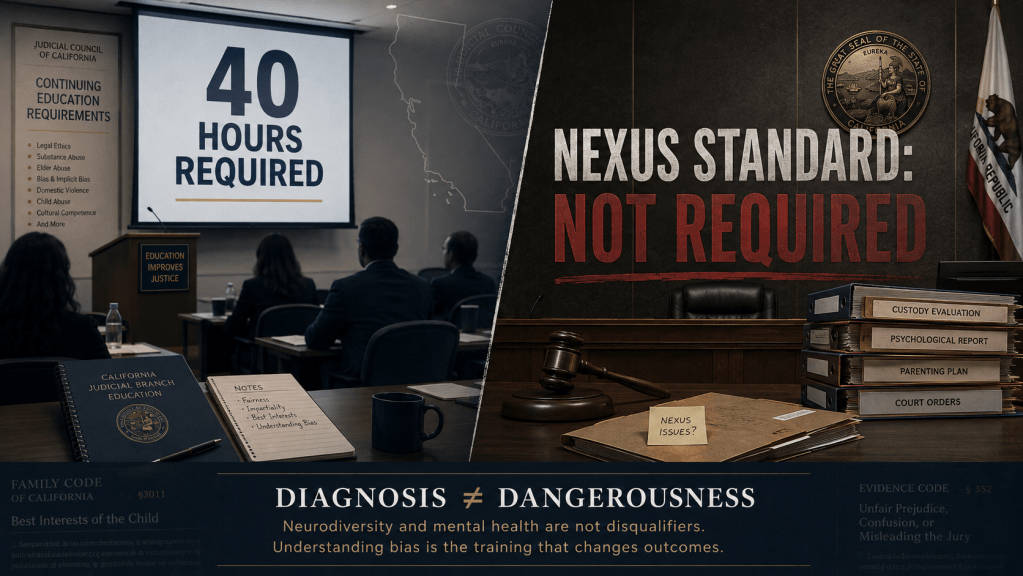
Every summer, a room full of California family law judges and attorneys sits down for a continuing education seminar most litigants will never hear about. This year’s version, hosted by the Los Angeles County Bar Association, included a panel called “Neurodivergent Parents and Children in Family Court,” taught by Daniel Pickar, a board-certified child psychologist who has spent two decades studying exactly this problem. The room learns something in that hour that no statute requires anyone in the courtroom down the hall to know.
That’s not a criticism of the seminar. It’s the problem.
Pickar’s work — most fully laid out in a 2022 Family Court Review article — starts from a specific, well-documented failure mode: family court professionals, like people generally, tend to associate a psychiatric or neurodevelopmental diagnosis with parental unfitness, independent of any evidence about how that parent actually functions. Pickar’s own language for it is direct: it is frequently the case that parents are presumed “not competent” simply by virtue of disclosing a mental health diagnosis.
The research he cites is specific about the mechanism. Van Brunt, Zedginidze, and Light’s 2016 review in the same journal cataloged the recurring myths that drive this — chief among them the belief that a serious diagnosis equates to dangerousness. Their prescription wasn’t to ignore mental health history. It was to redirect the inquiry: look at the behavior, not the diagnosis. A parent’s documented conduct, treatment compliance, and functional stability are what belong in a custody determination. The diagnostic label by itself is not evidence of anything.
Dane and Rosen, cited throughout Pickar’s article, put a name to the missing piece. The lead author, Hon. Edmund M. Dane, writes from the bench himself — this is a sitting family court judge’s own account of best practice, not outside commentary. Their argument centers on a legally required nexus: the existence of a mental health condition, on its own, cannot justify restricting custody or parenting time. There has to be a demonstrated, specific connection between the condition and an actual effect on the child. Depression doesn’t automatically mean an inattentive parent. ADHD doesn’t automatically mean instability. A diagnosis is the beginning of an inquiry, not the end of one.
“A diagnosis is the beginning of an inquiry, not the end of one.”
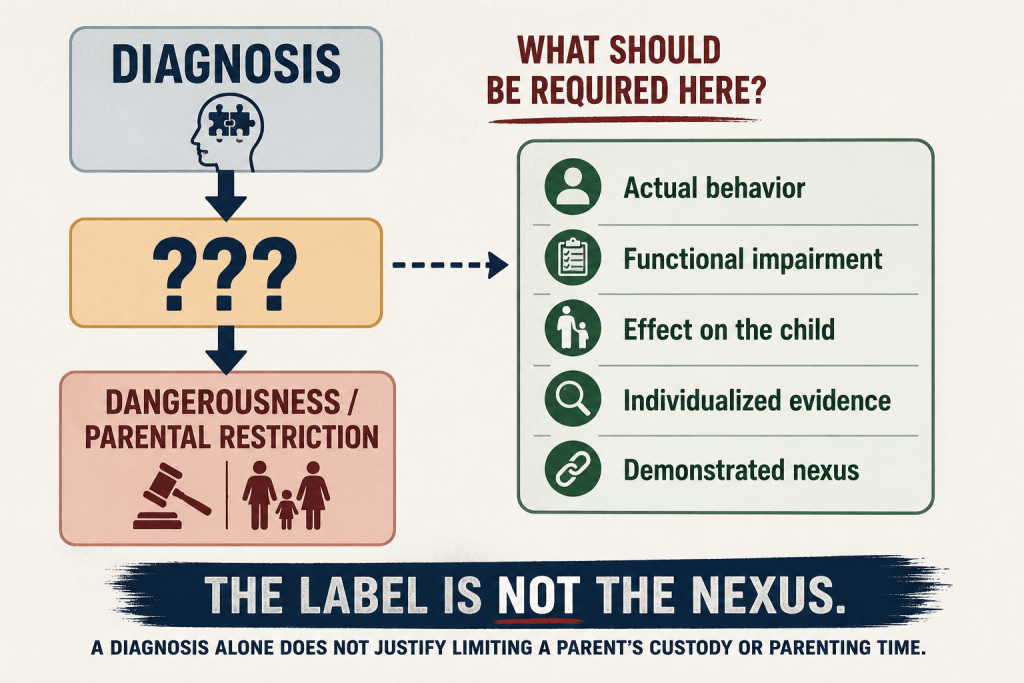
This isn’t a fringe position. It’s what the field’s own peer-reviewed literature, presented at judicial CLE seminars across the state, has been saying for close to a decade.
Here’s where the gap opens up. California Rules of Court do impose training requirements on the people involved in custody decisions — but they land unevenly, and the nexus standard Pickar and his colleagues describe isn’t codified in either one.
“There has to be a demonstrated, specific connection between the condition and an actual effect on the child.”
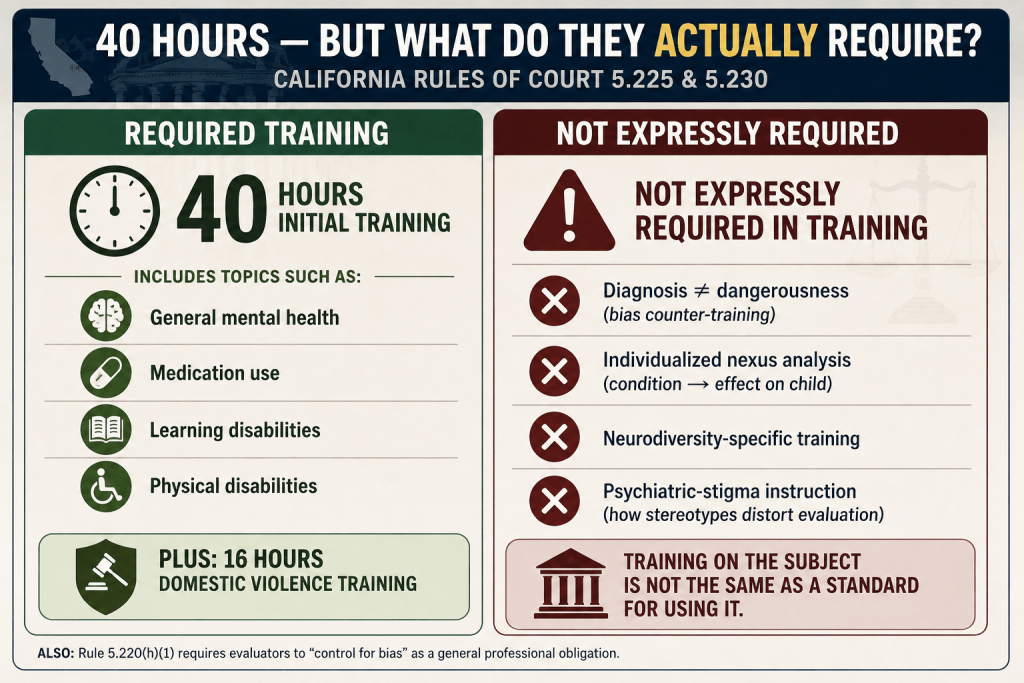
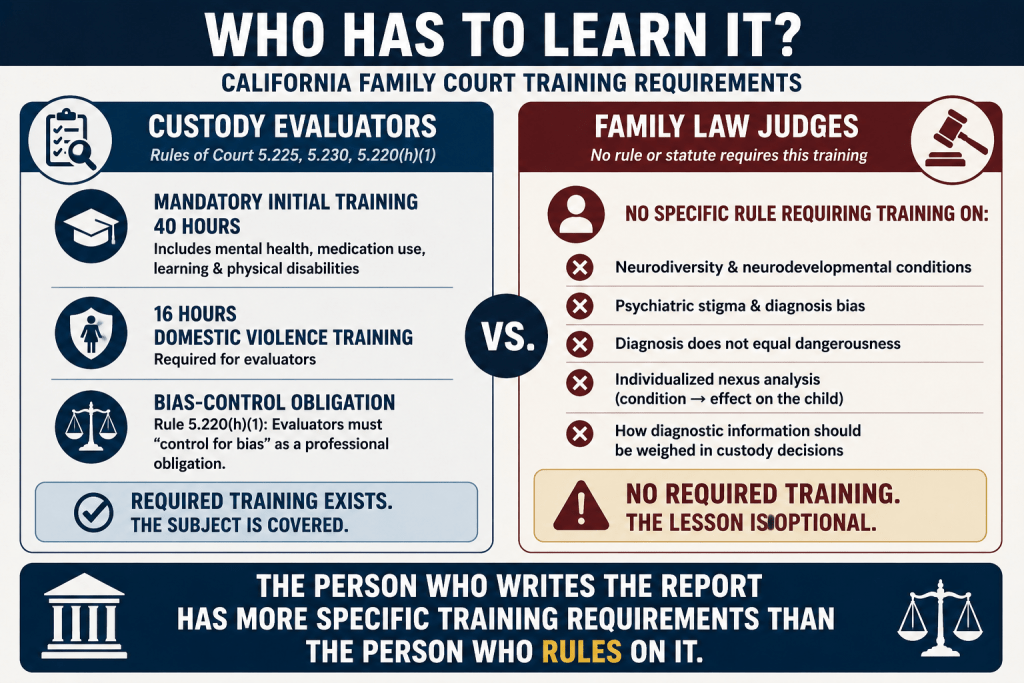
Evaluators are the more regulated of the two. Rule 5.225 requires 40 hours of initial training covering a list of specific topics — among them, “the importance of addressing issues such as general mental health, medication use, and learning or physical disabilities.” Rule 5.230 layers on a separate 16-hour domestic violence training requirement. Evaluators must also, under Rule 5.220(h)(1), “control for bias” as a general professional obligation.
That’s real. It’s also vague by design. Nothing in either rule specifies how an evaluator controls for the specific bias Pickar’s research documents — the reflexive move from diagnosis to danger. “Address issues such as general mental health” is training-topic language, not a substantive standard. It tells an evaluator the subject is relevant. It doesn’t tell them what a scientifically defensible conclusion looks like, or require them to apply anything resembling the nexus test.
“‘Address issues such as general mental health’ is training-topic language, not a substantive standard.”
Judges are the more consequential gap. The rules above govern evaluators — not the judicial officers who ultimately weigh the evaluator’s report, rule on the restraining order, or decide the custody outcome. There is no rule of court, and no provision in the Family Code, that requires a family law judge to complete training on neurodiversity, psychiatric stigma, or the nexus standard before ruling on a case where a parent’s diagnosis is at issue. The LACBA seminar where Pickar taught this material is continuing legal education — valuable, well-attended, and entirely voluntary. The judges in that room chose to be there. Nothing requires the judges who weren’t.
“The profession knows what the mistake looks like. It has published the research, named the mechanism, and taught it at conferences for a decade. It just hasn’t required anyone to learn it before they’re allowed to rule on a family.”
Mermelstein, Rosen, and Wolf made the logical extension of this argument in 2016, arguing that a child’s mental health needs should be a statutorily required factor under the best-interests standard, not merely a factor courts are permitted to consider if they think to. The same argument applies with equal force to how a parent’s diagnosis gets weighed — and nine years later, it still hasn’t been adopted into California law.
This is the same structural shape as the evidentiary gap in domestic violence restraining orders. A DVRO can be issued on an uncorroborated affidavit that cites a diagnosis as evidence of dangerousness, with no requirement that anyone establish an individualized connection between the label and the alleged conduct. The bias research says judges and evaluators are prone to make exactly that leap on their own, absent specific training to counteract it. And the training that exists to counteract it is optional, unevenly distributed, and reaches the people making evaluation reports far more reliably than it reaches the judges signing the orders.
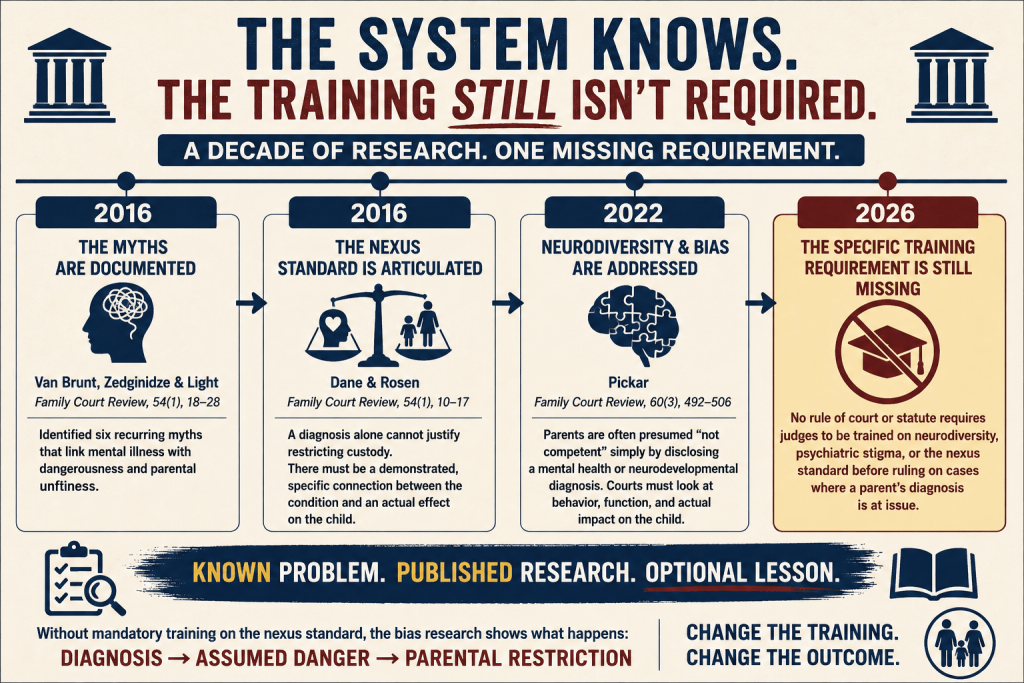
Put simply: the profession knows what the mistake looks like. It has published the research, named the mechanism, and taught it at conferences for a decade. It just hasn’t required anyone to learn it before they’re allowed to rule on a family.
“A diagnosis is not a fact about danger.”
This doesn’t require inventing new legal doctrine. Rule 5.225’s evaluator training list could simply name the nexus standard explicitly, rather than leaving “general mental health” to individual training providers to interpret. And the Judicial Council — which already sets mandatory continuing education requirements for judicial officers in other subject areas — could add neurodiversity and psychiatric-stigma bias to that list for family law judicial assignments, the same way domestic violence training became mandatory for evaluators in 1998.
Neither change would restrict what evidence a court can consider. Both would require the people considering it to have been taught, at some point, that a diagnosis is not a fact about danger.
Next in this series: how one father’s own case shows the diagnosis-as-evidence gap and the training gap converging in a single ruling — and what closing both would have meant for his family.
Sources: This piece draws on Pickar, D.B. (2022), “Considerations regarding child and parent neurodiversity in family court,” Family Court Review, 60(3), 492–506, accessed and read in full via the Massachusetts AFCC chapter’s archived PDF and cross-checked against the publisher’s abstract on Wiley Online Library. The three secondary sources cited within that article were independently retrieved and verified rather than taken on Pickar’s characterization alone: Van Brunt, Zedginidze, and Light (2016), “The Unfit Parent: Six Myths Concerning Dangerousness and Mental Illness,” Family Court Review, 54(1), 18–28, confirmed via Wiley’s abstract and a full-text archived copy; Dane and Rosen (2016), “View from the Bench: Parental Mental Health and Child Custody,” Family Court Review, 54(1), 10–17, confirmed via Wiley’s abstract and a full-text archived copy — Judge Dane writes as a sitting family court judge; and Mermelstein, Rosen, and Wolf (2016), “Best Interests of the Special Needs Child: Mandating Consideration of the Child’s Mental Health,” Family Court Review, 54(1), 68–80, confirmed via a full-text archived copy. The panel description is drawn from the LACBA 14th Annual Cultural Competency in Family Law Practice Seminar agenda. The California training requirements cite Rules of Court 5.220, 5.225, and 5.230, and Family Code § 3110.5, all accessed via the official California Courts website and cross-checked against Justia and FindLaw’s annotated codes.

Father & Co. offers non-legal document review and organization for people representing themselves. This includes clarity, structure, neutral tone, and timeline organization — not legal advice or representation.
Submissions are reviewed with care and discretion. We respect privacy and handle sensitive information responsibly.
Comments
Nothing yet. Say the first thing.
Sign in to join the conversation.