
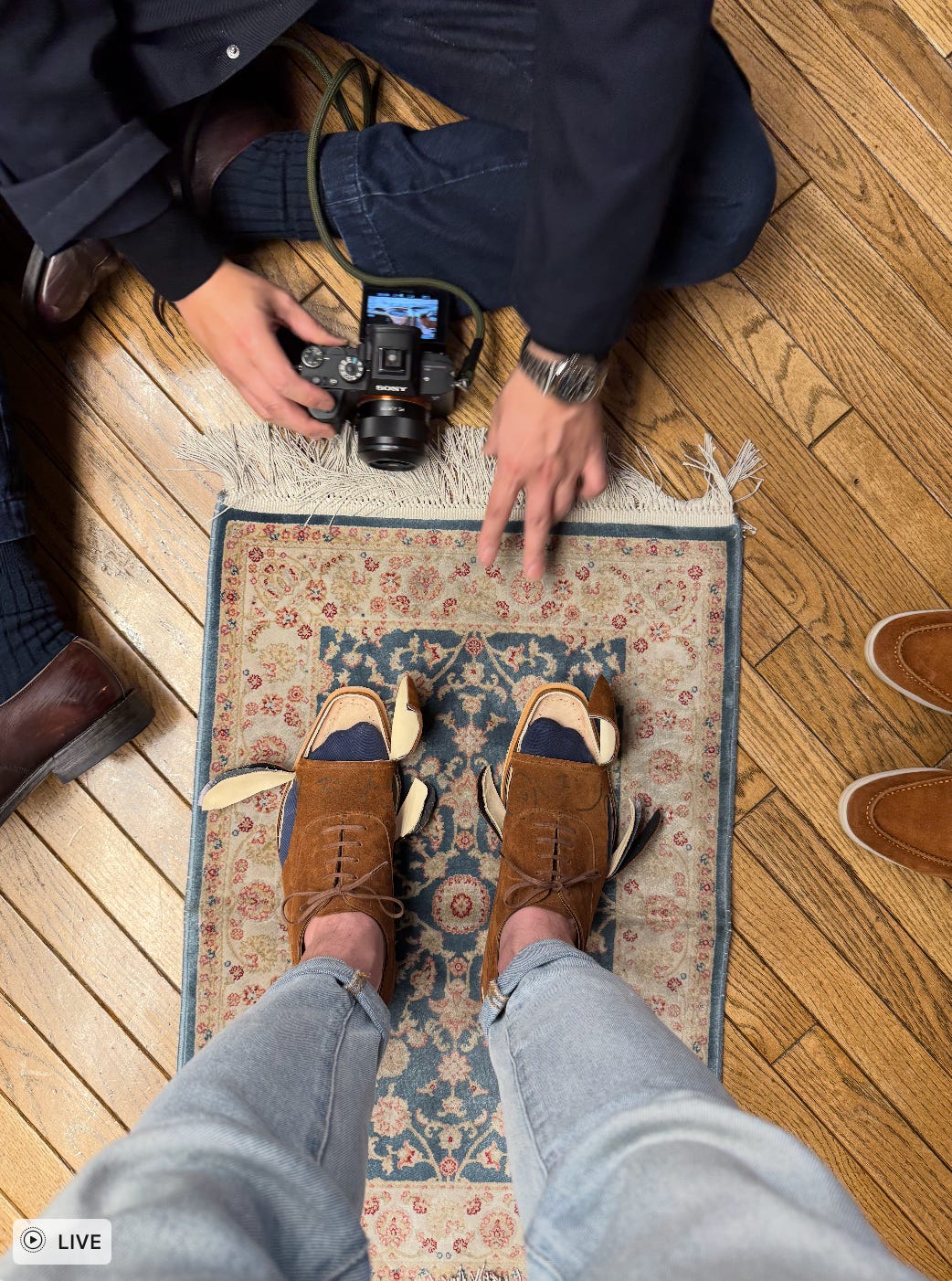
Earlier this year, I had a fitting in Tokyo with a bespoke shoemaker named Yohei Fukuda. The process is not what most people imagine when they hear the word bespoke.
First, he puts dots all over your feet and manually measures distances. Then he widdles a wooden replica called a last. Then he builds the shoe. A complete, finished shoe.
Then he destroys it!!
He puts it on your foot and asks where it feels right and where it feels wrong. He marks up the leather accordingly. And then he takes a razor and cuts it apart to see what’s happening behind your heel, along your arch, at the precise points where the leather was or wasn’t touching you correctly.
Only by destroying the first version can he understand what the second version needs to be. But when that second shoe arrives, it fits in a way that no off-the-rack shoe, however fine or expensive, can approximate. But because it was measured for your feet, it was made from the evidence of your specific feet.
I could buy five pairs of excellent shoes for the price of one pair of his. This has nothing to do with extravagance. It is that I would rather have one item made with that quality of attention than five made without it.
I don’t, in other words, just want a shoe. I want a Fukuda-San.
This is the difference between “things” and everything else.
Most hospitality service providers operate closer to the off-the-rack model than they would care to admit. They have a process; the process produces an outcome; and the outcome is delivered. And if the outcome broadly fits, the job is done. The question of whether it fits you, your operation, your specific vulnerabilities, the gap between what your team knows and what your inspectors keep finding, is not really part of the inquiry.
I have spent over a decade in hospitality operations, and I have come to believe that most service providers, even good ones, have a subtly mistaken idea of what they are selling. They believe they are selling outcomes: clean rooms, staffed functions, audited kitchens, managed facilities. And in a transactional sense, they are right.
But the real product that a client is paying for is time. Specifically: time back. And freedom from a category of worry.
But, like the CPA who sends your tax documents on the day they’re due, having given you no warning, leaving you scrambling to write checks and race to the post office by five o’clock or the insurance broker who copies you on correspondence you didn’t need to see and expects you to make decisions you didn’t expect to make or the vendor who tells a client that a problem is the client’s fault because the vendor sent an email that wasn’t actioned, what most service providers actually deliver is something closer to the opposite.
All of them have technically done something. But none of them has given a minute of time back.
If anything, they have taken time away.
Let me give you an example of what the opposite of this looks like.
One of my regional managers was at a property recently, at around five in the morning, engaging with a team finishing an overnight shift. He was there as a vendor; his remit was the building, not the guest experience. It was not his job to interact with hotel guests. In fact, it’s our job to be ninja-like…fly under the radar.
A guest appeared, an early riser, looking for coffee. The restaurant wouldn’t open for another hour.
He could have said: I’m sorry, I’m just a vendor, I’m not sure I can help with that. It would have been entirely accurate.
Instead, he went to the back of the house, found a kitchen team member already prepping for the morning, explained the situation, and arranged for coffee to be made. Then he went back, found the guest, and walked him personally to where the coffee would be waiting. He gave the guest’s name and told him she’d have something ready in four minutes.
Later, he included a brief note in his nightly report to the General Manager. The report was not long. It was specific, human, and considerate. He mentioned the guest’s name, described the encounter, and noted that the kitchen team had been responsive.
It communicated, without stating it, that his team thought of themselves not as vendors executing a contract, but as part of the fabric of this property.
What do you imagine the General Manager thought of his cleaning vendor the next morning?
There is a distinction I have been trying to teach and to institutionalize throughout my company for years, and it is harder to instill than any technical skill.
The distinction is between the person who is responsible for getting something done and the person who is responsible for making sure it gets done.
Because these are not the same person.
A manager who tells a team member to complete a task has discharged their responsibility in only the narrowest sense.
A manager who owns the outcome, who follows up, who accounts for the possibility that the team member got pulled away or misunderstood, who ensures the loop is closed before it matters whether it was, that person is running a different kind of operation entirely.
This is what I mean when I say that if our customer doesn’t do something we’ve asked of them, that is our failure. Not theirs. They are paying us precisely so that they do not have to remember to do activities. The moment we shift accountability to them, we have undermined the only reason they hired us.
Teaching this is not easy. But it can be done. And it starts with the way we communicate. Particularly, it starts with the words we choose to use in that communication.
There is a Forbes Travel Guide standard that most people outside luxury hospitality have never encountered, and it concerns a single word.
“Things”
You do not tell a guest: here are a few things I’ve come up with. Instead, you say: here are a few experiences I’d like to present. Or: a few items to consider.
The distinction sounds, at first, almost absurdly fastidious. And yet the more I’ve incorporated it into my vocabulary, the more it seems to me to contain an entire philosophy of service in a single syllable (or should I say lack of syllables).
The word “thing” is a word that communicates, subtly and unmistakably, that the speaker has not thought very hard about what they’re saying or offering. It is, to put it politely, a placeholder for precision.
A concierge who says “here are a few things…” is telling you, without meaning to, that what follows has been, like the mini fridge in your room, assembled rather than curated, and that the list exists for convenience rather than for you. Whereas “a few items” or “a few experiences” implies that someone sat with the question of who you are and what might actually delight you before opening their mouth.
The shoemaker in Tokyo doesn’t make things.
He doesn’t just make shoes, either.
By asking where the shoe feels uncomfortable and cutting it open to see inside and fix that particular part of it, he is making something else entirely.
He never uses the word things. He uses a razor.
What I am trying to build in both my service business and my first endeavor into being an operator myself is something closer to what Fukuda-San does.
Prioritizing the outcome over following the process:
What does this property actually need, right now, that it isn’t getting?
Where is the item that’s been wrong for six weeks that everyone has stopped seeing?
And then involves the willingness to cut the shoe apart, if that’s what it takes, until we find out.
The language, it turns out, is just where it becomes visible.
— Paul Fallon,
Founder, Fallon Hospitality
No posts
Comments
Nothing yet. Say the first thing.
Sign in to join the conversation.