

Most lifestyle and apparel DTC brands stall somewhere between $50M - $75M in revenue. In our advisory work, I have seen it happen often enough that it looks like a structural pattern.
The reasons tend to be consistent. Acquisition costs climb as the brand exhausts its core audiences. The supply chain, built for a smaller and simpler assortment, struggles to keep pace with demand and absorbs the markdowns that come from guessing wrong. Growth that once came from a few winning products starts to depend on paid media that gets more expensive every quarter. The brand spends more and more to perform.
Reformation filed to go public last month, and the numbers make that ceiling feel optional. $507M in net rev for FY25, up from $438M the year before. Roughly 90% of it DTC. Positive net income in almost every year since 2018. Twenty consecutive quarters of double-digit growth, most recently Q1 2026 net rev of $112M, up +30% YoY. The company crossed half a billion dollars in revenue while holding on to the channel that’s expensive and difficult to maintain past $100M.
Reformation is a good business. It is worth remembering that this IPO is also a PE liquidity event, with debt paydown and shareholder monetization embedded in the transaction.
It helps to be precise about what the wall actually is. A DTC brand at $40M has usually done a few things well. It found a product the market wanted, a channel to reach the customer cheaply, and a story that traveled. These are excellent advantages, but they are not permanent.
The cheap channel gets expensive as competitors bid up the same audiences. The single winning product tops out, so the brand adds more products, and the assortment grows faster than sometimes the merchandising logic behind it. The supply chain, set up to reorder a handful of SKUs, now has to forecast a much wider range, and the forecasting error shows up as either stockouts or markdowns. Each of these is survivable on its own. Together they compound, and the brand finds that its next dollar of growth costs more than the last one. It becomes a marginal diminishing return problem.
The brands that pass through this stage almost always do it by rebuilding the parts of the business that do not photograph well. The supply chain. The planning model. The assortment logic. The customer experience across channels. Reformation is a useful case study because the S-1 is unusually candid about having done exactly that, and because the results are legible in the financials.
Reformation is vertically integrated in a way almost no DTC apparel brand at its size is. The company designs in-house and manufactures a large share of its product in downtown Los Angeles, in its own factory and in nearby workshops, with additional production through vetted overseas partners. The model is built to move from design concept to the rack in roughly 6-8 weeks, and the company can move faster than that when a style starts to sell.
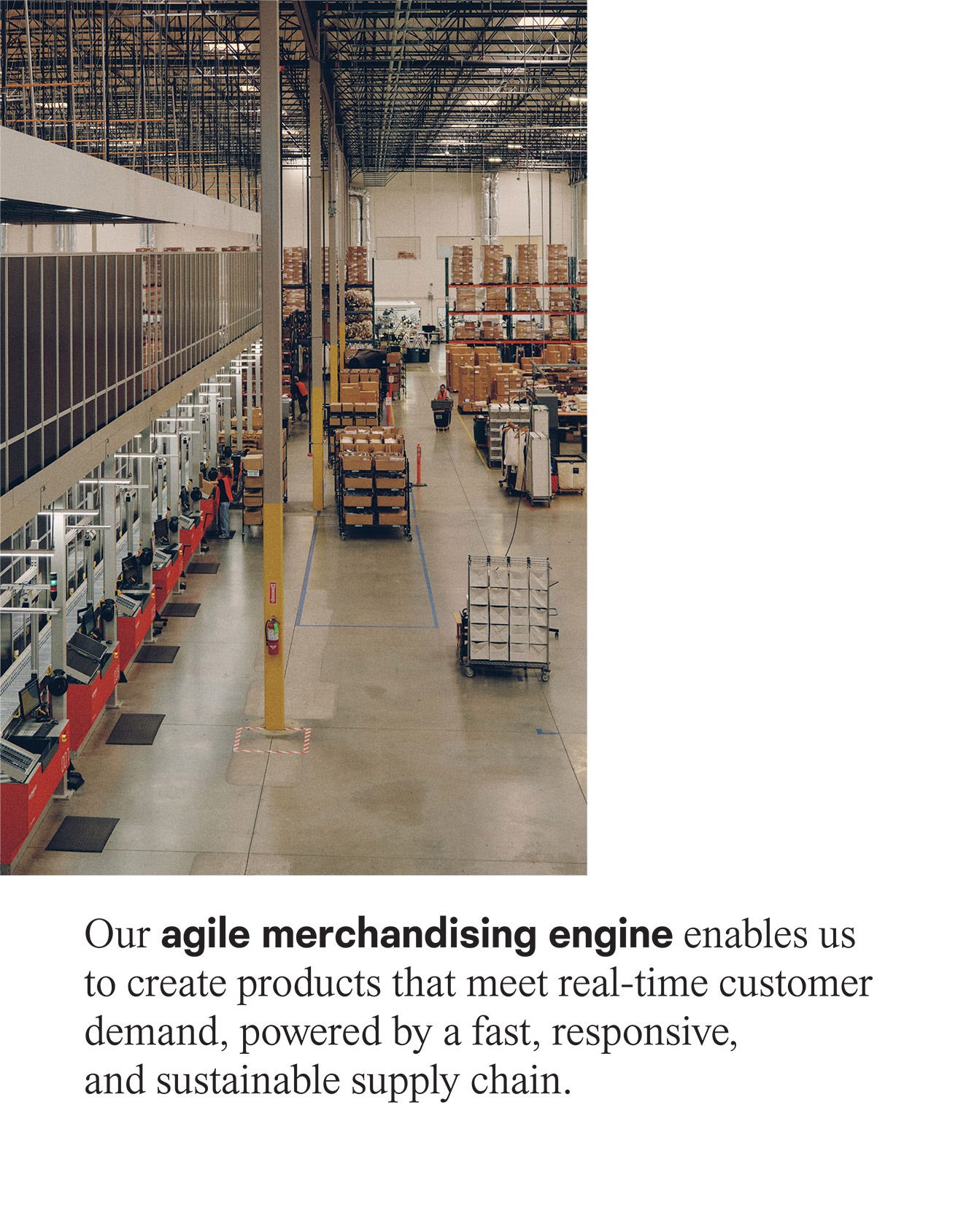
Speed is the entire point. Most apparel brands commit to inventory months before they know what will sell. That single lead time is responsible for a large share of the markdown activity in the category, because you are placing bets long before the customer votes. Reformation compressed that distance. It produces new styles in small initial quantities, watches how they perform, and reorders the winners. Short lead times turn the supply chain into a feedback loop, where each production run informs the next.
I think about this constantly when I see brands at $30M or $50M that are fully outsourced overseas with long lead times and min leverage on input costs. Every tariff change, every freight swing, every trend they missed by a season flows straight through to the P&L. There is little buffer. Reformation’s FY25 gross margin was 60%, and would have been closer to 64% without the IEEPA tariff drag. Even carrying that tariff pressure, the margin holds because the model wastes very little.
I recognize this is hard to replicate at small scale. The takeaway is simpler than building a factory: lead time is a financial variable. Bringing one finishing step closer to home, shortening a reorder cycle, or producing a test batch before a full run all reduce the distance between demand and supply, and that distance is where future float and margin can be protected.
The materials side reinforces the same discipline. Reformation has built its sourcing around deadstock and lower-impact fibers for years, and the vast majority of its 2025 line uses fibers it rates as preferred. Producing in small runs, closer to demand, means the company buys less fabric speculatively and throws less of it away. The company has also said it can deliver a large share of its products within a matter of weeks of design, and can accelerate further when a style starts to move. Speed of production and restraint in sourcing are usually treated as competing goals in apparel. Here they are outputs of the same system.
The S-1 gives merchandising its own dedicated section, which is itself worth noting. In a filing most people read for growth and margin, they chose to explain in detail how it decides what to make and in what quantity. This is an economic moat.
The mechanics are precise. New styles launch in small quantities twice a week online and once a week in stores. Sales signals come back within hours. Pre-order and waitlist functions gather demand signals before a product has even reached the distribution center. Machine learning helps allocate inventory to the right stores. The result is that roughly 90% of 2025 DTC apparel net rev came from styles informed by past performance, which lowers fashion risk and waste and raises the company’s confidence in each style before it commits capital to it.
That system shows up as a single, telling number: close to 80% of DTC net rev sold at full price, held roughly steady from 2021 through 2025. Discounting is the easiest lever in apparel, and Reformation mostly does not need it, because the scarcity model keeps the assortment current and the inventory clean.
I have argued for a while that merchandising matters more than paid media after a certain size and scale is obtained by an apparel brand. Paid media rents attention. Merchandising is what earns the second purchase, protects the margin, and compounds into a “brand.” Most DTC apparel brands that stall have treated their stalled growth as a marketing problem and spent their way at it, when the real issue was upstream: an assortment that had grown incoherent, a planning process that could not tell them what was working fast enough to act. Reformation built the upstream first, and it is the reason the paid-media treadmill never became the whole business.
A merchandising engine only matters if the assortment behind it is designed with intent, and this is where the S-1 gets interesting for anyone building a catalog.
Reformation’s product mix does two things at once. Certain categories bring in new customers, and others deepen the relationship. Tops and sweaters acquire a disproportionate share of younger customers, while denim and bottoms bring in older ones. Roughly 37% of Gen Z customers acquired in the last two years came in through tops or sweaters, and about 25% of Gen X and older came in through denim or bottoms. Those are acquisition wedges, the apparel version of a hero SKU: a focused entry point that solves a clear need and does the work of bringing someone into the brand.
The retention side is where the model compounds. About 74% of 2025 DTC net rev came from customers who bought more than one category. Among repeat orders, 78% contained more than one category, and 68% contained a category different from the customer’s first purchase. In other words, the brand is systematically graduating a dress customer into denim, a denim customer into knitwear, and so on. It’s like the catalog functions like a curriculum. You enroll the customer with a category that acquires efficiently, then sequence them into adjacent categories over time.
Price architecture supports the same logic. Points range from about $40 to $1,500, which gives the brand an accessible entry and an aspirational ceiling under one roof, and an AOV of $315 in 2025. The company has also signaled category expansion ahead, including intimates, based on customer demand.
I push the brands we work with toward exactly this structure: identify the products that acquire, the products that retain, and the products that carry margin, and build the site, the assortment, and the lifecycle marketing around those roles. Most brands add SKUs because a buyer or an investor asked what is next, and the catalog sprawls without a job for each product. Reformation’s assortment reads like every category was added with a specific role in the customer’s journey.
For a brand that is 90% DTC, the store strategy is doing more than most observers assume.
Reformation operates about 70 stores across the US, UK, Canada, and France, up from 14 when Permira invested in 2019. Roughly 75% of them run the company’s Retail X format, a showroom model where one sample of each style is on display and customers build a fitting room from a touchscreen. Those stores produce about 8.5% higher AOV and roughly 270 bps higher conversion than the rest of the fleet, and the format is capital-light relative to a traditional store because it holds far less floor inventory.
The more important number is what stores do for the whole system. Customers who shop both online and in store spend about 3X more than single-channel customers, and customer acquisition in a market rises by as much as 6x in the year after a store opens. A store does more than book its own sales. It works as an acquisition and retention engine that lifts the DTC business around it, and the fitting-room data feeds back into the merchandising loop.
This is the part smaller brands tend to get wrong in both directions. Some open stores too early, treating them as revenue when they cannot yet carry the fixed cost. Others avoid physical retail entirely and leave the acquisition and data benefits on the table. Reformation’s retail footprint is still concentrated on the coasts, which the company frames as room to grow domestically in the Midwest and South, and internationally. The stores that already exist are earning their place by making the customer more valuable, and that is the test worth applying before opening one.
Reformation has been carbon neutral since 2015 and has built its brand around sustainability from the start, using deadstock and lower-impact fibers and publishing the environmental footprint of its products. It is easy to treat this as marketing, and for many brands it is.
The record for values-first DTC is mixed. Allbirds built a similar sustainability-led story and never reached profitability, and recently sold itself for a fraction of its former value. The difference with Reformation is that the sustainability sits on top of a business that already works. The deadstock and small-batch approach is the same discipline that produces the full-price sell-through and the low markdown rate, described from the environmental side. The values and the economics point at the same operating behavior.
That points at the deeper question in this filing, which is whether the DTC model itself is durable at scale. For years the consensus has drifted toward the view that DTC is a customer-acquisition strategy that eventually needs wholesale and retail to survive. Reformation is a counterweight. It reached $500M with 90% of revenue direct, a profitable P&L, and a brand strong enough to sell at full price. The durability came from owning the customer relationship, the data, and enough of the supply chain to act on what the data says.
There is a wholesale piece, 142 doors, but it plays a supporting role while the direct relationship remains the engine. The brand has built the operating capability to run that direct business profitably at a size where most peers have already diversified away from it.
I paid close attention to the balance sheet here, because the operating story is strong enough that it is easy to skip past it, and that is usually where the risk hides.
Adjusted EBITDA was approx $45M in FY25, or 8.9% of net rev. In June, eight days before filing, the company added $92M in new term loan commitments and used roughly $90M of it to pay a dividend to existing stockholders. Reporting on the filing indicates IPO proceeds are aimed largely at paying that debt back down, along with a share buyback.
A few things are worth holding in view at once. The incremental term loan alone is roughly two times adjusted EBITDA, and Reformation has carried debt from the 2019 Permira buyout before this, so total funded debt is higher than the $92M headline. The exact figure, the cash balance, and net leverage live in the capitalization table and the liquidity section of the filing, and anyone forming a view should read them there directly. I would not call the debt alarming, and I would want the full picture before calling it conservative.
The more useful lens is coverage. A profitable business that sells about 80% of its product at full price, with low markdown risk and a decent share of new customers arriving through unpaid channels, generates fairly predictable cash, and predictable cash is what makes a given level of debt serviceable. The pressure points are the ones the filing already flags. Tariffs pressured gross margin, which came in around 60% against 64% excluding their impact. Net income fell to $12.6M from about $33M. The store expansion carries real capex. Adj EBITDA of $45M does not all convert to free cash once you fund new stores and service the debt, so the margin of safety is thinner than the growth rate suggests.
There is also a question of sequencing. The company added leverage to pay its owners, then filed to raise public equity that will in part remove that leverage. New public shareholders help de-lever a payout that has already gone to existing holders. This is common in sponsor-backed IPOs, and it is not a mark against the business. It does say something about capital allocation priorities heading into the offering, and it means the IPO is doing balance-sheet repair as much as it is funding growth.
My read, while staying pragmatic: this is a sound business carrying a normal amount of pre-IPO balance-sheet activity around a liquidity event. The operating model is what supports the debt, and the operating model is clear and strong. The thing I would watch after the IPO is how much clean balance-sheet capacity is left for the international and category expansion once the debt is paid down, because that expansion is the growth case, and it is easier to fund from cash flow and a light balance sheet than from a heavy one.
The first thing is that the ceiling is a property of how you build, not of the channel. The brands that stall at $50M and the brands that pass $500M are often selling into the same market with similar products. What separates them is upstream: the lead time in the supply chain, the speed of the planning loop, the coherence of the assortment. Reformation spent 10+ years on those layers, and the filing is the first time most people get to see them.
The second is that the pieces reinforce each other, the way they did for the businesses I find most durable. A short supply chain enables small-batch testing. Small-batch testing feeds a thoughtful merchandising and planning. Strong merchandising produces full-price sell-through and clean inventory. Clean inventory and healthy margin enhances balance sheet quality, fund the stores and the international expansion. The stores generate more customers and more data, which makes the merchandising sharper still. It is a loop, and each part is weaker alone than it is inside the system.
The third is about what sustainability means when it is real. For Reformation the environmental position and the financial position are the same behavior seen from two sides. Making less, making it closer to demand, and selling it at full price is good for margin and good for waste at the same time. That alignment is rare, and it is more durable than a values story bolted onto an ordinary supply chain.
The ceiling most emerging DTC apparel brands hit is real, but it is a limit of a particular way of building, not of DTC as a model. The brands that pass through it tend to have quietly rebuilt the parts of the business that do not show up in a typical brand deck. Reformation did that work over 15 years, and the machine underneath the brand is what decides how far the brand can still go.
Link to the S-1 is here.
No posts
Comments
Nothing yet. Say the first thing.
Sign in to join the conversation.