
A good friend and executive coach shared an observation with me a while ago that I haven’t been able to shake. He said: “The thing that got you here is the thing that will hold you back.” He was talking about me, specifically, in a moment where I needed to hear it. I’ve since watched that same observation apply to many founders my team has worked with. The quality that made them successful in the early years becomes the constraint that limits them in the later ones.
The strength of the founder is the weakness of the business.
I keep coming back to this line. It sounds like a paradox, and it is one. The person who willed the company into existence, who made every early decision, who carried the business through its most fragile period on instinct, energy, and personal conviction... that same person, operating in the same way, can become the ceiling the company grows into.
I want to acknowledge that much of my thinking on this topic has been shaped by founders and CEOs that I consider “intellectual sparring partners” and executive coaches I’ve worked with over the years. Their frameworks, their patience, and their willingness to hold up a mirror when I didn’t want to look have sharpened the way I see these patterns. This is not a novel idea. The best thinking on founder evolution has been developed by people who study it professionally. I’m adding my lens as someone who has lived through parts of this arc and advised others through the rest.
This comes up in our advisory work. Founders running $20M, $50M, $100M businesses who are still approving ad creative. Still in the weeds on packaging decisions. Still the bottleneck on every decision. They know it, usually. They can articulate it with clarity. And the behavior persists, because the identity that built the company is the same identity that resists letting go of it.
What I want to explore here is the arc. The journey from founder to CEO to, ultimately, capital allocator. Each stage requires a fundamentally different relationship with the business. Each transition demands that the founder let go of the thing that worked in the prior stage. And each one, done well, compounds the value of everything that came before it.
Every company begins with a player. Someone who does the work. In the early stage, the founder is the product team, the sales team, the ops team, and the finance function. The org chart is fiction. The founder occupies every seat because there is no one else, and because the business cannot yet afford the luxury of specialization.
This is the stage where instinct matters most. The founder who can formulate a product, negotiate a co-packer, design a label, build a Shopify site, run paid media, and manage cash flow in the same week has an enormous advantage over the founder who needs to hire specialists for each of those functions. Speed is an asset. Capital is scarce. The margin for error is thin. The player who can move faster than the constraints of the business allow is the player who survives.
The skill set that defines this stage is execution. The founder knows every detail because they touched every detail. They can answer any question about the business because they are the business. When a customer has a problem, the founder fixes it. When a shipment goes wrong, the founder is on the phone resolving the issue. When the cash is tight, the founder moves money between accounts at midnight.
I see this up close... (I’ve done this myself). The founders who make it through the first $1M, $3M, $8M in revenue are almost always extraordinary individual contributors. They outwork, outlearn, and outmaneuver competitors with more resources because they are willing to do things that don’t scale, every day, for years.
The problem is that the skills which produce $8M in revenue are the same skills that prevent the company from reaching $30M. The founder who built the business by being the best operator in the room has trained the organization to depend on them for every meaningful decision. The business runs at the speed of one person’s bandwidth. When that person is exceptional, the bandwidth is high. It is never high enough.
The transition from player to player-coach is the first real test of founder evolution. It is also where most founders get stuck, sometimes for years.
The player-coach is still doing the work. They are also, simultaneously, trying to build people and systems around them that can eventually carry the work forward. This is the stage where the founder makes their first senior hires, typically a VP of Marketing, a VP of Operations, etc. Each hire is an act of faith. The founder is handing over a function they built, know intimately, and can probably still do better than the person they just hired.
That last part is the trap. At $10M or $15M in revenue, the founder almost certainly can do the work better than the new hire. They know the customer more deeply. They understand the product more intuitively. They have context that takes months to transfer. The temptation to intervene is constant, and it is usually justified on a case-by-case basis. Each individual intervention makes sense. The pattern of intervention is what causes the damage.
I see this play out in a specific way. The founder hires a VP of Marketing. The VP develops a strategy. The founder reviews the strategy and sees 3 things they would do differently. They provide feedback. The VP adjusts. The founder sees 2 more things. More feedback. The VP adjusts again. By the 4th iteration, the strategy is essentially the founder’s strategy executed by someone else. The VP has learned that the fastest path to approval is to anticipate what the founder wants and deliver it. The organization has gained a pair of hands. It has not gained a mind.
This dynamic compounds. The VP stops bringing original thinking because original thinking gets revised into the founder’s version anyway. The team below the VP calibrates to the same pattern. Within a quarter, the entire function is operating as an extension of the founder rather than as an independent capability. The founder is still the player. They’ve just added a coaching title to the jersey.
The failure mode is subtle because the work still gets done. Revenue still grows. The quarterly numbers look fine. The founder feels productive because they are involved in everything. The cost is invisible in the current quarter and structural over time: the organization is not developing the capacity to operate without the founder’s direct involvement.
I’ll raise my hand here. I’ve made this mistake. The instinct to stay close to the work is strong, especially when you’ve done it before. The hardest lesson was learning that the goal of the player-coach stage is to make yourself unnecessary, and that this feels like loss before it feels like progress.
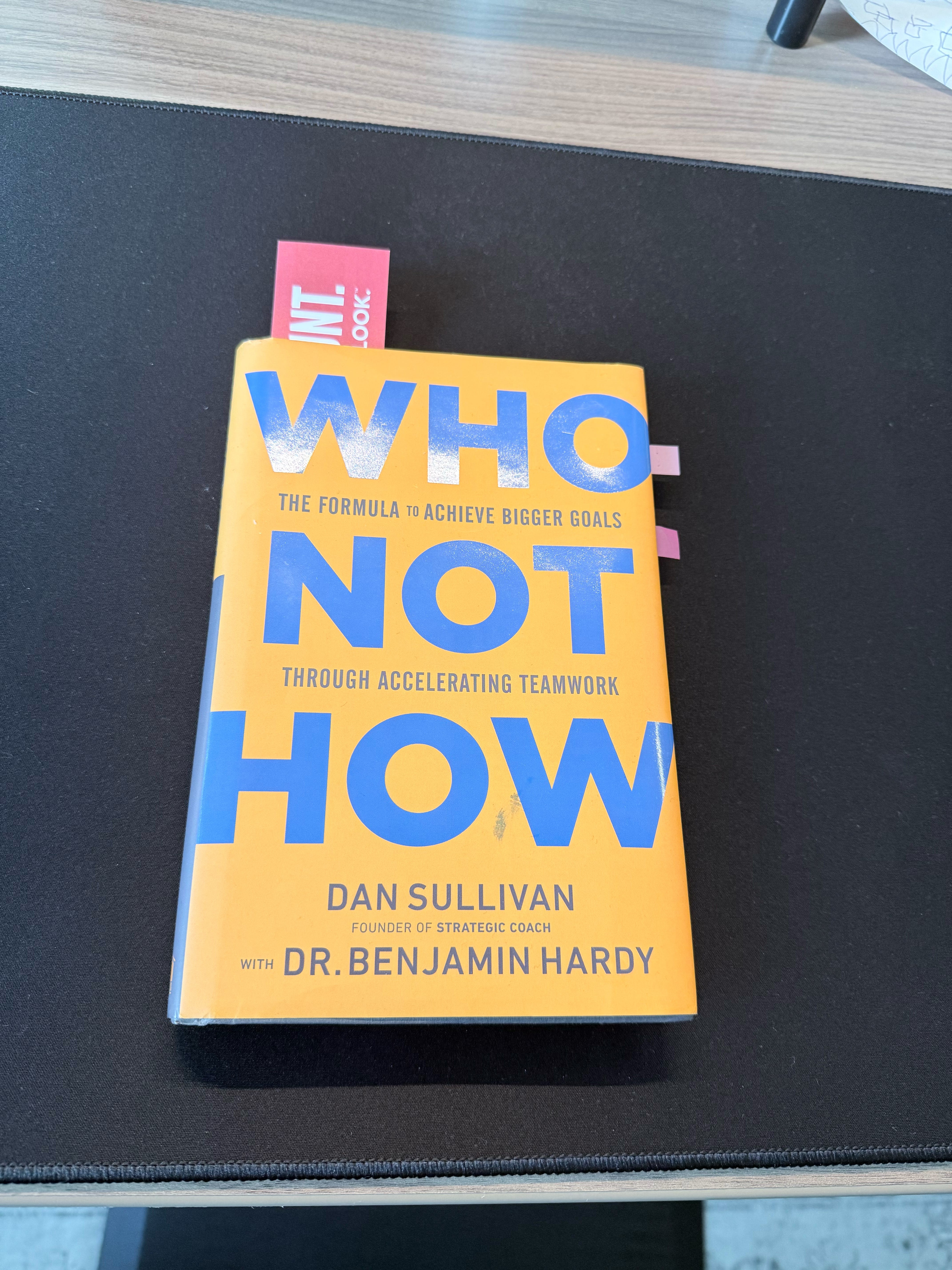
Dan Sullivan’s “Who Not How” (book link) captures something I wish I had internalized earlier in my commercial journey as a founder. The premise is deceptively simple: when you face a challenge, the instinct is to ask “how do I solve this?” Sullivan’s argument is that the better question is “who can solve this for me?”
The shift sounds minor. In practice, it rewires how a founder relates to the entire business.
The “how” mindset is the player’s mindset. Every problem is a personal challenge. Every gap in the organization is an invitation to learn a new skill, stay up later, work harder. The founder who asks “how do I build a better supply chain?” ends up spending 6 months learning logistics at the expense of everything else they should be focused on. The founder who asks “who already knows how to build the supply chain we need?” makes a hire, gives them ownership, and redirects their own time toward the 2 or 3 things only they can do.
Sullivan frames this as a freedom question. Freedom of time, freedom of money, freedom of purpose. The founder who tries to be the “how” for every function in the business is the founder whose time is fully consumed, whose energy is scattered, and whose highest-value contributions get crowded out by work that someone else could do as well or better.
I think about this framework often when I see founders who are technically capable of doing everything in the business and, precisely because of that capability, are doing too much. The very skill set that made them a great player becomes the reason they can’t let go. They know they could do it better. And Sullivan’s insight is that “better” is the wrong metric. The right metric is whether the “who” they’ve empowered can produce results that move the business forward, freeing the founder to operate at the level the business actually needs them.
The “who not how” shift is what makes the transition from player-coach to coach possible. It is also what separates the founder who builds a $30M business that depends on them from the founder who builds a $100M+ business that doesn’t.
The transition from player-coach to coach is where the founder’s relationship with the business fundamentally changes. The coach is no longer doing the work. The coach is building the system that produces the work.
This is the stage where the founder shifts from evaluating outputs to designing inputs. The questions change. Instead of “is this campaign good enough?” the question becomes “do we have a marketing team that can consistently produce campaigns at the quality standard the brand requires?” Instead of “why did this shipment go wrong?” the question becomes “do we have an ops infra that catches shipment errors before they reach the customer?”
The distinction sounds semantic. In practice, it changes everything about how the founder spends their time.
A coach spends time on org design. Reporting structures, meeting cadences, planning cycles, performance systems. The infrastructure that most founders find unglamorous and that, when built well, creates the conditions for sustained performance. A coach builds a weekly operating rhythm that surfaces problems early. They design a planning process that connects annual strategy to quarterly priorities to weekly execution. They create accountability structures that work when the founder is in the room and, critically, when the founder is not.
The emotional challenge of this stage is real. The founder who was the best player on the team is now watching other people play. The plays they would have run differently. The mistakes they would have caught earlier. The instinct to step back onto the field is powerful, especially during a crisis. And the team is watching to see whether the founder will actually let them play or will take the ball back when things get difficult.
I’ve observed that the founders who navigate this transition successfully tend to share a common trait: they redefine what “good” means. In the player stage, good means the work is excellent. In the coach stage, good means the system produces excellent work reliably, even when the output of any individual project is slightly below what the founder would have produced personally. The willingness to accept 85% of what you would have done, delivered by a system that can scale, over 100% of what you would have done, limited by your own capacity... that tradeoff is the entire game at this stage.
The companies that stall between $10-30M in revenue are almost always companies where the founder has not made this transition. The business has outgrown the player-coach model. The founder is stretched across too many functions. Senior hires cycle in and out because they don’t have the autonomy to actually lead. The organization operates in a perpetual state of dependency on one person’s judgment, bandwidth, and energy. Revenue growth slows, and the founder works harder, which deepens the dependency rather than resolving it.
I talk about this often with my team and with our clients: companies don’t grow because of their ability to do sales and marketing. They grow because of their ability to transpose leadership capacity.
The sales and marketing can be excellent. The product can be excellent. The demand can be there. And the business will still plateau if the founder has not built leaders who can carry the weight of the next stage. Growth is a leadership problem before it is a revenue problem. The company that can develop, retain, and empower leaders at every level is the company that compounds. The company that depends on one person’s capacity, no matter how extraordinary that person is, will always hit the same ceiling. The revenue number where it happens varies. The pattern does not.
The GM stage is where the founder begins to manage the business as a portfolio of functions rather than a collection of tasks. The shift here is from “how do we execute well” to “how do we allocate resources across competing priorities.”
A founder operating as a GM is making decisions about where to invest and where to pull back. Which function gets the next hire. Which initiative gets funded and which gets shelved. Whether to invest in brand building or performance marketing. Whether to deepen the existing channel mix or open a new one. Each of these is a resource allocation decision with an opportunity cost, and the founder’s role is to make those tradeoffs with a clear view of what the business needs over the next 12-24 months.
This is also the stage where the founder’s relationship with the financials mature. In the player stage, the founder thinks about revenue. In the player-coach stage, the founder thinks about revenue, margin, operating leverage and more. In the GM stage, the founder thinks about return on invested capital. The question shifts from “are we growing?” to “is the capital we’re deploying generating an adequate return relative to the alternatives?”
A consumer brand at $40M in revenue with 15% EBITDA margins is generating roughly $6M in operating profit. The GM’s job is to determine where each incremental dollar of investment produces the highest return. $1M into product development that improves gross margin by 200 bps across the line. $500K into a supply chain hire that reduces DIO by 15 days and frees working capital. $2M into wholesale expansion that adds $8M in top line at lower margin but diversifies channel concentration. Each of these has a different return profile, a different risk profile, and a different time horizon. The ability to evaluate them against each other, clearly and without emotional attachment to any single function, is what defines the GM.
The emotional challenge here is different from the coach stage. At the coach level, the founder had to let go of doing the work. At the GM level, the founder has to let go of being the expert. A GM managing 5 functional leaders cannot be the deepest domain expert in any of those functions. The VP of Marketing knows more about marketing. The VP of Ops knows more about the supply chain. The Head of Finance knows more about working capital structure and float. The GM’s value is in synthesis, in seeing the connections between functions that no individual leader can see from within their domain. The GM who insists on being the smartest person in every room is the GM whose team stops bringing their best thinking.
I think about this when I see founders at $30M, for example, who still lead every product meeting, still review every detail in a model, still make the final call on every hire below manager level. The organization has grown, the revenue has grown, and the founder’s operating model has not changed since $10M. The result is an executive team that looks senior on paper and operates like a group of individual contributors waiting for direction.
The terminal state of founder evolution is capital allocator. This is where the founder’s primary job becomes deciding how the business’s resources (cash, people, time, attention) get deployed across the highest-return opportunities available.
A capital allocator thinks about the business the way an investor thinks about a portfolio. Every dollar has an opportunity cost. Every hire is a bet on a future return. Every strategic initiative competes for a finite pool of organizational bandwidth. The capital allocator’s job is to ensure that the business is deploying its resources toward the outcomes that maximize long-term value, and to have the discipline to pull resources away from initiatives that are consuming capital without generating adequate returns.
This framing connects to something I’ve written about before (link: capital structure essay). Capital structure shapes the operating temperament of a business. The founder who has evolved into a capital allocator understands this intuitively. They see every major decision through the lens of what it does to the balance sheet, the cash conversion cycle, and the company’s optionality over a 3-5 year horizon.
The capital allocator asks questions the earlier versions of the founder may not have had time to reflect on. Should we use our FCF to retire debt, invest in capacity, or return capital to shareholders? If we raise equity, what does the dilution cost us relative to the strategic value the capital creates? Should we acquire a complementary brand, or would organic investment in our existing portfolio generate a better risk-adjusted return? Is this hire a $200K annual investment that generates $1M+ in incremental value, or is it an opex disguised as growth?
The distinction between organic and inorganic growth is where capital allocation thinking becomes most visible. A founder at $50M in revenue generating $7M in EBITDA and $4M in FCF faces a real choice. That $4M can fund an incremental $15M-$20M in organic revenue growth through new product development, channel expansion, and additional headcount. Or it can fund the acquisition of a $10M revenue brand that brings a complementary customer, a new category, or a distribution relationship the parent company would take 2 years to build on its own. The math on each path is different. The risk profile is different. The time horizon is different. The capital allocator’s discipline is in evaluating both with the same rigor, without a reflexive preference for one over the other.
The organic path compounds slowly and carries lower execution risk. The founder knows the business, knows the market, and controls the variables. The inorganic path can compress 2 years of development into a single transaction, and it introduces integration risk, cultural risk, and the possibility that the acquired business performs differently inside the parent than it did as a standalone. I see founders default to organic growth because it feels safer, even when the return on an acquisition is clearly higher. I see other founders chase acquisitions because they’re more exciting, even when the organic opportunity is staring at them. The capital allocator evaluates both paths through the same lens: risk-adjusted return on capital deployed, measured over a time horizon that reflects the actual investment.
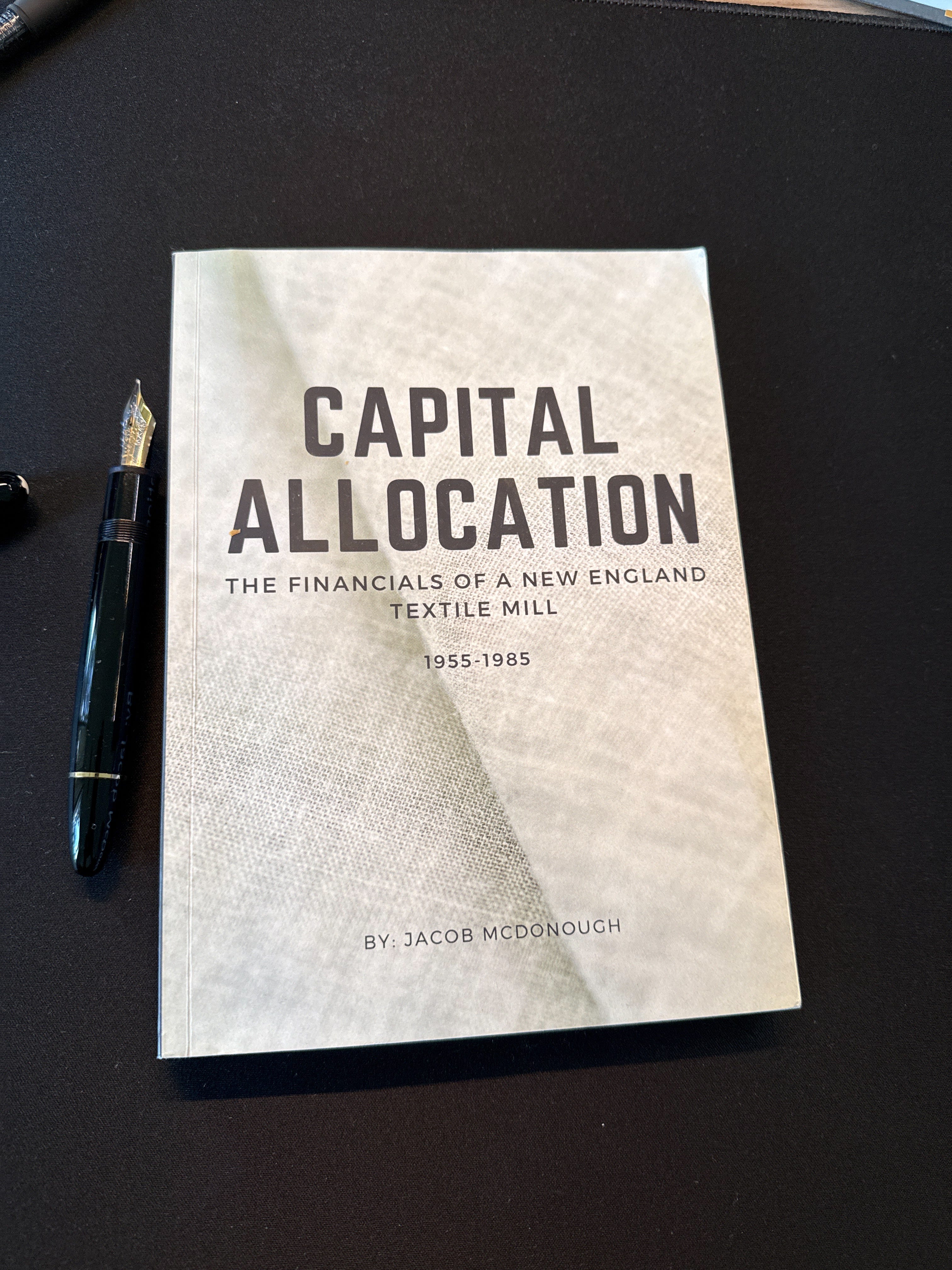
Jacob McDonough’s “Capital Allocation: The Financials of a New England Textile Mill” is one of the best books I’ve read on this topic (book link). It tells the Berkshire Hathaway story through the actual financial statements an investor would have seen at the time, from 1955 - 1985. What makes it remarkable is the granularity. You see Buffett, in real time, making the decisions that most people only study in retrospect. The textile business was generating cash. The cash was declining. The returns available inside the textile operation were poor relative to what Buffett could earn by deploying that same capital elsewhere.
The discipline author documents is specific and instructive. Buffett did not sentimentalize the textile business. He did not hold onto it because it was the original asset, the thing that started everything. He recognized that the business was a source of capital, and that his job was to allocate that capital toward the highest available return. When See’s Candies appeared, the math was clear. When the insurance float became available through National Indemnity, the math was clear. Each allocation decision was made on the merits, evaluated against alternatives, and executed without emotional attachment to the prior deployment.
The author describes it well: if you want the ESPN highlights of Berkshire, read the biographies. If you want the game film, the play-by-play that players and coaches study, read this book. The lesson extends far beyond Berkshire’s scale. A founder at $30M or $100M faces structurally similar decisions. The numbers are smaller but the discipline is identical. Should I reinvest this dollar into a business that is generating a declining return, or should I deploy it somewhere the return is higher? That question, asked consistently and answered honestly, is what separates a capital allocator from someone who is simply running a business.
Most of us mortals will never manage a business at Berkshire’s scale. The principle is identical at $30M or $100M. The founder who sees their business as a vehicle for capital allocation, rather than as an identity, makes fundamentally different decisions than the founder who is still psychologically fused with the day-to-day operations. The first founder exits a product line that consumes working capital without generating adequate margin. The second holds onto it because it was the original product, because it has emotional significance, because letting it go feels like letting go of who they are.
The reason these transitions are so difficult is that they are identity transitions, not skill transitions.
Learning to delegate is a skill. Accepting that someone else will do the work differently, and that differently does not mean worse, is an identity shift. Learning to read a balance sheet is a skill. Accepting that your value to the business is no longer tied to your ability to execute is an identity shift. Learning to evaluate resource allocation tradeoffs is a skill. Accepting that the company’s future matters more than your role in its daily ops is an identity shift.
Most internet writing on this topic treats these transitions as management challenges: Hire better. Delegate more. Build systems. EOS this, framework that… The advice is correct and also insufficient. The founder who knows they should delegate and continues to pull work back is not suffering from a knowledge gap. They are navigating an identity crisis that no management framework resolves.
The identity that built the company was forged in the early days, when the founder’s personal effort was the only thing standing between the business and failure. That identity was useful. It was necessary. And it became the constraint precisely because it was so successful. The founder earned the right to trust their own judgment above everyone else’s, because for years, their judgment was the best judgment in the room. The transition requires trusting other people’s judgment, and that trust develops slowly, unevenly, and with setbacks that reinforce the original instinct to do it yourself.
I’ve seen founders navigate this transition in different ways. Some do it through coaching or advisory relationships that provide an outside perspective on the patterns they can’t see from inside. You can’t read the bottle label from the inside. Some do it through a crisis that forces the shift (a health scare, a key hire leaving, a quarter where the founder simply couldn’t carry the load anymore). Some do it gradually, over years, through deliberate practice and self-awareness. None of them do it painlessly.
The companies where the founder has completed this arc look different in ways that are hard to quantify and easy to feel.
The executive team operates with agency and a high level of autonomy. Decisions can get made without the founder’s involvement, and the quality of those decisions is consistently high because the system was designed to produce them. The weekly operating rhythm surfaces problems early and resolves them at the functional level. The founder spends their time on the 3 or 4 highest-leverage decisions the business faces in a given quarter, rather than distributing their attention across 30 lower-leverage ones.
The founder’s role shifts to thought partner and sparring partner. They sit with their VPs, their directors, their senior managers, and they think together. The conversation is exploratory, not directive. “Here’s what I’m seeing. What are you seeing?” “Walk me through how you’re thinking about this decision.” “What’s the tradeoff you’re weighing, and where do you need help pressure-testing it?” The founder trusts these people to execute and to make the right call. And when they make the wrong call, as they inevitably will, the founder is comfortable with that too. A few mistakes in the hands of a high-agency operator are the cost of building someone who can eventually run a function, a team or a division. The founder who cannot tolerate mistakes from their team is the founder who will never develop leaders underneath them.
This is the “who not how” principle operating at the organizational level. The founder’s job is no longer to solve problems. It is to ensure that the right people are in position to solve problems, that those people have the authority and the context they need, and that the system reinforces their autonomy rather than undermining it. The best founders I’ve worked with at this stage describe their role as creating the conditions for other people to do their best work. The worst still describe it as making sure things are done right.
The financial profile reflects it. Working capital is managed deliberately, because someone in the organization owns the cash conversion cycle and reports on it regularly. Gross margin is defended, because the operations team has the authority to make sourcing decisions without waiting for founder approval. The capital plan extends beyond the current quarter, because the finance function has the sophistication to model scenarios and present options. The business is bankable, fundable, and acquirable, because the infrastructure is not dependent on a single person.
The culture reflects it too. People stay longer because they have room to grow. Senior hires succeed at a higher rate because they have the autonomy to actually lead. The organization develops institutional knowledge that persists beyond any individual. The business compounds in ways that were structurally impossible when everything ran through one person.
Here’s an interesting contrast. 2 brands at similar revenue, similar categories, similar market conditions. One has a founder who has made the transition. The other has a founder who is still the best player on the team. The first is growing at 20% with improving margins and a team that operates independently. The second is growing at 15% with stagnant margins and a key member that leaves every 6-9 months. The gap widens every year, and the root cause has nothing to do with product quality, market positioning, or competitive dynamics. It has everything to do with the stage at which the founder is operating.
The paradox is that the founder’s greatest contribution to the company is eventually to step back from it. To build something that does not require them in the way it once did. To create the conditions for the business to compound on the strength of its system rather than the strength of one person.
This is uncomfortable to write and, I suspect, uncomfortable to read for founders who are in the middle of it. I am still sharpening my approach to becoming a better leader… it’s a perpetual work in progress.
The early stage rewards heroism. The late stage rewards architecture. The instinct that carried you through the first $15M can become the constraint at $50M. Recognizing that is the beginning of the transition. Making it is the work of years.
The strength of the founder is the weakness of the business. And the founder who understands that, who sits with it, who does the difficult work of evolving beyond the identity that got them here... that is the founder whose business compounds.
No posts
Comments
Nothing yet. Say the first thing.
Sign in to join the conversation.