
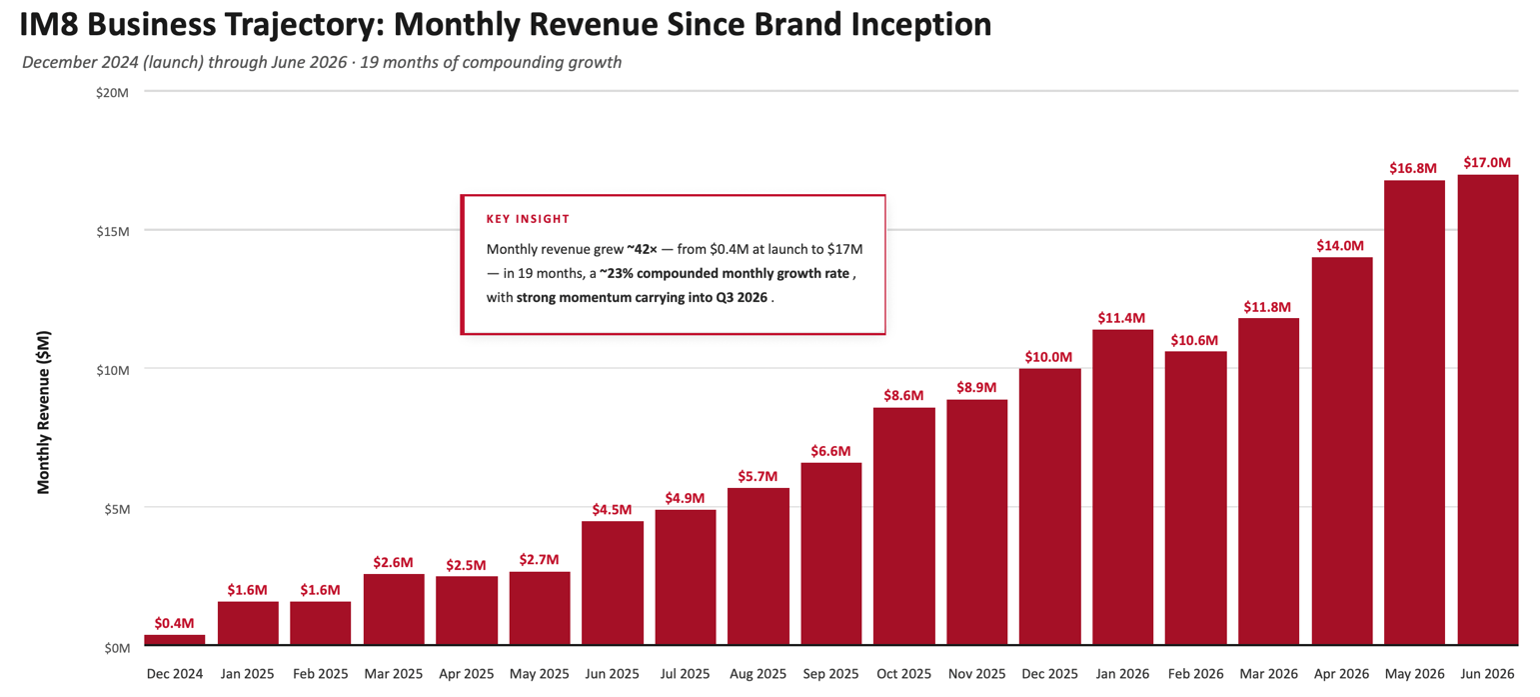
The announcement made the rounds this week, and it read like a milestone the whole category would point to. IM8, the supplement brand co-founded by David Beckham and Danny Yeung, secured up to $1B in non-dilutive growth financing from General Catalyst’s Customer Value Fund (GC CVF), a facility it can draw on at its own discretion to fund up to 70% of its marketing spend. IM8 gives up no equity, no warrants, no convertible notes. The growth numbers underneath are extremely strong: $200M+ of annualized run-rate revenue inside 19 months, 2026 guidance raised to $210M-$220M, and a path the company describes toward $300M of run-rate by year end and past $400M in 2027.
There’s a lot to unpack… What I keep turning over is the structure underneath it, because it sits on top of a question we work through with founders constantly: what kind of capital should pay for growth, and what does that capital actually cost once you model it out.
Non-dilutive capital sounds almost irresistible; esp for growth efforts. You keep your ownership, preserve your cap table, and someone else finances growth. Framed that way, saying “no” feels irrational. This capital carries a real cost, and used well it can be extremely effective. The more interesting question: should marketing and growth be financed this way? If yes, what’s the opportunity cost?
My perspective on capital hierarchy: equity and retained earnings should finance sales, marketing, and operations of the business. Debt should finance the working capital gap: inventory, receivables, the cash trapped between the day you pay a supplier and the day the customer pays you.
The logic underneath is duration and risk matching. Working capital is short, it repeats, and it’s reasonably predictable, so a short contractual obligation fits it, because the asset throws off the cash that retires the obligation on roughly the same clock. Long, uncertain bets belong to capital that can wait and can afford to be wrong, which is what equity financing can support. Most of the financing trouble I see comes from crossing those wires, funding something long-duration and uncertain with something short and fixed, and then watching the asset fail to show up on the schedule the obligation assumed.
This is why (as a best practice) I encourage founders and operators not to use debt to finance growth marketing. Inventory waits in a warehouse and converts on a cycle you can model, which is what makes debt fit it so well. A marketing dollar buys something less certain, a prediction about behavior, that the customer you just paid to acquire will stay, reorder, and eventually return more than they cost. Pair that variable, uncertain payoff with an obligation that has to be paid on time regardless, and when a cohort underperforms the asset softens while the obligation stays fixed. That is where a lot of consumer brands quietly get into trouble.
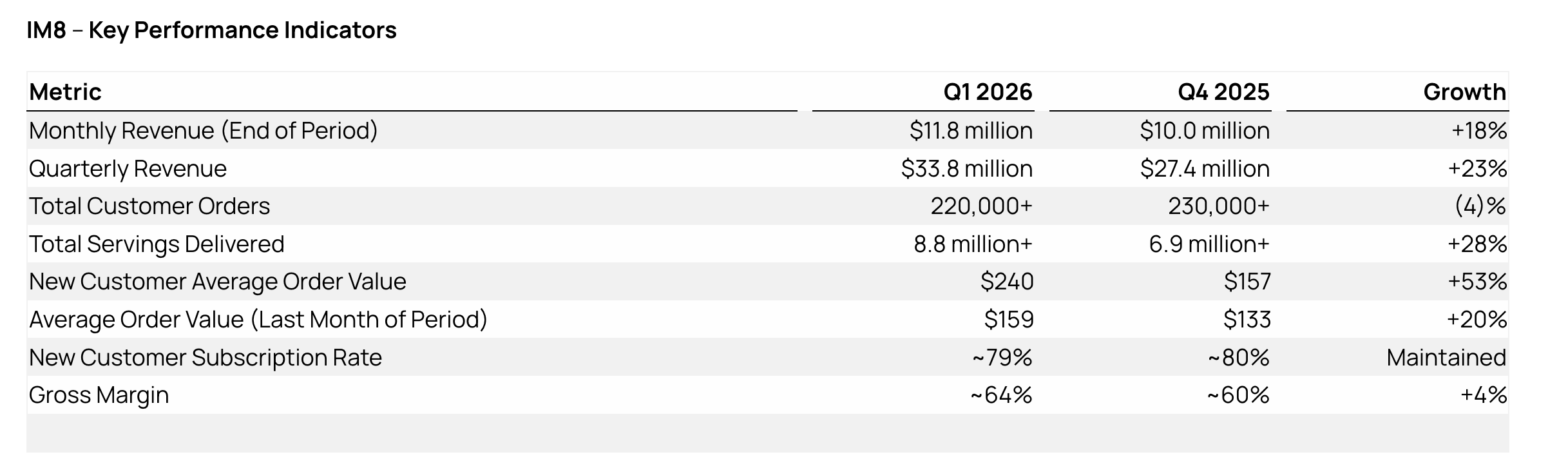
So I expected to read the IM8 terms and disagree with their thesis. What I found was that GC had built its product around the exact objection I had been making, and the reason turns on an idea worth taking seriously. For most brands, growth should be financed via equity capital or retained earnings. A small number of consumer businesses, though, reach a point where the cohort stops behaving like a guess. When CAC payback runs < 90 days, retention holds strong, and gross margins sit in elite territory, a new customer stops looking like a bet and looks more like a receivable. The spend self-liquidates on a known cycle. At that point marketing has quietly crossed into working capital, and my own capitalization hierarchy has to be reconfigured (at least in the instance of a high growth company like IM8).
Financing self-liquidating spend with equity would mean trading permanent ownership of the whole company to fund something that turns in a quarter or two. The dilution lasts forever. The asset can potentially turn in 90 days.
Financing never creates a great business. It only amplifies one.
That crossing is the entire thesis of the deal. Prenetics reports that each dollar invested in customer acquisition has generated roughly $1.44 of cumulative gross profit, blended across its mature cohorts. That is real evidence that the historical spread has been attractive. The harder question, and the one the facility turns on, is whether the marginal dollar deployed at much larger scale keeps producing anything close to it. When the numbers are genuinely that tight, funding the spend with capital cheaper than the return it produces, without giving up equity, keeps the difference for the people who already own the business. I want to be clear that I am not arguing against that. I have watched founders with tight cohort economics get reflexively told “no” by advisors, and the no was wrong. The argument I want to make is narrower, and I think more useful: what this capital actually costs, and whether the “working-capital quality” that justifies it survives contact with scale.
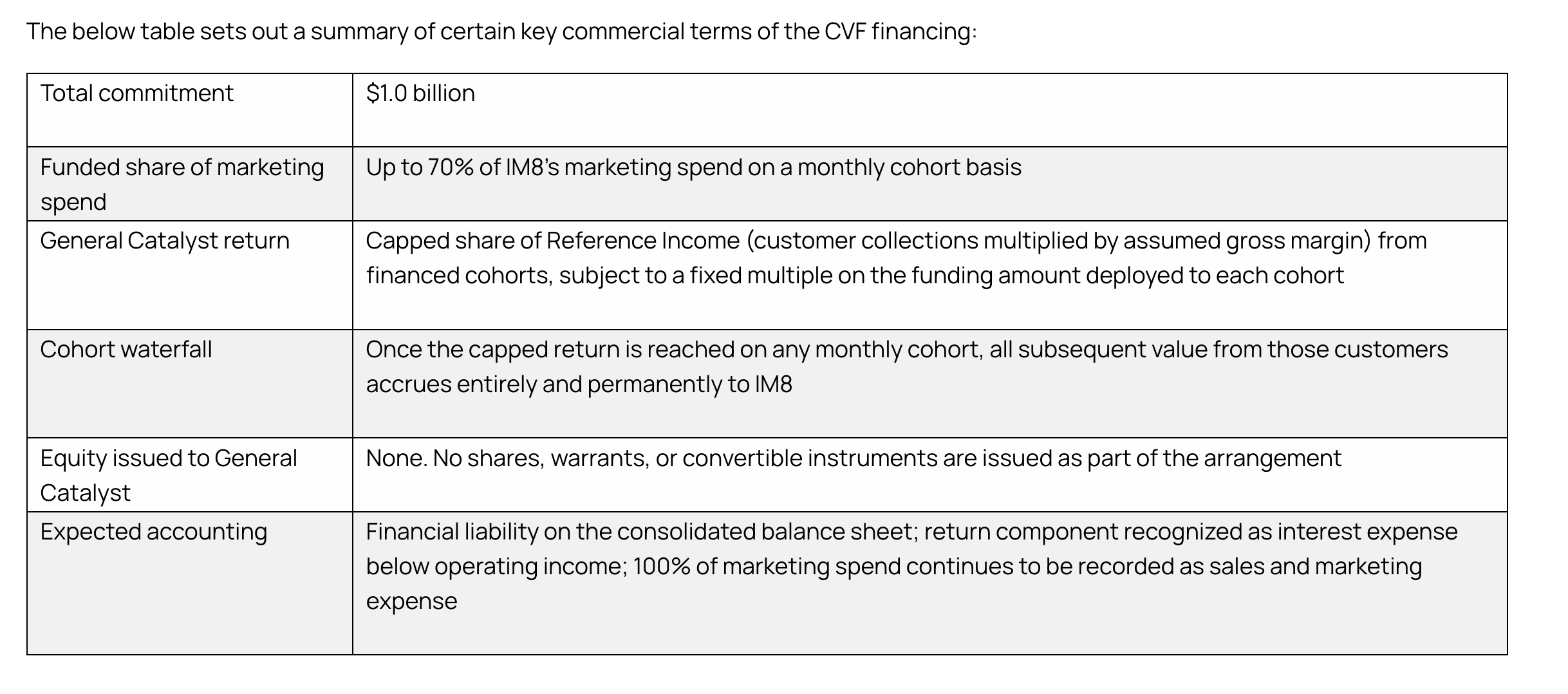
The instruments built for this, GC’s CVF being the most visible, sit somewhere between conventional debt and traditional equity. Each month the fund covers a large share of sales and marketing spend, then collects a slice of the value those newly acquired customers generate, cohort by cohort, until it has earned back a capped multiple of what it put in. After the cap, the cohort reverts to the company, and the long tail of customer lifetime value is yours to keep. Repayment flexes with performance. There is no fixed schedule, and the fund is paid as the customers pay. If a cohort disappoints, collections slow with it. If a cohort fails, the fund absorbs it. That is the asset-liability match ordinary debt could never give growth spend, and it is a real innovation, which is why the model has spread across a number of companies, Grammarly among them.
The cost hides in that capped multiple, and this is the part operators misjudge, myself included. IM8 disclosed the shape of the deal. General Catalyst takes a capped share of each cohort’s income until it recovers a fixed multiple of the capital it deployed, then steps aside. The company did not put a figure on that multiple, and I won’t guess at theirs. The shape alone is good enough, so take a round, purely illustrative number. Suppose the cap lands somewhere near 1.08x on a cohort that repays within a year. Read as a number on a page, 1.08x looks like an 8% cost of capital. That reading is a mistake.
A multiple is a total, undiscounted figure. It tells you how many dollars come back per dollar in. It stays silent on how fast they come back, and speed is where the real cost lives. Cost of capital is an annual idea. Assume, for illustration, that the premium is collected steadily over the repayment period. Getting 8% more than you put in over 12 months then annualizes into the mid-teens, already roughly double the impression the multiple gives. Shorten the payback, which is exactly what a great cohort does, and the same premium is earned in less time. Repayment in 6 months pushes the annualized cost toward the high 20s, and repayment in a quarter carries an effective annual cost north of 40%. The exact figure depends on the actual collection curve. The direction is the point: a repayment multiple cannot be read as an annual rate, and the faster the money comes back, the higher the true annual cost climbs.
Sit with what that does, because it is more nuanced than it appears. Faster payback means a higher annualized return on the fund’s capital, and it usually signals a stronger cohort, one that tends to create the widest economic spread for the company even after the capital is paid for. As the cohorts improve, so do the fund’s economics, and so does what the company keeps. The job is to maximize the value that remains once the capital is paid for. The real test is simple: do the economics left behind still comfortably exceed the true cost of that capital? That is the spread that matters.
Marketing around these structures leans on the idea that the investor carries the risk, and in part it does. On the terms Prenetics disclosed, GC absorbs any cohort that underperforms, with recovery limited to the revenue those customers produce and no recourse beyond them. IM8 has also said the arrangement carries contractual performance thresholds that every cohort has so far cleared, though the thresholds themselves are not public. I would not assume much more than that. The structure removes a fixed repayment obligation and lets repayment flex with how the customers actually perform. The underlying business risk stays exactly where it was. Capital like this behaves as a kind of “confidence capital”: easiest to access while the acquisition engine is performing, and harder to come by as the economics soften, which is the moment a company would most want it to stay. Balance sheet risk is not obvious. The business still carries the risk that the growth it funds stops paying.
Whether you keep winning depends on something that doesn’t hold still, the predictability itself. It’s highest early, when you are buying the most obvious customers through the cheapest, most incremental channels. IM8 reached more than $200M of run-rate inside 19 months, and I have no doubt those early cohorts look extraordinary. The question the deal is really underwriting is what the next $100M of spend buys, and the $100M after that. Multiply a marketing budget by 5 and you move down the demand curve, into cohorts that look progressively less like your best one. CAC climbs, incrementality falls, payback lengthens, and the working-capital quality that justified the whole structure can begin to erode, right as the financed base is largest. It is entirely possible to run a wide margin on the first tranche of spend and a negative one on the last while the blended numbers, the $1.44, still look healthy, because the strong early cohorts can potentially subsidize the story.
This is the part that, when I first read the IM8 news, felt a little like late-cycle behavior. The pattern is bigger than any one company: structures that finance customer acquisition tend to multiply when capital is abundant and growth is all that matters. We saw this often in the ZIRP era, and companies spent the following cycle retrenching when the predictability they had underwritten turned out to be conditional. The tool did what it was built to do. The assumption underneath it failed, that fast, cheap growth is permanent, and cheap capital lets a company scale that assumption faster than it can test it.
Absolute cost is only half the decision. The other half is the question every brand operator is actually asking: compared to what? The real alternative to GC’s capital is equity, and equity is the most expensive currency a fast-growing company has, because its price is a share of everything the company is worth.
It helps to make that concrete. Suppose IM8 could fund the same growth by selling equity today, and suppose, for simplicity, it costs them 15% of the company at today’s valuation. If the business compounds the way the guidance implies, that 15% is measured against a much larger number in a few years, and the true cost of the capital turns out to be enormous. By comparison, a customer-value structure charging even a 25% annualized return on each cohort can be dramatically cheaper, because its cost is bounded and one-time per cohort, and equity’s cost keeps growing with the company. This is the “capital allocator’s question”, the one I have written about before. Is this dollar better deployed here than anywhere else, and cheaper than the ownership you would give up to fund it. High-conviction founders and brand operators reach for non-dilutive capital because they believe their equity is worth far more than the market will pay for it today, and when they are right, they reap the rewards.
Equity feels expensive in growth stages as the company compounds. It’s also the only capital that shares the pain if it does not, absorbing the loss alongside you, with no fixed obligation and no cohort thresholds tripping at the worst moment. Non-dilutive capital is cheaper than equity when you are right about the spread, and it concentrates the damage on the existing owners when you are wrong.
This construct still governs all of it: return on invested capital against the weighted average cost of capital, the economic spread between the two, is the only test that has ever really mattered, and the choice between dilution and debt and this clever third thing collapses into it. The structure levers whatever spread you already have, and it levers how long that spread lasts as much as how wide it is. It cannot create a spread that was not there.
So the work is unglamorous. Prove the spread on the marginal cohort, the one the facility is actually funding, because the blended average will always flatter you. Watch what happens to CAC and payback as you push spend up the demand curve, and treat your best month as a poor guide to the next one. Sit with the fact that this capital is pro-cyclical, there in the good months and gone in the ones where you would trade almost anything to keep it. Then decide what you actually believe about the durability of the economics, and choose the instrument that fits that belief. A brand that has genuinely earned it should press hard, and non-dilutive capital is a reasonable way to do it. A brand that has not should be quietly relieved that the expensive equity it cannot raise today is protecting it from a mistake it cannot yet see.
What stays with me about the IM8 deal is that it might be exactly right. The marketing may be that good and the spread that durable, and if it is, they will have shown how the high growth subscription based consumer brands ought to fund themselves at their size and scale. None of this is a knock on the structure, which is well built. The caution is subtler. It’s good enough to make the one thing that matters, whether the spread holds, feel like it has already been settled. It has not (yet) been settled. It has to keep being true, cohort after cohort, long after the announcement has stopped circulating.
No posts
Comments
Nothing yet. Say the first thing.
Sign in to join the conversation.