
Foxgloves are one of the most enchanting wildflowers you might encounter in a shady woodland. With their deep pink flowers on spikes that can grow as tall as a person, they certainly arrest the attention.
Even their name is evocative, with a smattering of legends to explain where ‘foxglove’ came from. Yet as pretty as the foxglove (Digitalis purpurea) is, the plant is also poisonous. It’s great for bees, but less so for us.
At least, not if we don’t need the toxins it provides the pharmaceutical industry for heart medicine!
But given their host of folk names, association with witches, and appearance in legend, let’s dig into the folklore of foxgloves.
Remember, this article is for entertainment purposes. It does not provide or constitute medical advice, and any interaction you have with these plants is at your own risk. I’d advise you to look but not touch!
Foxgloves are native to the UK and Europe, and prefer dappled shade and rich soil. Most foxgloves self-seed so there is a ready supply of them.
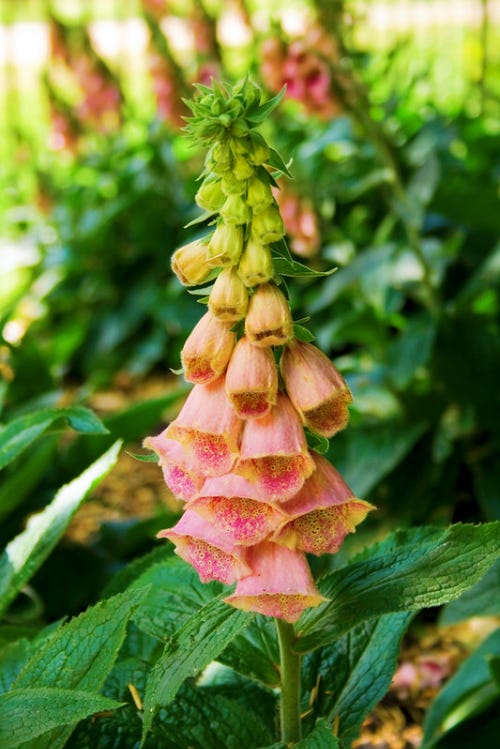
Foxgloves produce a spike of flowers, and the flowers at the bottom open first. That’s why you often see foxglove heads with bells at the top, but nothing further down. They tend to flower around midsummer.
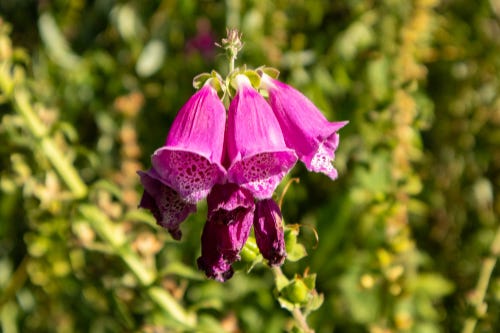
They’re great for pollinators, something Wordsworth noticed in 1802:
“Bees that soar for bloom
High as the highest peak of Furness Fells,
Will murmur by the hour in foxglove bells” (Wordsworth n.d.).
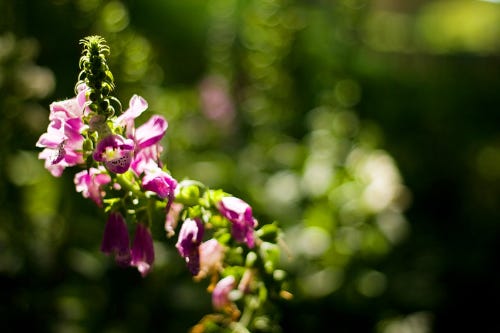
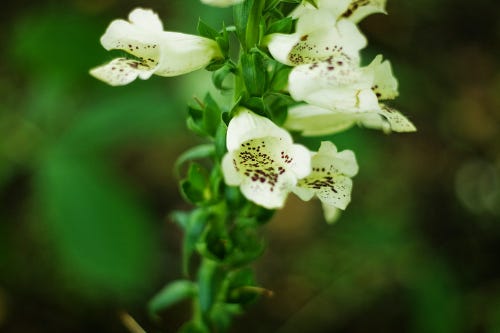
Tiny hairs line the insides of their bell-shaped flowers to help bees crawl inside. Insects might shelter inside them during rain, though animals don’t generally eat them, given they’re poisonous. In one legend, the mottled markings on the plant appeared as a warning of its poisonous nature (Grieve 1995-2026).
In the Victorian language of flowers, in which people allegedly sent messages to each other based on the meanings assigned to flowers, the foxglove represents insincerity (Burke 1867: 24). That’s because it hides a poisonous heart behind a pretty facade.
Richard Folkard includes an ancient floral vocabulary in his book of plant lore and includes foxglove for ‘adulation’ (1892: 185). I’m not entirely sure where this vocabulary came from, or how widespread its use was, but the difference between ‘adulation’ and ‘insincerity’ was stark.
The plant is also known as fairy thimbles, witches’ gloves, and dead man’s bells. According to folklore, if you hear the bells ring, you’ll die soon (Baker 2011: 61).
Other names included fairy cap, fairy petticoat, witch’s thimbles, Gloves of Our Lady, Bloody Fingers, and Virgin’s Glove (Gray 2015: 104; Grieve 1995-2026). In Ireland, it was called lusmore.
In some sources, the name ‘fox glove’ was just a misspelling of ‘folk’s glove’ (Binney 2018: 31).
Yet JRR Tolkien dismisses such links between ‘fox’ and ‘folk’s’. He wrote a letter to Christopher Tolkien in 1944 in which he described how the ‘fox’ part had always been part of the name, contrary to the titles that swap ‘fox’ for ‘folks’ in reference to the fairies. Tolkien notes that the plant was called foxes glófa in Anglo-Saxon, and suggested the association with foxes depended on a lost fable (Kenicer 2020: 91).
There is certainly a range of stories involving foxes and the plants. In one story, fairies apparently taught foxes to ring the bells, warning other foxes of hunters in the area (Binney 2018: 31). Yet another legend sees foxes asking God for protection, so he added foxgloves to woodlands and fields. If the flowers rang, the foxes knew hunters approached (Gray 2015: 104).
Sometimes, the foxgloves were there to help the foxes hunt, not avoid hunters. Another tale claimed that the fairies gave the flowers to the foxes to wear over their paws so the hens in the hen house wouldn’t hear them coming (Binney 2018: 31).
The ‘Digitalis’ part of its botanical name comes from ‘Digitabulum’, which was a thimble or finger protector (Grieve 1995-2026).
Much of its appearance in old herbals sees it mostly used externally, with its bruised leaves applied to sores and ulcers, or added to an ointment. One remedy sees it boiled in wine as an expectorant, but this would be toxic if tried (Grieve 1995-2026).
It was also believed to be useful in treating the ‘King’s Evil’ (scrofula). Scrofula is actually a condition in which tuberculosis bacteria affect parts of the body besides the lungs, particularly the lymph nodes. Nowadays, it is treated with antibiotics. Foxgloves were also called throatwort for the plant’s use in treating throat infections (Gilliam 2008: 30).
More famously, foxgloves provide chemicals for heart medicine. English doctor Will Withering discovered the plant’s properties from a herbalist in the 1770s. He originally developed a cure for dropsy using digitalis, but digitalin (from the leaves) is now used in heart medicine (Laws 2010: 64). A carved foxglove decorated Withering’s memorial after he died in 1799 (Baker 2011: 60).
It’s thought that the ancient Egyptians first discovered the power of digitalis to strengthen the heartbeat (Binney 2018: 31). But dose matters. The cardiac glycosides present in foxgloves can lead to heart arrhythmias within a few hours of ingestion (Mitcheson 2024: 75).
Foxgloves have so much digitoxin in the stems that drinking the water from a vase containing foxgloves could kill a person (Inkwright 2021: 110). According to folklore, digitoxin can also be used to treat aconite poisoning, and we’ll look at aconite next week, though this has not been backed by science. There is no known antidote to foxglove poisoning (Mitcheson 2024: 75).
Poor women in Derbyshire apparently drank foxglove tea in pursuit of its intoxicating effects, although this led to cases of accidental poisoning (Folkard 1892: 345).
Despite its toxicity, planting foxgloves in the garden may grant your house protection by driving away evil spirits. It is also said to attract fairies and according to legend, the white spots inside each bell are marks left by fairies (Inkwright 2019: 71). In some stories, the bending of the stalk indicates a fairy is hiding inside one of the flowers.
But don’t pick the foxglove and bring it inside, as it’ll annoy the fairies. In a cute turn of events, they apparently wear the flowers as hats (Dietz 2020: 77). That said, that may refer to a single story in which that happens, since the Shefro, a fairy in Ireland, apparently wore a foxglove flower as a hat (Folkard 1892: 344).
At one point, people in north Wales used the leaves to darken lines on stone floors to give them a mosaic appearance (Grieve 1995-2026). Alternatively, people in Wales used the dye made from the leaves to paint crosses on stone floors to ward off witches (Inkwright 2021: 106). That last one fascinated me, given the number of sources that describe how much witches apparently delighted in foxgloves and grew them for use in their spells. Was it the foxglove dye, or simply the shape of the cross that warded them off?
People also used its stalks to make parasol handles, while foxglove tea could make cut flowers last longer (Baker 2011: 61).
In Scotland, people considered the foxglove to be unlucky if brought indoors. It was also unlucky to take it on board a ship (Baker 2011: 61).
Its legends extend beyond fairies. According to some variations of a Roman myth, the goddess Juno grew tired of her husband Jupiter conceiving children with other women–but not her. It especially vexed her that he birthed Minerva himself from his own forehead. Juno went to see the goddess Flora, goddess of flowers. She touched a foxglove to her belly and breasts and Juno conceived the god of war, Mars. Despite this, Nicholas Culpeper placed foxgloves under the rulership of Venus, though that might make sense through the plant’s links with the heart (1985: 135).
Foxgloves are also associated with St Nectan in Devon and Cornwall. He was the eldest son of the Welsh King Brychan, but he left home to become a hermit rather than following a royal lifestyle. One summer, two thieves stole a pair of his cows, so he chased the thieves to retrieve the cows. When he caught up with the thieves, they beheaded him, but rather than die so far from home, Nectan picked up his head and walked home. He finally died at his hut, but foxgloves sprang up wherever he spilled his blood on the way back (Inkwright 2021: 108).
A lot of the stories around these plants are telling. Linking the plants with fairies and witches provided an excuse to warn people away from a plant that might be pretty but is incredibly poisonous. In many ways, such tales are an oral example of the public information films of the 20th century.
Its medicinal uses also reveal that poisons, when used correctly, can be used as medicine. As Paracelsus apparently said, “the dose makes the poison”, and while he meant anything could be poisonous at the right dose, in the case of foxgloves, it also demonstrates how crucial dosage is.
If you do want to grow them, then they are brilliant for pollinators, as long as you handle the plants safely. In Europe, foxgloves are part of the ecosystem, and we should respect these plants as neighbours rather than fear them.
Just don’t go ingesting them or bringing them indoors.
Baker, Margaret (2011 [1969]), Discovering the Folklore of Plants, 3rd edition, Oxford: Shire Classics (aff link).
Binney, Ruth (2018), Plant Lore and Legend, Hassocks: Rydon (aff link).
Burke, L (1867), The illustrated language of flowers, London: G. Routledge & Sons.
Culpeper, Nicholas (1985), Culpeper’s Complete Herbal, Ware: Omega Books.
Dietz, S. Theresa (2020), The Complete Language of Flowers: A Definitive and Illustrated History, New York: Wellfleet Press.
Folkard, Richard (1892), Plant lore, legends, and lyrics: Embracing the myths, traditions, superstitions, and folk-lore of the plant kingdom, London: S. Low, Marston, Searle, and Rivington.
Gillam, Fred (2008), Poisonous Plants in Great Britain, Glastonbury: Wooden Books (aff link).
Gray, Samantha (2015), The Secret Language of Flowers, London: CICO Books.
Grieve, Maud (1995-2026), ‘Foxglove’, Botanical.com, https://botanical.com/botanical/mgmh/f/foxglo30.html. Accessed 27 July 2026.
Inkwright, Fez (2019), Folk Magic and Healing: An Unusual History of Everyday Plants, London: Liminal 11 Press (affiliate link).
Inkwright, Fez (2021), Botanical Curses and Poisons: The Shadow-Lives of Plants, London: Liminal 11 Press.
Kenicer, Gregory J. (2020), Plant Magic, Edinburgh: Royal Botanic Garden Edinburgh.
Lawrence, Sandra (2020), The Witch’s Garden: Plants in folklore, magic and traditional medicine, London: Welbeck (affiliate link).
Laws, Bill (2010), Fifty Plants That Changed the Course of History, Hove: Quid Publishing (aff link).
Mitcheson, Fiona (2024), A-Z of Poisonous Plants: The deadly, dangerous & down right bizarre, Peterborough: Jarrold Publishing.
Wordsworth, William (n.d.), ‘Nuns Fret Not at Their Convent’s Narrow Room’, Poetry Foundation, https://www.poetryfoundation.org/poems/52299/nuns-fret-not-at-their-convents-narrow-room. Accessed 27 July 2026.
No posts
Comments
Nothing yet. Say the first thing.
Sign in to join the conversation.