
Aconitum, referred to as ‘aconite’, is part of the Ranunculaceae family, or the buttercup family. The Aconitum genus contains around 100 species, each of which is poisonous. Records of its use date back 3000 years (Mitcheson 2024: 19).
The Anglo-Saxons apparently called it ‘thung’, which meant ‘poison plant’ (Gilliam 2008: 4). The plant also gained the nicknames ‘helmet flower’, ‘friarscap’, ‘old wife’s hood’ and ‘granny’s nightcap’ (Baker 2011: 9).
Given how horrifically poisonous the plant is, it has few medicinal or even magical uses. Yet it still appears in folklore and legend, so let’s explore some of the tales of aconite…
But before we delve into the folklore and legends of these plants, I’d like to remind you that this article is for entertainment purposes and it does not provide nor constitute medical advice. Any interaction you have with these plants is at your own risk. I’d advise you to look but not touch!
Aconite is apparently named after Aconitus Hill, where Hercules fought Cerberus, the guard dog of the Underworld. As part of his 12 labours, he dragged Cerberus out of the Underworld and into daylight, where the dog gnashed the teeth in his three heads. Where the saliva hit the ground, it took root and gave rise to aconite (Mitcheson 2024: 19).
In another legend, Hecate, goddess of witchcraft, pulled the plant out of Cerberus’ saliva. It’s also associated with Hecate through its appearance at crossroads, something over which she presides. Elsewhere in Greek myth, you may have heard the legend in which Arachne boasted she was a better weaver than the goddess Athena. Athena challenged her to a weaving competition, and in many versions of the myth, Arachne won the challenge. In response, Athena threw aconite juice over Arachne, which turned her into a spider (Lawrence 2020: 187).
Theseus was the son of Poseidon, god of the sea, yet also enjoyed royal lineage through his mother’s husband, Aegeus, king of Athens. Theseus travelled around Greece before returning to Athens, where his stepmother, Medea, realised he would displace her son in the line of succession. When sending him to face the Marathonian Bull didn’t work, she switched to poison, giving him wine laced with aconite. Fortunately for Theseus, King Aegeus noticed that Theseus carried the sword Aegeus had left for his infant son, and knocked the cup from Theseus’ hands. Medea fled (Dodds 2022: 143).
Monkshood is the common name for the Aconitum napellus variety. It gets its name due to the shape of the flowers, which apparently look like monks’ hoods. Monkshood is native to western and central Europe.
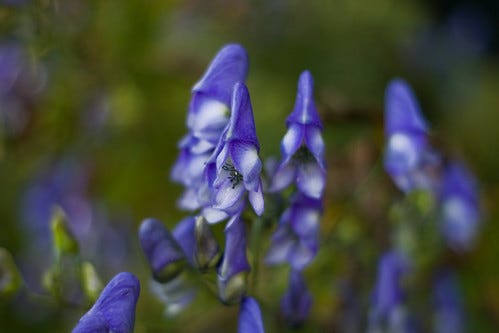
In the Victorian language of flowers, monkshood represents chivalry and knight errantry (Burke 1867: 40). While a link with chivalry might seem odd for such a poisonous plant, the flowers’ helmet shape made people think of knights. It is also sometimes called ‘Devil’s Helmet’, which sounds like a metal band waiting to happen.
Richard Folkard resorts to the doctrine of signatures to explain what different plants might be used for. Using this logic, monkshood “indicates in a most marked manner its poisonous and virulent nature, for its flower represents the skull of a dead man” (1892: 157).
You’ll often see monkshood, wolfsbane and aconite all given as synonyms for the same plant. While aconite refers to the genus, Wolfsbane is the common name of Aconitum lycoctonum, which is related to monkshood.
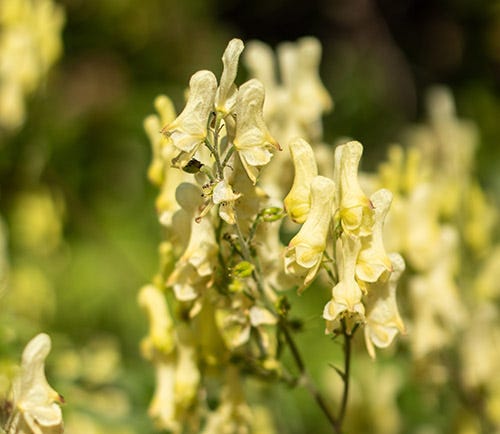
Wolfsbane is also sometimes called foxbane, badger’s bane, St Christopher’s herb, and harebane (RHS). Its flowers can be purple or yellow. Wolfsbane is native to central and eastern Europe.
Its name, wolfsbane, came from its use in dispatching wolves. People laced meat with aconite roots and left it for wolves (Mitcheson 2024: 20). One medieval recipe advised adding powdered aconite and toasted cheese to a flour paste, and leaving it near rat holes to dispose of your rat infestation (Brown 2018: 159).
According to legend, hunters rubbed their arrows in aconite before hunting wolves. Those hunting whales with harpoons in Alaska used it for similar reasons (Lawrence 2020: 187).
Some writers even claim the Nazis used it to poison bullets during the Second World War! (Brown 2018: 159) This also sounds incredibly fiddly so it’s more likely wartime propaganda.
It also appears as the herb of choice to ward off the Count in Dracula (1931). Dracula turns into a wolf in the novel (1897), so that makes sense.
Some scholars think it was aconite that the Viking warriors, the berserkers, took to allegedly become werewolves (Lawrence 2020: 187). This is highly unlikely due to its effects in causing dizziness, heart problems, and stomach pain. That said, the fact it produced numbness when rubbed into the skin might have been vaguely helpful for warriors. I’m just not sure that hyping up a bunch of warriors on a poisonous plant and sending them into battle was a good idea.
On the island of Ceos in ancient Greece, the state used wolfsbane to poison anyone deemed of no use to it (Mitcheson 2024: 20).
The Romans banned its cultivation in gardens in 117AD after a spate of monkshood murders (Baker 2011: 9).
Such was the fear of poisoning by the plant that Ovid called aconite “Mother-in-Law’s Poison”. Monk Walafrid Strabo wrote that you should take horehound if you suspected your stepmother had added aconite to your food or drink (Brown 2018: 160).
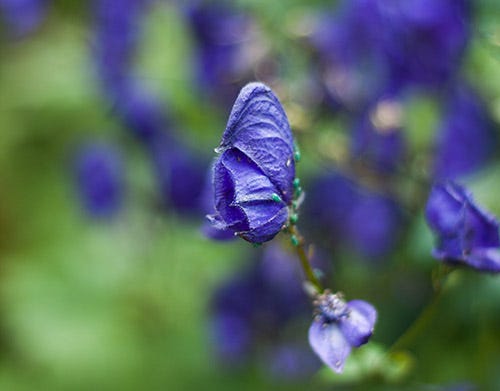
In 2009, Lakhvir Singh poisoned her ex, Lakhvinder Cheema, using aconitine from monkshood. According to Michael Brown, she used the Aconitum ferox species that grows in India (2018: 160). Cheema had broken up with Singh in favour of a younger woman, but Singh continued to clean his house for him. She put powdered aconite root in a curry sitting in the fridge. Cheema and his new partner ate the curry and soon fell ill. Cheema’s sister whisked them to hospital. Cheema died within an hour, but his partner made a full recovery. Singh was convicted of murder in 2010 (Mitcheson 2024: 21).
It was the first aconite poisoning in England since 1882. In that murder, Dr George Henry Lamson murdered his young brother-in-law to gain access to his inheritance via his sister. He poisoned the boy with an aconite-laced Dundee cake. Lamson claimed he chose aconite because someone told him it was undetectable. Advances in forensic science meant the poison was swiftly identified and he was convicted and executed (Brown 2018: 161).
Not all monkshood deaths were intentional. In 1842, a woman in Lambeth mistook monkshood root for horseradish and ate it with roast beef. She died three hours later. Meanwhile, a boy confused the leaves for parsley and died after eating it (Binney 2018: 114).
The primary alkaloid in the aconitum genus is aconitine, which causes a range of symptoms, including burning in the mouth, a numb throat, burning lips and mouth, vomiting, diarrhoea, muscle spasms, or paralysis in the respiratory system (Mitcheson 2024: 19). Ingesting any of the plant can be fatal.
While herbal folklore claims foxglove provides an antidote to aconite poisoning, medicine does not support this (Kunz 2010).
It’s difficult to find medicinal uses for monkshood since it’s often considered the most dangerous plant in Europe. It’s not impossible though: one remedy saw it used to cure scorpion stings or to stop someone becoming a werewolf (Gilliam 2008: 4).
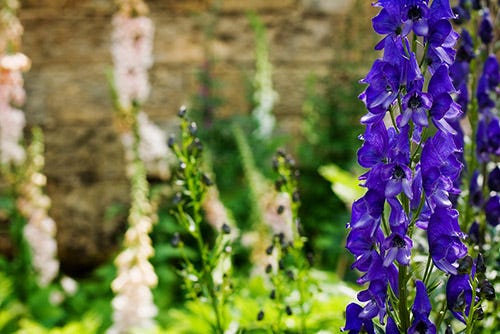
Witches’ flying ointment has been the subject of some debate, although I think most people agree that no one actually applied this ointment to physically fly anywhere. Most writers describe how the combination of plants was more likely to provide the sensation of flying through its hallucinogenic properties.
Monkshood was thought to be an ingredient in the flying ointment used by witches. One recipe included poplar, soot, fern, a plant called eleoselenium, and fat from children. Francis Bacon reported a recipe including monkshood, potentilla, wild celery, and wheat flour, along with children’s fat (Kenicer 2020: 105).
The ointment’s ingredients vary almost as much as how accusers assumed people applied it. One theory is that people smeared the ointment onto broom handles to apply it to the genitals, though other writers have debunked this, seeing it as part of the anti-witch propaganda. I can’t help thinking the threat of splinters alone would put people off that method.
Much of the lore rightly revolves around aconite’s poisonous nature. The lack of magical uses to ward off evil is telling, as if people simply didn’t want to handle it if they didn’t need to. Even Nicholas Culpeper warned people away from trying to use monkshood (1789: 71).
Instead, we find a lot of historical uses for the plant within murder or animal control, rather than outright lore. What lore exists tends to exaggerate, such as the use of the plant by the berserkers, or lies in the realm of myth.
There are some reported uses of aconite within herbal medicine, yet it’s also difficult to find an original source recommending its use. This is a plant steeped in its own reputation, and for once, it’s probably best to listen to the reputation and leave well alone.
Don’t ingest any part of the plant, and the RHS even recommend handling it with gloves if you grow it in your garden. This is definitely a plant to treat with the utmost respect.
Baker, Margaret (2011 [1969]), Discovering the Folklore of Plants, 3rd edition, Oxford: Shire Classics (aff link).
Binney, Ruth (2018), Plant Lore and Legend, Hassocks: Rydon (aff link).
Brown, Michael (2018), Death in the Garden: Poisonous Plants & Their Use Throughout History, Barnsley: White Owl (aff link).
Burke, L (1867), The illustrated language of flowers, London: G. Routledge & Sons.
Culpeper, Nicholas (1789), Culpeper’s English physician ; and complete herbal … Illustrated with notes and observations, critical and explanatory, London: E. Sibly.
Dodds, Liz (2022), The Secret Language of Flowers, London: DK.
Folkard, Richard (1892), Plant lore, legends, and lyrics: Embracing the myths, traditions, superstitions, and folk-lore of the plant kingdom, second edition, London: S. Low, Marston, Searle, and Rivington.
Gillam, Fred (2008), Poisonous Plants in Great Britain, Glastonbury: Wooden Books (aff link).
Kenicer, Gregory J. (2020), Plant Magic, Edinburgh: Royal Botanic Garden Edinburgh.
Kunz, Alexander; Marty, Hans; Nohl, Felix; Schmitt, Wolfgang; Schiemann, Uwe (2010), ‘Mixed intoxication with Aconitum nappellans (monkshood) and Digitalis grandiflora (large yellow foxglove)’, Medical Science Monitor, 16 (8), pp. 103-105.
Lawrence, Sandra (2020), The Witch’s Garden: Plants in folklore, magic and traditional medicine, London: Welbeck (affiliate link).
Mitcheson, Fiona (2024), A-Z of Poisonous Plants: The deadly, dangerous & downright bizarre, Peterborough: Jarrold Publishing.
RHS (no date), ‘Aconitum lycoctonum’, RHS, https://www.rhs.org.uk/plants/33788/aconitum-lycoctonum/details. Accessed 3 August 2026.
No posts
Comments
Nothing yet. Say the first thing.
Sign in to join the conversation.