
When we talk about poisonous plants, your mind might leap to the celebrities, like foxglove, aconite, or belladonna. You may not immediately think of cuckoo pint (Arum maculatum). It’s native to the UK and surprisingly common. I’ve equally found it in botanic gardens and city centre flowerbeds.
Poisoning caused by this plant is thankfully rare, and they do serve a purpose in the ecosystem. Their berries feed birds, and they’ll grow in conditions other plants don’t enjoy. Arum maculatum is in the araceae family. But how did people use arum for both mundane and magical purposes? Let’s find out!
But before we delve into the folklore and legends of these plants, I’d like to remind you that this article is for entertainment purposes and it does not provide nor constitute medical advice. Any interaction you have with these plants is at your own risk. I’d advise you to look but not touch!
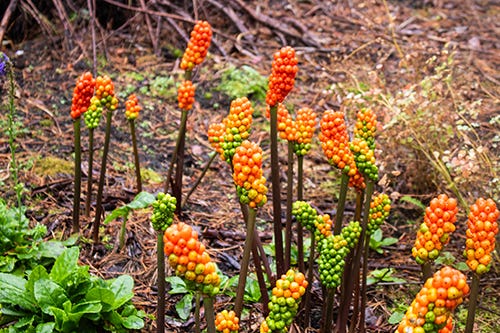
The plant grows from tubers and puts out arrow-shaped leaves in early spring. By April/May, the flower emerges, with its distinctive white hood surrounding a finger-like spike (spadix) that eventually turns a purple-brown. By early autumn, the hood and leaves are gone, but the spadix hosts a head of large red-orange berries. It’s found in hedgerows and woodland, favouring shady conditions (RHS n.d.).
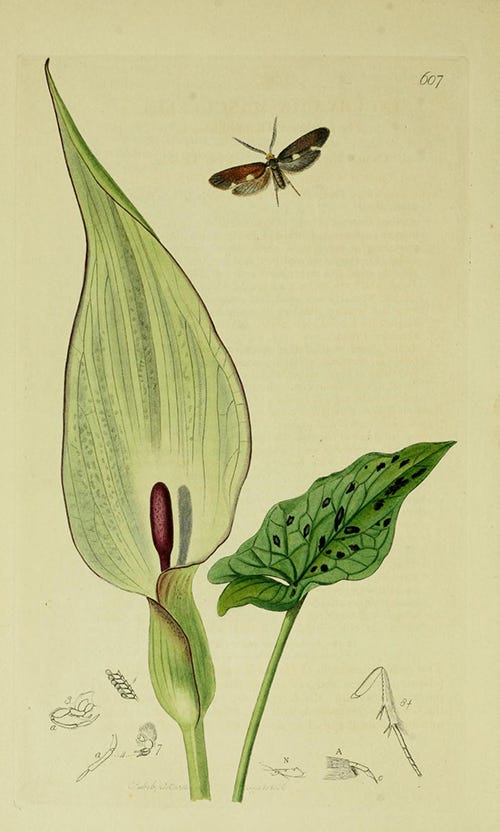
Cuckoo pint is actually a good indicator for the health of a wood because it shows the land has plenty of nutrients. There was a German belief that the spirits of the wood were happy if cuckoo pint was plentiful (Folkard 1892: 228).
It’s an unusual plant in that it’s pollinated by flies rather than bees. The plant lures the flies into the structure beneath the hood during the spring, where they pollinate the flowers inside. The plant can even raise the temperature of the surrounding air by up to 15°C to attract flies, something that was noted as far back as 1777 (Inkwright 2021: 79). Blackbirds and thrushes eat its berries in late summer, thus dispersing seeds for the plant.
The berries apparently taste horrible, meaning it’s unlikely anyone will accidentally eat them. If they do, it can cause the throat to swell, and vomiting (Lawrence 2020: 111). Nicholas Culpeper described how the plant’s taste would prickle “the tongue as nettles do the hands” (1985: 103). It certainly doesn’t sound appetising.
While most commonly known as Lords and Ladies or Cuckoo Pint, the plant has over 150 folk names, including starchwort, adder’s root, bobbins, friar’s cowl, kings and queens, parson and clerk, and wake Robin (Grieve 1995-2026).
They were also called Jack in the pulpit, referring to an old country nickname for the Devil, while it was called snake’s meat when it produced berries because people believed vipers ate the berries to create venom (Lawrence 2020: 111).
In Worcestershire, the bright red berries on their thick stalk earned the plant the nickname ‘Bloody Men’s Fingers’ (Folkard 1892: 228).
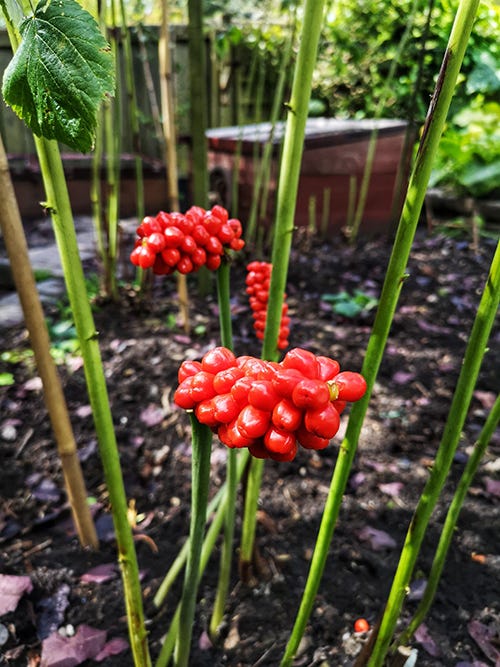
Another folk name is ‘fairy lamps’ because people believed it glowed at night, which isn’t entirely wrong, because the pollen is slightly phosphorescent (Lawrence 2020: 111).
Some say the dark green leaves have their unusual purple spatter because the plant grew at the base of Christ’s cross where His blood splattered them (Lawrence 2020: 111). These spots apparently earned the plant the nickname Gethsemane in Cheshire (Folkard 1892: 228).
Despite the plant being poisonous, Culpeper recommended bruising the leaves and applying them to plague sores to draw out poison. Culpeper recommended a drachm weight of either fresh or dried arum as a “remedy for poison and the plague” (1985: 103). Meanwhile, he claimed that using the leaves as a poultice could draw the poison from sores (1985: 104).
He also recommended boiling the root and leaf with wine and oil to relieve piles. Another ‘cure’ involved beating cuckoo pint berries with ox dung to ease gout. Or you could bruise the fresh roots and distil them with milk. The resulting liquid could apparently remove freckles, spots, or blemishes from the skin (1985: 104).
Many of his recommendations have been thoroughly debunked, so please don’t try any of these at home (Lawrence 2020: 111). Elsewhere in Britain, people thought bringing arum indoors would cause tuberculosis (Kenicer 2020: 99).
Still, it had other uses beyond medicine. In the medieval era, women might soak the root for five nights, changing the water every day, and then use the root as an exfoliant. It would still have been toxic but less likely to cause burns (Inkwright 2021: 80). It’s just more proof that women have turned to unpleasant methods to meet arbitrary beauty standards well before social media came along.
In a more mundane way, arum had uses around the home. People used juice from its berries for starch to stiffen ruffs in the Tudor and Stuart periods (Inkwright 2021: 79). Farmers in Cambridgeshire used arum juice on newly sharpened sickles to help keep them sharp during harvest time (Baker 2011: 47).
Richard Folkard named arum as being one of “the most esteemed herbs” by witches, used “in the hell-brothers, philtres, potions, and baleful draughts prepared for their enemies” (1892: 95). He goes on to explain that they gathered cuckoo flowers in meadows on 1 May. I’m assuming he means cuckoo-pint, since it’s the only related plant in his list of witchy herbs. He also explains that witches boiled various herbs together, usually seven or nine plants, and that witch ointments needed to contain seven herbs to be effective (Folkard 1892: 95).
It would have been helpful if Folkard thought to include more information about the magical use of arum.
Cuckoo pint was also part of a folk practice aimed at young men wanting to find a young lady at a dance. He put a piece of the plant in his shoe, while saying, “I place you in my shoe, Let all the girls be drawn to you.” Doing so apparently gave him the pick of the prettiest dance partners “and other favours” (Baker 2011: 46). Naturally, this would depend on his definition of ‘prettiest’, but given the phallic nature of the spadix, it’s fairly obvious what favours a young man would be hoping for in using the plant in such a way. The ‘pint’ part of its name even comes from an Old English word for ‘penis’, which again gives us clues about the less-than-wholesome intentions behind this practice.
It might explain why arum meant ardour in the Victorian language of flowers (Burke 1867: 9). In some parts of Dorset, young women were warned not to touch the plant or they’d become pregnant (Kenicer 2020: 99). Despite these links with love and sex, arum apparently fell under Mars’ dominion (Folkard 1892: 229).
If you find such love magic fascinating, you might also like the entire book I wrote about the topic! Bring Me Love: Finding and Keeping Love with Divination and Folk Magic features an entire chapter about using plants to find love.
It’s fascinating how the folklore around arum falls into its domestic use or a couple of folk practices. Yet we often run into this with plants. The folklore is sparse, either because it was so common that everyone knew what the plant was for, making redundant the need to pass on information through stories. Alternatively, the plant was so poisonous there was no need to preserve information since no one wanted to use it.
What does remain about cuckoo pint falls into the cosmetic (its use as an exfoliant or as starch for ruffs) or the seductive. Both of these ultimately tie into the same idea; using whatever means are at your disposal to have success with others. I think we can probably guess what ‘wake Robin’ refers to!
Baker, Margaret (2011 [1969]), Discovering the Folklore of Plants, 3rd edition, Oxford: Shire Classics (aff link).
Burke, L (1867), The illustrated language of flowers, London: G. Routledge & Sons.
Culpeper, Nicholas (1985), Culpeper’s Complete Herbal, Ware: Omega Books.
Folkard, Richard (1892), Plant lore, legends, and lyrics: Embracing the myths, traditions, superstitions, and folk-lore of the plant kingdom, London: S. Low, Marston, Searle, and Rivington.
Grieve, Maud (1995-2026), ‘Cuckoo-Pint’, Botanical.com, https://botanical.com/botanical/mgmh/c/cucko122.html. Accessed 24 July 2026.
Inkwright, Fez (2021), Botanical Curses and Poisons: The Shadow-Lives of Plants, London: Liminal 11 Press (affiliate link).
Kenicer, Gregory J. (2020), Plant Magic, Edinburgh: Royal Botanic Garden Edinburgh (affiliate link).
Lawrence, Sandra (2020), The Witch’s Garden: Plants in folklore, magic and traditional medicine, London: Welbeck (affiliate link).
RHS (no date), ‘Lords-and-ladies’, RHS, https://www.rhs.org.uk/weeds/lords-and-ladies. Accessed 24 July 2026.
No posts
Comments
Nothing yet. Say the first thing.
Sign in to join the conversation.