
We know culture moves faster than it gets documented. That’s why each issue we take the bar bell approach, splitting our findings into two themes:
Timely: What’s worth paying attention to now?
Timeless: What’s a longer-term viewpoint?
This week we’re looking at brand social.
At some point, it became impossible to imagine marketing without social.
Today, platforms like TikTok, Instagram and YouTube have become such big indicators of a brand’s success that without them many brands would simply fail.
When the British high street brand Lush walked away from social media in November 2021, it suffered an estimated short-term hit of £10 million ($18.5m).
Even brands that can say they’re platform agnostic are still digitally dependent.
In April, British streetwear brand Corteiz spontaneously had their Instagram account (1.6 million followers built over eight years) deactivated overnight. What followed was a panicked mass migration to Whatsapp stirred up by founder Clint Ogbenna (@clint419).
For a whole generation, marketing now equals ‘how X brand shows up online’.
We’re so deeply entrenched in the social era it’s hard to imagine a time without it. Yet we often forget how A) new this is, and B) how much the rulebook has changed in that time.
Let’s use Nike as an example.
The leap from Guy Ritchie’s “Take It To The Next Level” (2008) to the Swoosh’s World Cup mega moment “Rip The Script” released last week is huge.
Apart from the obvious upgrade in production quality, social moments have become a vital part of comms and strategy — Nike’s football ads now include the Kardashians and K-Pop stars. A quick AI analysis reveals that the latter drove 36% of comments. Same platform (YouTube). Different game.
Today the role of social is changing once again.
When everyone can go viral, virality stops being the goal. What’s scarce now isn’t reach, it’s depth. “In 2026, appearing to transcend the algorithm is the ultimate virtue, for brands and consumers alike”, wrote Amy O’Brien in Vogue Business last month.
As consumers spend less and less time online for their own sanity (The FT reported social media usage reached peak in 2022), brands are being forced to re-evaluate their social strategy as a result.
This week’s Field Notes serves as an investigation into the changing roles of social media marketing and virality through the lens of brand, brought to life through a collection of timely and timeless references.
Hope you enjoy.
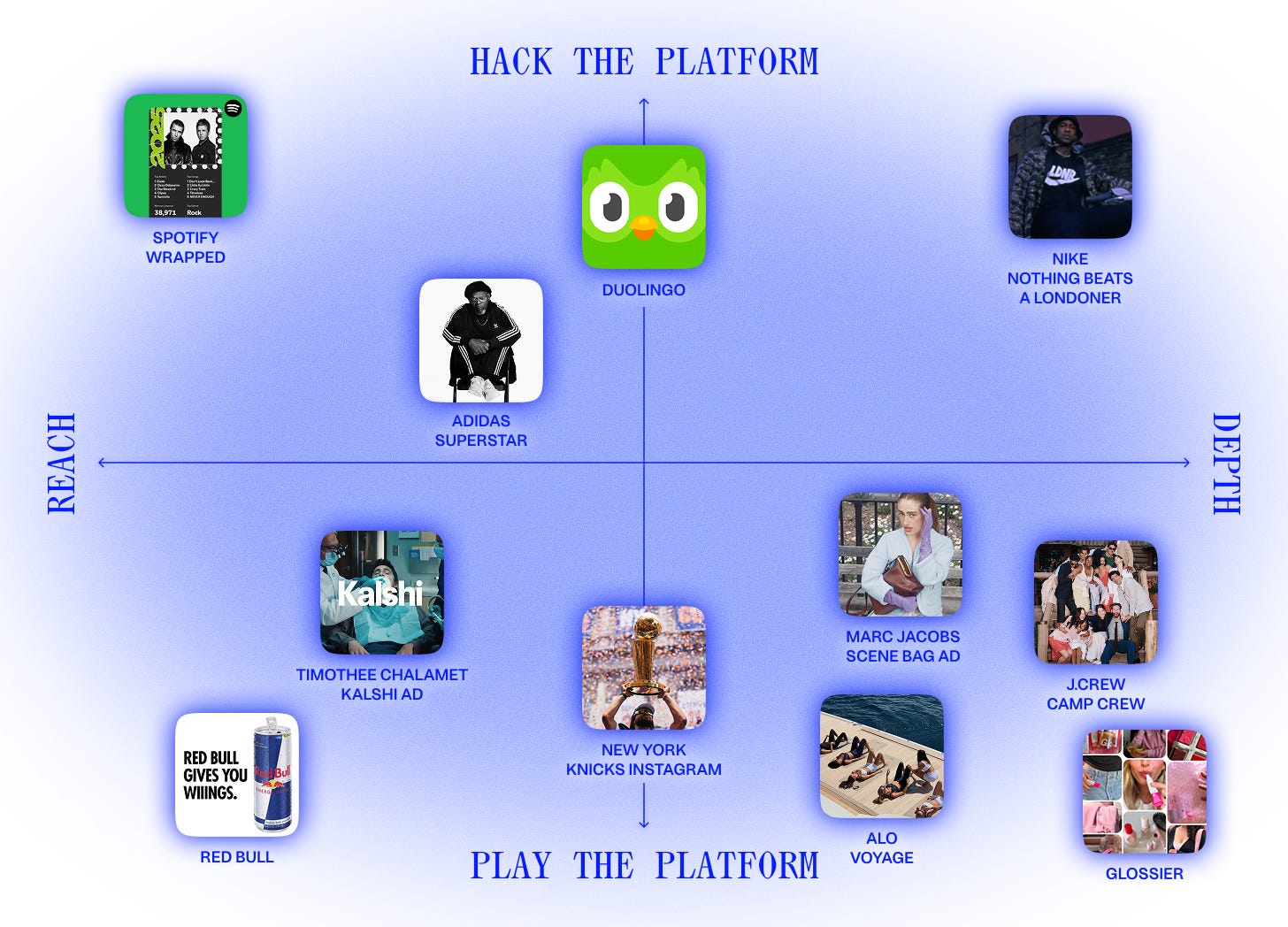
Alongside winning the championship, The Knicks put on a masterclass in brand social. Several pillars combine and compound together here. There’s the embracing of New York’s own iconicity to engage eyes beyond the core fanbase. The sheer volume play that prioritised speed over polish (@nyknicks posted over 15 times on 13th June alone, and hundreds of times since the start of the playoff finals on 1 June). But also, who could ignore the celebrity front row that throughout the playoffs served as a media channel in its own right? From Swift to Chalamet, megastar appearances lent their cultural equity to create new narratives, attract new audiences, and pour gasoline on the algorithm.
The prediction market app Kalshi is now valued at a cool $22bn. We can assume then, that for its first major marketing campaign, budget wasn’t a massive concern. It says a lot about the state of brand social and marketing today, then, that what was produced: 1) Didn’t mention the product, 2) Was made of a series of short vignettes optimised for short attention spans, 3) Harnessed the existing cultural equity of a megastar to bring itself into the cultural conversation, 4) Didn’t make much sense… like, at all. This is high production brain rot; a signal that screams when attention is the only thing that counts, it doesn’t matter what you have to say.
Instagram turned brands into TV channels. The brands that understand this today lean in, treating talent like the lead star in a show, and products as supporting props. On paper, this Marc Jacobs ad is for the Scene handbag collection. In reality, it turns commerce into entertainment, supported by the cultural capital of comedian Rachel Sennott, a series of witty cultural cues and high production. The result is you don’t feel like you’re being sold to, you feel like you’re in on the joke. Brand love and sales follow.
In 2026, brand trips have evolved to become content platforms that transform fan engagement into active spectatorship. When Alo Yoga buys a yacht to bring the world’s biggest influencers together, or when J.Crew invites 10 of the biggest models of the 2010s to a summer camp, the brands know that what results is the same experience documented from a variety of angles in real time, amplifying the coverage and adding narrative depth to the moment. Each guest acts like a star in a brand-owned reality TV show. The budgets just keep getting bigger.
This is a world class example of brand-tertainment. An episodic structure keeps fans anticipating the next moment. Visual clues link the narrative together and reward engaged viewers with IYKYK nods. Massive starpower amplifies the campaign to their respective audiences. An iconic product becomes the red thread through it all.
Red Bull launched its YouTube in 2008. Today it has 28.6M subscribers, and over 27B total views. It’s a best-in-class example at how brand social content can work in service to, and reinforce, brand messaging. For Red Bull, that means delivering on the brand’s “gives you wings” promise through its association with extreme sports. Case in point, the 2012 Stratos freefall moment. When Felix Baumgarten jumped from 38km (24 miles) above Earth, the stunt not only saw 8 million viewers tune in on YouTube, but also Global sales shoot up 133% the year following.
Launched as ‘an annual thank you to users,’ Spotify Wrapped has evolved to become one of the most viral cultural brand moments of the year. In 2025, 200 million users engaged in the first day, and 500 million shared. For brands, the blueprint seems simple, but is much harder in practise: turn your proprietary data into content, make shares the KPI, and prioritise consistency over short-term spikes.
Faced with changes to the Instagram algorithm, in the 2010s brands realised they had to take risks on social media to stand out. Duo is Duolingo’s brand mascot introduced in 2011. When users turned it into a meme, instead of ignoring it Duolingo leaned in, trusting Gen Z marketer Zaria Parvez (@zariaparvez) with the strategy. What followed was a social case study that has become emblematic of the 2020s surrealist, brainrot era, achieving 8B+ impressions, 16M+ TikTok followers, and catapulting the company’s market cap to nearly 7× in just five years by breaking into culture as an unexpected disruptor.
A best in class example of hacking a platform. Nike’s ultra-local “Nothing Beats a Londoner” campaign reconnected the Swoosh with young London athletes by celebrating London’s diverse sporting culture. The real story, though, is what happened on social. Nike used the story ‘swipe up’ feature before any other brand in the industry to create a multi-faceted integrated campaign that linked together perspectives from young athletes that were featured, boosted further engagement from London legends Harry Kane, Mo Farah and Skepta. The feature generated 171,000+ click-throughs to Nike’s website.
Beauty has often been the gold standard on social. Glossier were one of the first brands to treat community as the foundation. Rather than using Instagram simply as a marketing channel, the brand’s channel served to connect fans to each other and host UGC content. By prioritising authenticity over sales and using community passion to drive engagement, the brand reached 13,000 Instagram followers before any products existed, and now has 3.1M followers on Instagram alone.
Thanks for reading. If you enjoyed this dispatch of Field Notes, make sure to subscribe to Explorers Club’s Open Dialogue Substack to receive future ones.
No posts
Comments
Nothing yet. Say the first thing.
Sign in to join the conversation.