

By: Hanna Mandelbaum
Sometimes we engage in subterfuge. In this case, it was my (life) partner Noah who posed as a customer and reached out to a highly regarded fresh food company with questions. He wanted to know the full AAFCO panel of nutrition numbers for a cat food formula on a per 1000 kcal basis and couldn’t find any information on their website, beyond the basic macronutrient guaranteed analysis that is a requirement for labeling compliance.
To be honest, when he chooses to do this sort of thing unbidden, it inexplicably annoys me. But the response he received enraged me.
“We are working on updating our nutritional data, so I do not have this available at this time. In the meantime, I have attached what we have for the X formula for reference, as these recipes are very, very similar.”
Attached was a spec sheet that listed the guaranteed analysis on an as-fed basis (which is standard for labels) and complete nutrient profiles on a dry matter basis. To be fair, the recipes were very similar. But the absence of the specific recipe requested, combined with it being provided in the wrong format, led me to believe a few things. They didn’t have the numbers for the second formula, and they didn’t have any of the data calculated on a calorie basis. Or they did, and it wasn’t great.
It’s possible to get the per-calorie values from this information, but that requires math that a layperson—or even a professional—should not have to waste time doing. The average person doesn’t have the time, tools, or nutritional training to translate this data into something meaningful for their pet. And frankly, the fact that he had to ask for any nutrient information at all was problematic, though extremely common.
We hear all the time that customers value transparency. But what does that really mean when it comes to pet food?
For some, transparency means knowing who formulates the food, who makes it, where the ingredients come from, or what safety processes are in place. There are valid—if sometimes frustrating—reasons why certain details are considered proprietary: NDAs, competitive sourcing, and the like. Even we’re bound by those in a few cases. But nutritional profiles should never be part of that black box.
If a company does not share their numbers, any claims surrounding transparency are just marketing. You’ll see words like “honest,” “open,” or “nothing to hide” all over brand websites and packaging. But those words mean very little if the most basic and critical data—what’s actually in the food—is buried, unavailable, or shared only when someone pushes for it.
As much as every company would have you believe that their products are great—and many are—no food is great for every pet. Pet parents and professionals need access to detailed nutritional information in order to find the best fit for each animal.
This is especially important considering that many people feed their pets the same food every single day. Some pets have medical needs that require specific levels of key nutrients. A company might technically meet AAFCO’s “complete and balanced” standard, but there’s a huge range within that standard. Without actual numbers in a usable format, it’s impossible to evaluate whether a food is truly appropriate for an individual pet.
For example, we often hear from people whose pets have specific conditions, like early kidney disease, where phosphorus intake matters, or cardiac conditions requiring specific sodium levels. Without full nutrient profiles, there’s no way to assess whether a food supports or undermines those needs. People end up guessing, calling customer service, or assuming a food is appropriate when it might not be.
At Evermore, we publish our full nutrient profiles on an as-fed, dry matter, and per 1000 kcal basis. We believe this information should be baseline, not a bonus. We want our customers and their vets to have what they need to make informed decisions without needing to email, wait for attachments, or break out a calculator. Appreciation for the accessibility of this data is one of the most consistent pieces of positive feedback we receive.
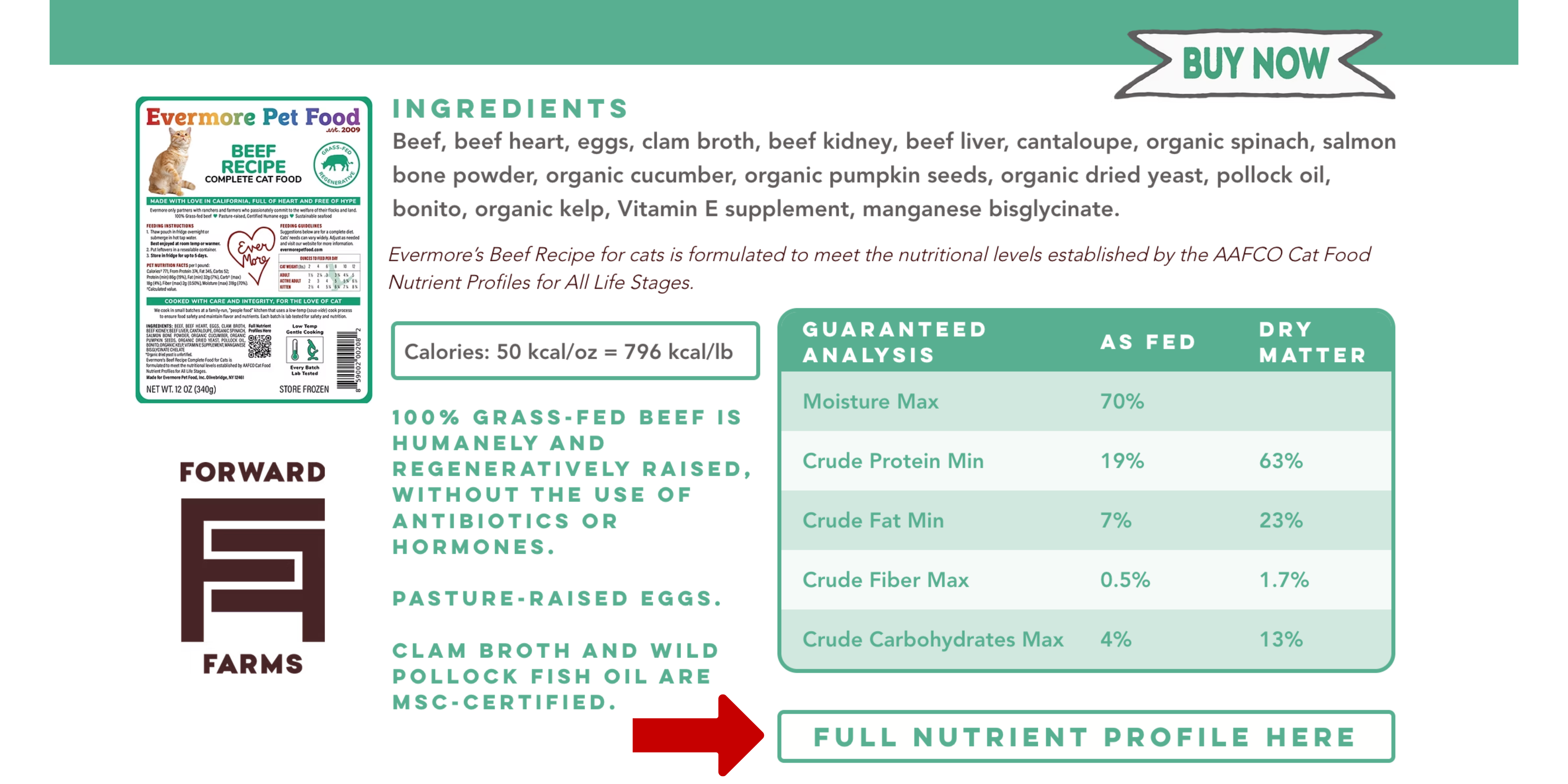
We take this a step further by also providing personalized consultations for both current and potential customers. These free, scheduled sessions are not veterinary advice and generally focus on things like price and feeding amounts. But we do help people determine whether our formulas meet their pets’ known needs. And if they don’t, we will recommend another company that makes food that might be a better fit.
So even from our perspective as a business, missing nutritional information on competitors' pages is frustrating.
Noah’s question was direct and completely reasonable. It was the kind of question any pet parent, vet, or nutrition nerd should be able to ask and receive a clear answer to.
Actually, they shouldn’t even have to ask. This information should be easy to find, clearly laid out on a company’s website (like ours). It’s better for the consumer, and it’s better for the business too. It saves time, cuts down on support needs, and avoids the poor optics of not having the answers.
Transparency matters, and it has to start with the basics.
What does transparency mean to you when it comes to pet food? We’d love to hear your thoughts!
Thanks for stopping by. We’ll be regularly sharing our adventures, insights, strong opinions, and a behind-the-scenes look at what it takes to be the gold standard in gently cooked food for pets!
Comments
Nothing yet. Say the first thing.
Sign in to join the conversation.