

By: Hanna Mandelbaum
Father’s Day is just around the corner, which means another opportunity for brands—like ours—to create cross-platform content. There’s a National Dog Dad Day and, like its maternal counterpart, it falls the day before the main event. As far as we’re concerned, it is the main event.
National Cat Daddy Day, in true feline fashion, does its own thing and lands on October 29. Of course, for the majority of us who didn’t get the memo, Father’s Day is also the perfect time to celebrate the furry patriarchs in our lives—or the ones we’d swipe right on.
So, who’s the better catch: the dog dad or the cat daddy? Let’s dive into the data.
Dogs are not only man’s best friend—they’re also man’s best wingman (or wingwoman). A considerable amount of academic energy has gone into exploring and quantifying the idea.
In a 2008 study titled "Domestic Dogs as Facilitators in Social Interaction: An Evaluation of Helping and Courtship Behaviors," researchers Serge Ciccotti and Nicolas Guéguen had an attractive young man named Antoine approach 240 randomly selected women in a public space and ask for their phone numbers. In half of these interactions, he was accompanied by a dog described as a “mongrel of medium height (42 cm) and weight (11.4 kg), with a black, mid-length coat.”
On his own, Antoine had a 10% success rate. With the “mongrel” in tow, that number jumped to 30%. In other words, dogs truly are date bait.
A 2013 study—Dog Ownership Increases Attractiveness and Attenuates Perceptions of Short-Term Mating Strategy in Cad-Like Men—looked at the familiar dating archetypes of “dads” and “cads,” with the former embodying “Mr. Right” traits and the latter leaning more toward “Mr. Right Now.” Unsurprisingly, it found that men who might typically be pegged as cads were seen as more viable long-term partners when a dog was in the picture.
My own participant-observational work in the sociological cesspool that is Brooklyn dating has replicated the conclusions of both studies.
When it comes to the dating prospects of cat dads, the picture is a little more complicated—much like the animals themselves.
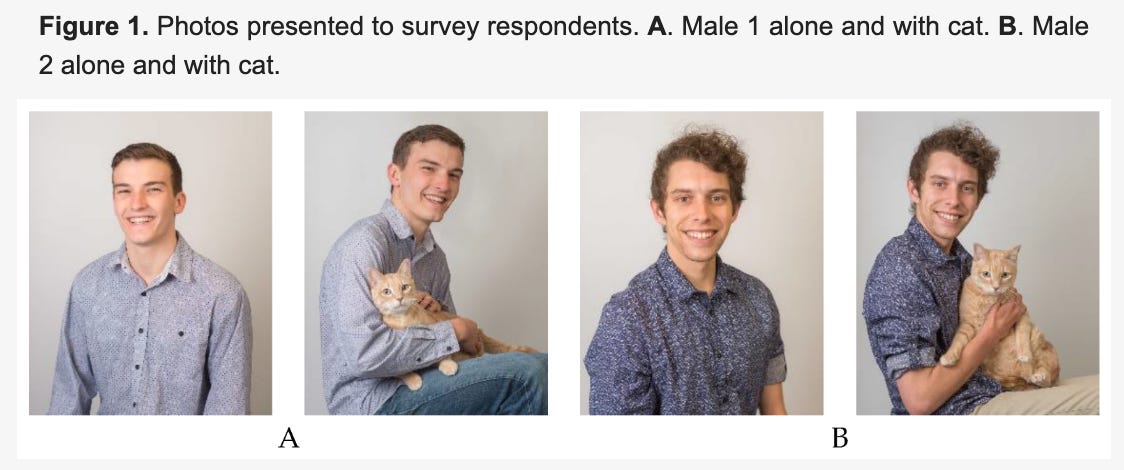
In the 2020 study titled “Not the Cat’s Meow? The Impact of Posing with Cats on Female Perceptions of Male Dateability,” researchers Lori Kogan and Shelly Volsche showed images of men alone and then with cats to 1,388 heterosexual women aged 18 to 24. Across the board, the men pictured with cats were rated as less masculine, more neurotic, and—critically—less dateable for both short-term and long-term relationships. At the same time, these same men were also rated as more agreeable and open-minded—both positive traits in a potential partner, but unfortunately a one-way ticket to the “friend zone.”
The effect wasn’t universal, though. Women who self-identified as “cat people” were more likely to view these men positively.
Personally, I think the study should be replicated with photos of a few more men—and cats that don’t look like they’re silently begging for release—before anyone gives the results too much weight.
A recent study commissioned by Temptations (not a brand endorsement, to be clear) claimed that 67% of Gen Z-ers find cat dads “more datable.” More datable than who—dog dads? guys with no pets?—is not clarified in the surrounding marketing materials. Still, it marks a noticeable departure from previous generations, who’ve generally held different views. Then again, it’s not exactly surprising. Gen Z tends to take a more flexible approach to gender norms.
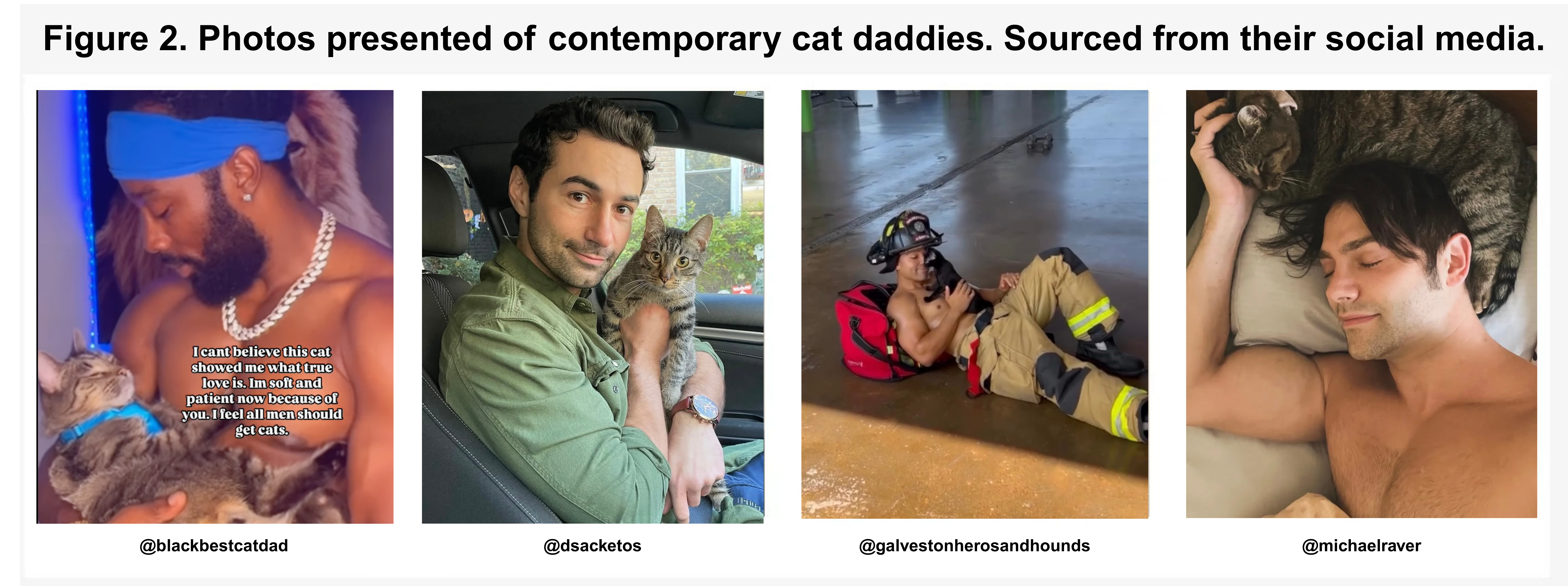
Lest you be wary of stats from a poll designed to back up a marketing campaign, there’s qualitative evidence everywhere that cat daddies are having a moment: Just look at the proliferation of Instagram and Tik Tok accounts like @hotdudeswithcats, @catdaddy_official, and countless creators whose feeds feature the winning combination of washboard abs and kittens. Maybe it is time to redo that study after all
When it comes to the clickbait false choice between dog dads and cat daddies, I think we can all agree that either animal enriches our lives and that men who choose to share theirs with a four-legged companion—whether they’re walking a golden retriever or negotiating bedtime with a Siamese—are already top-tier. It's not about species; it’s about emotional availability, snack sharing, and the willingness to talk in a baby voice when no one’s watching.
We’re not saying this is a competition… but we are keeping score. Sound off in the comments: who’s the better catch?
Thanks for stopping by. We’ll be regularly sharing our adventures, insights, strong opinions, and a behind-the-scenes look at what it takes to be the gold standard in gently cooked food for pets!
Comments
Nothing yet. Say the first thing.
Sign in to join the conversation.