
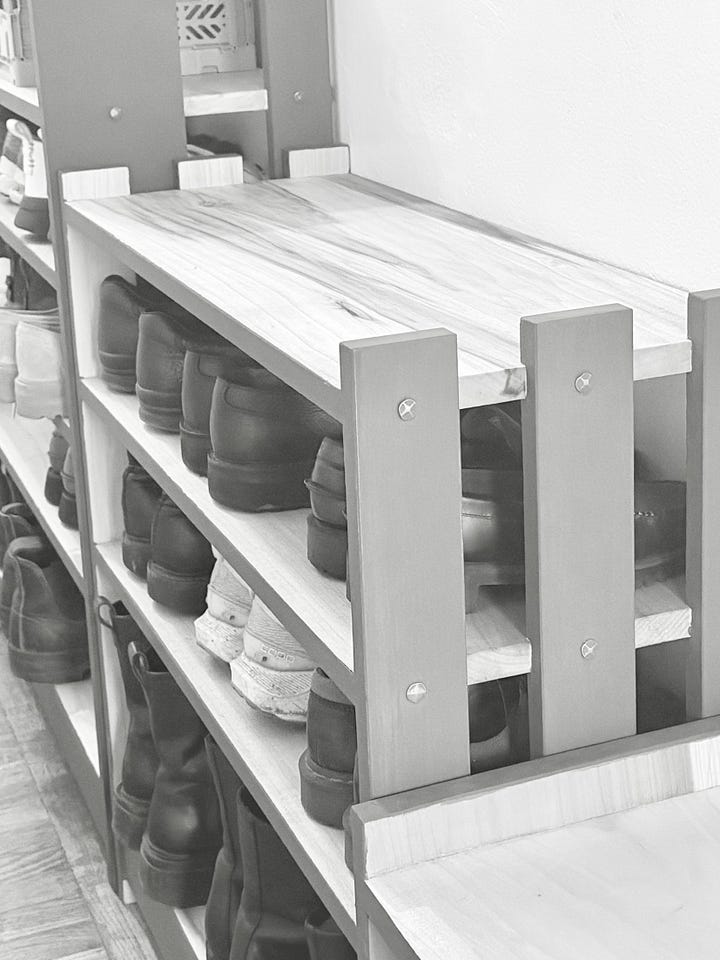
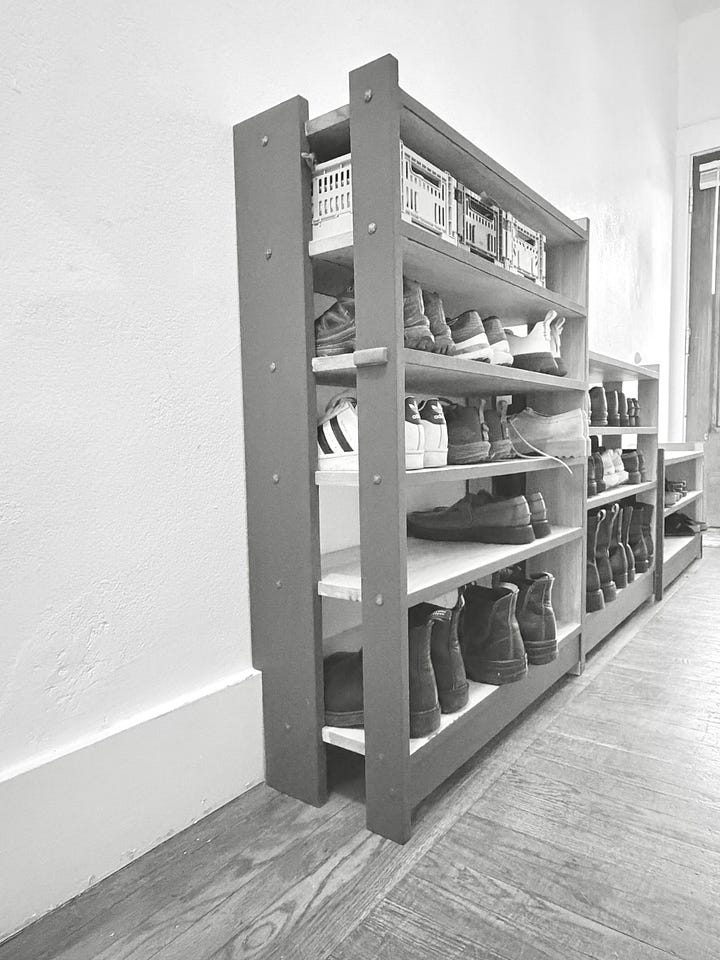
This week I finished the final installment in my entryway shoe shelf series (“shoe shelf series” is kind of a seashells by the seashore situation). I started back in July with a bench/shelf, then made a taller shelf at the end of October, and this week finished an even taller shelf.
They are all made of poplar. 30” across and 11.5” deep. Constructed of wide boards dadoed into varying widths of uprights. The dados are all reinforced with forged nails. Finished with Lexington Green milk paint on the outer edges and sides and then Odie’s Oil on top of everything.
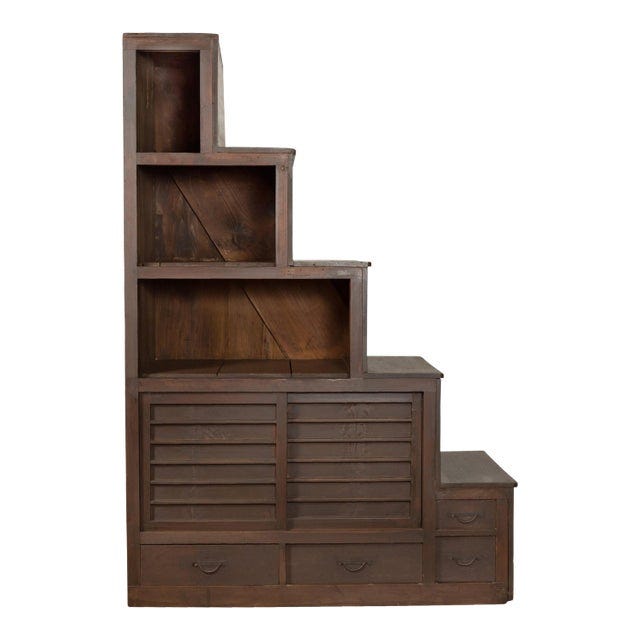
Besides just being practical — the bench-y shelf needed to be low enough to sit on and the subsequent installments needed to be tall enough to hold a lot of shoes — the “steadily increasing height” design was inspired by Japanese kaidan tansu (step cabinets). It’s loose inspiration, but I had visions of storage that invokes a staircase while conceiving of this project.
A few weeks after finishing the first shelf/bench, I found myself reading “Great-Grandpa Joe’s bookshelf,” a 2020 blog post on the site of American furniture company Thos. Moser. The Great-Grandpa Joe in question was Thomas Moser’s non-woodworking father. Apparently the one object he made out of wood in his lifetime was a cherry bookshelf for his sister.
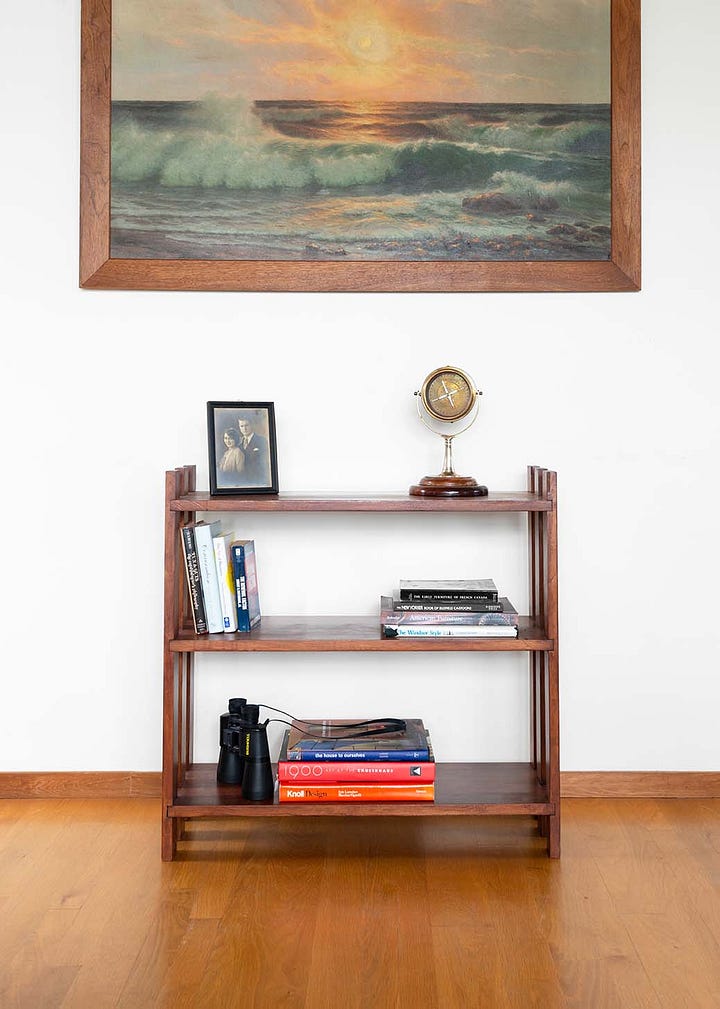
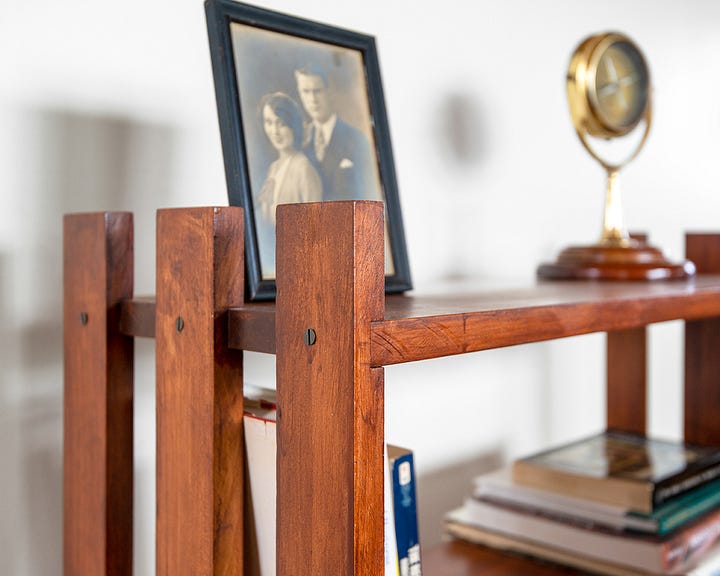
I like the simplicity of the design and decided to riff on the “multiple uprights as opposed to just one wide board” theme for the second and third shoe shelves.
The months in which this project unfolded were the same as those in which my confidence with machines increased. The two were unrelated, though, in the sense that I wasn’t working on machine skills for this project in particular.
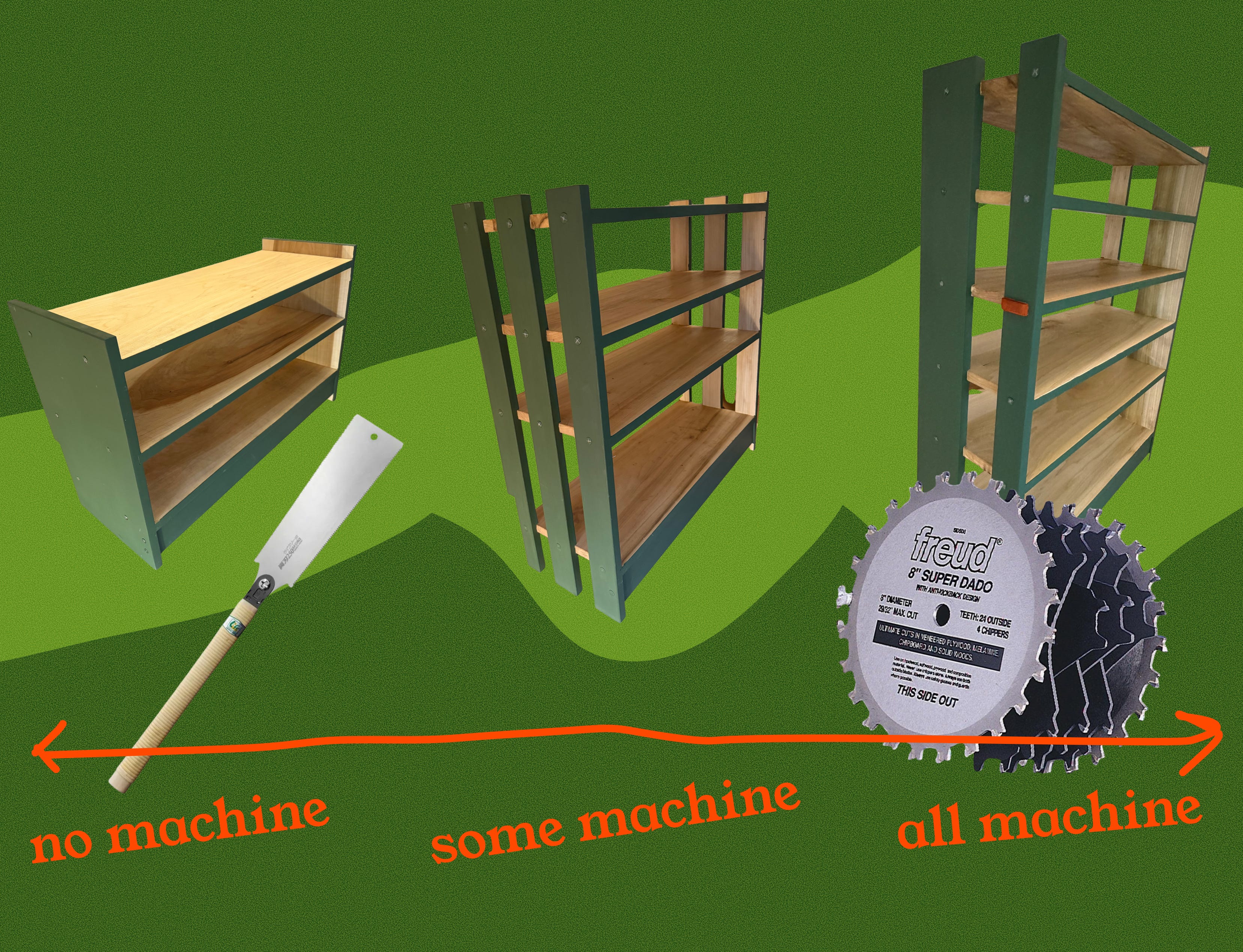
I did the first shelf/bench entirely by hand. For the second, I prepared the stock with machines (jointer, planer, table saw) but cut the dados by hand. I did the third entirely with machines, from stock prep to cutting the dados on the table saw.
Now that I have access to machines and (more) confidence with them, I have to sort out how they fit into my process. Part of me thinks that this is a profound philosophical question about the nature of craftsmanship. Another part thinks it’s not that deep; I’ll just use machines to mill wood and/or when I want to speed things up and can do so without sacrificing quality.
When I was a teenager my dad shared with me an aphorism he picked up along the way: “Never mistake virtue for lack of opportunity.” It’s a bitchy sentiment in certain contexts—like telling someone who brags about their health-promoting early bedtimes that maybe they just don’t get invited to parties. But in other contexts it’s useful. What are my actual commitments to making furniture with pre-industrial tools and techniques versus what was borne of not having access to post-industrial versions of the same? Now that I do have the opportunity, I can figure out my virtue 🫡
A couple of weeks ago, Lee Valley was no longer shipping the Clouterie Rivierre forged nails to the United States. But as of when I checked this morning, they are! It is very hard to find forged nails in the present, so this is a precious resource.
Read this Chris Schwarz post, The Bare Bones Basics of Nail Technology, if you don’t know what a forged nail is and have interest in finding out.
I am really into Sugihara Fine Furniture’s work. I particularly like this “peg board” vibed cabinet front motif. Gorgeous!
Speaking of cabinets: I really want to make a cabinet soon and use these “macaroni pulls” from Sam Stewart Studio. Obsessed. I think the blue ones would look so good on a cherry cabinet face 😮💨
Thanks for reading.
No posts
Comments
Nothing yet. Say the first thing.
Sign in to join the conversation.