


One side effect of my love for building things out of wood is that it has become challenging for me to buy things that I could theoretically make for myself.
Theoretically, in the sense that I can make furniture and objects that I need. But actually I can’t. At least not if I want them this month/year/lifetime, time being a finite resource. But I struggle to accept this as reality.
And that’s why I had a teetering stack of plastic boxes and other questionable storage situations cluttering my studio for six months. I had a faint notion that I’d eventually build a nice tall shelf for my various effects, perfectly sized to my needs and pleasing to the eye.
But this week, after unstacking boxes to get to the one I needed for the hundredth time, I decided enough was enough. It was time to forego the shelf fantasy.
Off I drove to Home Depot. $186.75 and an hour of assembly time later, I now have a tall and sturdy set of shelves. They aren’t perfectly sized nor are they particularly pleasing to the eye, but they exist.
On the other end of the spectrum, I spent a few afternoons making a tray for my chisels. Previously, I had them kicking around in a shallow cardboard box.
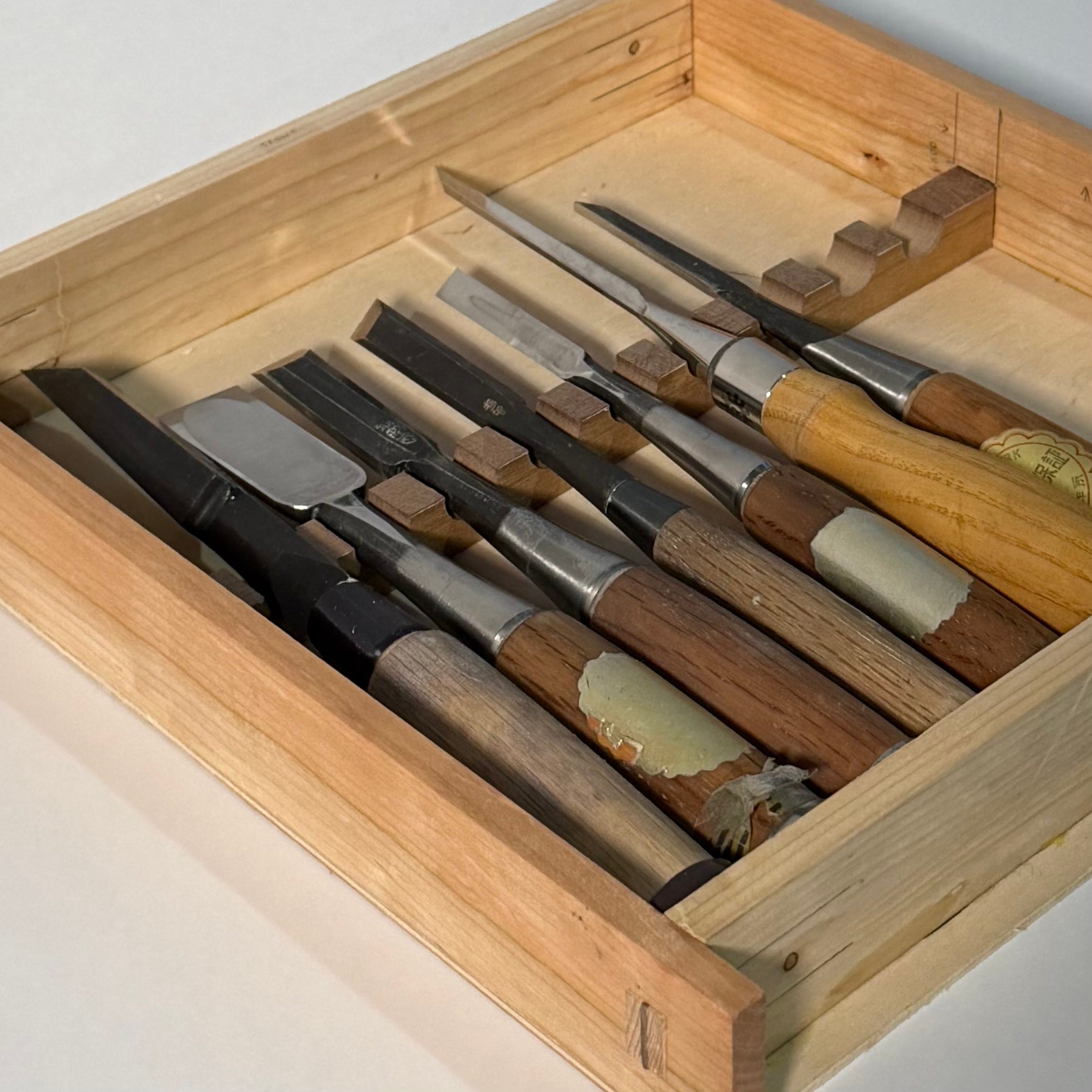
The sides are Port Orford cedar and cherry. The bottom is baltic birch plywood. The wedges and the central holder for the chisels are walnut.
I joined the sides with wedged mortise and tenons and attached the bottom with glue and these wonderful wooden nails. I made the center holder by drilling a line of holes in a small piece of walnut and then sawing it in half. It’s dado-ed into the side walls.
The tray is perfectly sized to the interior of my toolbox. I still need to install small battens inside the toolbox for the tray to rest on. Next week!
For now, I couldn’t be happier to have a dedicated place for each one of my beloved chisels. Plus a few slots waiting patiently to cradle my future chisel acquisitions, of course.
I recently finished William Coperthwaite’s book A Handmade Life: In Search of Simplicity. I loved it. I don’t think I have it in me to build my own yurt and then live in rural Maine on a plot of land accessible only by foot or canoe, like Mr. Coperthwaite. But I do aspire to live a life committed to truth and beauty and kindness (😎), and found a lot of practical wisdom in these pages for how to make that happen.
A few excerpts for the vibe:
Having nice things does not have to mean having expensive things. The quality of a thing comes from the knowledge and beauty it carries more than from its expense. Having one of the best pancake-turners in the world is possible for anyone who finds out what constitutes a good pancake-turner. Money need not enter into the equation. If you put many such small, incremental elements together, you can create one of the finest homes possible. It is these little elements multiplied many times over that make up our daily world. The impact of subtleties upon the quality of our life and work is incalculable. And the more that good design surrounds us, the easier it becomes to design well.
He describes design as “a conscious shaping towards perfection.” Wonderful.
If we are ever to develop a nonviolent society, we must eliminate violence in our concept of beauty. A Louis XIV chair and a Shaker chair are not equally beautiful. One was created by a violent, tyrannical way of life, the other by a peaceful and cooperative community that made fair treatment of all people a basic precept - so that the person making the Shaker chair and the one using it received equal respect.
Makes you think!
That’s all for this week. See you next time.
No posts
Comments
Nothing yet. Say the first thing.
Sign in to join the conversation.