
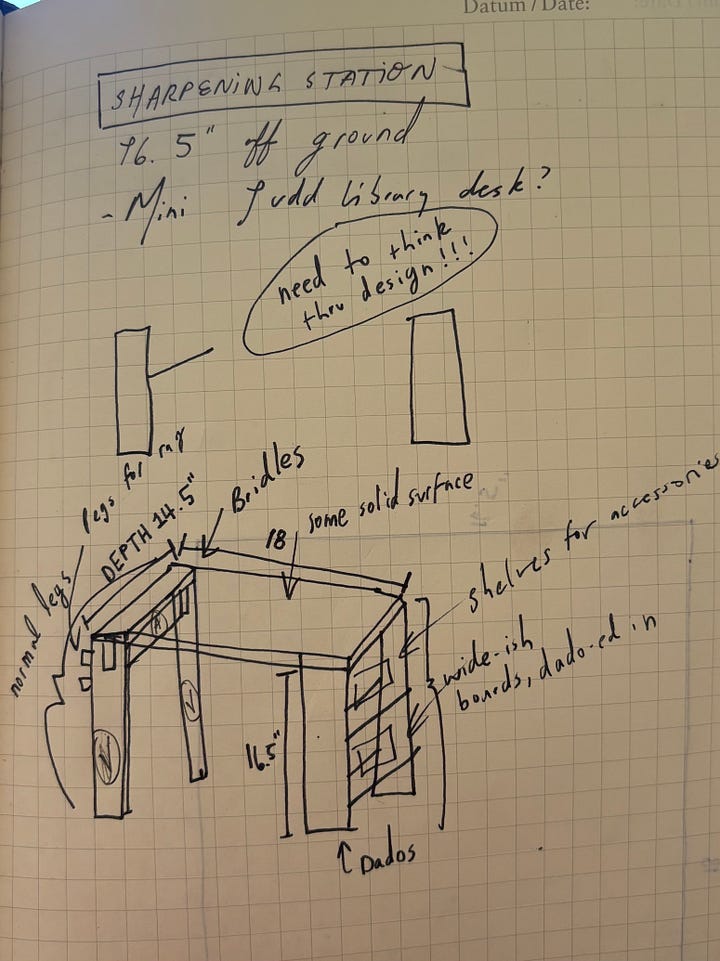
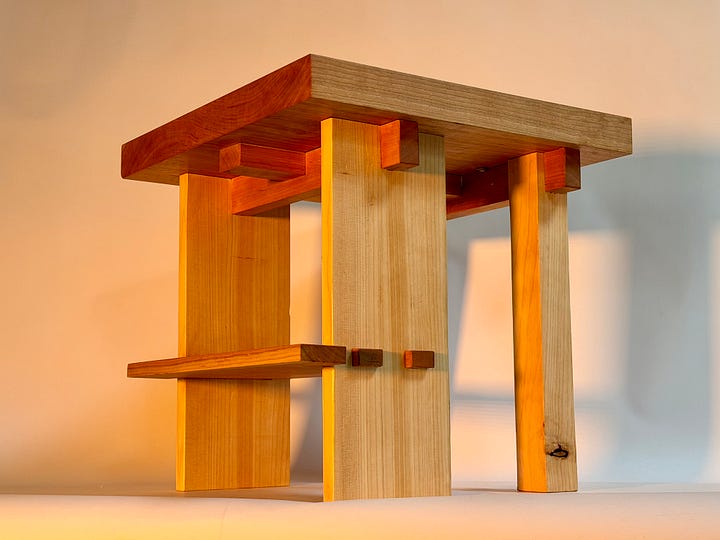
I finished the small sharpening table that I’ve been working on for the past few weeks. The legs are Port Orford cedar and everything else is cherry. 16” tall x 16” across x 18” deep.
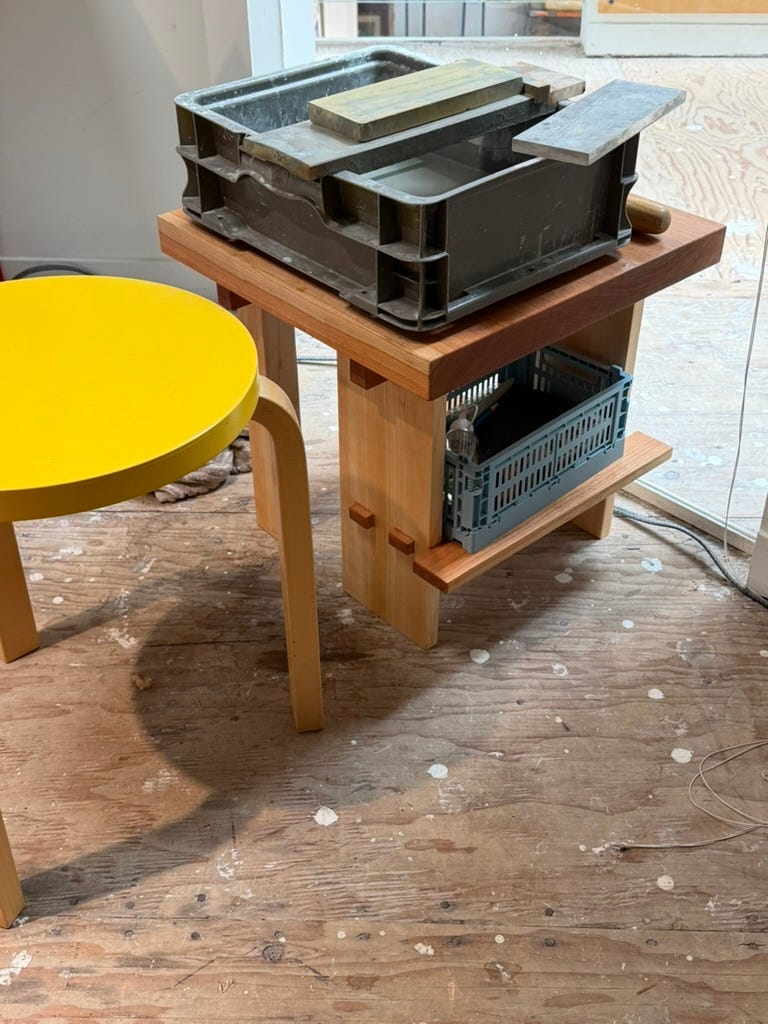
I have already spent many contended hours sitting on my little stool, sharpening on my little table.
The overall form as well as the joinery evolved as I built. This made for some false starts, layout-wise. The shelf piece had quite a few “old” layout lines but also quite a few “real” layout lines that I attempted to indicate as such via color and/or an esoteric system of arrows.
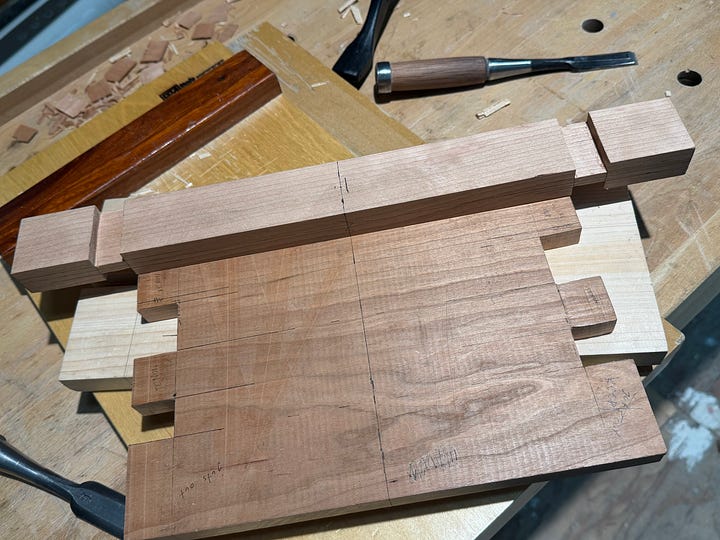
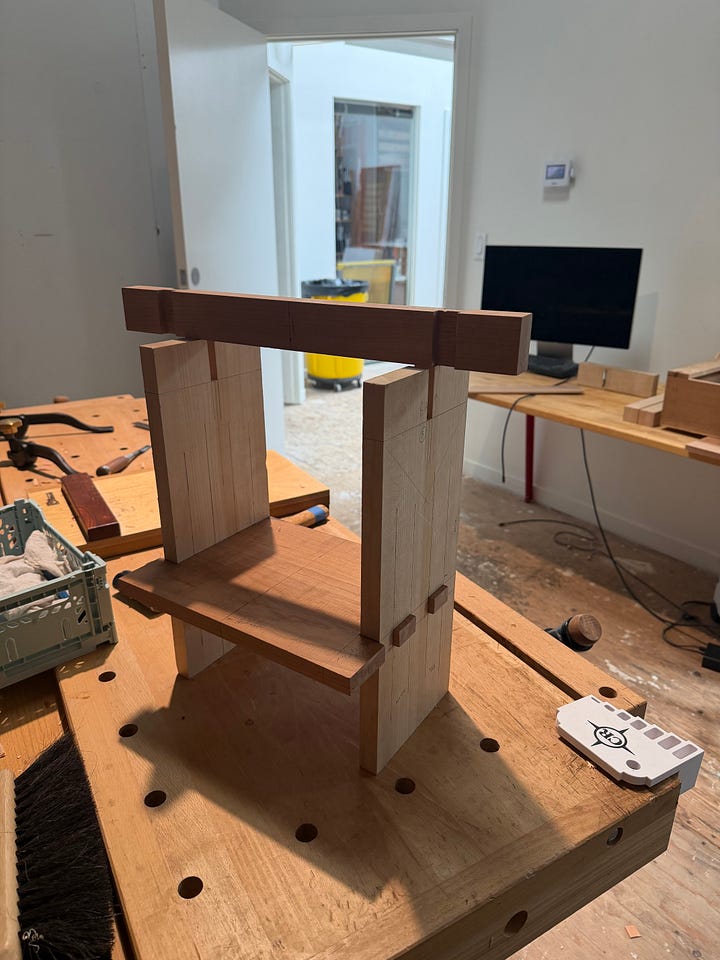
I should have just planed off the old lines! I accidentally cut the shelf to be too short, relative to the bridle piece holding the two legs together. I’m 99% sure this error would not have occurred if I had been working from clearer layout.
I could have engaged my human faculties of spatial perception and/or critical thought to catch this error while working. But I don’t want to bite off more than I can chew. So for now: Clear layout always.
The kernel of inspiration for this design was the “legs that are also shelves” of the Judd Library Desk. But I wanted to be able to put my legs around the table while sharpening, so I didn’t have space for two leg-shelves. So I just have the one.
To say anything about Donald Judd’s furniture is to claw for scraps from a carcass left bare by the vultures of the 2010s Interior Design Moodboard Industrial Complex. So I won’t try, except to mention that I recently revisited his 1993 essay, A Good Lamp is Hard to Find, which articulates his philosophy on furniture design and fabrication. The situation re: the impossibility of locating affordable, well-designed, well-made furniture has grown only more dire in the intervening 30+ years.
I find Judd’s perspective on comfort to be comical but also correct:
I am often told that the furniture is not comfortable, and in that not functional. The source of the question is in the overstuffed bourgeois Victorian furniture, which, as I said, never ceased. The furniture is comfortable to me. Rather than making a chair to sleep in or a machine to live in, it is better to make a bed. A straight chair is best for eating or writing. The third position is standing.
If I had infinite time, I’d devote some of it to reproducing every one of Judd’s furniture pieces with pre-industrial woodworking tools and techniques. I think I’d learn a lot.
Experimenting with the ‘stack and including some links to things I read/watched/so on as a way to pin them in memory for myself and perhaps point you, the reader, in the direction of something that compels:
Run don’t walk to Henry Glassie: Field Work. The documentary is mostly quiet footage of people absorbed in their craft intercut with the mustachioed folklorist himself sharing stories and theories. It put me into a more relaxed state than a restorative yoga class. Hat tip to Chris Schwarz’s American Peasant post for the recommendation.
While casting about for more footage of craftspeople at work, Japanese woodwork in particular, I found three videos. This one shows a man making a sideboard. Watching him shape the curves and apply the lacquer is mesmerizing. This one shows a man making a (perfect) small cabinet as does this one.
The Hillbilly Daiku blog which has content on all manner of handmade pursuits, including woodworking. I love the author’s illustrations. It appears to be dormant as of 2019 but nonetheless, it remains a treasure trove. I stumbled across it while looking for information on the shitage-kama joint and boy did it deliver: Blind Dovetail Thru Mortise and Tenon by Greg Merritt.
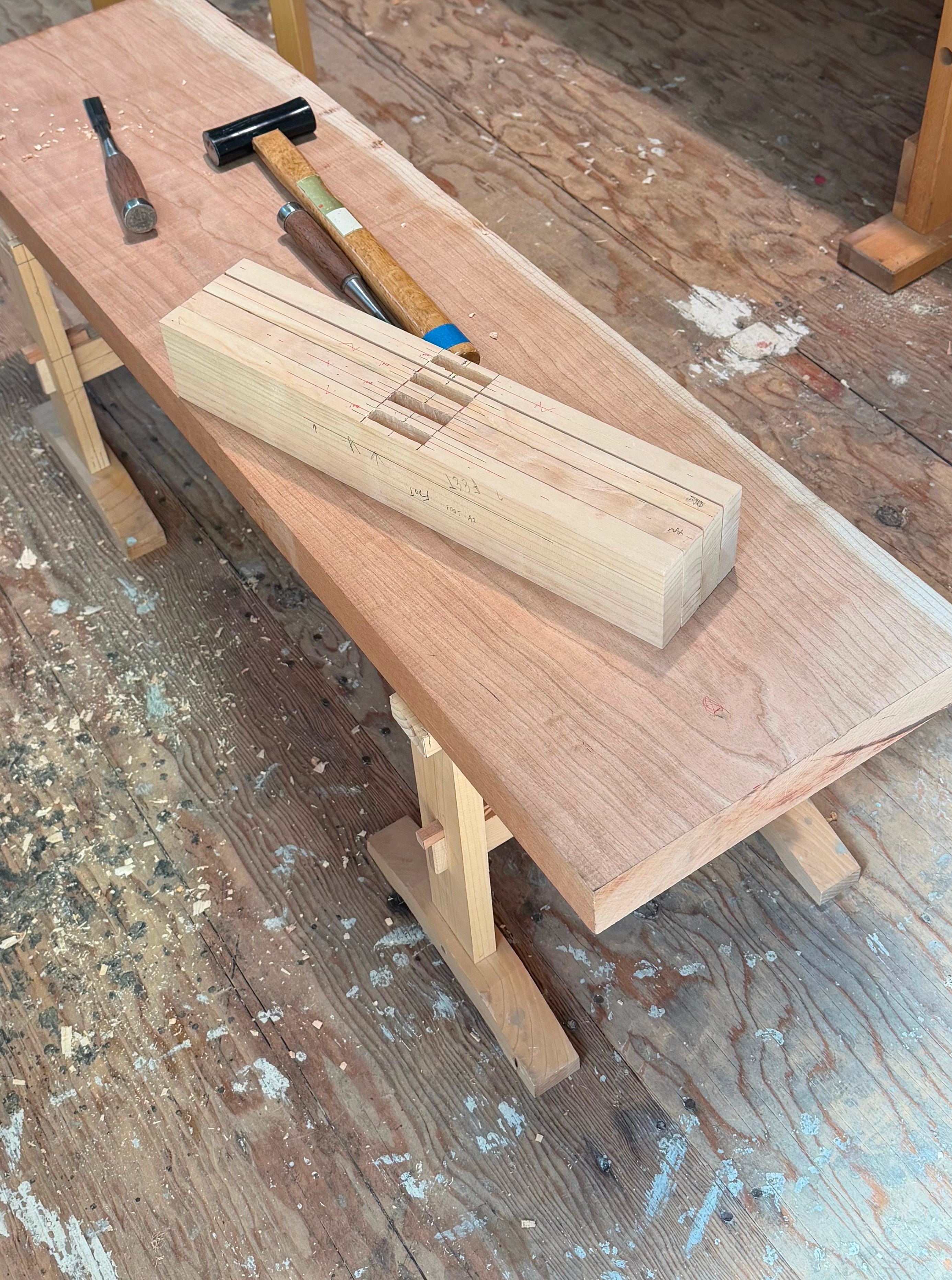
Next I plan to return to work on the Krenov-style sawhorses. I cut the blind mortises in the feet a couple of days ago. Momentum regained!
See you next time.
No posts
Comments
Nothing yet. Say the first thing.
Sign in to join the conversation.