
The Ringer’s Bryan Curtis, whose sports media podcast “The Press Box” is appointment-listening for anyone interested in the bizzaro state of sports journalism, often references a favorite sports story motif: “The Old Guy’s Still Got It” framing. While Sir Lewis Hamilton is ageless in that way all GOATs are, I think a 41-year-old winning his first grand prix for Ferrari fits the bill for the Old Guy framing.
In a year that’s felt predetermined to be Mercedes dominated — and a coronation of sorts for Kimi Antonelli — it’s fun to have Hamilton saying not so fast in Barcelona.
But this week’s newsletter is not about incumbents reasserting their dominance on the track. Instead, it’s about a new entrant in the endurance racing world and what a 13th-place finish at the Circuit de la Sarthe signals for Genesis.
Here is Toni Cowan-Brown’s report from the 24 Hours of Le Mans.

By Toni Cowan-Brown
I am, by my own admission, the wrong person to send to a car press trip. Six years into covering motorsport, I can tell you exactly how a TV rights deal is structured or why a sponsorship logo sits where it does on a livery, but ask me to identify an engine by its exhaust note (is that even the right term?) and I will stare at you blankly. So when Genesis invited me to the 24 Hours of Le Mans, I said yes for reasons that had less to do with horsepower and more to do with a hunch: this was a story about brand-building, not car specs.
I arrived sideways, in the best way. I’d just wrapped a week in Monaco covering the Formula 1 race, flew straight to Paris, then drove down to Le Mans — a journey that mirrors something about the event itself. Le Mans doesn’t sit inside motorsport’s usual rhythms. It’s not a round on a calendar you tick off. Instead, it’s a pilgrimage of sorts. The race runs for 24 continuous hours, through a full day-night-day cycle, on a 13.6-kilometer circuit that’s part permanent track, part public road closed for the occasion. Spectators camp in the infield for a week. Supercars park in a field next to a caravan. Drivers talk about the track as a journey and a destination, not a set of esses and turns. I spent Saturday night trackside in a teepee, which is either the most or least sensible way to experience a car race, depending on how you feel about sleep. There’s a reason this event has its own mythology: Le Mans rewards endurance, not just speed, and that single structural fact changes everything about how you approach building a car for this race.
And, yes, it is part of the World Endurance Calendar (WEC) but almost everyone will tell you that all the other races on the WEC calendar are there to prepare you for Le Mans — it’s less a race to win than a story you just hope to survive to tell. And survival, as a brand narrative, is gold.
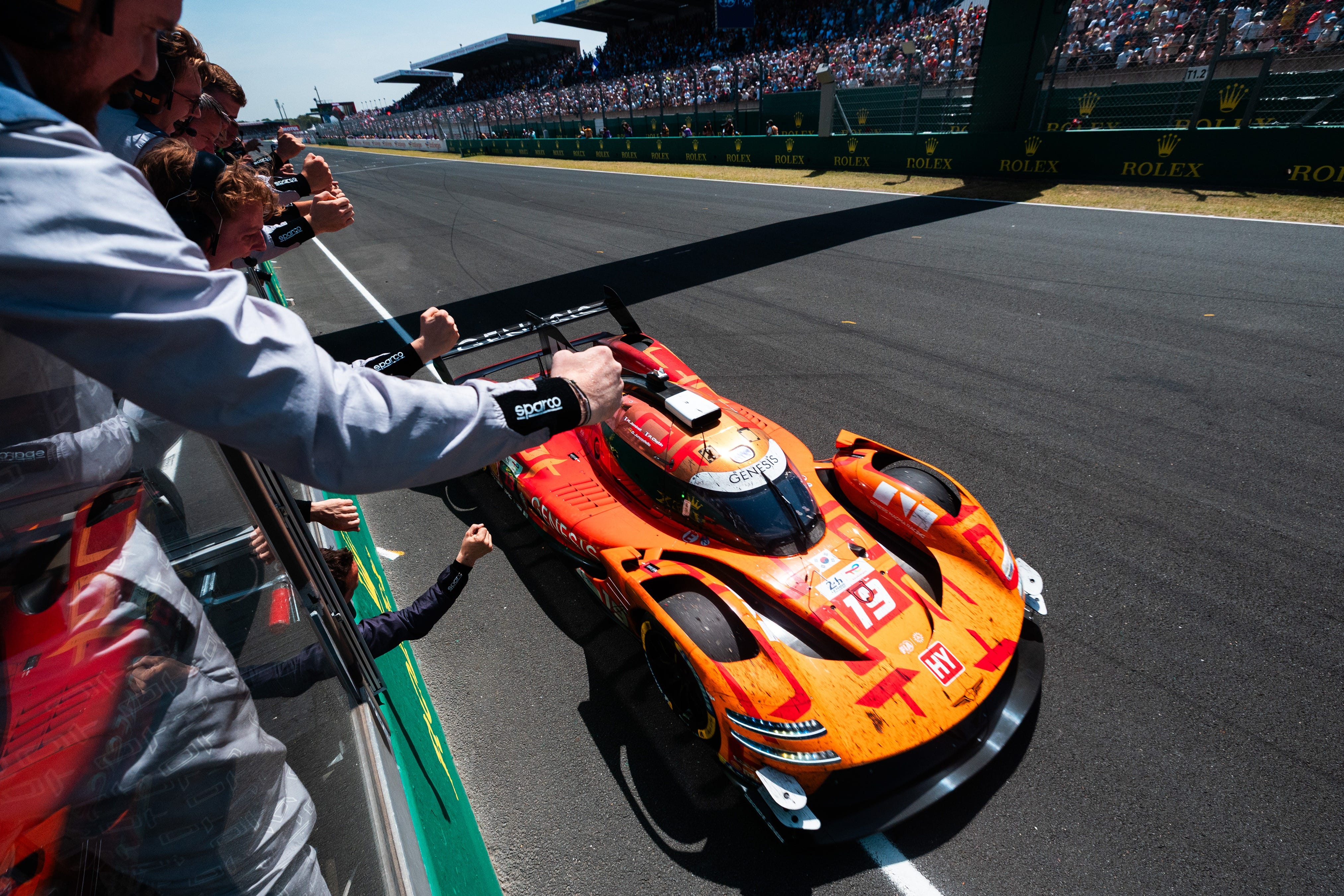
Genesis didn’t show up to Le Mans to win this year. Everyone involved did not hesitate to admit as much aloud, which is itself notable in a sport where manufacturers usually arrive swinging. Team principal Cyril Abiteboul, who I’ve heard speak candidly before, framed the Le Mans debut around one goal: get the car to the finish. Bringing the #19 GMR-001 home in 13th place after 372 laps wasn’t a disappointing result dressed up as a moral victory — it was the actual objective, hit on schedule, by a team in only its third competitive start. The car had shown strong pace in the first half of the race, fighting inside the top ten, before the team pivoted to managing reliability issues, and the sister #17 retired after sixteen hours with a suspension failure.
What makes that an “impressive” result rather than a forgettable one is the qualifying performance that preceded it: both GMR-001 Hypercars qualified inside the top ten, with Paul-Loup Chatin and André Lotterer placing the cars seventh and tenth in the final Hyperpole session. For a brand making its Hypercar-class debut, against manufacturers with years and, in some cases, decades more development time, that’s the kind of number that gets the paddock’s attention before a single competitive lap is run. Genesis didn’t need to win to make the point. It needed to look like it belonged, and for one week, it certainly did.
This is the part of the Genesis story I find genuinely compelling, and it’s not really about cars. Genesis is a sixteen-year-old luxury brand trying to do something almost no one successfully does fast: manufacture heritage. You can’t buy your way into Bentley’s or Ferrari’s relationship with endurance racing; that takes generations. What you can do is borrow motorsport’s emotional grammar — risk, drama, the all-nighter, the underdog narrative — and use it to compress decades of brand-building into a few competitive seasons. Le Mans, for a brand like Genesis, isn’t so much a marketing channel as a platform for building credibility and an emotional story arc. And as Cyril Abiteboul put it, “We’ve seen the hype that a Mercedes car and a Max Verstappen can create.”
The team’s trajectory from humility to an acknowledgement that they are here to build something special is nicely reflected in the pivot away from their black livery to their Magma- colored livery which debuted at Le Mans this past weekend. I have a sneaking suspicion we’ll be seeing a lot of that bravado in the near future.
If there’s one thing that defines how Genesis Magma Racing operates, it’s that they don’t seem to believe in doing one thing at a time. Walking the Manufacturer Village that week felt like walking into a design studio that had also, almost incidentally, entered an endurance race. This is very much due to the genius of Genesis’ Chief Creative Officer, Luc Donckerwolke.
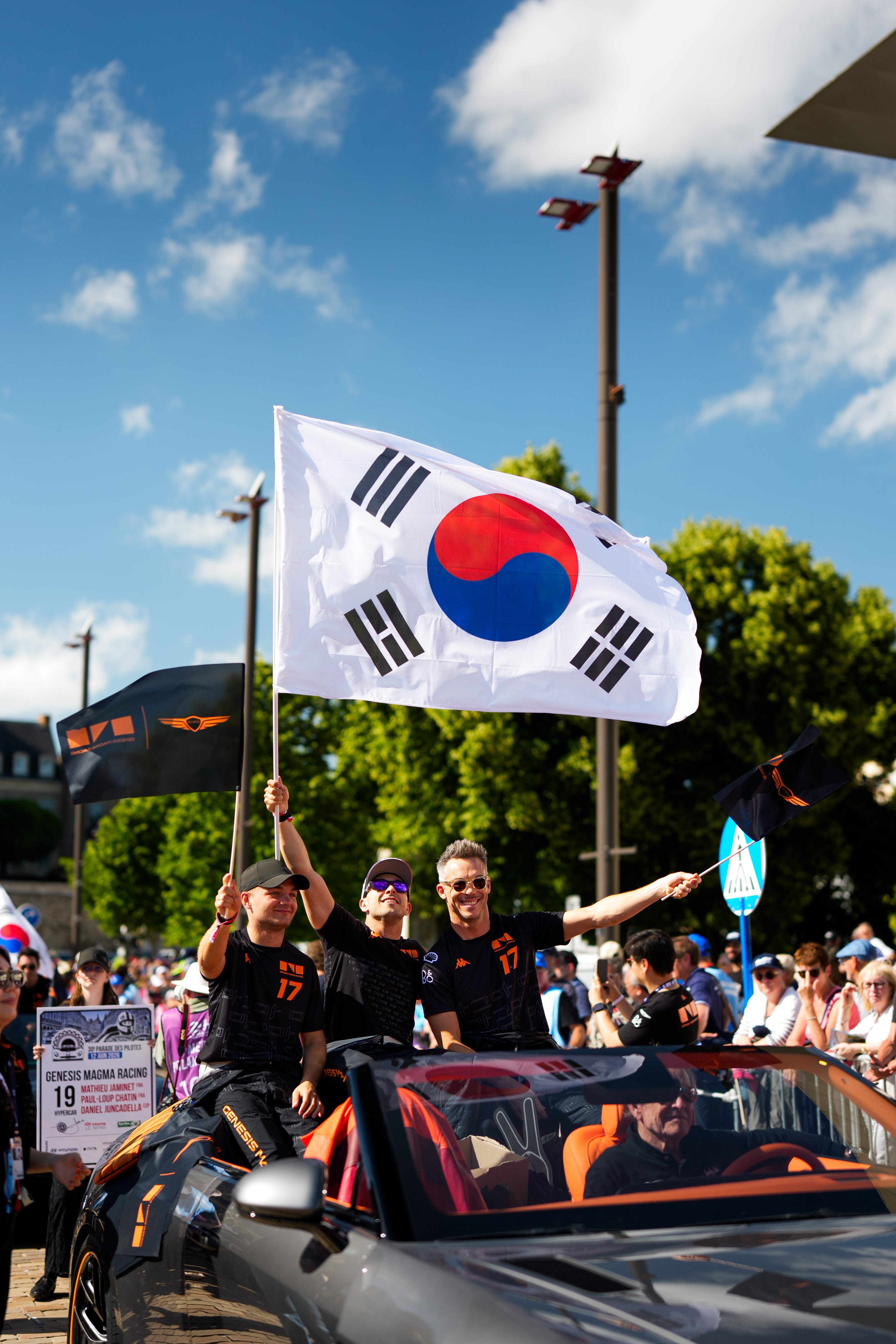
Ahead of the race, Genesis unveiled the Magma GT3 Concept — a track-focused, performance-first design built around current GT3 technical regulations rather than derived from an existing road car. It’s a car so good looking that even I, deaf to “exhaust notes”, can understand the machinery’s rare beauty. As one Genesis exec put it, “a car you will want to drive like you stole it.” Alongside the concept car is an updated Magma GT concept reimagined as a two-seat luxury grand tourer. Then, there were the two X Gran Convertible concepts, one in Liquid Titanium echoing the GMR racing colorway, the other in a quieter Midnight Teal with tartan-inspired interior textiles, both piloted through the drivers’ parade by brand ambassador Jacky Ickx and reserve driver Jamie Chadwick.
Finally, almost as a punchline, there was the Box Buggy which was truly the talk of the paddock: a 160-horsepower electric “golf cart” with four independent motors, capable of rotating in place and hitting 100 mph, which Genesis built largely because, as Chief Creative Officer Luc Donckerwolke put it, the brand has sponsored golf for years without ever having designed its own buggy. They decided to have some fun
The Box Buggy is, by any rational product-planning logic, a strange thing to debut at the same press conference as a Hypercar and a GT3 concept. But that incoherence is the point, and it’s the thread that ties back to something specific about how this team works.
Here’s the detail that, once you hear it, re-contextualizes everything else: the GMR-001’s V8 didn’t start life as an endurance racing engine. It was built by combining two of Genesis’s 1.6-litre turbo four-cylinder engines — the same powertrain architecture that’s seen success in Hyundai Motorsport’s World Rally Championship program. That’s not the conventional path. Most manufacturers entering Hypercar class design a bespoke powertrain from scratch, a process that eats years. Genesis didn’t have years. So they reached for what already existed, validated it on a different surface entirely, and bent it to a new purpose.
I’d argue that this single engineering decision tells you more about Genesis Magma Racing’s operating culture than any press release could. This is a team that is, by its own admission, time-poor — racing in Hypercar a full season behind teams like Toyota, BMW, and Cadillac, all building toward an event that requires a level of long-run reliability you genuinely cannot rush. Being time-poor in motorsport is usually a death sentence.
What’s interesting about GMR is that the constraint seems to have produced creativity rather than panic. You don’t get a four-concept-car reveal, a golf buggy, a potential GT3 programme, and a Hypercar entry all moving at once because you have abundant time and resources to sequence things neatly. You get that because you don’t have the luxury of sequencing, so everything runs in parallel, on borrowed and adapted parts, built by a team that’s learned to treat compression as a feature rather than a flaw. The convergence of all these projects is so much bigger than the sum total of these individual projects and it’s this that allows the team to move as fast as they are. As José Muñoz, President and CEO, Hyundai Motor Company, reminded us during Friday’s press conference, “Genesis is a tech company that happens to be an OEM.” This is the biggest differentiating factor, to me anyway, that allows them to move as fast as they are.
There is one last telling moment from the week that I’d be remiss not to share. One that had nothing to do with concept cars. On the Tuesday test day, before the race weekend had properly begun, Jamie Chadwick completed five laps in the #17 GMR-001, becoming the first woman to drive a Hypercar at the Circuit de la Sarthe. She described driving the Mulsanne Straight for the first time in a Hypercar as the kind of thing any racing driver dreams about, and was candid that the outing had made her hungrier to convert her reserve role into a full-time seat. It’s easy, in a week stacked with concept reveals and race results, to let that moment get buried under the noise. It shouldn’t be. Female representation at the top of endurance racing has been close to nonexistent, and Genesis put a woman in their Hypercar before they’d even started the actual race weekend. Chadwick’s historic drive was not a stunt. It was a structural part of how they’re building out their driver pipeline. The historic moment felt right at home in Genesis’s Le Mans debut.
No posts
Comments
Nothing yet. Say the first thing.
Sign in to join the conversation.