
By Toni Cowan-Brown
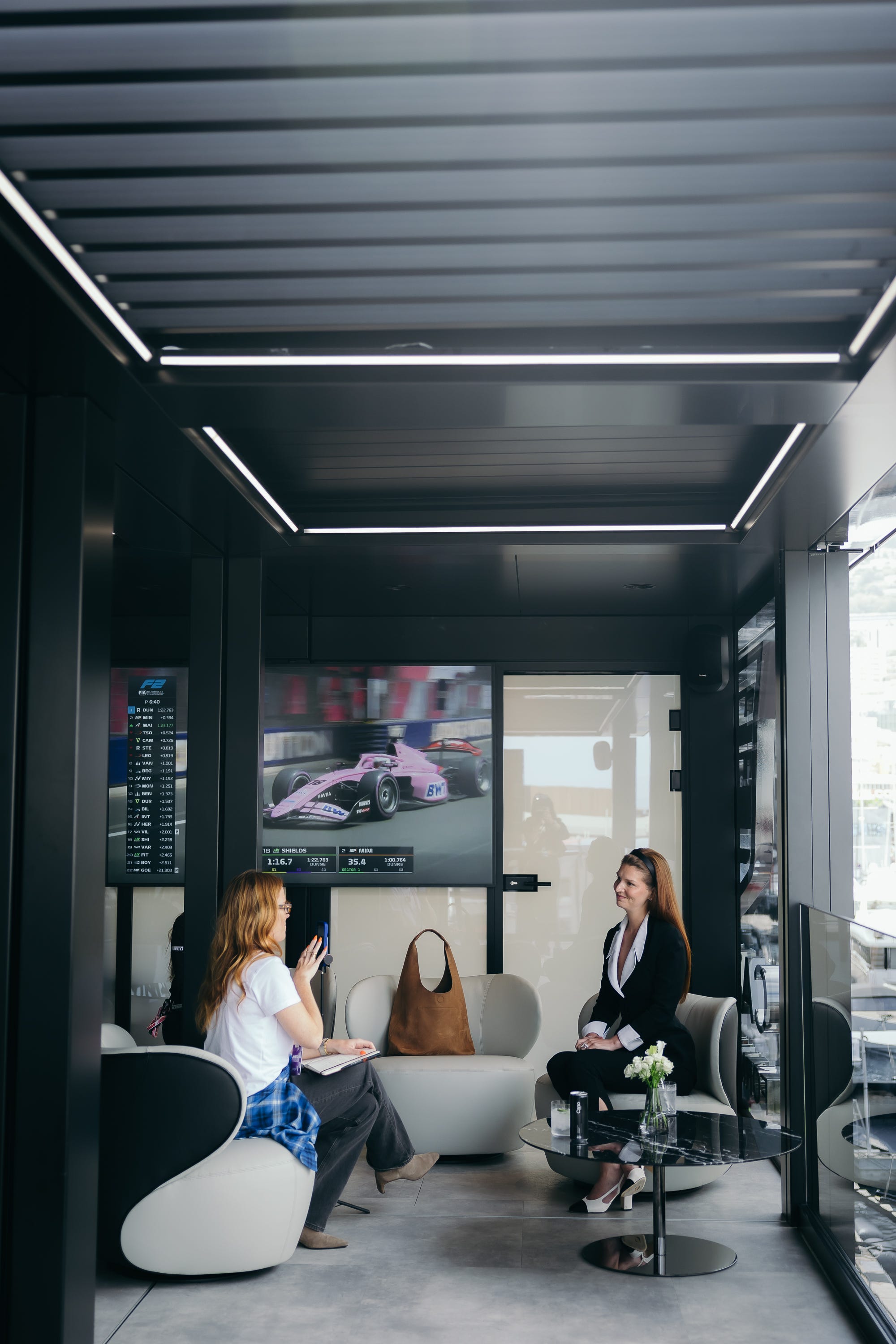
The top floor of Cadillac’s brand new motorhome is not where you expect to find calm, and yet it feels incredibly peaceful up here. And that’s in part due to the stunning view of Monte Carlo and the way this space has been designed. Monaco race weekend is, by its nature, organized chaos — a 100-year-old city circuit squeezed into a principality barely bigger than Central Park (so small that the Formula 3 paddock is in France, not in Monaco). Every inch of paddock real estate is contested and every brand is fighting for attention against the backdrop of one of sport’s most storied addresses. And yet, up here, there is something close to stillness. Soft leather chairs. Panoramic views of the harbor. The distant, tinny whine of support series cars threading through Casino Square as the only reminder that this is, in fact, a race track.
The motorhome itself is the statement. Three floors, introduced at the start of the European leg, and immediately one of the most talked-about structures in the paddock — not because Cadillac needed to announce they had arrived, but because, in a paddock increasingly fluent in the language of brand, the team took one of the most underappreciated brand assets in F1 — the motorhome — and turned it into a signal of how seriously they are taking the sport.
Cassidy Towriss is the person who helped build that point of view. As the team’s brand advisor, she occupies a particular kind of role in a Formula 1 paddock that is still working out what brand strategy actually means when your sport is simultaneously a racing championship, a Netflix franchise, and a global cultural moment. I sat down with Towriss in between media breakfasts, Netflix shoots, and various appearances to understand what it takes to build an F1 team identity from the ground up.

Toni: Female viewership and fandom in motorsport has genuinely shifted and women are now the majority of newer F1 fans, and by some measures they have more purchasing power and online influence than any other segment. But when you look at who’s making decisions about how that audience is spoken to, it’s still overwhelmingly men. Why is that gap still so wide, and what does it cost the sport?
Cassidy: Leadership can evolve its structure, and I don’t think we’ll be stuck in that way forever. I think we will get there, but I think you know the last thing anybody wants is as more female fans come in is that they feel like they’re getting mansplained Formula 1. We have an understanding, we have a passion for it, we don’t need it explained. But there’s going to be a gap any time the leadership doesn’t have that perspective and that insight into how to talk to that particular consumer or fan.
I think it’s a gap that will get closed, but it’s important to close it sooner rather than later, because there is a cost to not accounting for it. You look at female fans, and they are probably the biggest purchasers of merchandise at this point. Brands, teams, the whole series should really take them into consideration when not only designing merchandise, but how you market it to them, and all the above.
Have you talked about this? Like when you’re in meetings, do you say: do you realize the amount of money we’re leaving on the table by not catering to that audience?
I so enjoy my time working on the Tommy Hilfiger team, and conceptualizing things for fan wear, team kit, all of the above, and it really does come up more than I even thought it would. But it is fun to discuss, because people are actually interested in it. I don’t have to push as hard as I thought I would for certain silhouettes and things like that, because I think people can see that now, and see that if we don’t catch up right now, we could get left behind in not capitalizing on this amazing female fan base that we now have,
So, it’s less pushback, and it’s more of them saying, “We just didn’t know”?
Yes, it just wasn’t at the forefront. Content creation has become a bigger part of F1 and female content creators have such a big footprint in this space. And that’s because that’s what people like to consume. Before, I think the assumption just was that, well, Formula 1 is mostly for men, and now the landscape has changed.

You often talked about how you don’t wake up in the morning with this desire to go against the status quo. Instead, you wake up with this desire to want to do really good in whatever you’re doing. Talk to me about that, because I actually really love that mindset and framing.
Yeah, so I just really want to prioritize doing the work well. I don’t want to be sought out for my input because I’m female. I want it to be sought because you genuinely want my input. At this team, I don’t think I’ve been put in too many positions where my thoughts and input are so different that I feel like I’m really having to push. But when I have been, I feel so comfortable to push for my perspective to be heard.
It’s a very collaborative environment here at CF1, and I think that’s a true testament to the kind of culture we’ve built.
There’s this pattern we often see where an organization or league will say they want more women in all different levels of leadership, but then the women hired are placed in aesthetic or marketing roles. What do you think needs to change to see women at executive levels in the sport?
Yeah, I think it’s interesting because I think a lot of organizations are comfortable putting women in visible positions, but not necessarily ones that come with decision-making power or authority. So I really think we need to close the gap between just making them visible — almost in a performative sense to tick the box — to where people are comfortable putting them in a position of authority. But that means men may have to take direction from women. I don’t think that there’s people saying, ‘I don’t want to be directed by a woman.’ I think it’s that we’re not quite there yet.
But it will become easier to grow in this space, because as motorsports across the globe has become more popular and more interesting, we have a lot of young, really talented female talent coming up through school right now, through internships, and I think once they’ve gotten experience in this industry and they’ve had the opportunity to grow and cultivate a great career, they will make wonderful decision-makers one day. They should be the ones elevated into powerful decision-making roles, and they should not be worried about whether or not a man can take direction from them.
Your background is in brand, culture, emotional connection, not in engineering or strategy in the traditional F1 sense. Some would see that as outside the core. But you’ve argued that understanding what makes people feel something is itself a competitive advantage. How do you make that case internally, inside a team and a sport that runs on data and lap times?
Well, from the outside, it’s such a technical and data-driven sport. But I think what I would tell anyone is that data means nothing if nobody cares about it. A really good example of that is in 2024 when Charles Leclerc won the Monaco Grand Prix.
This isn’t exactly the most exciting race of the season, not a lot of passing to be had, but if you watched the final lap on TV, that broadcast and the way it was commentated gave you goosebumps. To hear them talk about his late father and just what it meant in that moment, those are the kind of things that resonate with people, and it will bring them back.
When you ask anybody about an iconic sports moment that they resonate with, they’re going to tell you about how it made them feel. The ability to connect with who you’re hoping to be your fan base, who you’re hoping to be your consumer, in order to do that and build a loyalist out of them, you have to be able to connect with them and make it mean more than just numbers on a page.
You talked about understanding who your consumer is and your fan base is. What did that exercise look like at Cadillac F1?
We have a big vision. I think we’re still very much in the process of trying to achieve that vision. But this is one of those moments where it’s like, dream big.
I’m such a motorsport fan myself, just personally, and so it’s hard not to be able to share it to the world and scream it from the rooftops and be like, ‘Let me tell you what you may not know that I’m sure will make you a fan.’ So, it’s deeply personal to me.
Motorsports gave me a place of belonging, of value. I found so much in my life through this sport: so much belonging, community, all of the things that sometimes when you’re young can be hard to come by. So if I can connect with F1 that way, it can connect with a lot of people across the world in a lot of different ways. I want people to feel like you don’t even need the invite and that the door is always open.
People are always like, ‘Oh, this is probably a dumb question.’ There is not a dumb question! I’d love to answer any question about motorsports, because I think that’s the whole point. The door should always be open to you.
No posts
Comments
Nothing yet. Say the first thing.
Sign in to join the conversation.