
There’s a great clip from Sleep Researcher Matthew Walker where he makes an analogy that sleep is more like landing a plane than it is like flipping off a light switch; You need to take an approach. It’s unwise to just crash straight down into bed and expect to sleep - just as you wouldn’t expect a plane to nosedive into the runway.
With this in mind, I’ve created this Sleep Flight Plan to help you safely and smoothly “land” your own high-performance machine - your Body & Mind. This plan will help you plot your course and keep you on track in your journey into the night.
Pilots and astronauts need a plan to get where they want to go, and oneironauts (explorers of the night mind) also need a plan for navigating the territory of the night.
In order to work with dreams, we need to first ensure that we’re setting ourselves up to sleep well.
You can craft your plan in a journal, word doc, or wherever else you can come back to and keep you on the right path. Wherever this plan is - keep it in close proximity for your journey.
There are four steps to this plan":
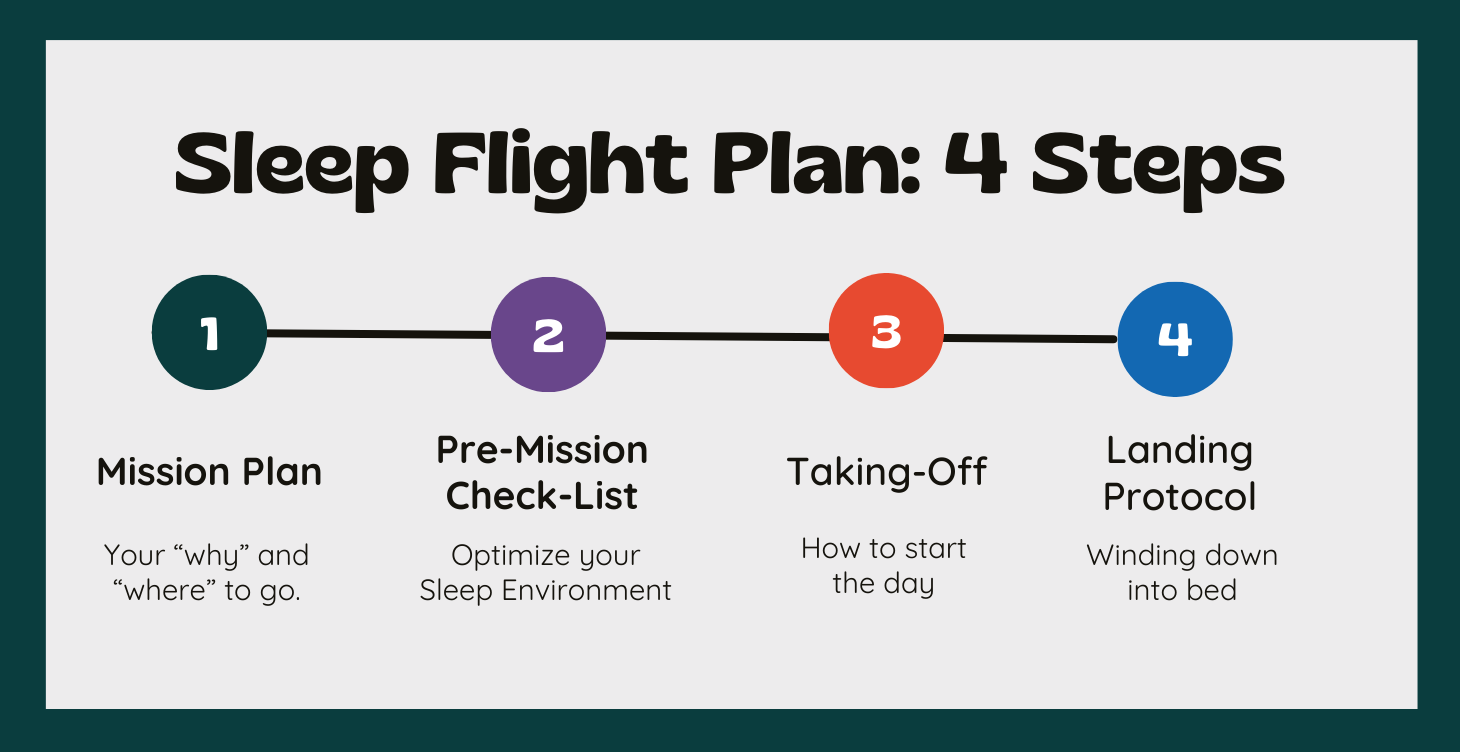
The first and most crucial step is defining your mission. Where do you want to go, and why does sleep matter in getting you there? Sleep impacts nearly every aspect of life - it can be the ultimate (free, legal, safe) performance enhancer - improving things from energy and focus to emotional resilience and physical health. By understanding how sleep influences your personal goals, you’ll have a strong foundation to stay motivated.

Consider these examples:
Aspiring Astronaut: If you're training to become an astronaut, you need sharp alertness, stress regulation, and strong memory retention to handle the challenges of flight school. Sleep plays a direct role in all of these.
Athlete: If you compete in sports, sleep is crucial for motor function, muscle recovery, reaction time, sprint speed, and injury prevention. Not to mention the impacts on focus and attention and energy. A well-rested body & mind is more resilient and primed for peak performance.
Parent & Partner: If you're a spouse or parent, sleep helps you be more present, patient, and emotionally stable for your loved ones. It affects your long-term health, reducing risks of illness and ensuring you can be there for your family for years to come.
Colleague: A good foundation of Sleep can help those in the working world showing up to your job with greater energy and alertness, ability to focus, and efficiency.
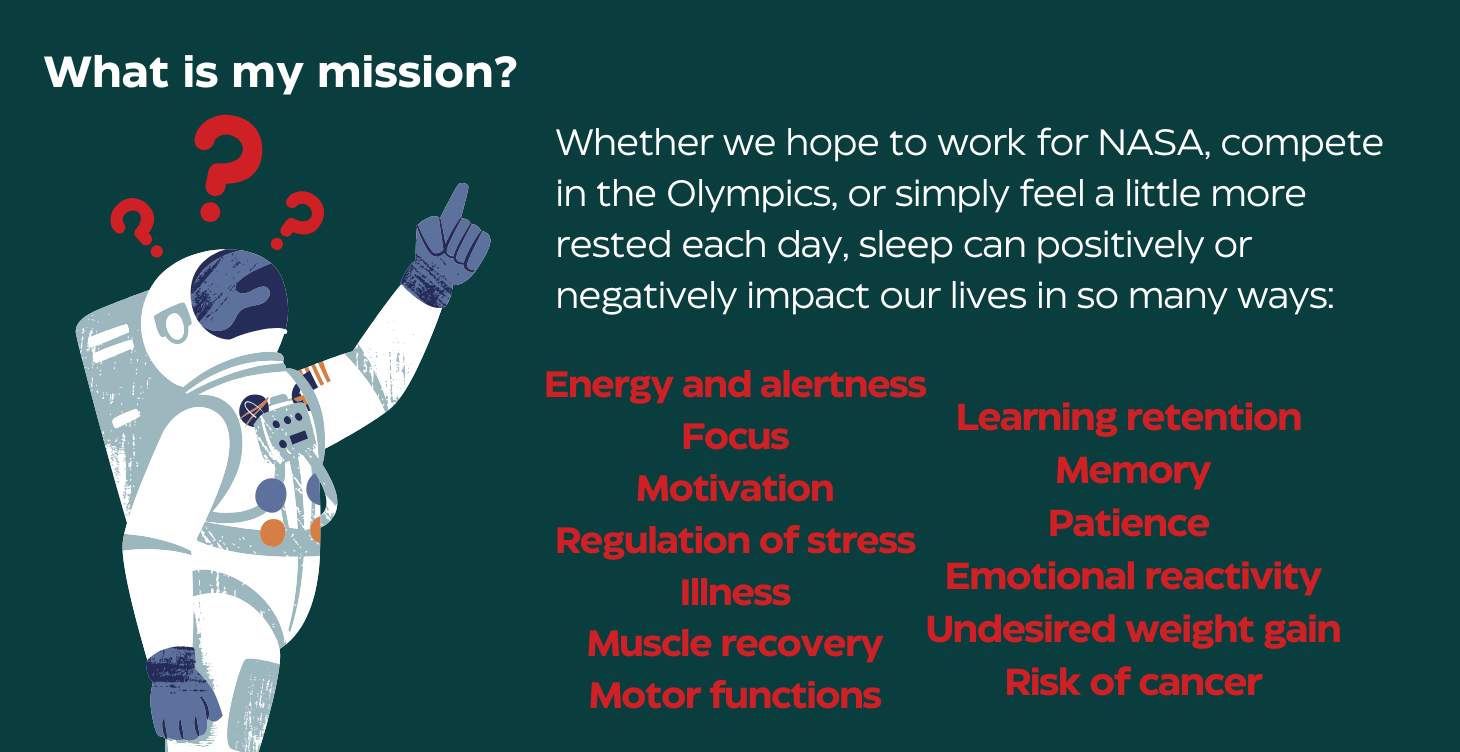
Write and reflect.
Whatever you wrote, investing in rest and recovery can help you achieve them. When life gets hard and you’re tempted to abandon this plan, remember this mission.
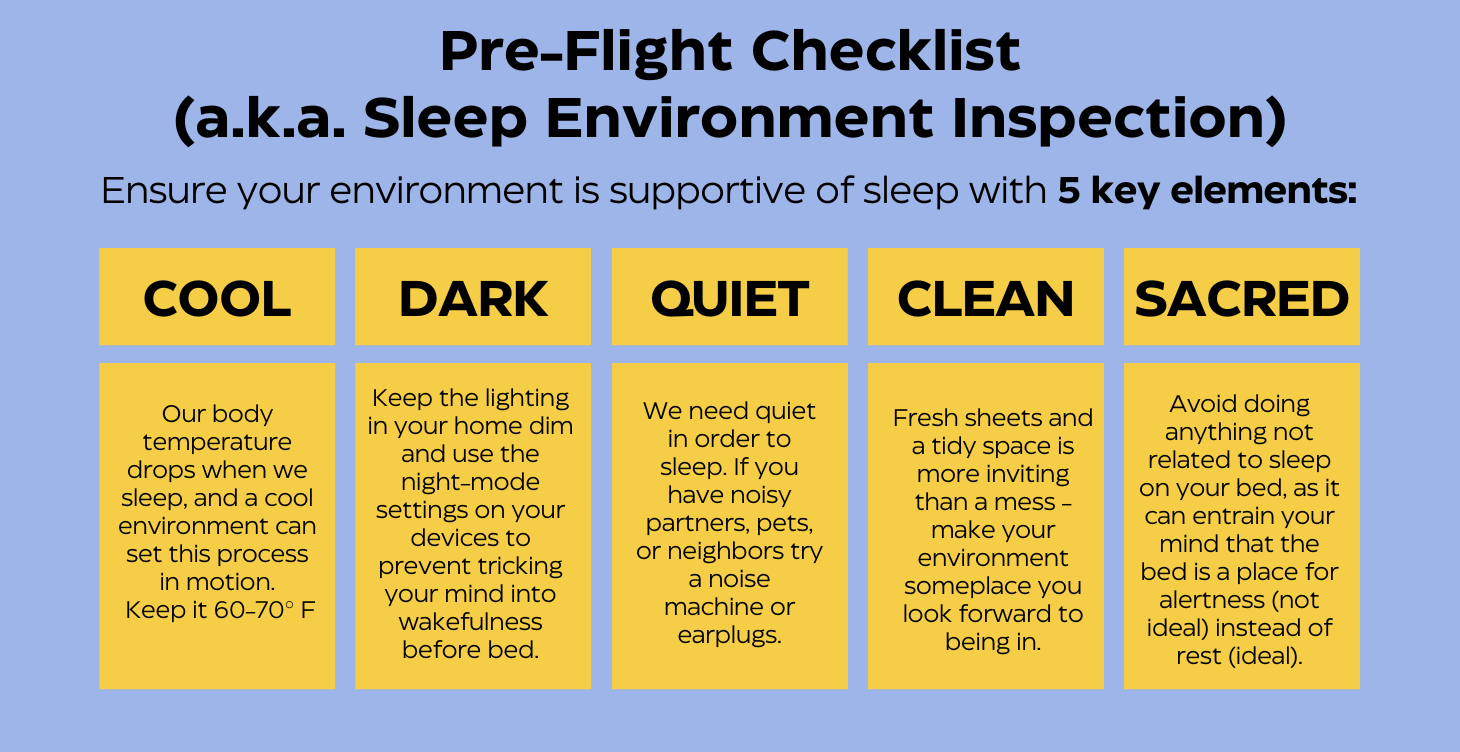
Before a pilot takes off, they go through a checklist to make sure everything is in order. In the same way, we need to assess our sleep environment to ensure it sets us up for deep and restorative sleep. There are five key qualities to optimize:
Cool: Our body temperature drops when we sleep, so a cooler room helps signal to the body that it’s time for rest. Aim for a temperature between 60-70°F (~15-20°C)
Dark: Light exposure can trick the brain into wakefulness. For most of human existence, we were awake during the day and Use blackout curtains, dim lighting before bed, and consider blue-light-blocking strategies if using screens at night.
Quiet: Noise disturbances can fragment sleep. If you have a noisy environment, try using earplugs, a white noise machine, or other sound-masking solutions.
Clean: A tidy and inviting sleep space reinforces the priority of rest. Fresh sheets, an uncluttered room, and a pleasant atmosphere make a big difference.
Sacred: Your bed should be a place for sleep and relaxation—not work, scrolling, or stressful activities. Keeping this boundary helps condition your brain to associate bed with rest.
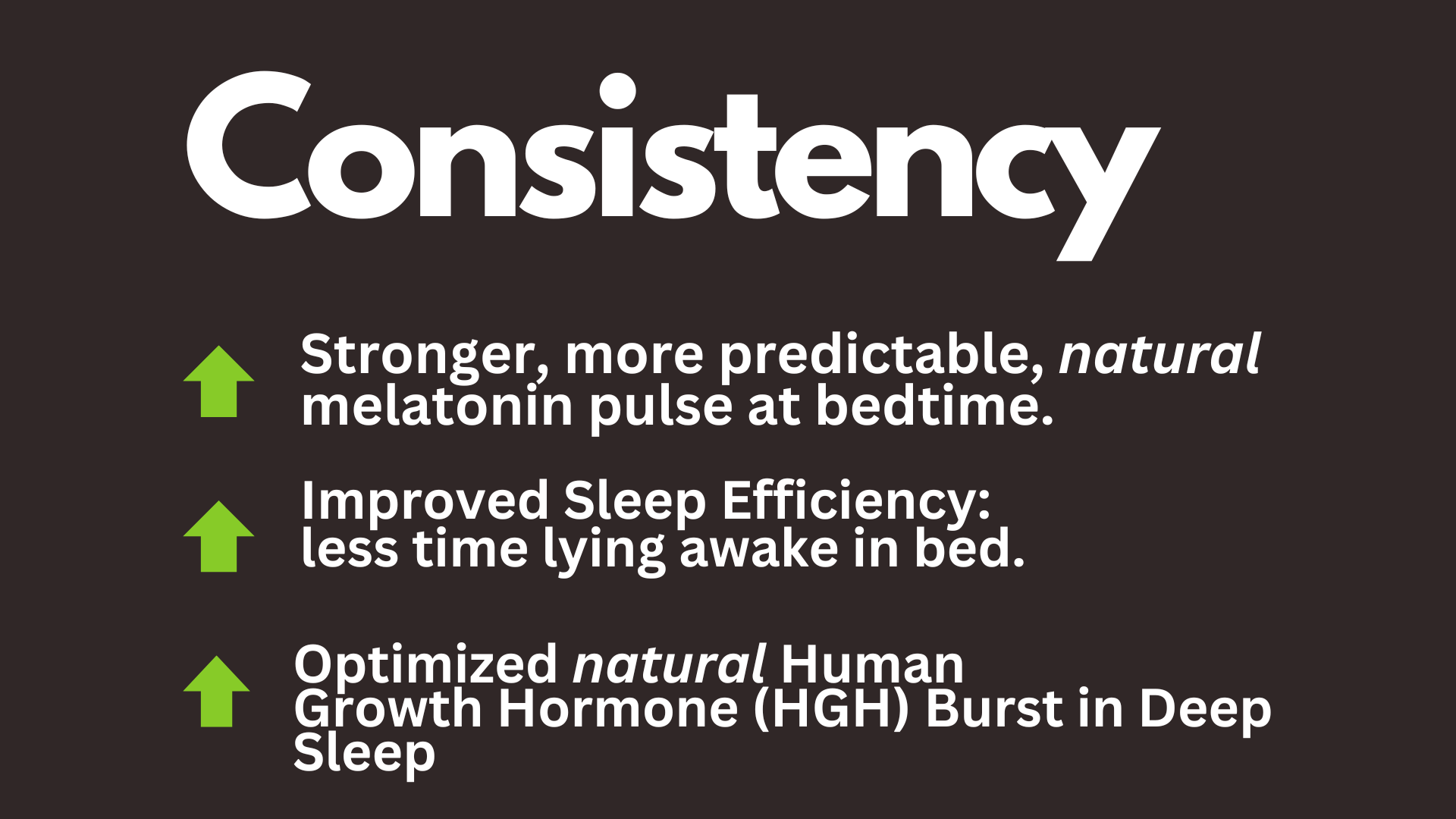
Once your mission is clear and your environment is optimized, the next step is ensuring a smooth takeoff—how you start your day. The most effective way to regulate your sleep-wake cycle is to wake up at the same time every day, including weekends.
Your body and mind love predictability! If you wake up at the same time, you will start to fall into a rhythm of getting tired at bedtime. This means better efficiency - a.k.a. less time spent laying bed and not falling asleep. Isn’t that GREAT!? I think most people don’t like that experience, so let’s cut it out! Consistency is a great remedy and a great practice that can reduce the regularity of this happening
A consistent wake-up time stabilizes your circadian rhythm, improves sleep quality, enhances cognitive function, and supports long-term health. Research shows that irregular sleep schedules can negatively impact learning, memory, and overall well-being.
We won’t always be perfect on this, but do your best within your unique life circumstances. If work, travel, or parenting responsibilities make strict consistency difficult (note: I am in this boat with a baby that has not developed a consistent rhythm yet - therefore I struggle with consistency), aim for as much regularity as possible. Shift workers, frequent travelers, or new parents may need to supplement with strategic naps or deep rest techniques (more on these to come) to maintain stability.
When setting a wake-up time, choose the earliest time you need to rise on any given day and stick to it. If you have extra time on some mornings, it helps to plan that time out with an intentional activity to fill that space rather than sleeping in. The benefits of a consistent sleep schedule will compound over time, helping you wake up feeling more refreshed and energized.

For deeper divers, consider this worksheet to further build out your sleep consistency.
Light is one of the most powerful regulators of our sleep-wake cycle. Our bodies rely on natural light cues to align our circadian rhythms, and modern artificial lighting and heavy device use can disrupt this process. To optimize your sleep, consider these key strategies:
Morning Light Exposure: Get at least 10–30 minutes of natural sunlight within the first hour of waking. This signals to your body that it’s time to be alert and helps optimize melatonin (the sleepy hormone) production later in the day.
Dim Evening Lighting: As the sun sets, mimic nature’s light transition by dimming indoor lights. Use warm, amber-toned bulbs and avoid bright overhead lighting.
Limit Blue Light at Night: Screens emit blue light, which can suppress melatonin and delay sleep. Equally important is what we are consuming on our screens. A lot of what we do on our devices triggers dopamine and cortisol, the opposite of the sleepy-hormones we want. Be intentional with your device use, and you can also use the device’s settings against itself to help. Download instructions for how.
Use Red or Amber Light for Nighttime: If you need light at night, opt for red or amber-hued lights, which have minimal impact on melatonin levels.
By consciously managing light exposure throughout the day, you can enhance your sleep quality, fall asleep more easily, and wake up feeling more refreshed.
Just as a plane follows a controlled descent before landing, your body and mind need a transition period before sleep. A wind-down routine helps signal to your nervous system that it's time to shift gears and prepare for rest.
Here are a few key elements to consider:
Set a Cutoff Time for Stimulation: Avoid intense work, heated discussions, or stressful activities at least an hour before bed. Give your mind time to slow down, shifting brainwaves from beta to alpha on your way into theta (stage 1 sleep) and down into Delta (Deep Sleep).
Create a Relaxation Ritual: Engage in calming activities to guide you into relaxation like reading, gentle stretching, meditation, prayer, journaling, expressing gratitude, or listening to soothing music.
Reduce Screen Time: Aim to put away devices 30–60 minutes before bed. If you must use screens, enable night mode or use blue-light-blocking glasses.
Use Breathwork or Body Scans: Techniques like 4-7-8 breathing, progressive muscle relaxation, or a short body-based meditation1 can help calm your nervous system.
Set a Bedtime Alarm: Just as you set an alarm to wake up, setting a nightly reminder can help you stay accountable to your wind-down routine. Download instructions for how to optimize your device2 for this.
By prioritizing a wind-down process, you create the conditions for a smooth landing into sleep—allowing you to drift off more easily and wake up feeling fully restored.
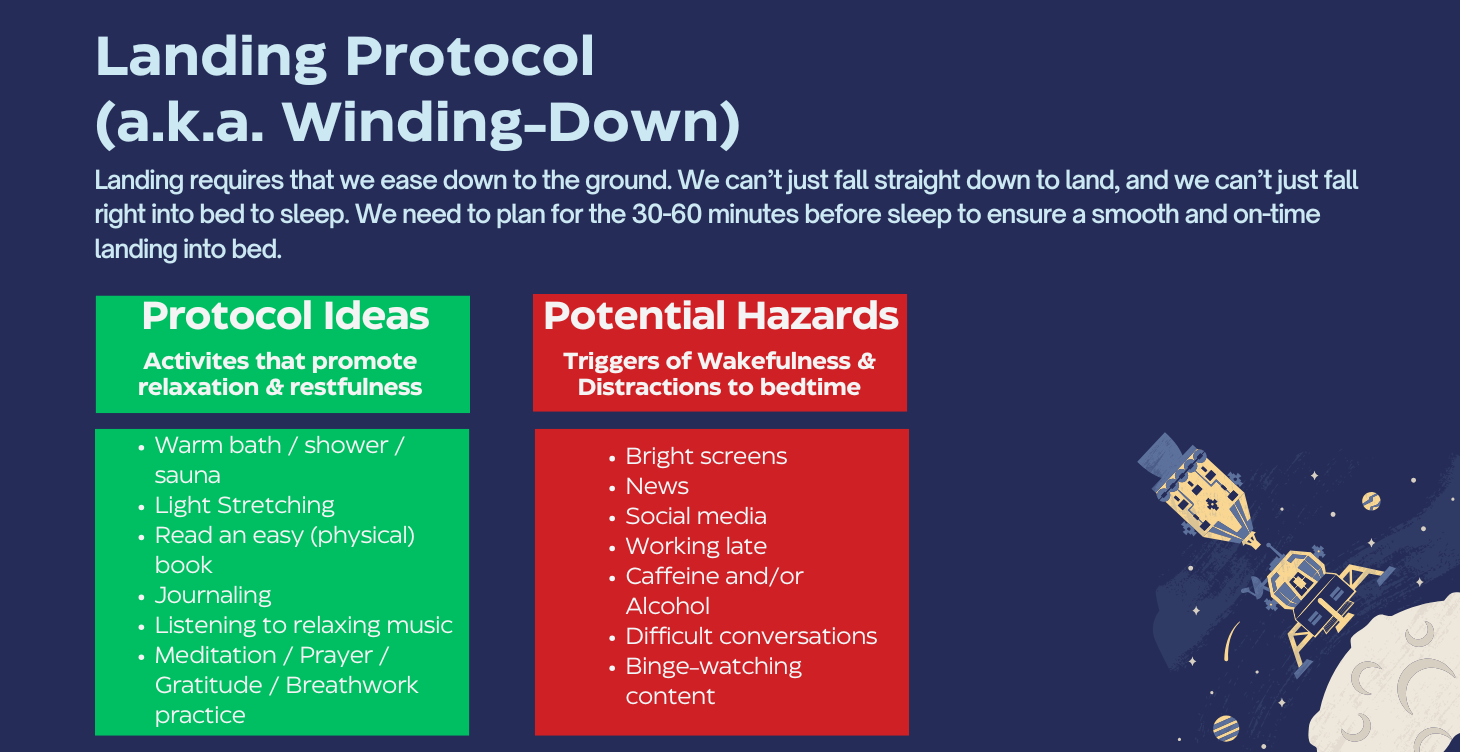
List 2-3 calming activities to wind down before bed (or to do if you aren’t tired at bedtime)
List 2-3 “hazards” that could be an obstacle that are likely to distract you and keep you alert at night.
Define Your Sleep Mission: Understand why sleep matters for your goals.
Optimize Your Sleep Environment: Follow the Pre-Flight Checklist (Cool, Dark, Quiet, Clean, Sacred).
Establish a Consistent Wake-Up Time: Regulate your circadian rhythm with a steady schedule.
Manage Light Exposure: Use natural light cues to align your body clock.
Implement a Wind-Down Routine: Prepare for sleep with a structured transition period.
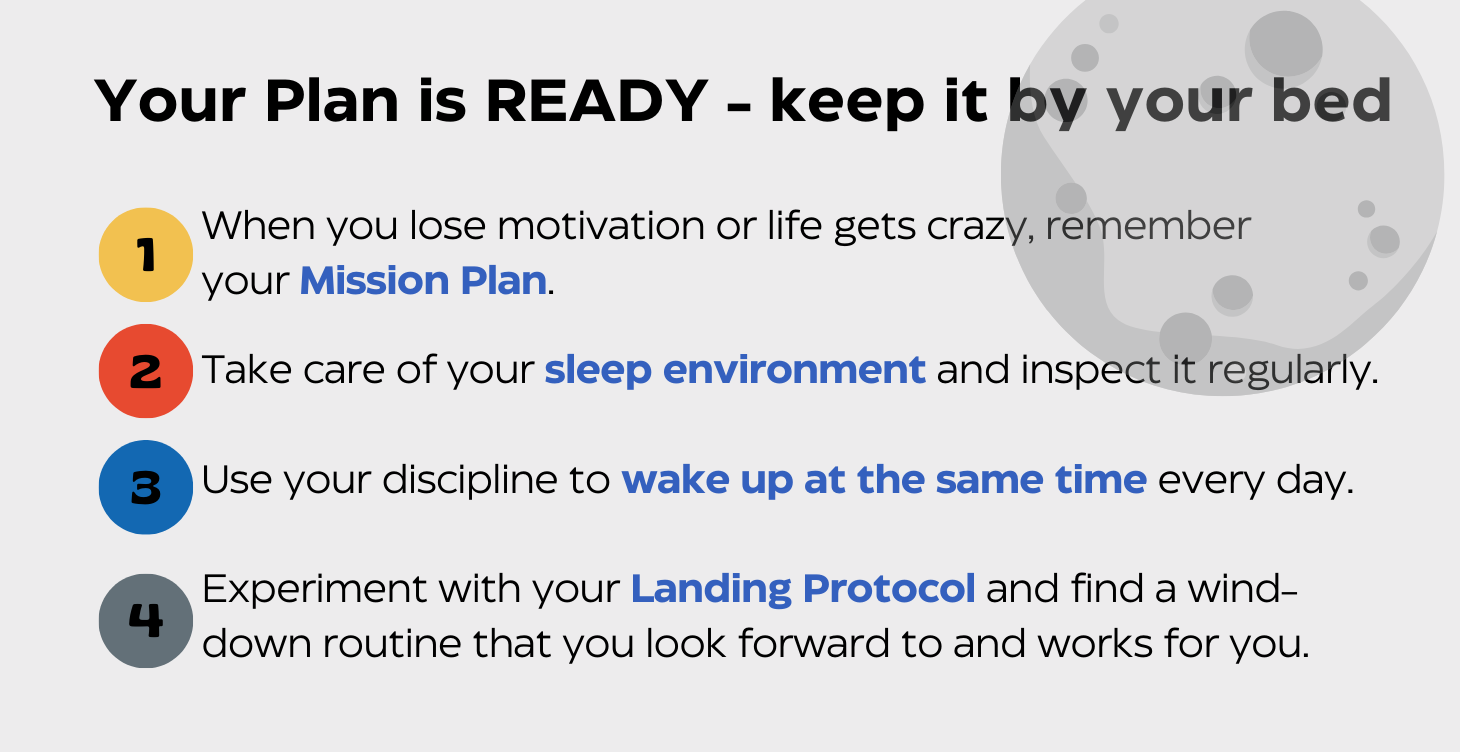
When motivation wavers, revisit your mission plan. Remind yourself: this is why sleep matters. With these first steps in place, you’re well on your way to elevating your sleep and, in turn, your performance in every area of life.
Our technology devices are designed by brilliant people to keep our attention, to keep us engaged and stimulated. See Stolen Focus, by Johan Hari for a great read on this.
Comments
Nothing yet. Say the first thing.
Sign in to join the conversation.