
We live in an age of spectacle. At home, we smother our daily routine in images that highlight the sensational, the beautiful, the outrageous. We seek the larger than life, and usually wind up with something that is neither.
On vacation, we race to visit the blockbusters, the must-sees, the once in your life moments. It’s natural after all. Who knows when or if we’ll ever be back?
In Rome, of course, there is an endless number of extraordinary things to see. But this is not my moment to see extraordinary things. Having had ankle surgery two weeks ago, I’m sticking close to home. Cobblestones and crutches are a laborious combination.
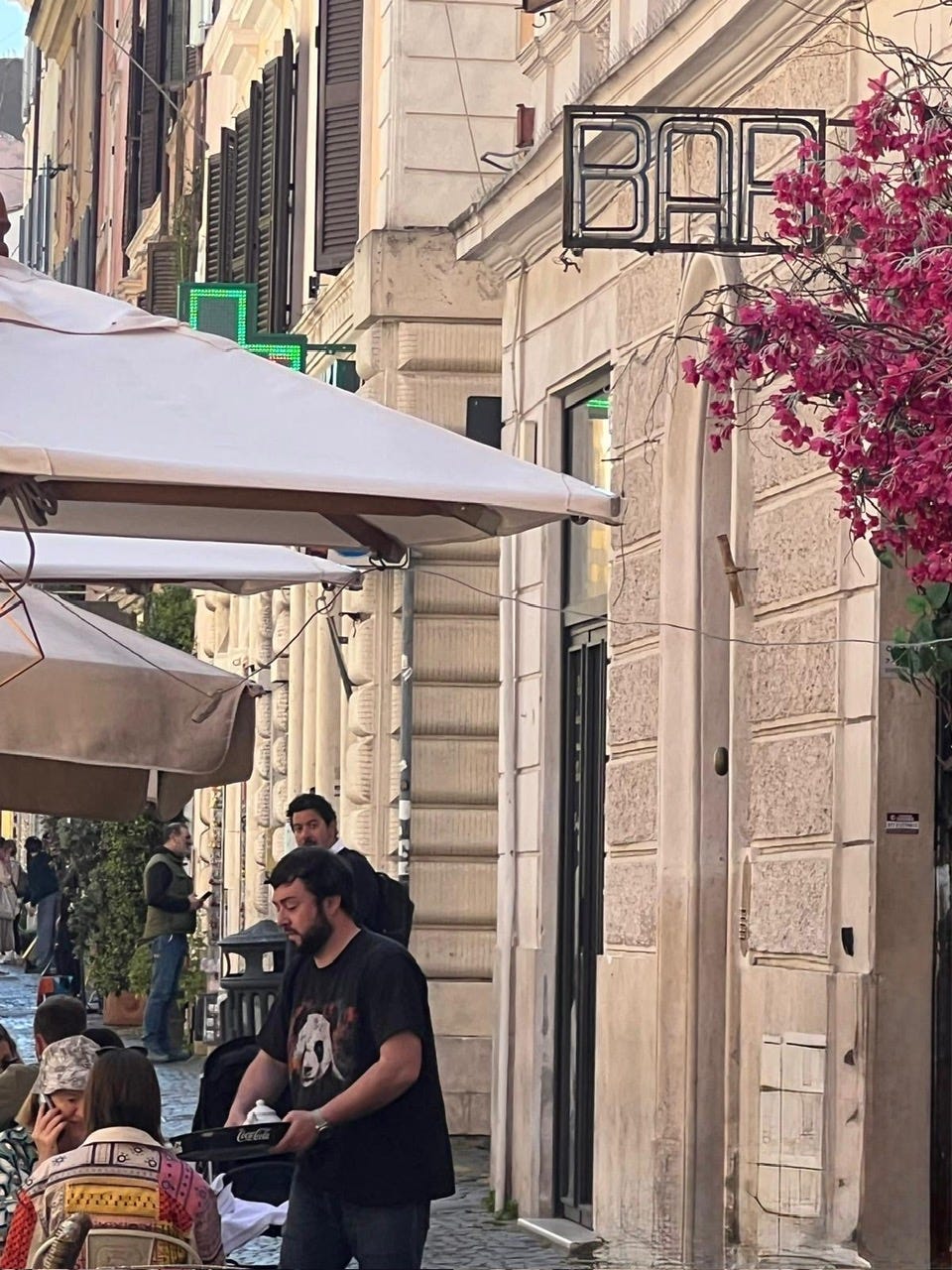
For me, this is not a time of wonder but of waiting. And so I see what I can— the ordinary, the routine— from a chair in the sun at Simone’s bar, just a few doors down from where we live.
Date: April 7
Time: 10:17am
Location: Bar Latteria Giuliani, Borgo Pio
Weather: Blue skies and a soft spring sun
Some visual notes:
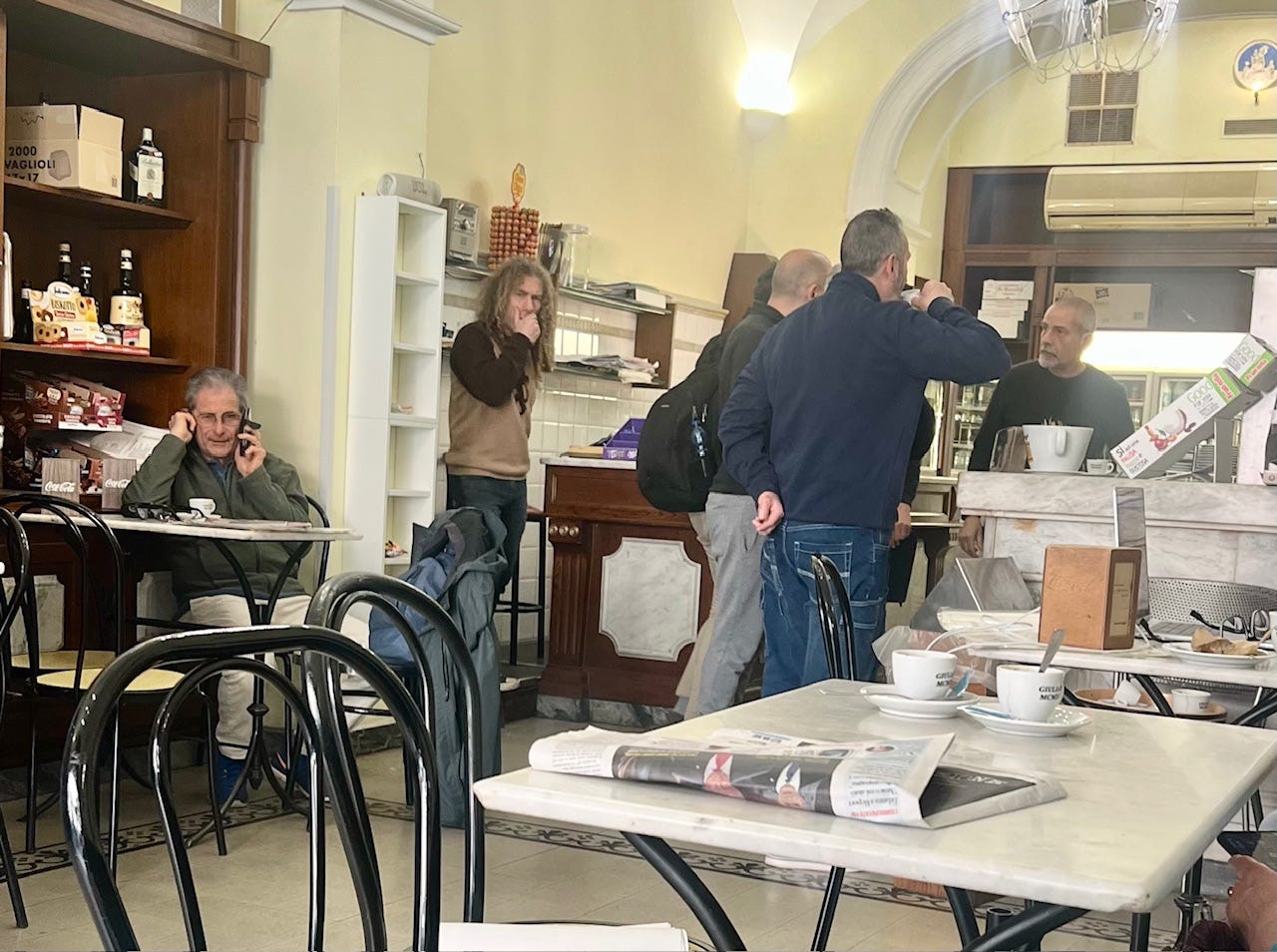
The marble bar counter at the rear of the narrow room is a monument—as big and heavy as an ancient Roman sarcophagus. It feels as if it will be here long after Bar Latteria is gone.
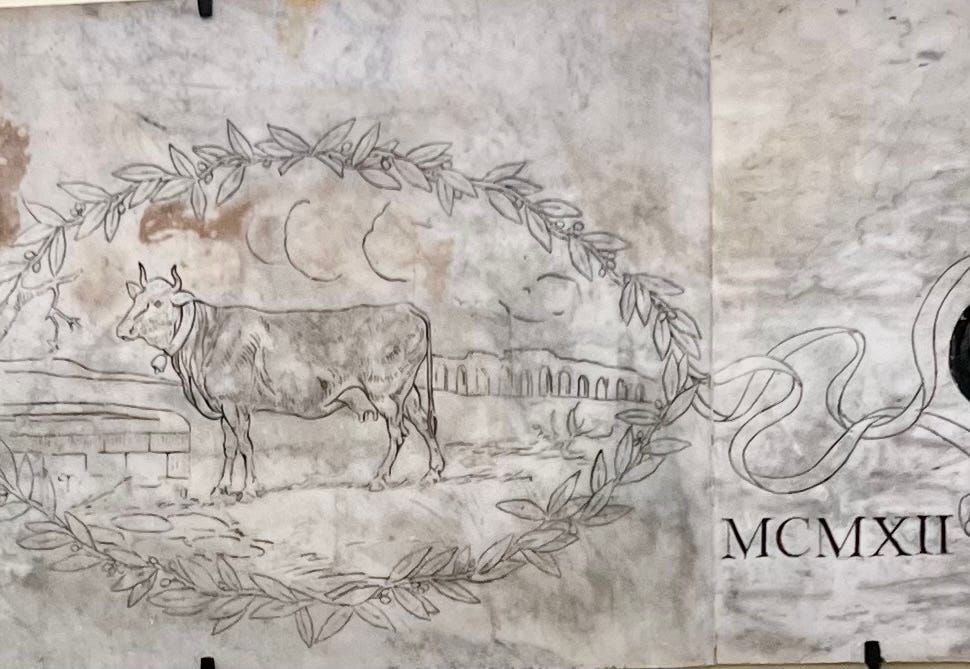
Above it is a marble plaque engraved with a cow. It too looks old, but the Roman numerals date it 1912. In any other town, that’s a piece of history.
On one wall there are three mirrors in simple wooden frames. Along the other: antique wooden display cases with fancy chrome latches that could have come from an old pharmacy. Wines and spirits, bottles of Aperol and Campari are stacked in one. A white flower vase never used. Boxes of potato chips are in the back case. Next to where I’m sitting are three shelves of sports trophies awarded to teams from Rione Borgo. The most recent from 2024. The oldest is 2006.
Observations:
A short man in large black glasses enters mid-conversation with two other men. They stand at the bar, drink their espressos and leave.
A woman in a leopard skirt and leather jacket takes a pastry to go.
The white-jacketed lady who runs the pharmacy next door brings in an empty espresso cup she leaves on the bar. Then she leaves with a tray of two more espressos.
Simone Guiliani, the third-generation proprietor, clears the tables. His younger counterpart Adriano is at the cash register. They alternate roles effortlessly, hardly speaking. A choreography of head nods and passing glances.
I’m convinced that Simone was once a drummer in a rock band. If it’s true, the tall, thin guy with the black hoop earring who is the barista was probably the bass player. A lot of Roman guys look like they were probably in rock bands, or still are. But after 30 years in the music industry, you recognize these things.
Also the music in the bar is a steady rotation of hard rock classics. A clear giveaway.
A painter, bright splotches all over his pants, has a coffee at the bar. He’s there for four minutes.
A man with sunglasses and a handlebar mustache drinks a cappuccino. 5 minutes. When he goes to pay, Simone waves him off.
More visual notes:
There are cocktail trays stacked on one of the back tables. The top one has the Coca-Cola logo. The one underneath says 1932 Meraviglia Italia.
There’s a Della Robbia-style statue of the Madonna mounted on the back wall.
A cartoon of Pope Francis, flying like a superhero, hangs behind the cash register.
Life goes on:
Simone’s glamorous wife, in a short skirt and knee high boots, drops a set of keys behind the cash register. She greets Adriano, slips on her sunglasses and strides out.
At an outside table, a broadcaster from French TV is doing an interview.
Three workers in black hoodies that say Da Impianti—the crew rebuilding the restaurant across the street—gather at the bar. 2 minutes, in and out.
A young priest with a backpack comes in and looks at the pastries. He does not stay.
A young couple in their early twenties are seated by the door. They drink two tall latte’s and hold hands.
Led Zeppelin is playing “Kashmir”.
Two female AMA workers, Rome’s sanitation crew, enter in their bright yellow jumpsuits. They are loud and funny and greet the others at the bar. They gulp their coffees and hurry out.
A young boy in orange pants and a shirt with tigers on it asks to use the bathroom.
A older white-haired man in a white hoodie and white puffer vest and white scarf drinks an espresso at the bar. Then he puts on his white-framed sunglasses and leaves.
A man in a blue blazer and tie enters with a woman carrying a big Vuitton bag. She’s wearing bright red sneakers.
The AMA women return for a second coffee. There’s a chorus of “Ciao” when they leave once more.
A woman with jet black hair cut in a bob, wearing a sweater of blues and reds and purples in an abstract design, stands at the bar. She orders, pays, eats a maritozzo, drinks her espresso, and leaves, never pausing her phone conversation.
Now we’re hearing AC/DC doing “Back in Black”.
Simone’s twenty-something daughter stashes her motorcycle helmet behind the cash register. She eats a cornetto and drinks a juice at the bar. She waves goodbye to Adriano and grabs her motorcycle helmet. She does not pay.
A German family orders spritzes and begins playing cards.
A tall, bald man in a blue vest and cashmere scarf greets Simone and Adriano, making a gesture with his hands that looks like he’s praying, even though he’s really saying “C’mon, give me a break”. Then he carries his cappuccino over to a table and joins two women who have been there for 30 minutes already.
The short man with big black glasses enters again, this time with a woman and a man. They are mid-conversation. He drinks another coffee.
A priest in a black cassock carries a bright orange plastic sack and says “Buona Pasqua!” as he enters. He sits at a table in the back, then approaches me to ask if he can borrow the Corriere dello Sport that’s on my table.
The superintendent of our condominium sits across from me and rolls a cigarette. We see each other and nod, but do not speak.
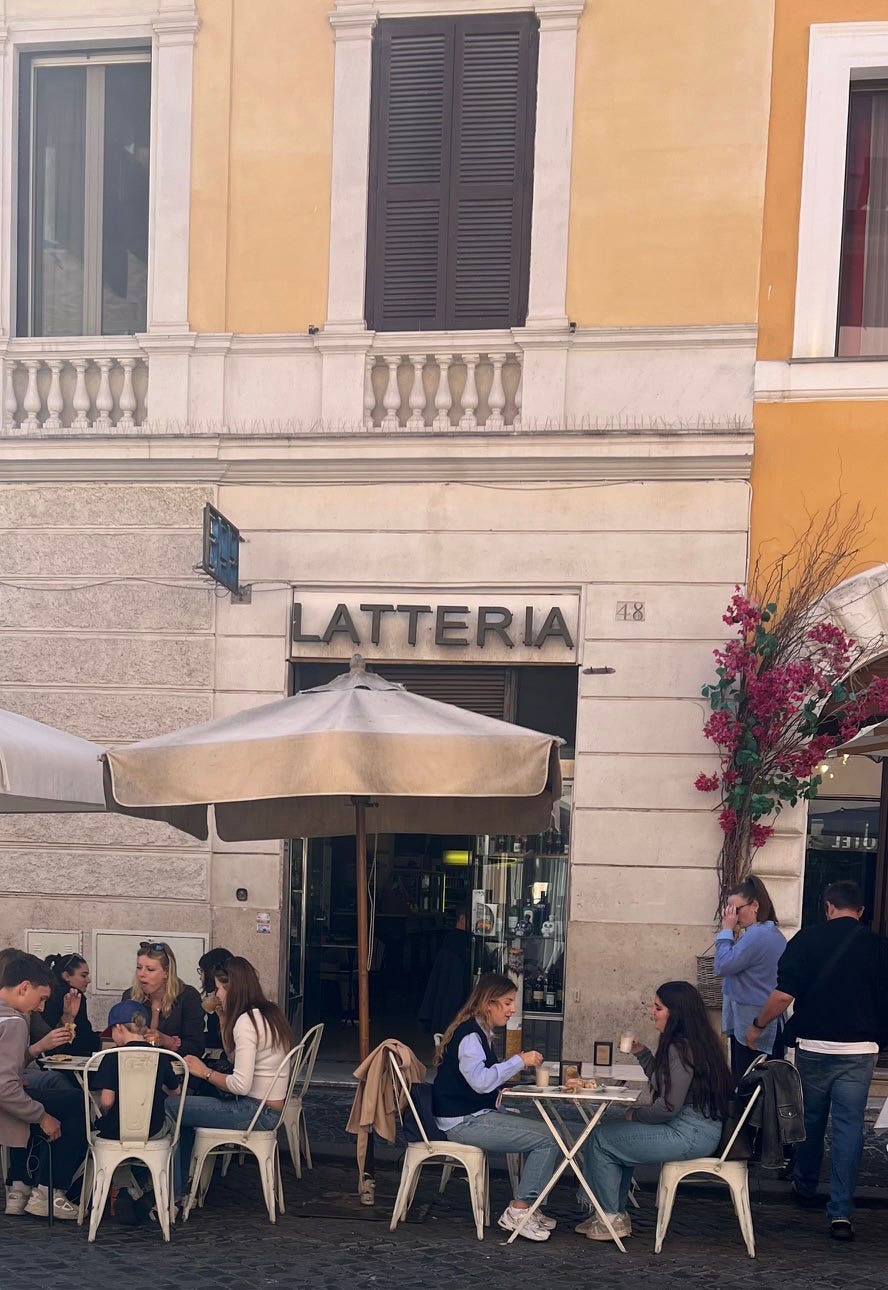
There is much talk in Rome, indeed in every popular European city, that the local life is vanishing— washed away by a tidal wave of tourism. Grocery stores succumb to souvenir shops, laundries give way to “leave your luggage” storefronts. Streets are turned into outdoor dining rooms: stage sets offering a fantasy version of Roman life. In five years, will there be anything left of reality? Of the way people actually live?
If the doomsayers are right, perhaps a list like this will not be mundane. It will be an elegy to the way people behaved in the last days, sticking to their daily routines even as the rug was being pulled out from under them. An anthropological study of the end of the Empire of the Everyday, before it all became as frozen in time as a postcard.
Or perhaps, just the opposite will happen. Five, 50, 100 years from now, a morning on Borgo Pio might look much the same as it has for the last few hundred years: locals going to work or running errands, visitors from strange lands, children playing, deliveries, romantic encounters.
It will be different no doubt but recognizable, just as this moment would probably not seem surprising to someone in the early 1900’s—or Rome being Rome— someone in the 1500’s. Perhaps there will still be somebody standing at the imposing marble bar, having a coffee and watching what happens: nothing and everything, all at once.
I hope this latter scenario will be the case. Not because the life here is perfect, but because it’s deeply human and sometimes funny and often achingly sweet.
A last observation:
A man on crutches makes his way to the cash register. Simone rings up the tab and inquires about his ankle. “Piano, piano…” he says to the man, with a gesture that says, “What else are you going to do?”
Then he adds: “At least in Roma, there is the sun”. The man with the bad foot nods in agreement. At least in Roma there is the sun.
* With thanks to Georges Perec’s “An Attempt at Exhausting a Place In Paris” (1975)
No posts
Comments
Nothing yet. Say the first thing.
Sign in to join the conversation.