
David Ogilvy passed away in 1999. This has not prevented the advertising industry from quoting him almost daily, usually underneath a photograph he did not choose and beside an opinion he may never have held.
One night in Milan, we decided this was getting unfair.
It was brutally hot, the kind of Milan heat that remains trapped between buildings long after midnight and makes everyone slightly more unpleasant than usual. The windows were open but nothing came through them. Somewhere below, a scooter kept failing to start. The glasses sweated more convincingly than we did.
There were six of us around the table. People from advertising, branding, strategy. Old enough to remember when a campaign lasted longer than the presentation explaining it, young enough to still have notifications turned on.
Dinner was over, technically. Nobody had left.
There were empty plates, two phones face down, four phones face up, a bottle of whisky that had begun the evening as decoration and was now doing useful work. Someone was checking a campaign that had gone live that afternoon. Someone else was pretending not to check LinkedIn.
We had been talking about advertising for two hours, which is approximately ninety minutes longer than anybody should.
AI had already been blamed. Then procurement. Then clients. Then agencies.
Then Legal, algorithms, Gen Z, short attention spans, long approval chains, TikTok, Cannes, consultants and a generation of marketing people apparently unable to order lunch without first defining its purpose.
We had solved nothing.
This did not distinguish us from most industry conferences.
Someone said creativity had become too safe. Someone else said clients had become too scared. A strategist argued that brands no longer understood culture. A creative director asked whether culture had ever expressed any interest in being understood by brands.
That bought us another drink.
On the table was a laptop still open on LinkedIn. A CEO was explaining the importance of vulnerability beneath a professionally lit photograph of himself looking into the middle distance.
Nobody commented.
There are moments when satire becomes redundant.
We talked about AI making fifty campaign routes before breakfast. About brands producing six hundred pieces of content a month and still somehow having nothing to say. About agencies that no longer call themselves agencies. About companies desperate to be culturally relevant and terrified of upsetting anyone who might actually belong to the culture.
Then somebody said:
“What would Ogilvy think of this?”
It was one of those questions people in advertising ask when they want a dead man to settle an argument among the living.
Normally somebody produces a quote. Nobody did.
Perhaps we were tired. Perhaps the whisky had finally reached the part of the brain responsible for professional dignity. Or perhaps we had simply exhausted the living.
David Ogilvy had been invoked in advertising conversations for decades anyway. His opinions on headlines, research, positioning, copy, creativity and clients had survived him with remarkable efficiency. He had become less a person than an industry reaction GIF.
Everyone knew what Ogilvy supposedly thought.
That was precisely the problem.
I looked at the others.
“What if we actually asked him?”
There was a pause. Not a long one.
Advertising people will reject an original idea for six months and accept a terrible one immediately if there is alcohol involved.
Someone laughed. Someone else said, “Why not?”
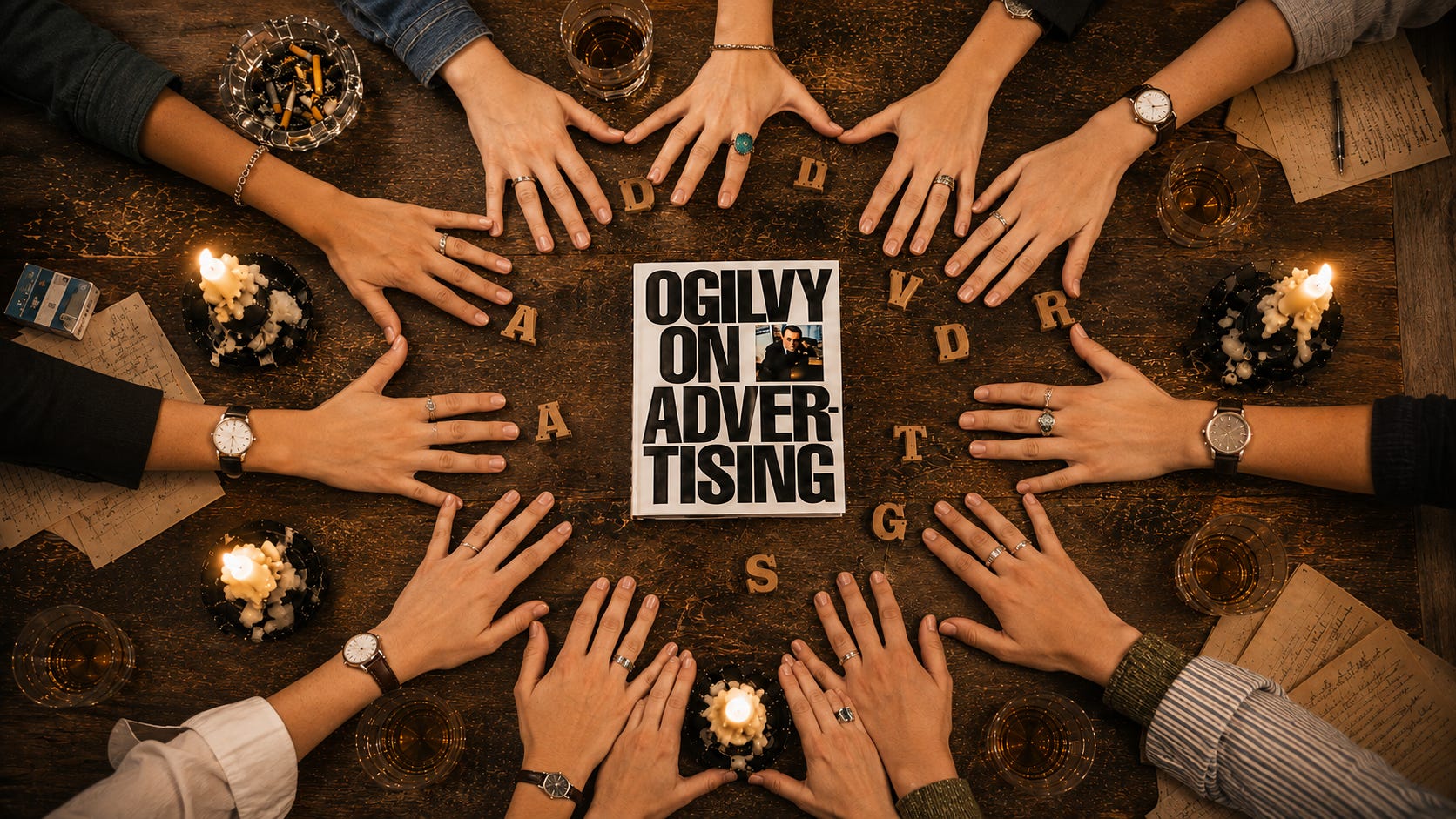
And that was how, on an absurdly hot night in Milan, after years of talking about disruption, innovation and the future of everything, six reasonably educated adults decided the most useful thing we could do for advertising was hold a séance.
The candles were not my idea. I want that recorded.
Someone found them in a cupboard. Another person put my copy of Ogilvy on Advertising in the middle of the table. The whisky stayed. This seemed historically appropriate.
We moved the phones away.
That may have been the most supernatural event of the evening.
Then somebody suggested we place our hands on the table and touch fingers.
We did. For once, everyone aligned without a workshop.
The room went quiet.
Outside, Milan continued doing what Milan does in August: sweating behind closed shutters and pretending it had gone somewhere better.
For the first minute, nothing happened.
Of course nothing happened.
There were six adults sitting around a book trying to contact an advertising executive who had passed away twenty-seven years earlier.
I remember thinking that if anyone photographed us, none of us would ever work again.
Then one of the whisky glasses moved.
Not dramatically. No thunder. No flying furniture. It simply slid perhaps two centimetres across the table.
Nobody spoke.
A candle flame leaned sideways although there was no air in the room.
Someone took their hands off the table.
“Don’t,” somebody whispered.
The glass moved again.
And then, from the empty chair at the far end of the table, came a voice.
English. Educated. Dry. And already annoyed.
“If this is a brainstorm, send me back.”
Nobody laughed.
The chair was no longer empty.
David Ogilvy looked around the table, then at the candles, the phones, the laptop and finally at his own book sitting in front of him.
He picked it up.
For a few seconds he studied the cover as though he had discovered somebody had been selling merchandise after his funeral.
Then he looked at us.
He considered this.
Nobody asked what he meant.
He reached for the whisky.
I opened the laptop.
“David, we have some questions.”
He poured himself a drink and looked at the six of us with the expression of a man who had already regretted returning to earth.
He took a sip.
And so we asked David Ogilvy what happened to advertising.
ERCOLE: Advertising has changed enormously since you passed away.
ERCOLE: Brands are much more sophisticated today.
ERCOLE: Today every brand wants a purpose.
ERCOLE: Consumers increasingly expect brands to take positions on social issues.
ERCOLE: Climate. Equality. Politics. Social justice.
ERCOLE: Yogurt, in one case.
He looked at me.
ERCOLE: Isn’t that rather old-fashioned?
ERCOLE: Brands want to become part of culture now.
He laughed.
ERCOLE: We have entire departments studying culture.
ERCOLE: We know far more about consumers today. Search behavior, purchasing data, social listening, location, sentiment, predictive analytics.
His face brightened.
This was unexpected.
He read silently.
Another page.
Another.
He shut the laptop.
ERCOLE: But these segments are built from enormous amounts of data.
ERCOLE: We can measure almost everything now.
ERCOLE: Engagement is important.
ERCOLE: The content.
ERCOLE: Brands need to feed social channels constantly.
ERCOLE: Brands need to remain present.
ERCOLE: What should a brand do when it has nothing interesting to say on Tuesday?
He shrugged.
ERCOLE: That’s impossible now. Algorithms punish inactivity.
Someone at the table coughed.
I moved on.
ERCOLE: Artificial intelligence can now write advertising.
Ogilvy leaned forward.
At last, something had interested him.
ERCOLE: Some. Mostly competent advertising.
ERCOLE: AI can generate a hundred headlines in seconds.
ERCOLE: Aren’t you frightened by AI?
He looked genuinely offended.
ERCOLE: Some creatives think it will replace them.
ERCOLE: What makes a creative difficult to replace?
ERCOLE: Creatives complain they have lost power.
ERCOLE: Clients are much more conservative today.
He laughed.
ERCOLE: But very good ideas are killed in meetings.
ERCOLE: So you side with clients?
ERCOLE: Sometimes fifteen or twenty.
He stared at me.
ERCOLE: We call it collaboration.
ERCOLE: We need alignment.
He smiled.
The whisky was disappearing faster now.
Outside, the temperature had not moved.
Somewhere in another apartment a woman shouted at somebody called Marco. Marco did not seem to be having a good night either.
ERCOLE: Agencies don’t like being called advertising agencies anymore.
ERCOLE: They think the word sounds limited.
ERCOLE: Agencies do much more than advertising now.
ERCOLE: That’s unfair.
ERCOLE: Modern agencies have specialists in data, experience, social, strategy, technology, influence, culture,
ERCOLE: Advertising is more complex now.
ERCOLE: What do you think of brand manifestos?
ERCOLE: Agencies. Brand teams. Sometimes employees.
ERCOLE: Rarely.
ERCOLE: Every brand now has a tone of voice.
ERCOLE: Some tone-of-voice documents are eighty pages long.
ERCOLE: Storytelling is extremely important now.
He sighed.
ERCOLE: But people don’t want to be sold to anymore.
ERCOLE: So advertising should sell.
He looked at me as though I had asked whether rain should be wet.
ERCOLE: Many people would say advertising builds meaning, culture, fame, long-term brand equity.
ERCOLE: And then what?
ERCOLE: Consumers get bored.
ERCOLE: So you would keep successful campaigns running longer?
ERCOLE: That’s cynical.
ERCOLE: Every brand wants an emotional connection now.
ERCOLE: Consumers.
ERCOLE: But emotion sells.
ERCOLE: Authenticity is very important today.
ERCOLE: Brands demand authenticity from influencers.
ERCOLE: They give them guidelines, scripts, mandatory talking points, prohibited claims, approved language.
ERCOLE: Influencers are enormously powerful now.
ERCOLE: The difference is that creators own their audiences.
ERCOLE: Some companies now use virtual influencers. Entirely synthetic people.
He considered this for a moment.
ERCOLE: No.
ERCOLE: No.
ERCOLE: No.
ERCOLE: You approve?
I showed him LinkedIn. This was perhaps unnecessary.
He scrolled. There were CEOs discussing vulnerability.
Consultants discussing courage.
People announcing that they were humbled, thrilled and delighted to begin jobs they had aggressively negotiated for.
A man standing on a conference stage had written seven hundred words explaining why leaders should listen.
Ogilvy stopped.
ERCOLE: Sharing ideas publicly.
ERCOLE: It’s become an industry.
He scrolled again.
ERCOLE: They’re not.
ERCOLE: LinkedIn helps people build personal brands.
He handed the laptop back.
ERCOLE: Everyone is talking about Gen Z.
ERCOLE: There was.
ERCOLE: A great deal of it, collectively.
ERCOLE: Young consumers are changing everything.
ERCOLE: Brands are obsessed with customer journeys now.
ERCOLE: The journey needs to be seamless.
ERCOLE: More or less.
ERCOLE: Seamless sounds more strategic.
ERCOLE: Customer experience has become central to branding.
ERCOLE: Performance marketing has become dominant.
ERCOLE: Some performance marketers think brand advertising is impossible to measure.
ERCOLE: Creatives hate research.
He smiled.
Now we had reached familiar territory.
ERCOLE: But research can kill ideas.
ERCOLE: What if research says one thing and your instinct says another?
The room had gone quiet again.
Even the people who had initially enjoyed seeing clients and consultants abused were beginning to realize that Ogilvy had no intention of respecting departmental boundaries.
Nobody was safe.
This improved the evening enormously.
ERCOLE: What do you think is wrong with creativity today?
ERCOLE: What about Cannes?
ERCOLE: Awards matter enormously to agencies.
ERCOLE: That’s not always the primary criterion.
He took a drink.
ERCOLE: Isn’t advertising also an art form?
ERCOLE: So beauty doesn’t matter?
ERCOLE: What’s the biggest mistake agencies make?
ERCOLE: We call that immersion.
ERCOLE: What about the product itself? Advertising today often starts with culture rather than product.
ERCOLE: Can advertising save a bad product?
ERCOLE: Brand managers don’t always like agencies criticizing the product.
ERCOLE: What has modern advertising genuinely improved?
He did not answer immediately.
For the first time that night, he seemed less amused.
He looked at the laptop.
At the phone.
At all the machinery we had placed between ourselves and people.
He paused.
Nobody spoke.
ERCOLE: Are we?
He looked at me.
The heat had become strange by then.
Or perhaps it was the whisky.
The candle nearest Ogilvy had burned into a shallow lake of wax. The city outside had finally become quieter. Even Marco seemed to have surrendered.
I asked the question we had been circling all night.
ERCOLE: So what happened to us?
Ogilvy leaned back.
ERCOLE: That’s rather bleak.
He looked at the MacBook.
ERCOLE: What should young creatives learn?
ERCOLE: What should brand managers learn?
ERCOLE: CEOs?
ERCOLE: Agencies?
He barely hesitated.
It was almost two. The whisky had gone. Nobody had noticed.
Ogilvy seemed tired now. Or perhaps simply finished with us.
I had one question left.
ERCOLE: If you opened an agency tomorrow, what would you put above the door?
He gave me a look which suggested the question had already been designed for LinkedIn.
Fair.
He thought for a moment.
I waited.
ERCOLE: That’s all?
The room was warming. His outline had begun to look less certain. Then I remembered something.
ERCOLE: David. One last question.
He closed his eyes.
ERCOLE: Would you like to watch some recent Cannes case studies before you go?
He opened one eye.
ERCOLE: Usually about two minutes.
I hesitated.
He smiled.
Not kindly.
Then the chair was empty.
Outside, Milan was still hot. The candles had died.
The MacBook remained open on LinkedIn.
Someone reached over and closed it.
For once, nobody felt the need to post anything.
(This is a fictional interview.)
Comments
Nothing yet. Say the first thing.
Sign in to join the conversation.