
There is a peculiar moment in every shortage story when the economist and the household shopper seem to be living in two different countries.
The economist looks at the warehouse and says, “There is enough sugar.”
The household looks at the grocery bill and says, “Then why does sugar suddenly cost this much?”
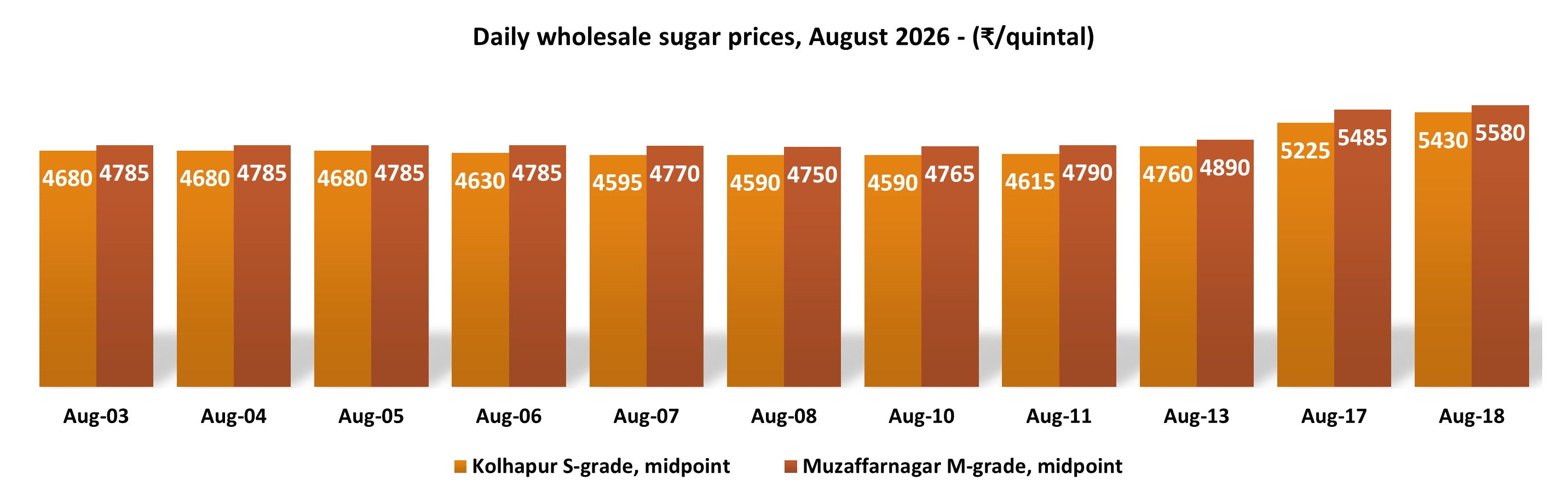
That is precisely the puzzle India is confronting in August 2026. Sugar prices have jumped sharply just as the country enters the festival-heavy part of the year. Wholesale sugar at Kolhapur, one of the country’s important price-discovery centres, has risen almost 20% in August to around ₹5,350 per 100 kg, or ₹53.50 a kg. Prices in northern markets such as Punjab have reportedly reached around ₹60 a kg at wholesale level, while retail prices in some markets have moved towards ₹65. Reuters reports that ex-mill prices in Maharashtra have also climbed sharply.
And yet, the government insists that this is not a simple “India has run out of sugar” story.

On July 28, the government imposed stockholding limits on sugar dealers from August 1 through November 30, explicitly arguing that the recent increase in ex-mill sugar prices was not supported by underlying demand-supply fundamentals. Dealers have also been required to declare stocks through the government’s online system on a weekly basis.
At the same time, the government is considering something that sounds almost absurd in a country that says it has enough sugar: importing it. Policy discussions reported on August 18 include a possible duty-free import programme of up to 1 million tonnes, adjustments to mill release quotas, releasing refined sugar currently tied to export-oriented arrangements, and potentially reducing the amount of sugarcane diverted towards ethanol.
So which is it?
Is India short of sugar, or merely short of sugar in the right warehouse, at the right location, at the right time and at the right price?
The answer is more interesting than either extreme.
India is confronting a classic commodity-market problem: aggregate supply can be adequate while effective market availability is tight.
And when inventories are thin, markets are regulated, imports are expensive, production is geographically concentrated and demand is about to become unusually predictable, even a relatively small disturbance can produce a disproportionately large price movement.
That is the sugar paradox.
This brings us to the most important distinction in the entire sugar story.
When someone says, “India has enough sugar,” the natural question is: enough for what?
Enough to exist on paper? Enough to cover annual consumption? Enough to be released by mills this month? Enough to reach a wholesaler in Punjab? Enough to deliver to a biscuit manufacturer tomorrow morning?
These are five different questions pretending to be one.
Think about your own household. You may technically have enough money to pay your bills for the month. But if that money is locked in a fixed deposit that matures next week, it is not particularly useful for paying the electricity bill due tomorrow. The wealth exists. The liquidity does not.
Sugar works in much the same way.
At the national level, India may have several million tonnes of sugar somewhere in the system. But the quantity that matters for today’s price is much narrower: sugar that is legally saleable, physically accessible, commercially uncommitted and available in the market at this very moment.
That is why it is useful to think of sugar supply as a hierarchy rather than a single number.
At the top sits aggregate physical supply: everything physically present in the country across mill warehouses, trader inventories, ports, logistics networks and other storage points. Below that is available supply, after accounting for stocks that are committed, reserved or otherwise not immediately responsive to market demand. Below that is tradable supply, the quantity that can actually be released into the domestic market under the prevailing regulatory framework. And finally, at the bottom of the pyramid is spot liquidity the sugar that can actually be bought, moved and delivered to the buyer who needs it now.
The distinction matters because India’s sugar market is not completely free to behave like a textbook commodity market. The Department of Food and Public Distribution explicitly has powers under the Sugar (Control) Order, 2025 to regulate production, sale, movement and international trade, including the release of quotas for domestic sale.
And this is not merely theoretical regulation sitting in a government file. DFPD continues to issue mill-wise stock and release-related orders, while its own documents show that monthly domestic release quantities can be adjusted against export allocations. In February 2026, for example, the department issued an order specifically dealing with the exchange of export quota and domestic monthly release quantity.
So the market can have sugar physically sitting in warehouses without all of that sugar becoming an immediate source of additional supply.
That is the first clue to the August price spike.
Imagine that a sugar mill is sitting on 10,000 tonnes of sugar.
Economically, it owns 10,000 tonnes.
But suppose only a portion can be released under its current domestic allocation, another quantity has already been committed through commercial arrangements, and another portion is simply being held because the mill expects prices to be higher later.
For the market, those 10,000 tonnes are not one homogeneous pool.
The relevant quantity is the amount the mill is willing and able to sell now.
This is why using a single inventory number to explain commodity prices can be misleading.
ICRA’s estimates are instructive here. Its May and July 2026 assessments put expected end-September 2026 sugar stocks at around 4.3 million tonnes, or roughly two months of consumption, under a more conservative demand-supply assumption. Its March and April assessments had placed the expected closing stock closer to 5.6 million tonnes.
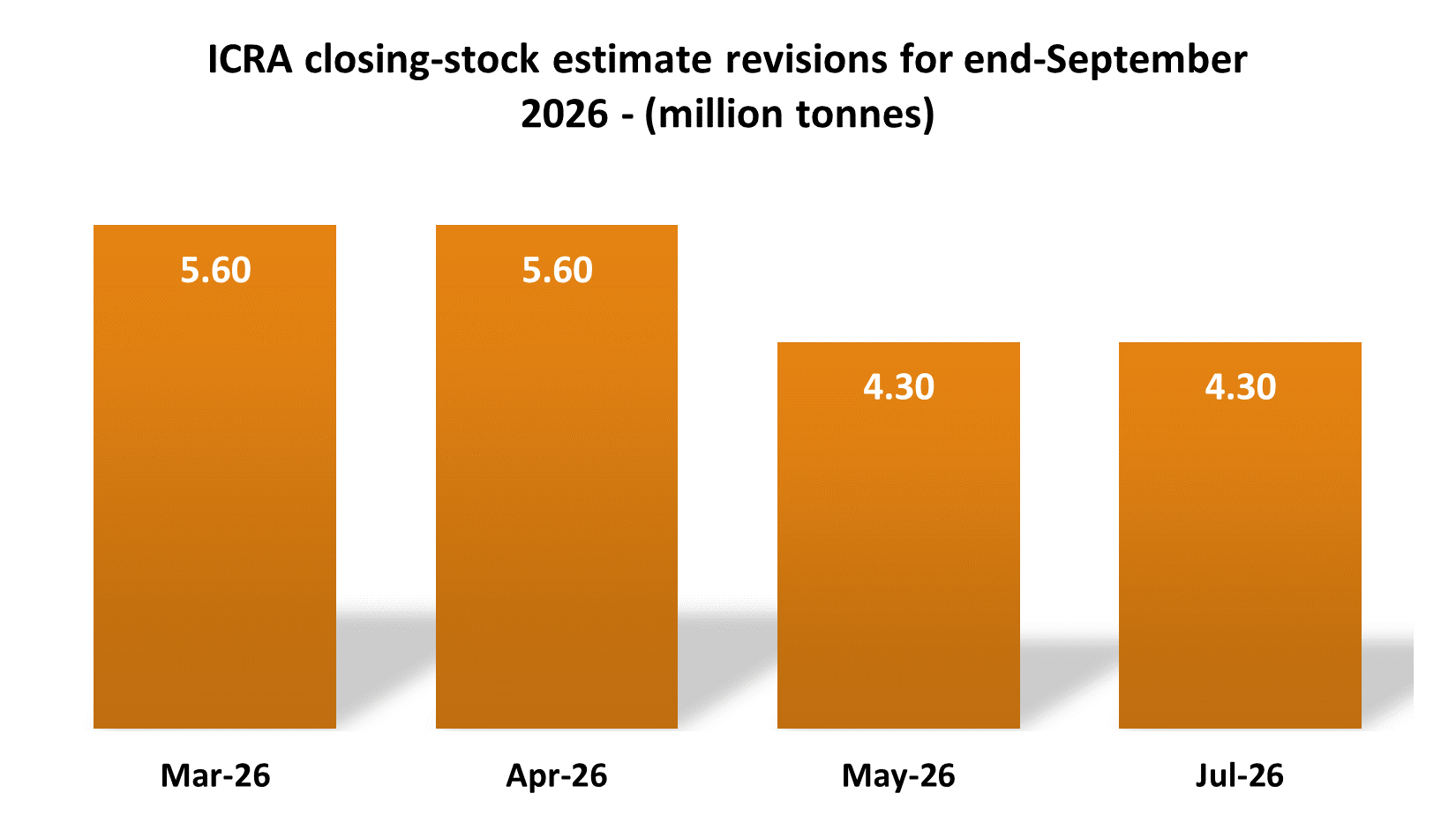
Notice what happened. The country did not suddenly go from “sugar everywhere” to “no sugar”. Instead, the expected inventory cushion became progressively thinner.
And once the cushion becomes thin, the marginal tonne becomes disproportionately important.
If India has six months of effective inventory, losing one million tonnes may be uncomfortable but manageable. If it has barely two months of inventory, the same one million tonnes suddenly becomes a much bigger economic event.
The market is not pricing the average tonne. It is pricing the next tonne that someone desperately needs. That is a very different calculation.
Annual production numbers are excellent for agricultural reports.
They are not always excellent for explaining Tuesday’s wholesale price.
A sugar balance sheet is a flow story: how much was produced during the season, how much was consumed, how much was exported and how much remained.
But the spot market is a stock story.
It cares about how much inventory remains today.
India’s sugar year runs from October to September, which naturally creates a seasonal inventory cycle. Production accumulates during the crushing season, while consumption continues throughout the year. By the time the crushing season ends, the country progressively eats into the inventory accumulated during the preceding months.
This sounds obvious.
But the economic consequences are not.
During the production months, every additional tonne of sugar is another tonne entering warehouses. During the later months of the season, every tonne sold represents another tonne leaving the buffer.
The market therefore becomes increasingly sensitive to supply disruptions as the season progresses.
That is why the same weather shock can have very different consequences depending on when it occurs.
A supply disruption in January is one problem.
The same disruption in August can be another.
In January, several months of production may still lie ahead.
In August, the market is largely living off accumulated inventory and waiting for the next crushing season.
India’s recent numbers illustrate this narrowing cushion. ICRA’s April 2026 assessment estimated around 5.6 million tonnes of closing stock for September, equivalent to roughly two months of domestic consumption; by May and July, its estimate had moved lower, towards around 4.3 million tonnes.
Whether the eventual number lands at 4.3, 5.0 or 5.5 million tonnes is less important for our argument than the direction.
The buffer has become thinner.
And once inventory becomes thin, volatility becomes more valuable than comfort.
Everyone suddenly cares about the next truck.
This takes us directly to the role of government.
India’s sugar market has never been a pure free-market system. That is deliberate.
The government has multiple objectives: protect cane farmers, maintain consumer affordability, prevent destructive sugar-price collapses, manage exports, encourage ethanol production and keep mills financially viable.
The Sugar (Control) Order, 2025 gives the government explicit powers over production, sale and movement, including release quotas for domestic sale.
The logic behind monthly release controls is understandable.
Sugar production is seasonal.
If every mill were allowed to sell as much as it wanted immediately after the crushing season, mills could flood the market, crash prices and create severe problems for cane payments and working capital.
At the other extreme, unrestricted withholding could tighten availability and create artificial scarcity.
So the government attempts to smooth the flow.
In theory, it is a sensible objective.
The problem is that smoothing supply and responding to shocks are not always the same thing.
A rule designed to prevent excessive supply volatility can become restrictive when demand suddenly jumps or inventories become thinner than expected.
And this is where a regulatory market becomes fascinating.
The government is effectively trying to manage not only the amount of sugar in the economy, but the timing of its arrival.
That makes the release mechanism a critical part of the price system.
The existence of monthly release quotas is not speculation or an abstract policy assumption. The government’s own documents show that domestic release quantities are actively managed and can be adjusted in response to export allocations and other considerations.
The system is designed to stabilise the market. But stabilisation has an interesting side effect. Suppose normal demand is 2.0 million tonnes in a month and the release system allows somewhat more than that.
Everything is comfortable. Now imagine festival-related procurement pushes actual demand temporarily higher. The market wants more sugar.
But the mill cannot simply increase sales without regard to its regulatory allocation. The physical sugar may exist. The willingness of the buyer may exist.
The cash may exist. What does not necessarily exist is the same flexibility in the quantity legally released into the market. That is when a regulatory constraint can begin to behave like a supply constraint.
This does not mean the release quota itself should be blamed for the entire August price increase. The government has explicitly argued that the recent increase in ex-mill prices is not supported by underlying demand-supply fundamentals and has responded with stockholding measures aimed at curbing hoarding and speculative activity.
Rather, the more interesting point is that regulation can amplify an underlying tightening. A market with abundant inventories has room to absorb rigidities. A market with thin inventories has much less room.
On July 28, the government imposed stockholding limits on sugar dealers from August 1 through November 30, 2026, explicitly citing concerns about hoarding and speculative activity and requiring dealers to disclose inventories.
The intended mechanism is straightforward. If a dealer is holding excessive stocks because he expects prices to rise, force him to reduce those stocks.
More sugar reaches the market. Availability increases. Prices should fall. It is the textbook anti-hoarding mechanism. But markets have a habit of reading the fine print. A dealer does not necessarily ask only, “How much am I legally allowed to hold?” He also asks, “How much inventory do I need to operate safely without risking regulatory trouble?”
That difference is important. A wholesaler might legally be able to hold 1,000 tonnes but choose to hold only 700 because maintaining a larger position creates compliance risk, documentation costs or uncertainty about enforcement.
The legal ceiling therefore does not necessarily become the commercial operating level. This creates a fascinating possibility. A rule designed to increase availability can, at the margin, reduce the amount of buffer inventory sitting inside the distribution system.
And those buffers have a purpose. They absorb small disruptions. A wholesaler with some inventory can serve a customer while waiting for the next truck.
The lesson is not that stockholding limits are necessarily wrong. The lesson is that inventory is not always speculation. Sometimes inventory is the lubricant that makes a physical market function.
This is where the sugar story becomes considerably more interesting.
Until relatively recently, a sugarcane farmer had a fairly simple economic destination for his crop: mill it, extract sugar, sell the sugar, and let the remaining molasses find its way into other uses. Ethanol was part of the ecosystem, but it was not the strategic centre of it.
That has changed.
India’s ethanol programme has effectively created a second buyer for the same agricultural raw material. The sugarcane plant can now be thought of as a kind of economic fork in the road. One route produces sugar. Another route produces fuel.
And once the government creates a large, predictable market for ethanol, that second route is no longer a side business. It becomes an alternative allocation of scarce cane.
This matters because the sugar market does not care that ethanol is a national energy-security success story. It only cares about one very simple question: how much cane is being converted into sugar rather than ethanol?
The answer has become increasingly important as India has pushed ethanol blending rapidly upward.
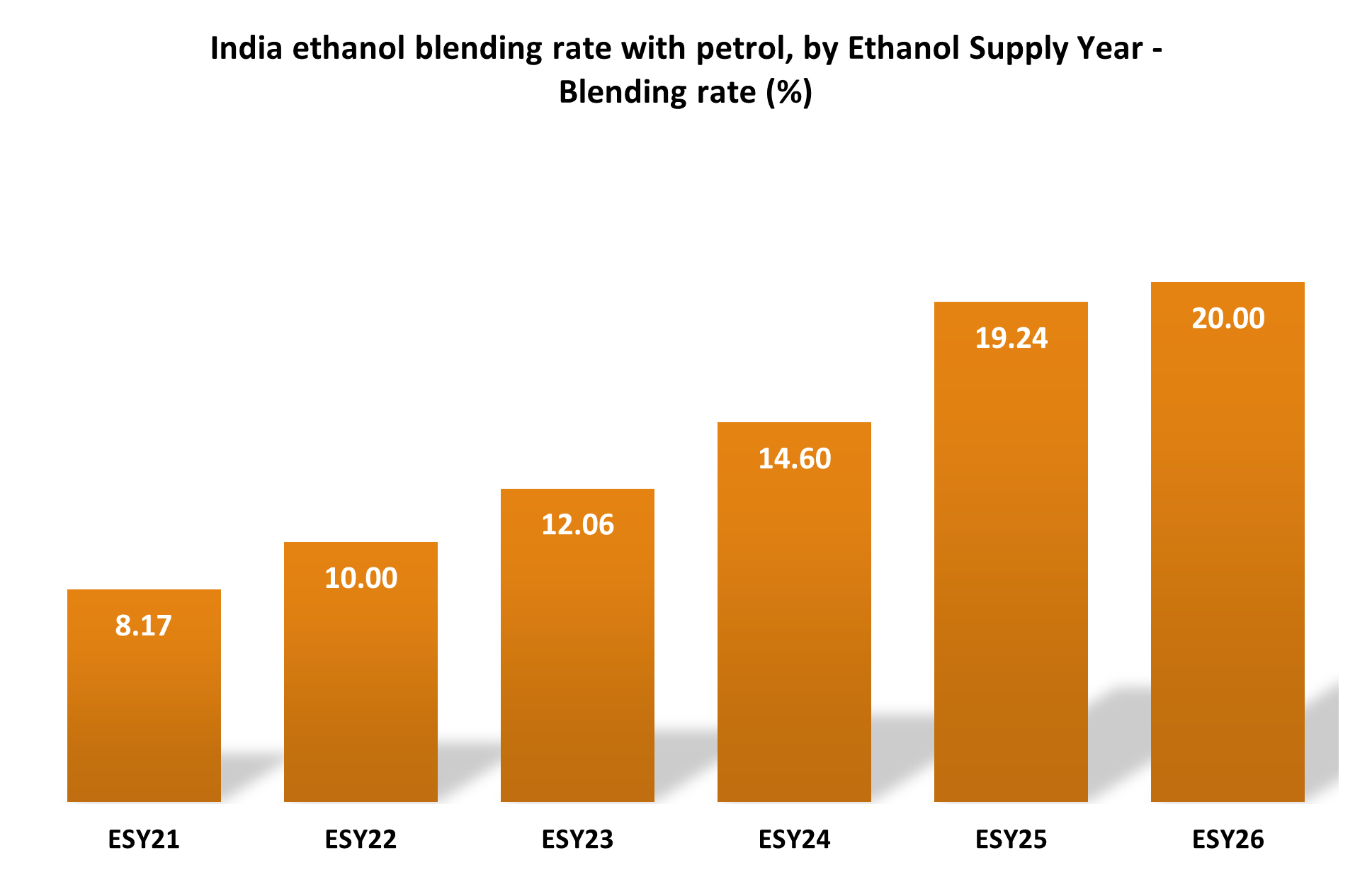
That is an extraordinary policy achievement. It is also a major change in the economics of sugar.
Sugarcane processing effectively offers mills different pathways.
If cane juice or syrup is diverted directly to ethanol, the sugar that could have been crystallised from that juice is sacrificed. If B-heavy molasses is diverted, some sugar recovery still takes place, but less white sugar is produced than under the conventional C-heavy route. The precise economics differ by recovery rate, cane quality and plant configuration, but the economic principle is straightforward: more ethanol from cane-based feedstock can mean less crystallised sugar available to the domestic market.
This is an opportunity-cost problem. There is no mysterious equation hiding here. The cane has one physical existence but several economic uses.
When the government makes ethanol procurement attractive through administered pricing, guaranteed offtake and infrastructure support, it increases the value of the ethanol pathway relative to leaving all available feedstock for sugar production. The policy has explicitly used administered ethanol prices, long-term offtake arrangements and other incentives to expand domestic ethanol capacity and supply.
And the transformation has been large.
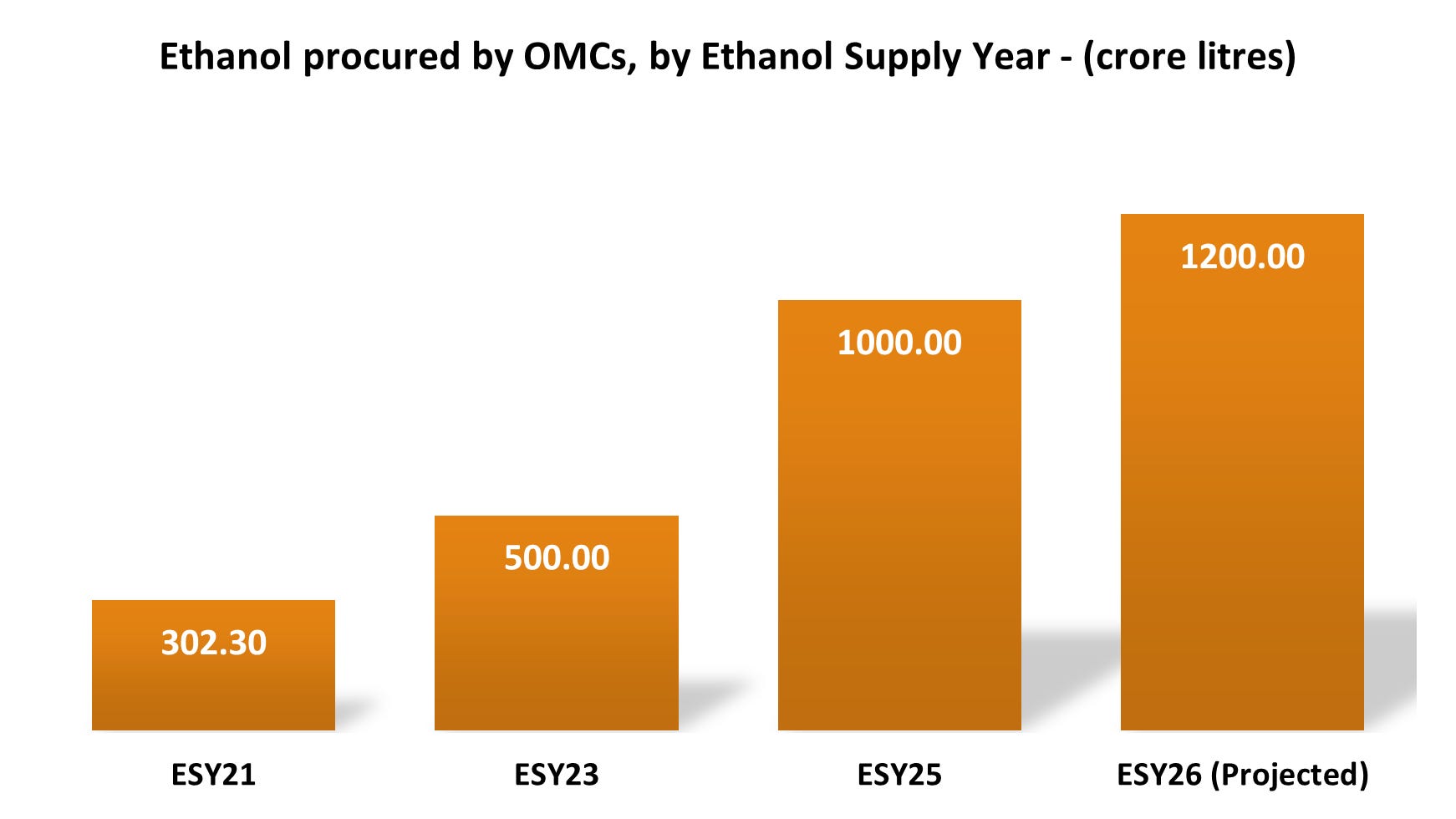
So when we discuss sugar shortages in 2026, it is no longer sufficient to ask how much sugarcane India grew. We also have to ask:
How much of that cane was economically destined to become sugar? That is a much harder question.
This distinction is important because the political debate often turns the issue into a morality play: ethanol versus food.
Economics is less dramatic. The actual issue is allocation.
When sugar prices are low and sugar stocks are excessive, diverting some cane towards ethanol can be extremely useful. It gives mills another revenue stream, reduces the burden of surplus sugar inventories and improves their ability to pay farmers.
The government itself has highlighted precisely this function. It has argued that ethanol diversion helped manage surplus inventories and supported timely payment of cane dues. For SS 2024–25, official data put sugar availability at 340 lakh tonnes, domestic demand at 281 lakh tonnes, with another 34 lakh tonnes diverted to ethanol.
That is not a small intervention. It is industrial policy performing a stabilising function. But the economics change when sugar inventories are already thinning.
A tonne of cane that is diverted towards ethanol during a period of surplus may be economically equivalent to removing excess inventory from a warehouse. The same diversion during a period of scarcity is more like removing a cushion from a mattress that is already becoming thin. The physical act is identical. The opportunity cost is not. And that is why the current policy debate is so revealing.
Reuters reported in August that the government is considering limiting the use of sugarcane for ethanol in the 2026–27 season to increase sugar availability, with the possibility of prioritising sugar production and relying more heavily on alternative ethanol feedstocks such as maize and rice.
The logic is almost embarrassingly simple. When sugar is scarce, the marginal value of sugar rises. Therefore, the opportunity cost of sending cane to ethanol rises. Markets do not need a new ideology to discover this.
They merely need a price signal.
This is where the 2025–26 balance sheet becomes important.
ICRA’s April 2026 assessment, based on ISMA’s third advance estimate, put gross sugar production at around 32.41 million tonnes and estimated that about 3.1 million tonnes would be diverted towards ethanol, leaving net sugar output of roughly 29.3 million tonnes. Against domestic consumption of 28.3 million tonnes and exports of 0.7 million tonnes, the expected closing stock was around 5.6 million tonnes.
Earlier ISMA estimates had been more optimistic, putting gross production at 34.4 million tonnes and the ethanol diversion at about 3.4 million tonnes, which would have left approximately 31 million tonnes of net sugar production.
Notice what this tells us.
The ethanol number does not have to be enormous relative to total cane production to become macroeconomically important.
An ethanol diversion of around 3.1–3.4 million tonnes of sugar equivalent is meaningful when the eventual closing inventory itself is only around 4–6 million tonnes.
That is the crucial ratio. The question is not whether 3 million tonnes is large relative to India’s total sugar economy. The question is whether 3 million tonnes is large relative to the buffer sitting between domestic consumption and the next crop.
It is. That is why the ethanol programme has become part of the sugar-price story. Not because ethanol alone explains the August spike.
It does not. But because ethanol has reduced the flexibility of the sugar balance sheet. And when the buffer is thin, flexibility is what markets value most.
India’s ethanol programme exists for a very good reason.
India imports a large amount of crude oil. Every litre of domestically produced ethanol that substitutes for imported petroleum can reduce the economy’s exposure to global energy prices and foreign-exchange pressures.
The government estimates that the ethanol programme has already helped substitute more than 260 lakh metric tonnes of crude oil and generate large foreign-exchange savings.
So the policy has genuine macroeconomic benefits. It supports farmers. It creates another market for agricultural output. It improves the financial position of sugar mills. It reduces dependence on imported crude. It also supports investment in distilleries and related infrastructure.
But economics rarely allows a free lunch to survive for long. When one use of a resource expands, another use eventually faces its opportunity cost. The same sugarcane cannot simultaneously become an additional litre of ethanol and an additional kilogram of crystallised sugar.
At some point, the country has to decide which output is more valuable at the margin. And today that decision is becoming unusually visible.
This creates a fascinating connection between a refinery in India, an oil tanker somewhere in the Middle East and the price of sugar in Kolhapur.
At first glance, these are unrelated markets.
They are not. Suppose global crude prices rise sharply because of a geopolitical shock. India’s crude import bill rises. The current account comes under pressure. The value of energy security increases. The economic case for domestic ethanol becomes stronger.
Oil marketing companies still need ethanol to meet blending requirements. Sugar mills with distillery capacity therefore have an attractive alternative outlet for cane and molasses.
More feedstock can flow towards ethanol. Less can flow towards sugar. The sugar balance tightens. And eventually, the price of a sweetener can respond to an energy shock thousands of kilometres away from the sugarcane field.
This is the beauty and occasional absurdity of modern economic systems. A crude-oil shock can eventually make mithai more expensive. The transmission mechanism is not immediate.
It is an interconnected chain of opportunity costs. And India has deliberately created that chain through its ethanol policy.
There is an important qualification.
It would be wrong to conclude that every tonne diverted to ethanol inevitably creates a one-for-one increase in sugar prices.
The government has increasingly diversified ethanol feedstocks. Rice and maize can also supply distilleries, and policy has actively encouraged expansion of grain-based and multi-feedstock capacity.
That gives policymakers another lever. If sugar becomes unusually scarce, ethanol production does not necessarily have to collapse. The feedstock mix can change.
That is precisely why the August 2026 debate is economically interesting. Reuters reports that policymakers are considering greater use of maize and rice if sugarcane diversion to ethanol is restricted.
In other words, India is not trapped between “food” and “fuel”. It is increasingly trying to optimise which feedstock produces the fuel.
That is a much more sophisticated policy problem. And it also means future sugar-market volatility will increasingly depend not simply on cane yields, but on the relative prices and availability of competing ethanol feedstocks.
If ethanol explains the changing allocation of sugarcane, weather explains why that allocation suddenly became more consequential.
Sugarcane is a long-duration crop. You plant it months before you know exactly what the weather is going to do. Rainfall determines vegetative growth. Water availability affects cane development. Temperature affects sucrose accumulation. Excessive rainfall can damage crops and disrupt harvesting.
The result is that India’s sugar supply is not merely a function of how many hectares farmers planted. It is a function of how much recoverable sugar those hectares eventually produce. That distinction is extremely important.
Farmers harvest cane. Mills do not sell cane. They sell sugar. The gap between the two is the recovery rate.
And when recovery falls, the sugar balance can deteriorate very quickly.
Consider a simplified example.
Suppose mills crush 350 million tonnes of cane.
At a 10% recovery rate, that produces roughly 35 million tonnes of sugar. Now reduce recovery to 9%. The same quantity of cane produces around 31.5 million tonnes. Nothing dramatic happened to the amount of cane.
The difference is entirely in processing yield. Yet national sugar output falls by 3.5 million tonnes. That is an enormous quantity when India’s annual domestic consumption is around 28–29 million tonnes.
This is why crop reports that focus entirely on cane production can sometimes give a misleading impression of abundance. More cane does not automatically mean proportionally more sugar.
The quality of cane matters. The timing of harvesting matters. The sucrose content matters. The efficiency of mills matters.
And the weather matters at every stage.
India has seen exactly this kind of uncertainty recently. USDA’s 2026 India sugar assessment notes that excessive rainfall in Maharashtra, Uttar Pradesh and Karnataka during late August to early September 2025 reduced cane yields and sugar output, pushing its 2025–26 production estimate materially below the initial forecast.
The important phrase there is below the initial forecast. Commodity markets trade expectations. A crop does not have to be catastrophically bad.
It only has to be worse than what the market previously believed.
Suppose everyone expects India to produce 35 million tonnes. The final number comes in at 32 million.
India has still produced a huge quantity of sugar. But the market does not compare 32 with zero. It compares 32 with 35.
That three-million-tonne disappointment can suddenly matter enormously because inventories, exports, ethanol diversion and consumption were all planned around the original expectation.
This is why the sugar balance sheet can deteriorate without a dramatic collapse in agricultural output.
The problem lies in the interaction. A lower recovery rate reduces output. Ethanol diversion reduces net sugar availability further. Domestic consumption remains relatively stable.
Stocks are drawn down. Festival demand arrives. And suddenly the market discovers that the buffer it thought it had is smaller than expected.
The price does the talking.
There is also a useful counterpoint to the current anxiety.
The outlook for the next crop is not universally bleak.
USDA’s latest assessment expects India’s 2026–27 sugarcane production at about 4630 million tonnes, supported by favourable rainfall in 2024 and 2025 that helped replenish groundwater and reservoirs in Maharashtra, Uttar Pradesh and Karnataka.
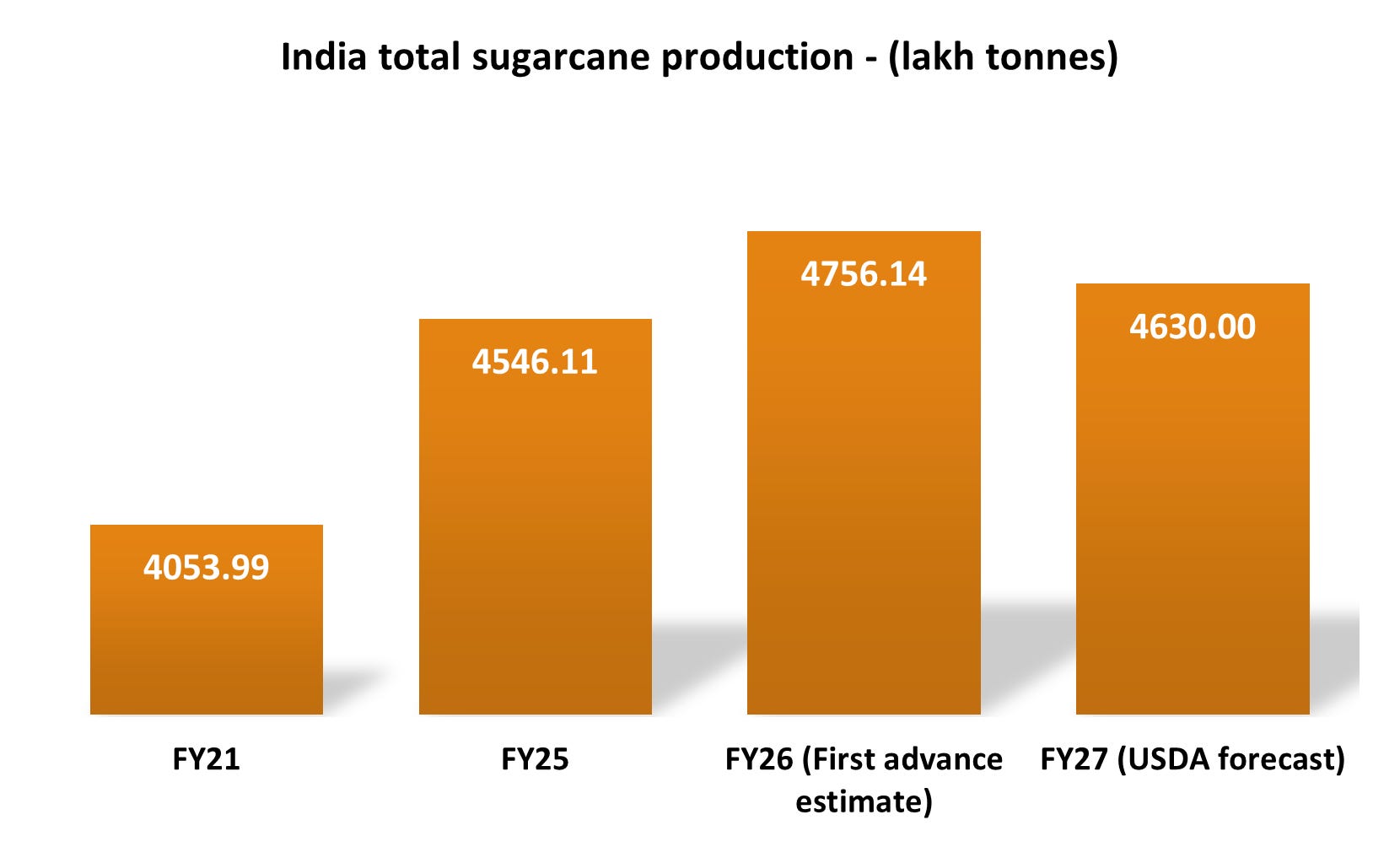
Maharashtra’s own 2025–26 sugarcane production is estimated at 1,316.49 lakh tonnes, up sharply from 1,099.70 lakh tonnes in 2024–25, and the state reported an average sugar recovery rate of 11.26% in the recently concluded season.
Those are encouraging numbers.
They also demonstrate why the current episode should not be described simply as a story of collapsing agricultural productivity.
The more accurate story is one of tight timing and shrinking buffers.
Better weather in the next crop helps October.
It does not manufacture sugar in August.
And markets do not give consumers a discount today because the next harvest looks healthier.
There is another reason the old way of thinking about sugar demand is becoming less useful.
For a long time, sugar consumption was imagined through a simple image: households buying sugar for tea, sweets and cooking. But India’s sugar market today is increasingly shaped by something less visible—the industrial economy.
The sugar that disappears from a warehouse does not necessarily disappear into someone’s kitchen. It can disappear into a soft-drink bottling plant, a biscuit factory, a dairy processor, a bakery, a confectionery line or a food-processing facility.
And this matters because industrial demand behaves differently from household demand.
A household can respond to a price increase, at least at the margin. It can buy a little less sugar, switch to another sweetener, reduce the amount used in cooking, or simply decide that this year’s homemade mithai will be slightly less ambitious.
A factory has fewer such freedoms.
A biscuit manufacturer cannot casually tell its production line, “Sugar is expensive this month, so let us make fewer biscuits.” A beverage company cannot immediately redesign its entire formulation because sugar prices have increased by ₹5 a kilogram. Contracts, recipes, production capacity, branding and distribution systems make industrial demand considerably stickier in the short run.
This is why the growing importance of food processing and organised consumption matters for the sugar balance.
USDA’s India sugar assessments have repeatedly pointed to food and beverage processing as an important source of domestic demand growth, alongside rising consumption through food-service channels. Domestic consumption is now around the high-20-million-tonne range annually, with USDA estimating India’s 2025–26 sugar consumption at roughly 31 million tonnes on a total domestic consumption basis that includes industrial and other uses.
The exact household-versus-industrial split is difficult to pin down with the precision sometimes suggested in industry commentary, so the useful takeaway is not that precisely 70% of sugar is industrial. It is that industrial and commercial buyers have become important enough that changes in their procurement behaviour can move the market.
And that changes the nature of a sugar shortage.
Now add India’s favourite economic variable after the monsoon: the festival calendar. From August through November, the country’s demand for sugar becomes unusually visible.
Ganesh Chaturthi arrives. Then comes Navratri and Dussehra. Then Diwali.
And around the same period comes the wedding season. India does not merely celebrate these events.
It feeds them. Sweets, snacks, beverages, bakery products and packaged foods all become more important during this period.
The result is a predictable but powerful seasonal demand increase. And predictability does not necessarily make the market calmer. Sometimes it makes the market more aggressive.
Everyone knows demand is coming. Which means everyone can start preparing for it in advance.
That is why the current price increase is particularly sensitive. Reuters reports that the government itself is focused on the August-November period because of higher festival demand, even as it says national supply remains adequate.
This is the exact environment in which precautionary inventory becomes valuable. A sweet manufacturer does not want to discover three days before Diwali that the sugar supplier cannot fulfil the order. The cost of being overprepared is a little additional inventory.
The cost of being underprepared is a production disruption during the most commercially important season of the year.
That asymmetry encourages buying.
There is a cruel coincidence in India’s sugar calendar.
The festival-demand acceleration happens just as the sugar season is approaching its inventory trough. It is a month in which stronger demand meets weaker inventory flexibility.
This is why the same festival demand that would be relatively harmless in a year with 7–8 million tonnes of comfortable carryover stocks can become much more inflationary when the buffer is closer to 4–5 million tonnes.
The demand shock has not necessarily become dramatically larger. The supply cushion has become smaller. That is the more important variable.
Think about a crowded railway platform. If there are 2,000 people waiting and 20 trains are expected, nobody worries much.
If there are 2,000 people and one train is expected, everyone suddenly becomes very interested in getting through the door first.
The crowd has not changed. The capacity cushion has. Sugar’s August problem has a similar flavour.
This is why simply saying “festival demand pushed up sugar prices” is incomplete.
Festival demand is the trigger. The inventory structure determines how large the response becomes. If the market had abundant immediately accessible stocks, stronger demand would mostly produce a modest quantity response.
With thinner stocks, stronger demand produces a larger price response. And because expectations of festival demand are predictable, the market starts adjusting before the festival itself arrives.
That is why August can become more important than Diwali. The market does not wait for consumers to buy sweets. It anticipates them.
Economists have a useful phrase for this: forward-looking expectations. India’s sugar traders probably have a less academic phrase. “Diwali is coming. Buy now.”
At this point, the consumer sees ₹60 sugar and naturally asks why the government cannot simply tell the industry to reduce the price.
But prices are not created in one place. The price of sugar is the endpoint of an entire policy chain. Start with the farmer.
The government sets the Fair and Remunerative Price, or FRP, for sugarcane. For the 2025–26 sugar season, the central FRP was fixed at ₹355 per quintal at a basic recovery rate of 10.25%, with adjustments linked to recovery.
For the following 2026–27 season, the government has raised the FRP again, to ₹365 per quintal at the same 10.25% basic recovery rate. So the cost of the main agricultural input is administered upward over time.
Then comes the mill.
The mill has to crush cane, recover sugar, finance inventory, pay workers, operate distilleries where integrated, maintain machinery and carry working capital. And at the other end sits the sugar price framework.
The Department of Food and Public Distribution introduced the Minimum Selling Price of sugar in June 2018 at ₹29 per kg and raised it to ₹31 per kg in February 2019. The official policy framework still lists ₹31 per kg as the sugar MSP.
And there lies a rather fascinating policy asymmetry. The cane price has moved. The sugar MSP has barely moved.
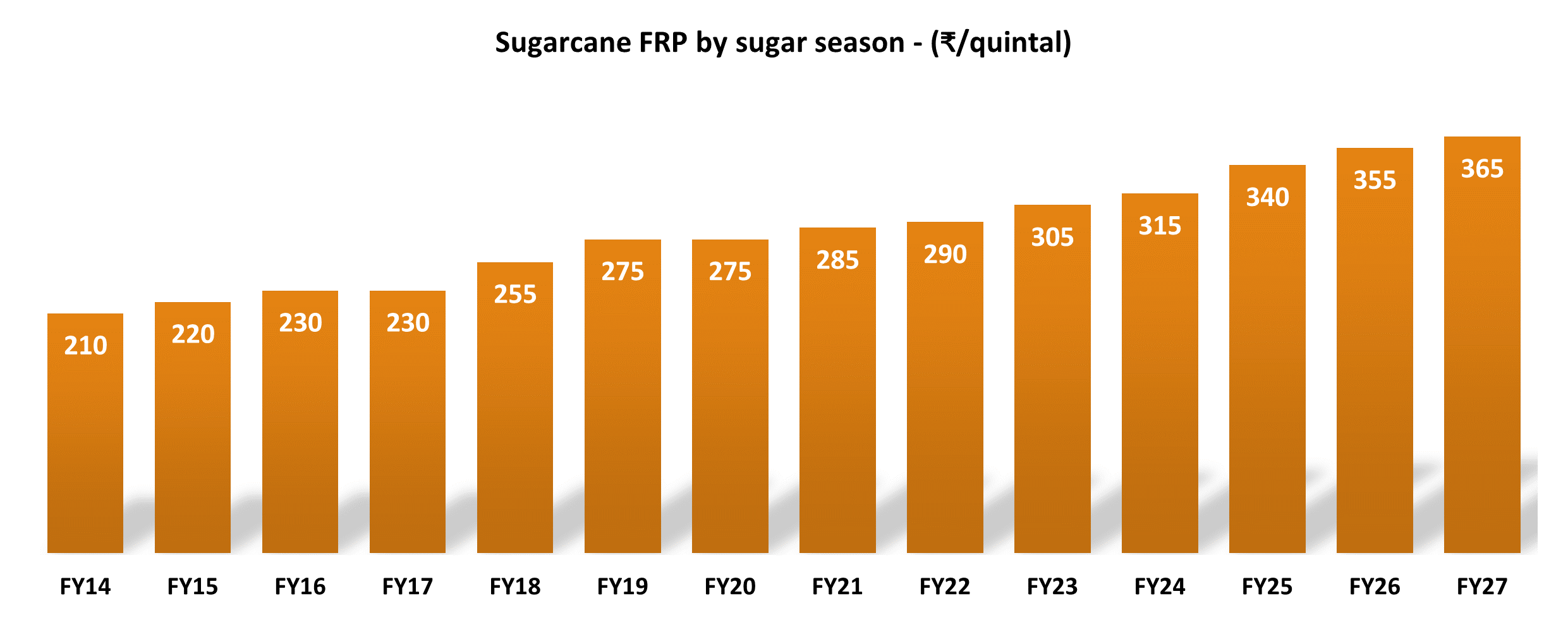
The sugar MSP, meanwhile, remains ₹31. That does not mean mills necessarily sell sugar at ₹31. They don’t. The market price is usually much higher. The point is that the official floor has not kept pace with the increase in the administered cost structure.
This distinction is worth making because the word “minimum” can be misleading.
The ₹31/kg sugar MSP is not a promise that sugar will sell for ₹31.
It is a regulatory floor for mill-gate domestic sales, intended to ensure that sugar realisations do not fall below a level associated with the industry’s cost structure and its ability to clear cane dues. The government’s own sugar-policy page says the MSP was introduced to help ensure that the industry could obtain at least a minimum cost of production and thereby clear cane-price arrears.
In a surplus year, that floor matters enormously.
Without some protection, a flood of sugar could push prices down to levels at which mills cannot comfortably meet cane liabilities.
In a shortage year, however, the MSP becomes almost irrelevant because market prices sit far above it.
And that explains something about the August episode.
The current problem is not that sugar cannot be sold below ₹31.
The problem is that the market has moved far above the floor because the marginal value of available sugar has increased.
The MSP is therefore a background institution, not the direct cause of the August spike.
When domestic prices rise sharply enough, eventually someone asks the most obvious question:
Why not just import sugar?
The answer is that India has spent years building walls around its domestic sugar market.
The Department of Food and Public Distribution states that the basic customs duty on sugar was raised from 50% to 100% with effect from February 6, 2018, partly to prevent unnecessary imports and stabilise domestic prices in the interests of farmers.
That policy made sense in an era when India was worried about surplus sugar.
Cheap imports entering during a domestic glut could depress domestic prices and hurt mills and cane farmers.
But tariffs have an interesting property. They are excellent protection when domestic prices are low. They become an increasingly expensive protection when domestic prices rise.
A 100% tariff does not know whether the country is experiencing a surplus or a shortage. It simply makes foreign sugar more expensive. Markets, unfortunately, do know the difference.
Imagine global sugar can be landed in India at an attractive price.
Under normal circumstances, Indian buyers would compare imported sugar with domestic sugar and choose whichever is cheaper after transport and taxes.
A 100% basic customs duty can make that comparison meaningless. Foreign supply becomes too expensive. Domestic producers are therefore insulated from global prices. This is useful in a surplus market.
But when Indian sugar prices suddenly spike, the same protection prevents the cheapest marginal supply from entering quickly. The result is a very interesting policy dilemma.
The government can say, quite reasonably: “We cannot allow imports at low prices because that would hurt farmers.” But the market can respond: “Fine. Then who protects consumers when domestic prices become very high?”
This is why tariffs are really distributional instruments. They transfer some of the benefit of protection towards domestic producers and away from consumers.
The trade-off becomes politically painful when the price environment reverses.
There is also a reason policymakers are unlikely to want a completely open sugar import regime. If domestic producers repeatedly face low prices whenever global sugar becomes cheaper, cane farmers eventually respond.
Planting decisions change. Farmers shift towards other crops. Mills reduce investment. Distillery economics weaken. Over time, domestic production capacity itself can suffer.
That creates another supply problem later. Agricultural commodities therefore have a peculiar dynamic. A low price today can plant the seeds of a high price tomorrow. And a high price today can encourage too much production tomorrow.
This is why governments are constantly tempted to smooth the cycle. The trouble is that smoothing the cycle requires making difficult choices about who gets protected at each stage.
The next step is to follow the consequences.
An increase in sugar prices does not remain politely inside the sugar market. It moves through the economy as each participant reacts to the new price.
Start with the household.
A retail sugar price around ₹55–65 per kg is hardly enough to bankrupt a household, but food budgets are built from many small increases rather than one dramatic shock. Lower-income consumers have less room to absorb repeated price increases, while some households may switch towards cheaper sweeteners or reduce discretionary sugar consumption. The direct demand response is therefore likely to be modest, but not zero.
Then comes the industrial buyer.
A biscuit company, confectionery producer, beverage manufacturer or bakery does not merely observe the sugar price. It incorporates the price into its cost structure. A sustained rise eventually has to show up somewhere: lower margins, higher product prices, smaller pack sizes, reformulation or a combination of all four. The sugar market therefore becomes an input-cost channel into broader food inflation.
This matters for the macroeconomy because businesses do not think in terms of one commodity in isolation. A sugar-price increase arrives alongside changes in milk, wheat, edible oils, packaging, transportation, electricity and wages.
The final consumer sees the combined number. She does not see the sugar line item in the manufacturer’s cost sheet.
This is where a humble commodity becomes a macroeconomic variable.
The Reserve Bank does not set sugar prices. It does not manage sugar inventories. It does not decide how much cane goes into ethanol. But it does care about inflation.
And food inflation matters for monetary policy because households form expectations from what they see every day. A sugar-price shock by itself is unlikely to determine the path of interest rates.
But the RBI is not looking at sugar alone. It is looking at the entire food basket. If sugar is rising alongside cereals, vegetables, milk, edible oils and other food components, the question becomes whether the shock is isolated or broad-based.
That distinction is critical. One volatile food price is noise. Several simultaneously rising food prices can become an expectations problem.
And expectations are exactly what a central bank worries about.
A household that repeatedly sees higher grocery bills starts to behave differently. Workers may seek higher wages. Businesses may protect margins through higher prices. Consumers may accelerate purchases before prices rise further. The inflation process can acquire its own momentum.
That is the second-order feedback policymakers fear.
Put the entire system together and the mechanism becomes almost circular.
The household faces higher retail sugar prices and either absorbs the cost or slightly reduces discretionary consumption.
The food processor faces higher input costs and eventually passes some of them into biscuits, beverages, sweets and other products.
The mill receives stronger sugar realisations and gains liquidity, improving its ability to service debt and clear cane dues.
The farmer experiences the benefit primarily through improved payment reliability rather than an automatic increase in the statutory cane price.
The government sees elevated food prices and responds with stockholding rules, release adjustments, import considerations or changes to ethanol policy.
The RBI watches whether the food-price increase is isolated or broad enough to affect inflation expectations.
The ethanol industry and OMCs then respond to any change in cane diversion rules by adjusting the mix of feedstocks used to satisfy the country’s blending requirements.
Every participant’s reaction changes the environment faced by the next participant.
That is why the sugar market can move in loops rather than straight lines.
Perhaps the strangest thing about India’s sugar spike is that it does not really begin with sugar. It begins with a system that has become very good at solving yesterday’s problem. When sugar was abundant, India built export controls, release quotas, ethanol incentives and import protection. When sugar became tight, those same instruments began pulling in different directions.
The result is a market where the sugar exists, but flexibility does not. A tonne can be sitting in a warehouse and still be economically scarce. A farmer can benefit from higher sugar prices without receiving a higher cane price. Ethanol can improve energy security while making the sugar balance tighter. Imports can protect consumers while hurting mill economics. Stock limits can fight hoarding while removing the buffers that keep markets liquid.
That is why the ₹60 sugar story is more revealing than it first appears. It is a story about what happens when several rational policies collide around the same scarce resource.
And perhaps this is the question India should carry into the next sugar season: Are we trying to manage scarcity or merely deciding who should bear its cost?
When the next shock comes, will India have enough sugar?
Or, more importantly, will it have enough freedom to move sugar, cane, ethanol and imports quickly enough when circumstances change?
Because the next sugar crisis may not arrive when India produces too little.
It may arrive when India has enough and still cannot get it to the right place, at the right time, under the right rules.
And that is a much harder problem to solve.
Sources- TOI, PIB, BusinessStandard, FinancialExpress, DFPD & ICRA.
Comments
Nothing yet. Say the first thing.
Sign in to join the conversation.