

For most of its history, the telecom industry was built around one simple idea: build more infrastructure to carry more data. More towers, more spectrum, more fibre, more capacity. But that model is beginning to encounter a different kind of problem. As 5G adoption accelerates, data traffic explodes, AI workloads move closer to the edge and billions of devices become connected, the network itself is becoming too complex to manage through traditional human intervention.
The next phase of telecom, therefore, may not simply be about building a bigger network but a smarter one.
AI is moving from being an application that runs on top of telecom infrastructure to becoming part of the infrastructure itself. Networks are beginning to predict congestion before it happens, optimize spectrum in real time, detect failures, manage energy consumption and increasingly make decisions without waiting for a human operator. At the same time, another boundary is disappearing: the boundary between terrestrial networks and space. Direct-to-Device satellite connectivity is turning satellites into an extension of the mobile network, allowing ordinary smartphones to remain connected even where conventional towers cannot reach.
Together, these developments point toward a fundamental change in the economics of connectivity. The telecom network of the future may be AI-native, increasingly autonomous and no longer confined to the ground.
For operators, this could mean lower operating costs and better utilization of expensive spectrum and infrastructure. For equipment and semiconductor companies, it creates new demand for AI-enabled RAN, edge computing and high-performance network infrastructure. And for consumers and businesses, it could eventually mean something much more fundamental: connectivity that is no longer defined by where the nearest cell tower happens to be.
But this transition raises a more difficult question. If networks become autonomous and connectivity extends into orbit, who will capture the value of this next telecom cycle and who will bear the cost of making it reliable, secure and economically viable?
This edition of Industry Pulse explores two forces that could shape that answer: the rise of AI-native and autonomous networks, and the emergence of Direct-to-Device satellite connectivity.
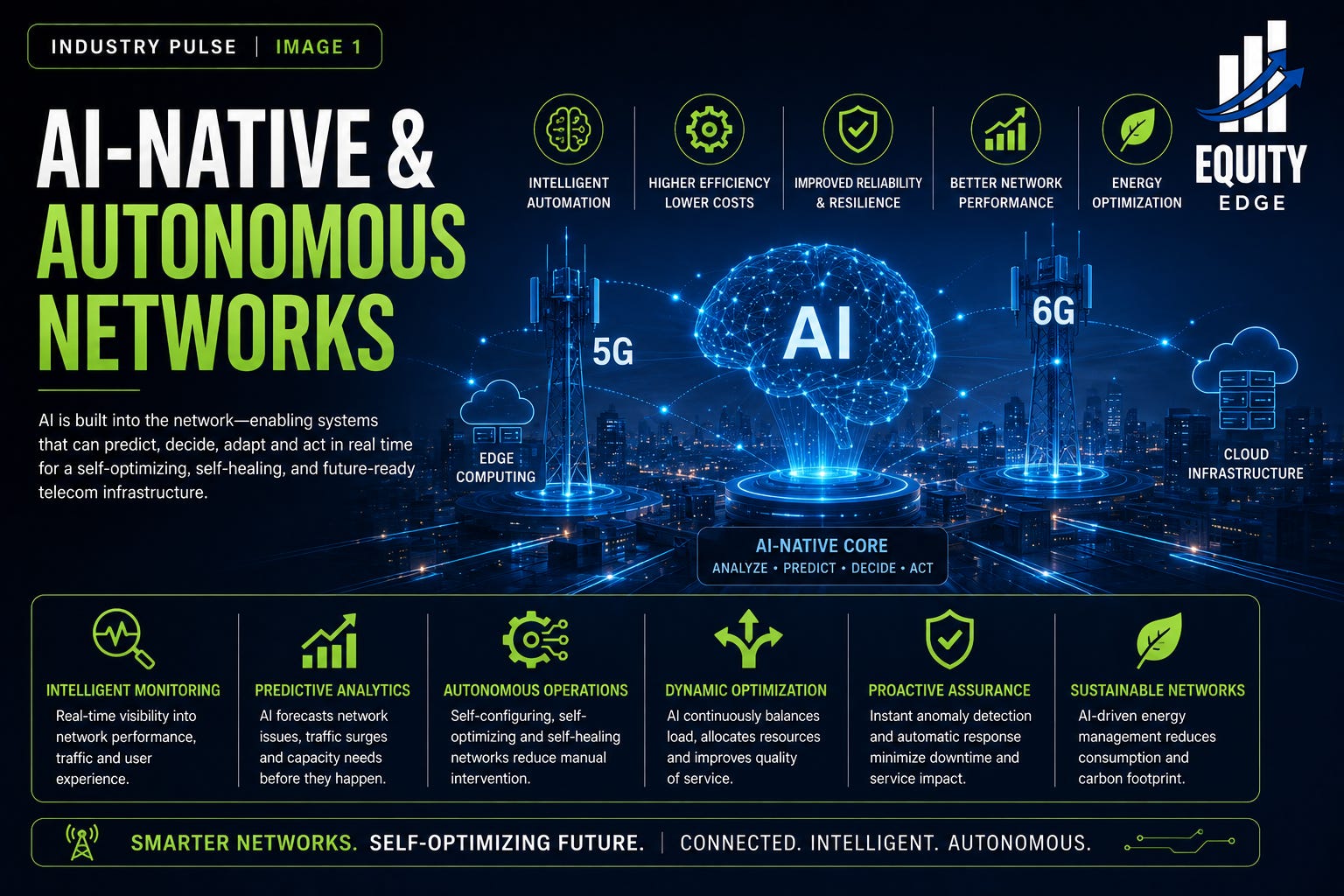
AI-native and autonomous networks represent the next stage of telecom evolution, where AI is embedded directly into network design, operations and decision-making rather than being used only as an external analytics tool. These networks can continuously monitor traffic, predict failures, optimize network capacity, manage energy consumption and increasingly self-configure, self-heal and automatically respond to changing demand.
The shift is being driven by rapidly growing data traffic, 5G/6G complexity, edge computing and AI workloads. As networks become more software-defined, telecom operators are moving toward autonomous systems that require less human intervention, potentially reducing operating costs while improving network reliability, efficiency and quality of service.
Nokia Launches Commercial AI-Native RAN Platform
Nokia launched what it describes as the industry’s first commercial AI-RAN platform in July 2026, built on its AI-native anyRAN software and NVIDIA’s Aerial AI-RAN platform. Nokia says the platform could deliver more than 2× spectral efficiency by 2028, allowing operators to extract substantially more capacity from existing spectrum assets.
Ericsson Brings AI Directly Into 5G Radio Networks
Ericsson launched its “AI in RAN” software in June 2026, embedding telco-specific AI models directly into basebands and radios. The system is designed for real-time network optimization, including AI-managed beamforming, scheduling and coordination.
Ericsson says deployments and trials have demonstrated up to 20% higher downlink throughput and up to 10% better spectral efficiency.
Nokia Expands Agentic AI Across Autonomous Networks
In June 2026, Nokia expanded its autonomous-network portfolio with an Autonomous Networks Agent Library and upgraded Autonomous Networks Suite. The company’s approach uses agentic AI across RAN, IP, fixed and optical networks to automate increasingly complex operational tasks.
Ericsson and Nokia Join Forces on Multivendor Autonomous Networks
In March 2026, Ericsson and Nokia announced cooperation to improve interoperability between their automation ecosystems. Ericsson joined Nokia’s SMO Marketplace while Nokia joined Ericsson’s rApp ecosystem, allowing operators to use automation applications across multivendor environments.
AI-RAN Alliance Reaches 132 Members With 33 AI-Native Network Demonstrations
The AI-RAN Alliance reached 132 members in February 2026 and showcased 33 AI-driven demonstrations at MWC Barcelona, covering AI-for-RAN, AI-and-RAN and AI-on-RAN use cases. The demonstrations included agentic RAN, large telco models and digital twins for testing AI-driven network optimization.
(Source: Nokia, Ericsson, AI-RAN Alliance)
India Begins Moving Toward AI-Native Networks
At the India AI Impact Summit 2026, India’s Department of Telecommunications brought together Jio, Airtel, Vodafone Idea, industry technology companies and government representatives to discuss AI-native telecom infrastructure.
The discussions specifically focused on AI-driven predictive maintenance, intelligent spectrum optimization, energy-efficient network management and adaptive self-optimizing networks.
Jio Pushes AI-Driven Network Automation and Self-Organizing Networks
Reliance Jio is deploying AI/ML-based network automation, including Self-Organizing Network (SON) capabilities that can automatically optimize network parameters, detect configuration problems and improve network performance.
Jio’s SON technology is designed to automate network planning, configuration, optimization and healing, reducing the need for manual intervention.
Airtel, Jio and Vi Identify AI-Driven Network Automation as a Major 2026 Priority
Indian telecom operators are increasingly incorporating AI into network operations. Industry discussions involving Jio, Airtel and Vodafone Idea have highlighted AI-driven traffic management, network automation, 5G Standalone, edge computing and AI-RAN as key areas of development.
Vodafone Idea is already using AI-powered Self-Organizing Network (SON) capabilities, while Jio and Airtel are investing in AI and cloud infrastructure.
Nokia India Links AI With the Next Wave of Telecom Network Investment
Nokia India has identified AI-driven network automation, data centres and transport infrastructure as important areas of future telecom investment as Indian data consumption continues to rise.
Nokia has specifically highlighted the growing importance of automated radio resource planning, traffic optimization, network slicing and programmable networks.
India Moves Toward AI-Ready 5G and 6G Networks
India’s telecom ecosystem is increasingly positioning 5G Standalone as the foundation for AI-native networks, with industry participants linking the development of AI-RAN, edge computing, network APIs and future 6G capabilities.
Industry forecasts indicate India’s 5G subscriber base could exceed 1 billion by 2031, increasing the importance of AI-based network optimization as traffic and network complexity rise.
(Source: Jio Platforms, ET Telecom)
Telecom networks are becoming too complex and too data-intensive to be managed entirely through traditional, rule-based systems. The expansion of 5G, edge computing, IoT and AI workloads is creating millions of network decisions around traffic, spectrum, capacity, energy and service quality.
AI-native networks address this by embedding AI directly into the network, allowing systems to predict congestion, optimize resources, detect failures and increasingly take corrective actions without human intervention. Ericsson describes AI-RAN as a way to improve network performance, automation and energy efficiency, while Nokia’s approach makes the RAN a programmable, AI-native platform.
The significance is therefore much broader than simply reducing telecom operating costs. It could fundamentally change the economics and architecture of telecom networks:
Manual management → automated networks → autonomous networks → AI-native networks
For operators, greater automation could mean lower operating costs, better spectrum utilization, fewer outages and more efficient use of existing infrastructure. It also creates a new technology layer around AI accelerators, network software, cloud infrastructure and edge computing.
The development is being driven by a combination of telecom operators, network-equipment companies and semiconductor/technology companies.
Nokia – Building AI-Native RAN
Nokia is developing AI-RAN where conventional radio functions and AI workloads can operate on a shared computing infrastructure. Its objective is to make the RAN more programmable and allow AI models to optimize network performance at radio-network timescales.
Ericsson – Embedding AI Into the Radio Network
Ericsson is integrating AI directly into the RAN rather than using it only as an external analytics layer. Its AI-RAN strategy focuses on intelligent network optimization, automation and energy efficiency.
Jio – Automating Network Operations
Reliance Jio has developed AI/ML capabilities for telecom network automation, including self-organizing networks, network optimization and automated troubleshooting. Its enterprise offering also includes telecom AI/ML solutions designed for communication service providers.
Airtel – Moving Toward AI-Driven Network Management
Bharti Airtel is increasingly incorporating AI and automation into its network and digital infrastructure, while working with global technology partners across cloud, 5G and network technologies.
The broader industry direction is toward using AI for traffic optimization, predictive maintenance, network planning and enterprise network services.
NVIDIA – Providing the Computing Layer
NVIDIA is becoming an important technology supplier as telecom networks begin incorporating AI workloads. Its AI-RAN approach combines accelerated computing with telecom infrastructure, enabling network functions and AI applications to run on a common platform.
This is strategically important because autonomous networks require significantly more real-time computing and AI inference at the network edge.
Telecom Capex Could Shift From Hardware Toward Software
As networks become increasingly programmable, operators may rely less on constant hardware upgrades and more on software-driven network optimization.
This could gradually change the revenue mix for telecom equipment companies toward software, AI platforms and recurring services.
AI Creates a New Computing Layer Inside Telecom
Autonomous networks require real-time AI inference close to the network. This could increase demand for AI accelerators, edge servers, networking chips and distributed computing infrastructure.
Therefore, telecom could become another important demand driver for the semiconductor industry.
Network Operating Costs Could Decline
AI can automate tasks that currently require significant human intervention, including fault detection, network optimization, capacity planning and predictive maintenance.
If deployed successfully, operators could manage increasingly complex networks without a proportional increase in employees or operating expenditure.
Energy Efficiency Becomes More Important
Telecom networks consume substantial amounts of electricity, particularly as 5G traffic increases.
AI can dynamically adjust network resources based on traffic patterns—for example, reducing capacity during low-demand periods and activating additional resources when demand increases.
This creates an important opportunity for AI-driven energy optimization.
Telecom Vendors Could Become More Software-Like Businesses
The traditional telecom-equipment model has been heavily dependent on selling physical equipment.
AI-native networks could increase the importance of software licenses, network orchestration platforms, AI models, APIs and managed services, potentially creating higher recurring-revenue opportunities.
Cybersecurity Risk Also Increases
Greater autonomy means networks are increasingly capable of making decisions without human intervention.
That creates a new challenge: what happens when the AI makes the wrong decision or is manipulated?
As autonomy increases, operators will need stronger AI governance, cybersecurity, human oversight and fail-safe mechanisms.
The central question is:
Can telecom operators achieve genuinely autonomous networks that reduce costs and improve performance without creating unacceptable reliability, cybersecurity and governance risks?
The technology is progressing rapidly, but the commercial outcome will depend on whether AI can move beyond pilot projects and isolated automation use cases into reliable, large-scale, closed-loop network operations.
For investors, the bigger question is:
Who captures the economic value of autonomous networks—the telecom operators through lower costs, equipment vendors through AI-native infrastructure, or semiconductor and software companies through the computing and intelligence layer?
That will determine where the next major telecom capex and technology spending cycle ultimately flows.
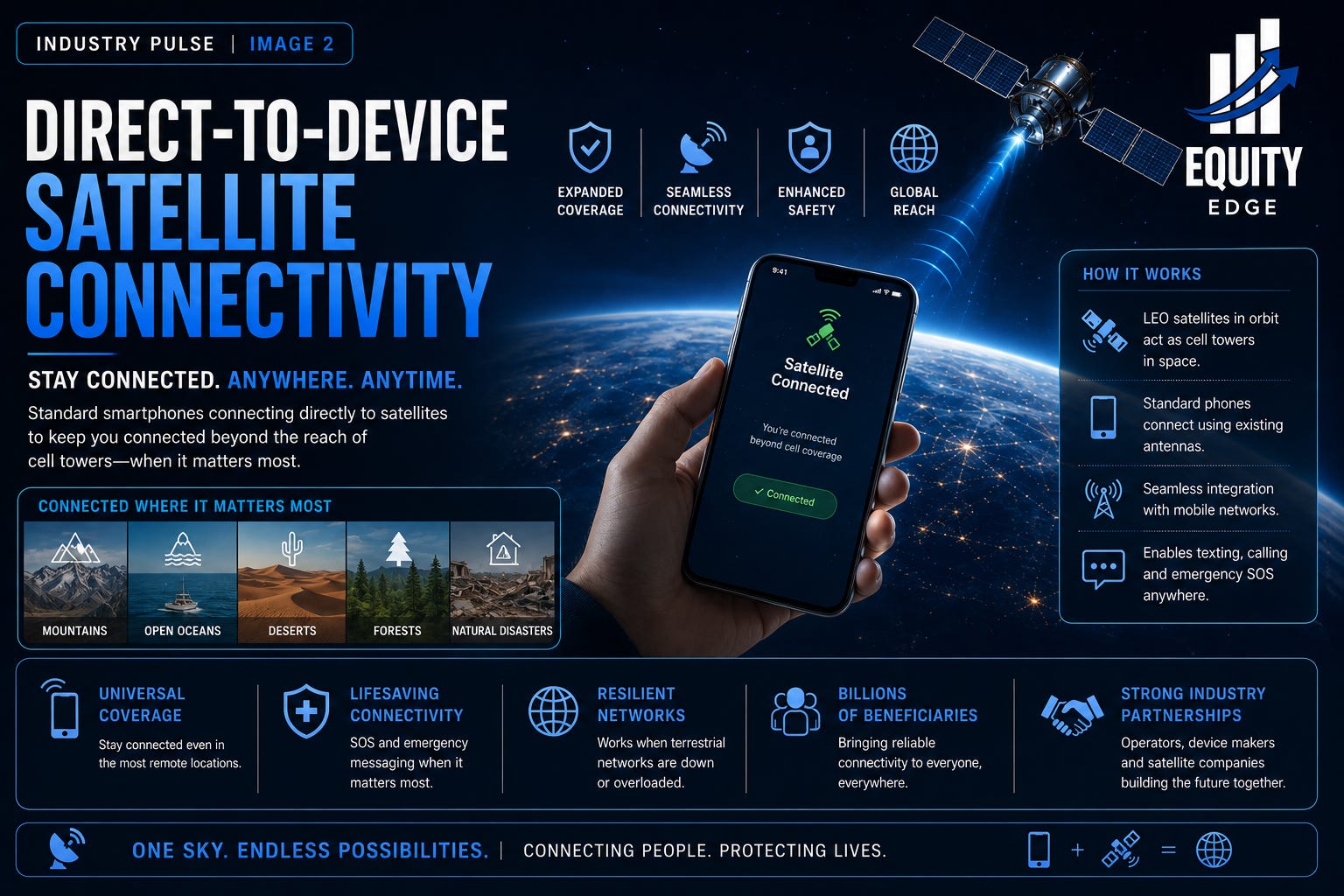
The telecommunications industry is undergoing a major shift with the arrival of Direct-to-Device (D2D) satellite connectivity. For decades, connecting directly to a satellite required bulky, specialized handheld phones with giant antennas or expensive satellite dishes on rooftops. Today, rapid technological advancements are changing that completely: everyday, standard smartphones in our pockets can now connect directly to satellites orbiting overhead without requiring any extra attachments or hardware modifications.
This breakthrough works by using networks of satellites placed in Low Earth Orbit (LEO), which fly much closer to Earth (a few hundred kilometers up, compared to traditional satellites stationed tens of thousands of kilometers away). Because these satellites are so much closer, they can communicate with tiny phone antennas and effectively act as giant “cell towers in space.” They work alongside standard ground-based telecom operators, ensuring that when you walk outside cell tower range—into remote mountains, open oceans, deserts, or dense forests, your phone quietly stays connected for emergency SOS alerts, text messages, and basic calling.
The real-world value of this technology is monumental for safety and everyday life. When natural disasters like floods, earthquakes, or cyclones knock out local power lines and snap ground towers, space-based direct-to-phone networks step in as an unshakeable safety net. As mobile network providers, phone makers, and satellite companies partner up worldwide, direct satellite connectivity is moving from a futuristic luxury into a standard safety feature for billions of people around the globe.
Major News Related to Direct-to-Device Satellite Connectivity
AST SpaceMobile Launches Next-Gen BlueBird Constellations (August 2026):
Satellite broadband company AST SpaceMobile completed the orbital launches of its next-generation BlueBird satellites. Featuring massive phased-array antennas designed to operate in low Earth orbit, the satellites are built to beam 5G cellular broadband, supporting voice calls, video streaming, and data applications, directly to standard mobile phones in partnership with carriers like AT&T and Verizon.
Chipmakers Integrate Non-Terrestrial Network (NTN) Silicon into Mainstream Phones (2025–2026):
Major mobile semiconductor manufacturers, including Qualcomm and MediaTek, began standardizing 3GPP-compliant non-terrestrial network (NTN) modem capabilities across mainstream and mid-range mobile processor lines. This mass-market integration ensures that next-generation affordable smartphones will support direct satellite texting and telemetry out of the box.
Starlink and T-Mobile Launch Commercial Direct-to-Cell Messaging (July 2025):
SpaceX and T-Mobile officially launched commercial satellite-to-phone messaging, deploying specialized satellites that function as orbiting cellular towers. The service enables standard smartphones to send texts, share GPS locations, and route free emergency 911 texts in remote dead zones without cellular coverage.
Apple Broadens Satellite Messaging and Roadside Assistance (Late 2024–2025):
Apple expanded its direct satellite capabilities across the iPhone ecosystem. Beyond initial emergency SOS alerts, the service now supports two-way non-emergency SMS text messaging with family and friends outside cellular service, as well as on-demand satellite roadside assistance, embedding space connectivity into standard consumer mobile features.
DoT and TRAI Initiate Regulatory Consultations for Satellite Frameworks (April 2026):
The Telecom Regulatory Authority of India (TRAI), working alongside the Department of Telecommunications (DoT), officially released a consultation paper to establish authorization and spectrum assignment rules for satellite communication networks. The regulatory roadmap aims to establish pricing terms, technical safeguards, and radio frequency guidelines to ensure space-based signals operate alongside existing ground telecom networks without creating signal interference.
Indian Telecom Operators Push for Terrestrial Spectrum Integration (Early 2026):
Leading domestic telecom operators, including Reliance Jio and Bharti Airtel, accelerated their satellite-to-cellular roadmaps. Domestic carriers submitted stakeholder representations calling for hybrid frameworks that enable satellite providers to utilize standard mobile spectrum bands, ensuring Indian subscribers can switch automatically between ground 4G/5G mobile towers and orbiting satellites in rural and border areas.
BSNL and Viasat Successfully Showcase India’s First Direct-to-Device Trial (October 2024):
State-owned telecom operator BSNL partnered with global satellite communications firm Viasat to demonstrate direct satellite connectivity on standard consumer smartphones in India during the India Mobile Congress. The trial successfully sent two-way text and emergency SOS messages directly from a standard Android phone to a satellite in orbit, proving that everyday mobile devices can communicate with satellites without external hardware accessories.
The rise of Direct-to-Device (D2D) satellite connectivity matters because it eliminates the geographic boundaries of mobile telecommunications. For over three decades, cellular networks have been tied to physical ground infrastructure, such as cell towers, fiber-optic backhaul cables, and diesel generators. While telecom operators have built networks that reach over 95% of the world’s population, their ground towers cover only about 38% of Earth’s total landmass and virtually none of the open oceans. In remote mountains, deserts, rural farm belts, and maritime trade corridors, building and maintaining physical cell towers is either technically impossible or financially unviable.
Direct satellite connectivity solves this coverage gap by turning low-orbiting satellites into a seamless, overhead extension of ground-based cellular networks. Instead of competing with mobile network operators (MNOs), satellite constellations integrate directly with standard telecom spectrum. This ensures that consumer smartphones, connected cars, and industrial Internet-of-Things (IoT) trackers can automatically stay connected without requiring bulky specialized dishes, external satellite transceivers, or costly hardware retrofits.
To understand why this is a game-changer for everyday life and global industry, consider these concrete real-world impacts:
Saving Lives in Crisis Zones and Natural Disasters: When extreme weather events like cyclones, floods, wildfires, or earthquakes tear down local power lines and disable terrestrial cell towers, traditional communications go completely dark. Direct satellite connectivity provides an unshakeable, space-based safety net, allowing trapped citizens to send emergency SOS alerts, share GPS coordinates with first responders, and receive government disaster warnings in real time.
Eliminating Dead Zones for Travelers, Maritime Fleets, and Aviation: Outdoor enthusiasts, long-haul truck drivers, maritime vessels, and commercial flights frequently navigate vast dead zones where ground signals vanish. With D2D connectivity, users maintain continuous two-way SMS messaging, basic voice calling, and turn-by-turn navigation across off-grid highways, national parks, and international waters.
Continuous Global Tracking for Enterprise IoT and Supply Chains: Global logistics companies, agricultural operations, and energy grids rely on millions of connected sensors to monitor cargo containers, soil moisture, cross-country pipelines, and heavy machinery. Direct satellite connectivity enables these remote assets to transmit telematics data continuously from any point on Earth, preventing costly supply chain disruptions without expensive satellite terminals.
From an economic perspective, D2D expands the addressable revenue base for both telecom operators and satellite constellations. Rather than spending billions on building and fueling physical cell towers in low-density rural areas, telecom operators can partner with satellite providers to offer 100% geographic coverage as a premium subscription tier or basic roaming safeguard. As next-generation satellites deploy larger antenna arrays and smartphone chipmakers standardize space-connectivity modems, Direct-to-Device technology is transforming satellite communications from a niche emergency backup into a foundational layer of global connectivity.
The buildout of the Direct-to-Device (D2D) satellite ecosystem is being driven by a diverse set of satellite network operators, non-terrestrial service aggregators, enterprise telematics leaders, and tech giants, each unlocking a distinct piece of space-to-phone infrastructure:
Skylo Technologies (Pioneering Standards-Based Virtual Satellite Networks):
Rather than launching its own hardware, Skylo Technologies operates as a specialized non-terrestrial network (NTN) service provider. Skylo leases existing satellite capacity from operators like Viasat and Ligado Networks to route standards-based satellite roaming directly to cellular carriers, automotive OEMs, and Android smartphone brands, serving as the connective software layer between terrestrial mobile networks and orbiting satellites.
Lynk Global (Deploying “Cell Towers in Space” for Global Carriers):
Lynk Global focuses on deploying low Earth orbit nanosatellites that function directly as orbiting cellular base stations. Partnering with regional mobile network operators across Africa, the Pacific Islands, and Latin America—alongside backing from satellite giant SES—Lynk provides periodic emergency messaging and SMS coverage to standard, unmodified GSM and LTE phones without requiring customized phone hardware.
Iridium Communications (Advancing Project Stardust for 5G NB-IoT Integration):
Leveraging its established, battle-tested low Earth orbit satellite network, Iridium is developing Project Stardust. The initiative upgrades its existing orbital constellation to support 3GPP-standard 5G Narrowband-IoT (NB-IoT) protocols, allowing consumer device makers, tablet manufacturers, and automotive tracking platforms to integrate low-latency messaging and emergency SOS directly into standard hardware.
Amazon Project Kuiper (Exploring Direct-to-Cell Expansion for Global Broadband):
While initially focused on high-speed broadband via ground terminals, Amazon’s Project Kuiper is expanding its strategy into direct-to-cell services. Amazon is actively engaging global telecommunications regulators to explore using its planned 3,200+ low Earth orbit constellation to beam direct cellular signals to consumer handsets, aiming to leverage its massive cloud infrastructure (AWS) to power enterprise D2D connectivity.
Garmin & Bullitt Group (Scaling Satellite Messengers and Rugged Hardware):
Pioneers in consumer satellite messaging like Garmin (with its inReach network) and rugged device makers have paved the path for direct satellite safety. These companies are now embedding two-way satellite SOS, off-grid live tracking, and emergency response dispatch directly into specialized rugged smartphones, wearables, and vehicle dashboards for outdoor recreation and industrial field workers.
Telecom Capex Could Shift From Rural Towers Toward Orbiting Networks
Building and maintaining physical cell towers in remote deserts, dense forests, and rugged mountainous terrain is notoriously unprofitable for telecom operators due to massive civil engineering costs, expensive diesel generator maintenance, and low subscriber density.
By partnering with satellite constellations to cover these low-density areas from orbit, telecom carriers can reallocate billions in physical capital expenditure away from building rural towers and redirect those funds toward upgrading high-capacity urban 5G and fiber networks.
Global Emergency Response and Disaster Management Are Transformed
When extreme weather events like cyclones, floods, or earthquakes knock out power grids and destroy ground cell towers, emergency response teams traditionally suffer from complete communication blackouts. Direct satellite connectivity enables survivors to transmit real-time GPS coordinates, send SOS text messages, and receive evacuation alerts directly on standard smartphones.
This continuous connectivity drastically reduces search-and-rescue response times, coordinates multiple disaster relief agencies simultaneously, and lowers fatality rates during major crises.
Industrial Supply Chains and Cold-Chain Logistics See Frictionless Tracking
Cross-country trucking, global freight shipping, and remote pipeline monitoring have historically relied on expensive, proprietary satellite hardware bolted onto assets. With standard smartphones and simple IoT sensors now connecting directly to satellites, logistics operators can track cargo containers, refrigerated food shipments, and high-value freight seamlessly across open oceans and barren transit corridors.
This widespread visibility prevents inventory loss, improves cold-chain temperature compliance, and cuts operational tracking costs across global trade routes.
Workforce Safety Standards and Travel Insurance Models Are Upgraded
Industries operating in isolated environments, such as mining, agriculture, forestry, and offshore oil rigs, alongside adventure tourism and mountaineering sectors, are experiencing an immediate upgrade in personnel safety. Workers and travelers no longer need to carry specialized satellite transceivers or emergency locator beacons to stay safe.
Standard smartphones act as continuous safety monitors, altering travel insurance risk underwriting, simplifying remote workplace compliance, and lowering liability insurance premiums for off-grid operations.
The long-term realization of Direct-to-Device (D2D) satellite connectivity will depend less on proving basic orbital transmission physics and more on whether satellite operators and terrestrial telecom providers can resolve severe bandwidth limitations and coordinate scarce radio spectrum globally.
Can global regulators and telecom operators establish unified spectrum-sharing frameworks that prevent satellite signals from interfering with ground cellular networks? Will satellite constellations achieve the orbital density and high-throughput capacity needed to deliver seamless, mass-market voice and video data beyond basic emergency text messaging?
Comments
Nothing yet. Say the first thing.
Sign in to join the conversation.