
As many of you know, EQUAL MEANS EQUAL has appealed our constitutional equality case to the United States Court of Appeals for the First Circuit.
Our appeal brief is due on August 3. We are now inviting organizations across the country to join this appeal by signing onto an amicus brief supporting women's full constitutional equality. If you know an organization that should be part of this effort, please share this article and our amicus sign-on form with them.
This appeal asks whether women are entitled to the Constitution's full guarantee of equal protection—and whether the Equal Rights Amendment must finally be recognized as the law of the land.
If you believe this fight matters, please help us carry it forward.
Join the Constitutional Equality Appeal
Our case challenges the Military Selective Service Act, not because we support the draft, but because men’s rights organizations have repeatedly asked the courts to require women to register for Selective Service while remaining unequal under the Constitution.
The Military Selective Service Act is one of the last remaining laws where sex discrimination is so blatant and visible. Although women have served in every military occupation, including combat, for nearly a decade, only men are required to register for a potential military draft. Men must; women cannot.
Our position is simple: if women can be compelled to serve, fight, and die in defense of the Constitution, they must also be recognized as fully equal under it.
If you're going to encourage an organization to join this appeal, which I hope you will, I think it's important to share with you the constitutional issues at stake. What follows are excerpts from the official hearing transcript in our case. They present the arguments made by both sides and the constitutional questions now before the United States Court of Appeals for the First Circuit.
MARCH 24, 2026
THE CLERK: Civil Action Number 25-10806, Equal Means Equal, et al vs. Trump, et al.
THE COURT: And would counsel identify themselves.
MS. MURPHY: Good afternoon, nice to see you again, your Honor.
(Pause.)
MR. HOLLAND: Good afternoon --
THE COURT: You need to put your name on the record, although I recognize her as Ms. Murphy.
MS. MURPHY: Oh, I’m so sorry.
THE COURT: That doesn’t get her anywhere, but she has appeared before me before, that’s all.
(Laughter.)
THE COURT: And counsel?
MR. HOLLAND: Okay. Liam Holland for the United States Department of Justice and the federal defendants, your Honor.
MS. MURPHY: And Wendy Murphy on behalf of the plaintiffs, and I apologize, your Honor.
THE COURT: Oh, no apology is necessary. Ms. Murphy, you’ve got a long road to hoe here.
Understatement of the year.
We weren’t asking the Court to interpret a statute or resolve some technical dispute between agencies. We were asking a federal judge to recognize that the Equal Rights Amendment is part of the Constitution, that women are entitled to strict scrutiny under it, and that a Supreme Court decision written when women were barred from combat can no longer justify treating women differently under the law.
“Long road” indeed.
THE COURT: I’ll hear you.
MS. MURPHY: Um, it’s the defendant’s motion, but you’d rather just hear from me? Okay.
THE COURT: I’ll let you go first on their motion.
EQUAL MEANS EQUAL’s attorney, Wendy Murphy, immediately recognized what had happened. It was the government’s motion to dismiss, yet Judge Young had asked her to argue first. Ordinarily, the defendants would have presented their motion first.
I remember thinking that I wanted Wendy to have the last word, not the first.
MS. MURPHY: Okay. Fair enough. Your Honor, if you’ll indulge me, just a little introductory moment here, um—
THE COURT: You’ve got 10 minutes, but go ahead.
MS. MURPHY: I’ll go fast.
The words “Equal Justice Under Law” are carved in stone on our United States Supreme Court building in Washington, D.C., but those words have never ever applied to women. Ever.
So we’re here today not only asking you to strike down the Selective Service Act as unconstitutional, because it excludes women, but to do so—
THE COURT: The Supreme Court has ruled otherwise.
Judge Young immediately brought the discussion to what he believed was the central legal obstacle in our Selective Service claim: Rostker v. Goldberg, the 1981 Supreme Court decision upholding male-only draft registration because women were then excluded from combat.
MS. MURPHY: I understand that. But, your Honor, women are now serving on the front lines of battle, bleeding to death for their country in service, in combat, they deserve to be seen as fully equal persons under the law now. Their time has come.
THE COURT: Evidently, and you have appeared before me, and I hold you in great respect, Ms. Murphy, but that’s not an argument to make to me, I also have an oath, and my oath is to follow the decisions of those courts with higher commission. I’m sworn to do that. You’re making the policy argument before me.
Judge Young wasn’t dismissing Wendy’s point. He was drawing a distinction that would become important throughout the hearing. He wasn’t asking whether women should be treated equally. He wanted to know whether, under existing law, he had the authority to rule in our favor.
MS. MURPHY: Well I have a legal argument as well, your Honor, because I’ll—
THE COURT: Well let’s get to that, because I’m bound—I’ll tell you straight out, I’m bound by this.
MS. MURPHY: The Rostker case, from 1981, does say that the Selective Service Act is constitutional, despite the fact that it explicitly discriminates against women. It was upheld solely—the only basis for the Court’s decision was that women were not eligible for the draft, because they were not then eligible to fight on the front lines of combat. That has changed now. And the Supreme Court has said, in a couple of different cases, that where the underlying conditions of the Supreme Court’s ruling have changed, the calculation changes. So it is a new question for you to decide, your Honor. You’re not bound by a decision where the circumstances underlying that ruling are no longer valid.
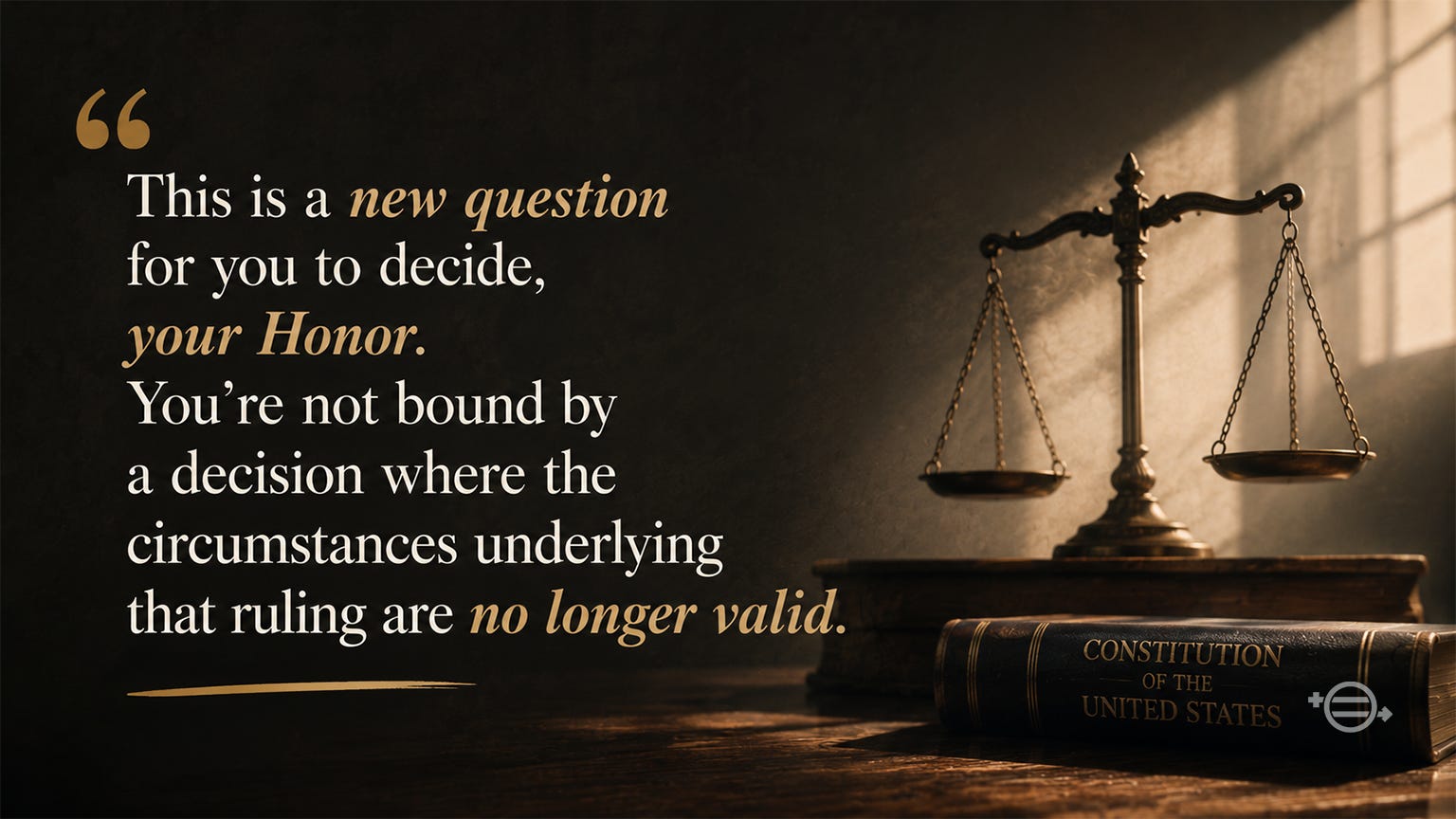
This was the heart of Wendy’s legal argument. She wasn’t asking Judge Young to overrule the Supreme Court. She was arguing that Rostker rested entirely on a factual premise that no longer exists. Women now serve in combat. If the factual foundation of the decision has disappeared, she argued, then the constitutional question must be examined again.
To show that another federal court had already recognized this principle, Wendy pointed Judge Young to a district court decision from New Jersey.
MS. MURPHY: And Judge Salas, in the New Jersey Federal District Court, said exactly that when she not only granted standing to the female plaintiff, but said, “I’m not bound by Rostker, because the conditions underlying that ruling are no longer applicable.”
THE COURT: I grant you that there’s standing for the female plaintiff, or at least subject to hearing the other side, I think she has standing. But I do have standing questions with respect to the associational standing of the Equal Means Equal group. But as to Ms. Fenore, she has standing.
Hearing Judge Young say that he believed Jacqueline Fenore had standing immediately caught my attention. Standing determines whether a court can even consider the constitutional issues before it. Without it, the courthouse doors close before the merits are ever reached. From where I sat, this sounded like an important step forward.
Wendy stayed focused.
MS. MURPHY: Well my point about citing Judge Salas, your Honor, and that’s the Kyle-Labell case, is that she didn’t just find standing, she also said, point-blank, “I am not bound by Rostker. Yes, that’s a Supreme Court case, yes, I’m generally bound by the Supreme Court’s precedent, but not in this case.”
THE COURT: And why?
MS. MURPHY: Because the conditions have changed—
THE COURT: What was the judgment in that case?
MS. MURPHY: That case is still pending.
THE COURT: All right.
MS. MURPHY: But it was a motion to dismiss in part on the grounds by the government, by the same government, arguing that the case had to be dismissed, because Rostker is the law, and a lower-court judge, the District Court, doesn’t have authority to disregard the Supreme Court precedent.
Judge Salas and I agree that it’s not disregarding precedent when the precedent is based on conditions—the only basis for the Court’s ruling are conditions that no longer exist. In other words, your Honor, it presents to you a brand-new question that the Supreme Court has not yet decided.
And so you won’t be disregarding precedent at all.
I found myself thinking, How does the government answer that?
Wendy wasn’t arguing that lower courts are free to ignore Supreme Court precedent. She was arguing that Rostker rested entirely on one fact: women were barred from combat. That fact no longer exists.
If a Supreme Court decision rests entirely on circumstances that have fundamentally changed, doesn’t a lower court have not only the authority, but the responsibility, to recognize that reality?
At that moment, Judge Young shifted the discussion to the Equal Rights Amendment.
THE COURT: Perhaps you want to go to the proposed Equal Rights Amendment.
For EQUAL MEANS EQUAL, the ERA was the heart of the case. We weren’t simply asking the Court to reconsider the Military Selective Service Act. We were asking it to recognize that the Equal Rights Amendment is now part of the United States Constitution and requires courts to afford women the same constitutional protection as classifications based on race.
MS. MURPHY: Your Honor, the Equal Rights Amendment is currently the law of the land. I’m delighted to tell you that a—
THE COURT: It’s untimely, isn’t it?
For years, nearly every discussion about the Equal Rights Amendment has eventually arrived at this question. Not whether thirty-eight states ratified it—they did. Not whether Article V says an amendment becomes part of the Constitution when it is proposed by Congress and ratified by three-fourths of the states—it does. The question has almost always been whether Congress’s seven-year ratification deadline prevented the amendment from becoming valid.
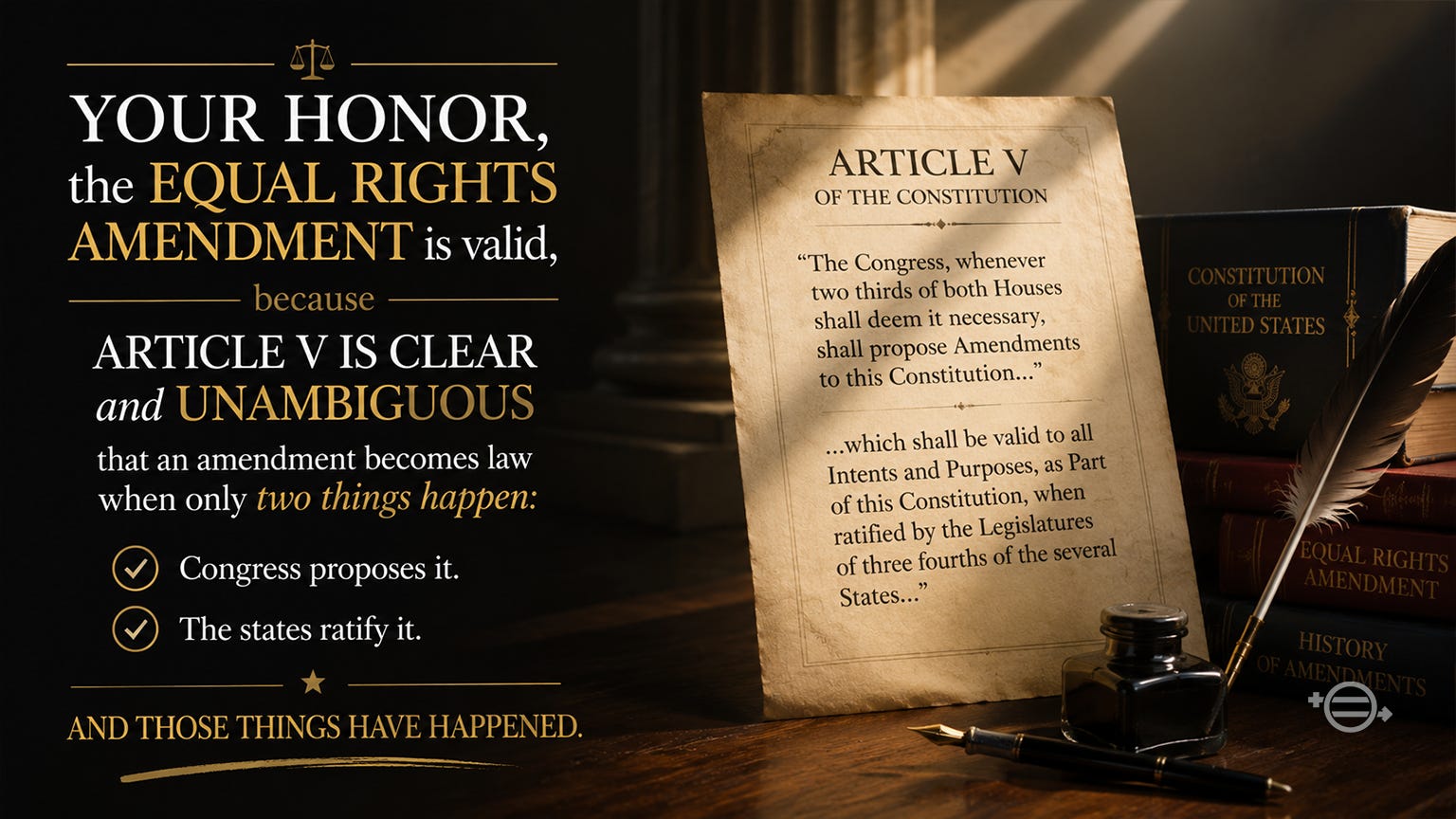
MS. MURPHY: I’m delighted to let you know that a contemporary of yours, Professor Lawrence Tribe, from Harvard Law School, agrees with me that the deadline is invalid, and when a deadline on an amendment’s ratification is invalid, and the amendment has been ratified by the necessary number of states, the amendment is valid. The American Bar Association agrees with me, many constitutional scholars agree with me, but the government disagrees with me, but they’re wrong.
Your Honor, the Equal Rights Amendment is valid, because Article V is clear and unambiguous that an amendment becomes law when only two things happen, Congress proposes it, the states ratify it. And those things have happened.
THE COURT: Doesn’t a proposal include the deadline?
MS. MURPHY: The proposal does not include the deadline because the proposal—that thing that Congress proposes, is the text of the amendment. The deadline is in the preamble, it’s in the introductory clause, it’s in the “set-up,” if you will. That is not law, that is not enforceable substantive law.
Multiple amendments before had put a time-limit in the text of the amendment, that was arguably enforceable. And I don’t want to concede, because I think deadlines in general are anticonstitutional, but let’s just talk about the preambulatory space where this deadline appears.
Because it is not substantive law, it is not enforceable. The states only ratify the text of an amendment, they do not ratify preambles. Again, this is what Professor Tribe, and the American Bar Association—and President Biden, I might add, agree with us on, that it’s not enforceable unless it’s in the text—
THE COURT: No court agrees with it.
I remember this exchange vividly. Judge Young wasn’t saying Wendy’s argument lacked merit. He was saying that no court had accepted it. My heart dropped into my stomach.
From my perspective, however, no court had actually decided it. In EQUAL MEANS EQUAL v. Ferriero, our case was dismissed because the court concluded we lacked standing. In Commonwealth of Virginia, State of Illinois, and State of Nevada v. Ferriero, the court likewise held that the states lacked standing and therefore did not reach the merits.
Nevertheless, the Judge Rudolph Contreras volunteered the opinion that the Equal Rights Amendment was not valid. That’s a remarkable thing to do while simultaneously concluding that the court lacks jurisdiction to decide the question.
MS. MURPHY: Well you can, that’s why we’re here. That’s why we’re here.
The Supreme Court has not ruled on the constitutionality of a deadline in a preamble—
That response went to the very purpose of the judiciary. If courts decline to decide difficult constitutional questions simply because no previous court has decided them, constitutional law never develops. Every landmark constitutional decision began as an argument that no court had yet accepted.
THE COURT: I don’t challenge the full faith, I don’t challenge your argument, as an argument, but it’s also true, as a matter of actual historical truth, that never has an amendment to the United States Constitution been declared invalid in litigation. There’s always been a more sweeping affirmation that the amendment is in—the preamble of the Constitution says, is the expression of “We, the people.”
It’s quite something to ask a Court to say—to declare that the Constitution has been amended.
MS. MURPHY: Your Honor, I would suggest to you that because well over 80 percent of the American people support the Equal Rights Amendment, that that’s pretty sweeping. And I go so far to say that the cases are very clear that when there is a dispute about what the Constitution means, which is this dispute—it’s rare, it’s unusual, I agree, but when there is a dispute about what the Constitution means, it is exactly the courts that ought to decide. It is the courts where we go to say “Does Article V mean what it says?”
While Judge Young openly acknowledged that Wendy’s legal argument was coherent, his concern was whether a federal district judge should be the first to declare that the Twenty-Eighth Amendment is already part of the Constitution.
Wendy’s response was simple: when there is a genuine dispute over what the Constitution means, who else is supposed to decide it? Interpreting the Constitution is precisely what courts exist to do.
Judge Young then returned briefly to the question of standing.
THE COURT: Two more minutes. And what about the standing of Equal Means Equal?
MS. MURPHY: Well, as the Court has indicated, standing in general for Ms. Fenore, I think is not disputed. I would point the Court to the Students for Fair Admissions case for pretty clear guidance on the standing for the organization.
Again, we’re not seeking organizational standing, but associational standing, where their two members tried, just like Ms. Fenore did, and failed to be registered for the draft, they were rejected solely because they were female.
That is exactly what happened in the Harvard case, the Students for Fair Admissions case. They were Asian students, who applied to Harvard, were rejected on the basis of their race, they were members of SFFA, and that was enough for SFFA to have its own—
THE COURT: I don’t have a problem—as a practical matter dealing with the case, I don’t have a problem with Ms. Fenore having standing, and if you have members—and that’s undisputed, and we’ll ask the government here, um, with respect to the attack on the Selective Service law.
MS. MURPHY: Well, your Honor, they have the same standing that Ms. Fenore has, they just have it through the organization in the same way that Students for Fair Admissions had standing in that case, and they also had a single live named plaintiff as an individual plaintiff. That was my only point about that.
THE COURT: Thank you. I appreciate it. And we’ll hear the government.
The Department of Justice took a very different approach. Rather than disputing that women now serve in combat or have assumed equal military obligations, the government argued that existing law did not permit the Court to grant the relief we were seeking.
MR. HOLLAND: Thank you, your Honor. I do want to start out with the standing issue. We do dispute that Ms. Fenore has standing as well. In Allen v. Wright, the Supreme Court held that a stigmatizing injury alone is insufficient to establish Article III standing. Rather, the Court explained that stigmatic injury is only judicially cognizable to the extent that the plaintiff is personally subject to discriminatory treatment—
THE COURT: Isn’t she? I mean she sought to register for the draft.
MR. HOLLAND: So she has to be both—there’s two prongs. She has to be personally subject to the discriminatory treatment—and I’ll concede that by registering for the draft she was subject to discriminatory treatment, but the subject of the discriminatory treatment has to involve a concrete interest, and that is where Ms. Fenore doesn’t actually show a concrete interest in her being on this list of people who are compelled to join an organization that she may join voluntarily.
In other words, the government acknowledged that Jacqueline had been discriminated against because she is a woman, but argued that the discrimination did not amount to the kind of legally recognizable injury required to bring the case.
Judge Young then turned to the Equal Rights Amendment.
THE COURT: Now Equal Rights.
MR. HOLLAND: Sure. So the, um—as your Honor indicated, the plaintiffs’ claims—so the Equal Rights Amendment is not part of the Constitution because it was not ratified before the deadline—
THE COURT: She has an answer, her answer is that it’s in the preamble.
MR. HOLLAND: It is in the preamble. So I think the Court should review the D.C. Circuit’s opinion—if it hasn’t already, the D.C. Circuit’s opinion of Illinois v. Ferriero, from 2023.
So the Supreme Court established, in a case called Dillon v. Gloss, in 1921, that Congress had the authority to set a deadline, and when the Supreme Court said as much, in Dillon v. Gloss, it explained the basis for that deadline. It said that the authority of Congress to set a deadline is “incidental to the power to establish matters of detail that flow from its powers to designate the Mode of Ratification in Article V.”
And in every—in every—Congress has exercised its power to designate the Mode of Ratification in every single proposed Constitutional amendment, including those that become part of the Constitution, in the preamble or the proposing clause.
So because the—because the source of the authority is the ability to choose the mode and the ability to regulate the mode, it flows from that reasoning that you can also include incidental powers, as the Supreme Court has said in Dillon v. Gloss, in the proposing clause, and putting it there doesn’t render it invalid.
The government’s position was straightforward: Congress had the constitutional authority to impose a ratification deadline, placing that deadline in the amendment’s proposing clause did not make it unenforceable, and the Equal Rights Amendment therefore did not become part of the Constitution when the thirty-eighth state ratified it.
Wendy sees it differently. She argues that the Supreme Court has never actually decided whether such a deadline is constitutionally valid.
The language in Dillon v. Gloss that the government relies upon was not essential to the Court’s decision in that case. Lawyers call this dictum—language in a judicial opinion that was not necessary to decide the case and therefore is not binding precedent. Wendy argues that the Court’s comments about ratification deadlines deserve even less weight because the constitutionality of such a deadline was not the issue the Court was deciding.
More importantly, the Court’s reasoning rested on the idea that constitutional amendments should be ratified within a relatively short period to demonstrate a contemporary national consensus. That rationale was fundamentally undermined when the Twenty-Seventh Amendment became part of the Constitution more than two centuries after it was first proposed.
If an amendment can still be ratified after 203 years, the premise that constitutional amendments must be ratified within a limited period to reflect contemporary consensus no longer holds.
The government’s central response to Wendy’s argument about Rostker came near the end of its presentation.
MR. HOLLAND: And, you know, I think the case law is pretty clear that insofar as the changed facts are like legislative facts that were part of the Court’s basis for declaring a law—only the Supreme Court can revisit that opinion. And so Ms. Murphy is free to seek cert in this case and ask the Supreme Court to overturn its decision based on those changed facts.
But we’d respectfully submit that based on cases like State Oil v. Kahn, that this Court does not have the authority to do so.
This was the central disagreement between the parties. Wendy argued that when the entire factual foundation of a Supreme Court decision disappears, a lower court has both the authority and the responsibility to decide whether that precedent still governs.
The government did not dispute that women now serve in combat or that the circumstances underlying Rostker had changed. It argued that only the Supreme Court could decide whether those changed circumstances required a different constitutional result.
At the conclusion of the hearing, Judge Young dismissed our Equal Rights Amendment claim from the bench:
THE COURT: The Court respectfully agrees with the government with respect to the arguments concerning the proposed Equal Rights Amendment. Under the controlling cases—and I’m not speaking to policy at all, nor did government counsel, but under the controlling cases, this Court is bound to follow the precedent of courts with a higher commission and must dismiss the counts brought, both by Ms. Fenore and by Equal Means Equal, that seek a declaration that the Equal Rights Amendment has, um, by operation of law, um, been adopted. Those counts are dismissed.
As to the assault on the Selective Service Act, the Court will take that under advisement and render a prompt decision.
On April 21, 2026, Judge Young issued a twenty-page written opinion addressing the Selective Service and Equal Protection claim.
He agreed with us on one critically important point: Jacqueline Fenore had standing to bring her constitutional claim. She had personally attempted to register for Selective Service, had been rejected because she is a woman, and had therefore suffered a concrete injury. This meant that the constitutional issue could proceed to appeal rather than being stopped at the courthouse door.
Judge Young concluded that EQUAL MEANS EQUAL itself lacked associational standing because, under the First Circuit precedent he believed controlled, our two female members who had also attempted to register were not identified by name in the complaint.
On the Equal Protection claim, however, his opinion acknowledged the very change at the center of Wendy’s argument:
“The Court’s reasoning rested heavily on the then-operative ban on women serving in combat.”
The opinion also recognized that women are now permitted to serve in all combat roles and that this change undermined the original factual logic of Rostker. Nevertheless, Judge Young concluded:
“This Court is, nevertheless, ‘in no position to overrule binding Supreme Court precedent.’”
He therefore dismissed Jacqueline’s Equal Protection claim, not because the facts had remained the same, but because he believed a district court lacked the authority to decide whether Rostker should continue to control after those facts had fundamentally changed.
That is precisely why we have appealed.
Our opening brief to the United States Court of Appeals for the First Circuit is due August 3.
Leah Gould—a highly experienced federal court attorney, military veteran and longtime advocate for women’s constitutional equality—is preparing an independent amicus brief supporting the two legal principles at the center of our appeal:
The Equal Rights Amendment is valid.
Even if the ERA is not recognized, women are entitled to full constitutional equality under the Equal Protection Clause.
Tens of thousands of military women and veterans, together with the National Women’s Political Caucus, will serve as our lead amici. We are now reaching out to additional organizations that may wish to join them.
We are deeply grateful to every reader who believes in this cause. Although only organizations can sign onto an amicus brief, many of our readers have connections to organizations that may wish to participate. If you serve on a board, work with a nonprofit or advocacy group, belong to a veterans' organization, bar association, women's organization, faith community, professional association, or know someone who can place this request before the appropriate leadership, we invite you to help us build this coalition.
That is how you can help.
Please forward this article and the sign-on information to organizations that should be part of this appeal.
Organizations that previously supported our amicus efforts may renew their support through the Google document below.
New organizations may also use the document to indicate their interest and receive the brief and supporting materials for review before filing.
JOIN THE APPELLATE AMICUS BRIEF:
Organizational Amicus Sign-On Form
Because organizations often need time to obtain board, legal or internal approval, please help us circulate this request as quickly and widely as possible.
The Court of Appeals will soon confront a question the courts have repeatedly avoided answering directly:
If women have equal obligations under the law, why don’t they have equal constitutional protection?
No posts
Comments
Nothing yet. Say the first thing.
Sign in to join the conversation.