
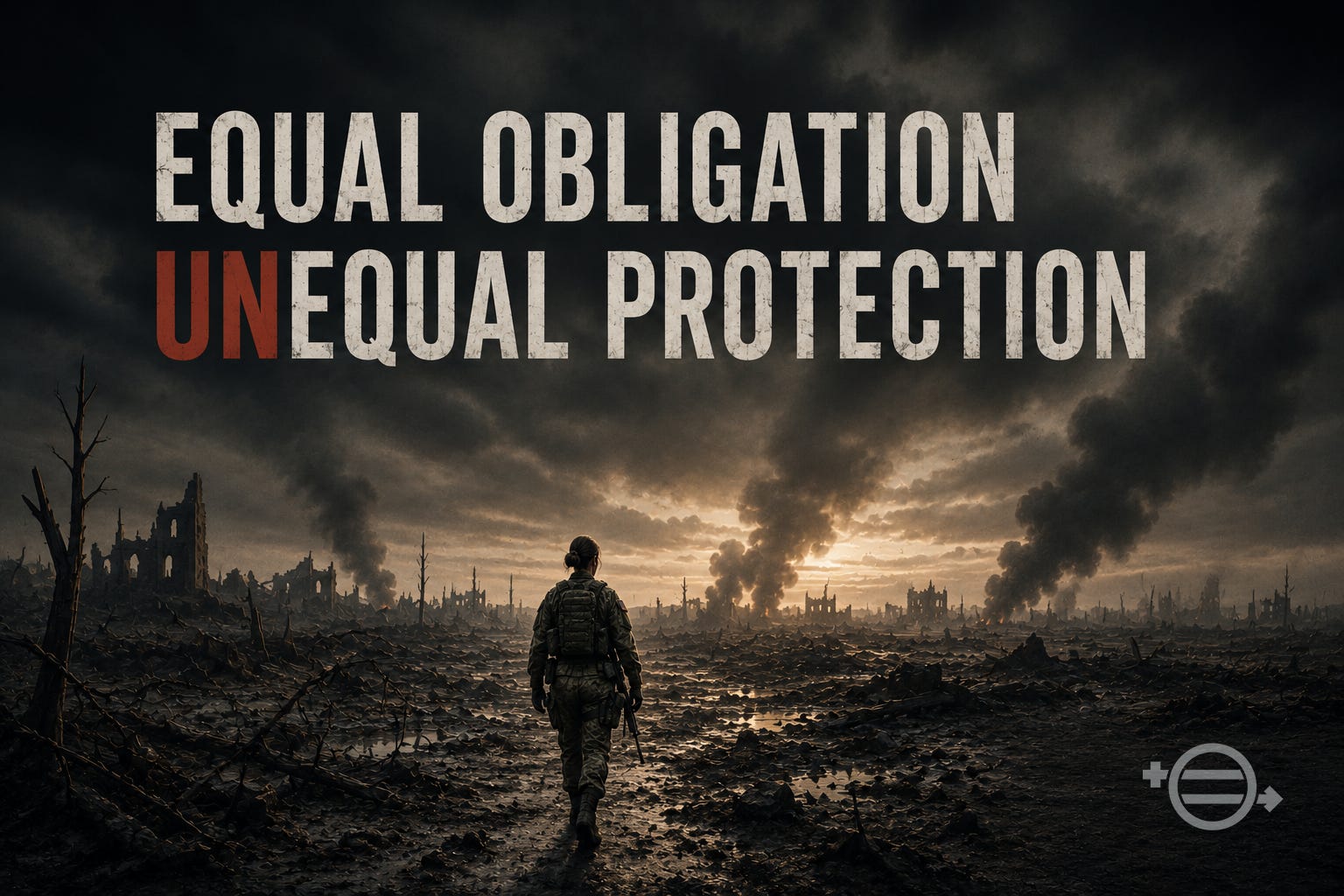
There is no such thing as partial equality.
That statement sounds self-evident. Yet much of modern American life depends on pretending otherwise.
We understand that freedom is not a matter of degree. A person cannot be partially free. We understand that personhood is not a matter of degree. No one is more human than someone else.
And equality is no different.
People are either equal under the law or they are not.
Yet when the subject turns to women, Americans routinely accept a contradiction that would be unacceptable almost anywhere else. We celebrate women’s achievements, point to women’s progress, and insist that equality has been achieved, while continuing to tolerate legal and constitutional structures that treat women differently.
Women serve in combat. They command military units, lead major corporations, hold elected office, serve as judges, and occupy positions of leadership throughout American life.
These facts are often presented as proof that the debate is over.
They are not.
Because progress is not equality.
Representation is not equality.
Opportunity is not equality.
Equality is equality.
The question is not whether women have advanced.
The question is whether equal means equal.
Today, women sit on the Supreme Court bench, yet discrimination against women is still afforded less constitutional protection than discrimination based on race.
That contradiction lies at the heart of a series of cases now moving through the federal courts and toward possible review by the Supreme Court, including EQUAL MEANS EQUAL v Trump. It was also at the center of a gathering held last week in Chicago, where women veterans, constitutional advocates, attorneys, and community leaders came together to discuss a question the nation has avoided for generations:
What does it mean for a country to demand equal obligation — including the ultimate sacrifice — from women while continuing to treat equality itself as conditional?
Americans often talk about women’s equality as though it were an accomplished fact.
Compared to previous generations, the progress is undeniable.
But progress and equality are not the same thing.
Progress describes movement.
Equality describes a condition.
A society either treats people as equal under the law or it does not.
For decades, Americans have largely substituted evidence of women’s advancement for evidence of women’s equality. The result is a peculiar form of civic confusion. Men frequently say that women are already equal. What more do they want? Show me the laws that treat you unequally.
But that is the wrong question.
The issue is not whether a law appears neutral on paper.
The issue is whether women receive equal protection when those laws are applied, interpreted, and enforced.
Too often, they do not.
So while women are frequently told that equality has already been achieved, their lived experience tells a different story.
The reason is simple.
The Constitution itself continues to distinguish between different forms of discrimination.
And that distinction matters.
Not because it is symbolic.
Because it determines which forms of discrimination the Constitution treats as most serious—and which it does not.
At the Chicago event, one of the clearest explanations of this contradiction came from former U.S. Navy Pilot, EQUAL MEANS EQUAL Attorney, and Assistant Dean of Public Interest at Northwestern Pritzker School of Law, Leah Gould.
Watch Leah Gould’s remarks on constitutional equality, military service, and why women are being asked to accept equal obligations under conditions of unequal protection:
Before becoming a lawyer, Gould served as a military officer. Reflecting on her military experience, she explained that equality is not an abstract concept inside the armed forces.
“It is something we live every day,” she said. “It’s embedded in how decisions are made and how performance is judged and in whether people are given the same opportunities to succeed.”
Yet Gould observed that for many women in the military, equality has often meant meeting the same standard while being asked to prove themselves twice simply because they are women. It has meant navigating systems that were never designed with women in mind and recognizing that even when the rules appear neutral, the outcomes are not always equal. That observation reaches beyond military service.
It reaches into constitutional law itself.
When the government discriminates on the basis of race, courts apply strict scrutiny—the highest level of constitutional review. The government must demonstrate a compelling reason for the discrimination, and courts examine those claims with deep skepticism.
When discrimination is based on sex, however, courts can apply a lower standard known as intermediate scrutiny.
This is one of the most consequential distinctions in American constitutional law and it is precisely where equal becomes unequal.
Levels of scrutiny determine how rigorously courts examine discrimination. They determine how difficult it is for government to justify unequal treatment. They determine which forms of discrimination the Constitution treats as most serious.
Gould described this framework as a “hierarchy of equality.”
As Gould explained, intermediate scrutiny “allows for more room for assumptions, for generalizations, and for differences that would not survive if they were based on race.”
The distinction, she noted, is not merely procedural. “It reflects a hierarchy of equality. It sends a message about how seriously the law treats sex-based inequality.”
The phrase is powerful because it reveals the contradiction embedded within it.
A hierarchy of equality is not equality.
It is a ranking system.
A hierarchy of rights.
A hierarchy of constitutional concern.
A hierarchy of whose injuries matter most.
But equality itself does not come in tiers.
Either people are equal or they are not.
Either equal protection means equal protection or it does not.
The legal distinction between race discrimination and sex discrimination did not emerge because discrimination against women causes less harm.
If anything, the opposite is true.
The scale of discrimination and violence directed at women because they are women exceeds virtually every other category of discrimination on earth. Across nations, cultures, religions, races, and political systems, women continue to experience unequal treatment, sexual violence, economic discrimination, forced marriage, trafficking, denial of education, political exclusion, and state-sanctioned inequality across every continent, every era, and virtually every system of human governance.
Women are not a racial group, a political party, or a religious minority. They comprise half of humanity and exist within every race, nation, religion, and social class.
Yet discrimination against women continues to receive less constitutional protection.
This unequal standard of review emerged because historical assumptions and cultural biases about women became embedded in law and then normalized over time.
What begins as precedent eventually comes to masquerade as principle.
And that is where we find ourselves today.
For decades, debates about women’s equality have often been framed around hypotheticals.
What if women had to serve?
What if women had to fight?
What if women had to die?
Those questions once carried political force because women were largely excluded from combat roles.
The hypothetical is over.
Retired Army Lieutenant Colonel and former Nevada State Senator Pat Spearman addressed this reality directly during the Chicago gathering.
Spearman’s remarks are significant because they expose the growing gap between public debate and lived reality.
The nation continues to argue about whether women can shoulder the obligations of citizenship while they have already been shouldering them for years.
Women have deployed.
Women have served in combat.
Women have endured sexual harassment and sexual assault while serving.
Women have been wounded.
Women have been killed.
As Spearman observed, women do not need to prove they belong.
They already have.
The unresolved question is not whether women are capable of service.
Gould described the current moment as “a confrontation between two realities.” On the one hand, government increasingly signals its willingness to impose equal obligations on women through draft registration and military service. On the other hand, the legal system continues to evaluate discrimination against women under a lower constitutional standard.
The result, she argued, is a profound contradiction.
“We are asked to accept equal obligation under conditions of unequal protection.”
If the government intends to impose “the highest level of civic obligation” — including the possibility of service, injury, or death — then it must also be prepared to meet “the highest standard” when it justifies unequal treatment under the law.
“Anything less,” Gould concluded, “is a form of second-class citizenship.”
That is the contradiction at the heart of these cases.
The consequences of constitutional inequality do not end when military service ends.
Throughout the Chicago gathering, speakers repeatedly returned to a common theme: invisibility.
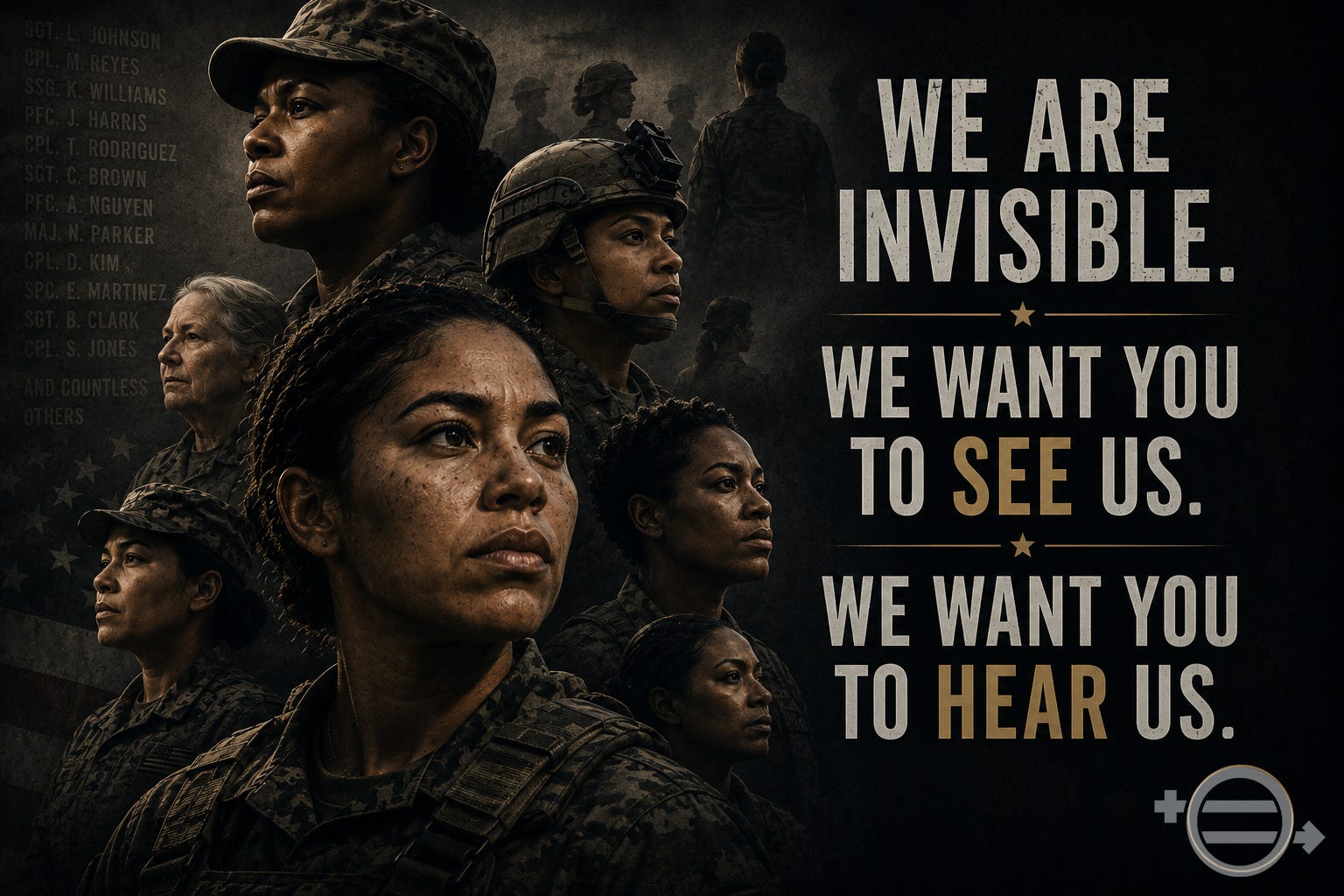
Dr. Renee Dickerson spoke about women veterans who continue to disappear from public awareness despite their service.
“We are invisible,” she said. “Well, we want you to see us. We want you to hear us.”
She also described the reality faced by women who excel in leadership positions only to lose opportunities because of their sex and race, calling it “an insult to the nation.”
Her comments highlight an important point.
Constitutional inequality is not merely a legal doctrine.
It shapes institutions.
It shapes expectations.
It shapes whose experiences are recognized and whose are ignored.
Rochelle Crump and Dr. Pamela Wilson similarly emphasized the responsibility women veterans often bear to preserve their own history, tell their own stories, and advocate for their own needs.
The message was unmistakable.
Women are repeatedly asked to justify their presence in institutions they have already helped build.
They are repeatedly asked to prove their value after they have already demonstrated it.
And they are repeatedly asked to wait for recognition that should have been automatic.
The Supreme Court has encountered this kind of contradiction before.
After the Civil War, the nation abolished slavery but left systems of racial hierarchy largely intact.
Later, courts upheld segregation under the fiction that separate could somehow be equal.
Precedent protected those arrangements.
Precedent justified them.
Precedent normalized them.
Eventually the Court was forced to confront a reality it could no longer ignore.
Separate was not equal.
The principle had always been false.
The Court simply took decades to admit it.
Today’s debate over women’s equality presents a different set of facts but a similar challenge.
The Supreme Court’s 1981 decision in Rostker v. Goldberg rested heavily on the fact that women were excluded from combat roles.
That factual foundation no longer exists.
Women have served in combat since 2015.
Women have already demonstrated their willingness to bear the same risks and responsibilities once used to justify their exclusion.
Yet the legal framework built on those assumptions remains.
The Constitution has been treated as though it already answers a question it has never actually resolved.
The Court is not being asked to invent a new reality.
It is being asked to acknowledge the reality that already exists.
As Gould asked during her remarks:
“What does it mean to be equal in a system that does not treat your equality as fundamental?”
That question now hangs over every military-service case moving through the courts.
And increasingly, it hangs over the Constitution itself.
Every generation inherits a contradiction.
Some inherit slavery.
Some inherit segregation.
Ours has inherited the persistent insistence that women are equal while preserving legal structures built on the assumption that they are not.
Our government today continues to treat discrimination against women differently than discrimination against other groups and that must change.
That contradiction has survived because it has been softened, normalized, and obscured.
Women have been told that progress is equality.
Men have been told that equality for women already exists.
And both have been encouraged to ignore the growing gap between what America says and what America does.
But reality has a way of exposing contradictions.
Near the conclusion of her remarks, Gould observed that the cases now moving through the courts are forcing a question that has been left unresolved for far too long: whether equality under the Constitution is full or partial.
“The answer to that question,” she said, “will depend in part on whether the Supreme Court hears the full reality of what inequality looks like and what it costs.”
Women are already serving.
Women are already sacrificing.
Women are already dying.
The obligations of citizenship have arrived.
The question now is whether equality will arrive with them.
Because equality is not conditional.
It is not hierarchical.
It is not partial.
People are either equal under the law or they are not.
And until this country is willing to confront that fact honestly, it will continue demanding equal sacrifice from women while denying them equal constitutional protection.
The Supreme Court may choose not to hear Valame.
It has already declined to hear National Coalition for Men.
It denied EQUAL MEANS EQUAL’s extraordinary writ.
And it may continue finding procedural reasons to avoid confronting the constitutional contradiction at the center of these cases.
But avoiding a question is not the same thing as answering it.
The factual assumptions underlying Rostker v. Goldberg no longer exist.
Does equal mean equal, or does it not?
EQUAL MEANS EQUAL has no intention of allowing that question to disappear.
If the Court declines to address it in one case, we will continue raising it in another.
If the Court refuses to confront it through Valame, we will continue pursuing it through EQUAL MEANS EQUAL v. Trump and through every available avenue of review.
Because the issue is not going away.
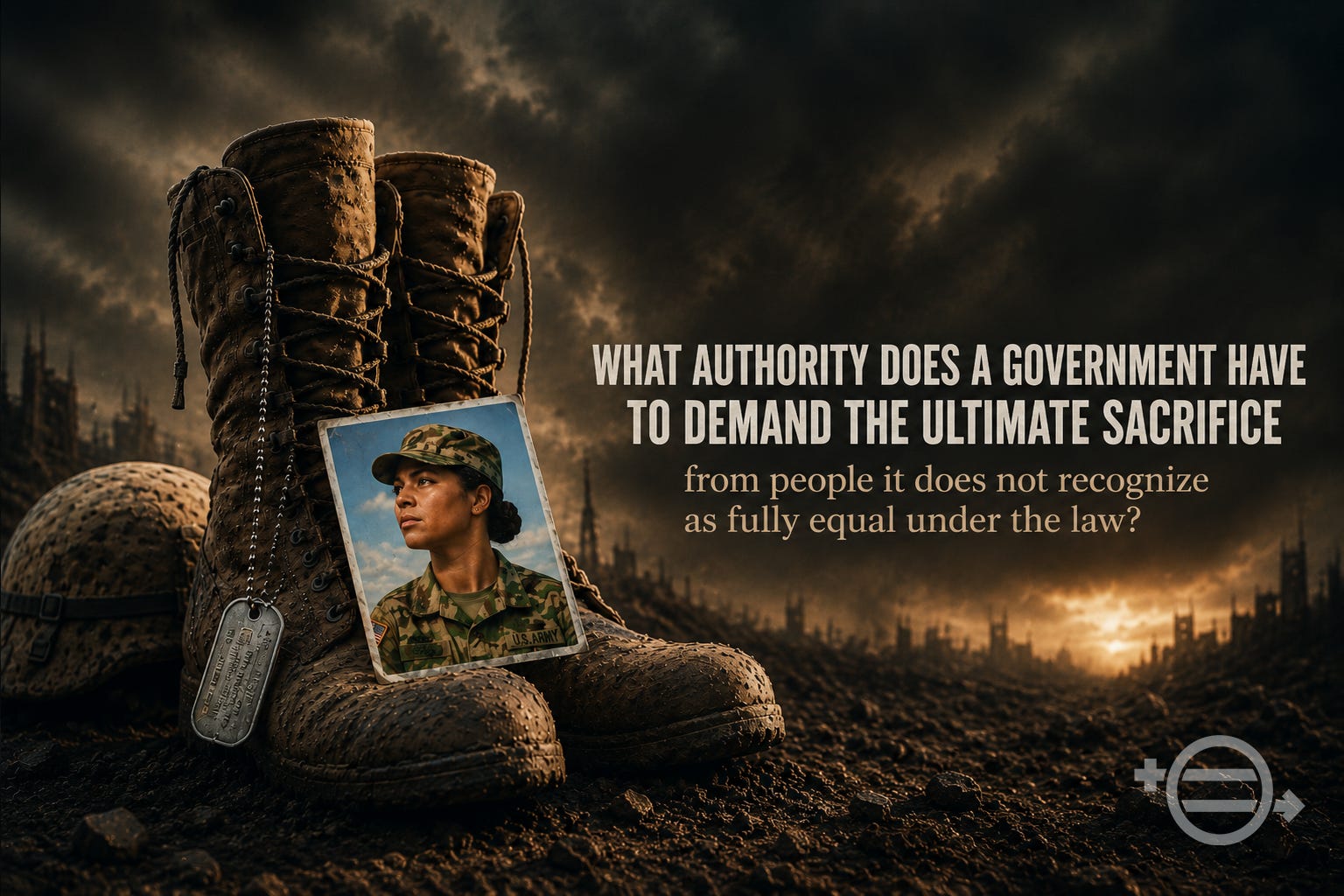
The question before the nation is no longer whether women are capable of service. Women have answered that question repeatedly through their actions.
The question is whether a government that increasingly claims the authority to compel women to fight, suffer, and die in service to their country can continue treating discrimination against women as a lesser constitutional concern.
That is the question moving through the courts.
It is the question underlying Rostker.
It is the question confronting the Supreme Court.
And sooner or later, it is a question this country will have to answer.
ADDITIONAL RESOURCES
For readers interested in exploring these issues further:
· Pat Spearman’s powerful full remarks from Women Veterans Day
· Women Veterans Day Chicago Webinar
· Additional interviews with women veterans
No posts
Comments
Nothing yet. Say the first thing.
Sign in to join the conversation.