
Women are asked to serve, fight, kill and die for the United States of America while the Constitution they swear to defend still does not expressly guarantee their equality.
That contradiction is not theoretical. It lives in the law. It lives in our courts. And perhaps nowhere are its consequences more brutally exposed than in the treatment of women inside the United States military.
EQUAL MEANS EQUAL has just filed its appeal in the United States Court of Appeals for the First Circuit, asking the federal courts to confront women’s constitutional status directly. We argue that the Equal Rights Amendment was validly ratified and is enforceable, and that continued application of intermediate scrutiny to sex-based classifications denies women the rigorous constitutional protection afforded to other forms of discrimination.
Intermediate scrutiny is not an abstract law-school concept when you live in a society in which discrimination against women is routine.
Under intermediate scrutiny, government may discriminate on the basis of sex if it convinces a court that the discrimination is “substantially related to an important governmental objective.”
That may sound rigorous to a layperson. It isn’t.
“Substantially related” is not a measurable quantity. “Important” is not an objective threshold. Those words leave enormous room for judgment and discretion: government offers a justification for treating women differently, and judges decide whether that justification is important enough and whether the discrimination is sufficiently related to it.
Strict scrutiny starts from a much harder place. Government must show that discrimination serves a compelling interest and that what it is doing is narrowly tailored to achieve that interest. Intermediate scrutiny gives government more latitude when the discrimination is based on sex.
And that distinction exists inside a culture in which women’s unequal treatment is so ordinary that we often cease to recognize it as discrimination at all.
Women learn to calculate where they walk, where they park, what they wear, how they speak, how forcefully they can exercise authority, whether reporting a superior will destroy a career,
whether a police officer will believe them, whether a prosecutor will prosecute, whether an employer will retaliate, whether a judge will understand.
None of that means intermediate scrutiny causes sexual violence. It means the law’s willingness to tolerate more government discrimination against women exists within the same society that has historically tolerated women’s subordinate status everywhere else.
The military concentrates that contradiction.
Women are expected to serve, obey lawful orders, deploy, lead, fight and die. Yet the constitutional system under which they serve still subjects sex discrimination to a lesser standard of review.
Alongside our appeal stands an extraordinary amicus coalition. Forty-nine amici have joined a brief supporting the fight for women’s full constitutional equality. At the forefront are organizations whose members know intimately what it means for women to serve this country: National Women Veterans United, the International Association of Military Women of Color, Service Women’s Action Network, and Victory Place.
They are joined by dozens of organizations spanning the women’s movement and civil society — from the National Women’s Political Caucus to national, state and local equality organizations — standing with military women to say:
No more.
What makes the military women’s participation particularly important is not simply that they have served. It is that military service places women under extraordinary government authority while simultaneously restricting freedoms and remedies civilians take for granted. The institution can control where they live, where they go, what orders they obey, their evaluations, their promotions and enormous portions of their daily lives. And when they are harmed inside that structure, the law itself can limit where they may turn for redress.
If you want to understand why full constitutional equality matters, listen to the women who have served.
On August 17, while preparing to testify before the Nevada Legislature about military sexual trauma, former Nevada State Senator Pat Spearman told us a horror story I cannot get out of my mind.
Staff Sergeant Maureen F. Burns served in both the United States Army and Air Force, beginning her military service in 1979. At 19 years old, she became the youngest drill sergeant in the country — a distinction she still holds.
She was the only woman among the drill sergeants. The three senior drill sergeants who supervised her decided that she “needed to be brought down a peg.”
On June 12, 1980, while stationed at Fort Jackson, South Carolina, they abducted her, beat her and gang-raped Maureen for four hours. These were men who were her supervisors and whom, as she told Nevada legislators, she “should have been able to trust.”
When Maureen reported what they had done, she was not believed. The three men protected one another. She was left to carry the consequences alone.
The physical consequences were catastrophic: cracked ribs, a radical hysterectomy that left her unable to bear children, removal of her gallbladder, sexually transmitted hepatitis C and pelvic inflammatory disease.
And those were just the physical injuries.
It is the psychological damage that persists more than four decades later. Maureen has lived with complex post-traumatic stress disorder, shame, stigma and the emotional pain of not being believed.
But that was not the end of what the institution did to her.
Maureen was labeled bipolar and placed on lithium in toxic amounts for two decades. She says the medication caused diabetes and kidney failure. Decades later, three independent psychiatrists reevaluated her and concluded that she had been misdiagnosed: she was not bipolar. She had PTSD and moral injury. The VA apologized.
Maureen is now 66 years old, suffering from stage four kidney disease and congestive heart failure, and receiving hospice care.
She told the Nevada Legislature:
“I took an oath to fight all enemies, foreign and domestic, and I did fight that night.” She fought three combat-trained soldiers. She survived.
But, as Maureen said:
“I was gravely wounded, both physically and morally.”
At the conclusion of her testimony, Maureen made a remarkable request.
When soldiers fight for their country and are wounded by an enemy, she said, their courage and sacrifice are often recognized with a medal. She fought fellow service members — men who were supposed to serve beside her and protect her — and received no recognition for the wounds she suffered.
Now, as she is dying, she has asked for an honorary Purple Heart to be presented posthumously to her family.
She wants them to have it as lasting recognition of the truth.
Then she ended:
“I served my country. I honored my oath. I fought for my life. I was gravely wounded. And I was a brave soldier.”
What happened to Maureen exposes exactly why EQUAL MEANS EQUAL’s fight cannot stop with individual statutes, programs or promises of reform. When women enter an institution operated by the federal government, the legal structure surrounding them matters — not only when they are serving, but when that institution fails them.
And in the military, one Supreme Court doctrine has closed the courthouse door on servicemembers for more than seventy-five years.
In 1950, the Supreme Court decided Feres v. United States. Here is the simple version.
Congress had passed a law allowing ordinary people, under certain circumstances, to sue the federal government when federal employees wrongfully injured them.
Congress listed exceptions.
Then the Supreme Court created another one.
The Court ruled that servicemembers generally could not sue the government for injuries arising from activity “incident to service.”
That became known as the Feres doctrine.
In practice, Feres can mean that someone injured by government wrongdoing may have access to a federal courthouse, while a servicemember can be turned away because the injury happened in connection with military service.
Eventually the federal courts were forced to confront an almost obscene question:
Is being raped by another member of the United States military “incident to military service”?
The answer depends, astonishingly, on which federal court is answering.
In Doe v. Hagenbeck, a former West Point cadet alleged that another cadet raped her after she had taken a prescribed sedative. She alleged something larger as well: that senior West Point officials had fostered a sexually aggressive culture that discriminated against female cadets and placed them at risk of violence.
The Second Circuit barred her constitutional claims under the military-immunity principles stemming from Feres. When the Supreme Court later declined to take her case, Justice Clarence Thomas noted that she could have brought comparable claims had she been a civilian.
Then came Spletstoser v. Hyten.
Army Colonel Kathryn Spletstoser alleged that Air Force General John Hyten sexually assaulted her in her hotel room while they were attending a civilian conference in California. Hyten denied the allegations, and a military investigation did not substantiate them.
When the government sought dismissal under Feres, however, the United States Court of Appeals for the Ninth Circuit refused.
The Ninth Circuit emphasized that sexual assault is a grievous violation of bodily integrity and serves no conceivable military purpose. Spletstoser alleged that she was in her private hotel room preparing for bed, not performing a military mission. The court said it “cannot fathom” how the alleged sexual assault could be considered incident to military service.
Think about that.
One federal appellate court barred a woman’s claim arising from military sexual violence.
Another federal appellate court confronted sexual assault and essentially said: How could rape possibly be part of military service?
Same country. Same federal legal system. Same Supreme Court doctrine. Different courthouse.
Different answer.
And the Supreme Court knows it.
The Supreme Court has repeatedly been asked to reconsider Feres. It has repeatedly declined. The most revealing recent example is Beck v. United States.
The case arose after Air Force Staff Sergeant Cameron Beck was killed when a civilian government employee driving a government vehicle struck his motorcycle. His family asked the Supreme Court to reconsider or limit Feres.
In November 2025, the Court declined to hear the case. But what happened around that denial matters.
Justice Neil Gorsuch said he would have granted review.
Justice Clarence Thomas dissented and argued that the Court should confront a doctrine he believes has no foundation in the text Congress actually enacted.
Justice Sonia Sotomayor — approaching the issue from a very different jurisprudential perspective — wrote separately. She did not believe the Court should intervene at that moment, in part because Congress had begun addressing some of the problems created by Feres. Yet she nevertheless called Feres “a difficult decision to justify” and acknowledged its “near- universal criticism.”
The dispute is not ideological.
Judges across the spectrum recognize that there is a problem. Federal courts cannot even agree on where Feres ends. Servicemembers and their families have been denied judicial remedies because of it. And federal appellate courts have reached profoundly different answers when sexual violence collides with military immunity.
And yet Feres still stands.
If that sounds familiar, it should.
EQUAL MEANS EQUAL has encountered another version of this problem in our own constitutional equality litigation.
In Rostker v. Goldberg, decided in 1981, the Supreme Court upheld male-only Selective Service registration.
The decision arose from a military structure that no longer exists.
At the time, women were categorically excluded from combat positions. The Supreme Court relied heavily upon that exclusion in concluding that men and women were not similarly situated for purposes of a draft intended principally to produce combat troops.
Women have since been integrated into combat roles.
The factual foundation beneath Rostker has changed profoundly.
The Supreme Court itself acknowledged that changed reality in 2021, when it declined to hear another challenge to male-only registration. Justice Sonia Sotomayor, joined by Justices Stephen Breyer and Brett Kavanaugh, noted that women’s role in the military had changed dramatically since Rostker, including the elimination of the combat restrictions on which the decision relied. Yet the Court declined to revisit the precedent while Congress was considering the issue.
Congress did not resolve the underlying constitutional inequality.
And Rostker remained.
That is precisely the bind lower courts face: they cannot simply declare a Supreme Court precedent obsolete because the factual world that produced it has disappeared. Only the Supreme Court can overrule its own precedent.
We confronted that reality directly in EQUAL MEANS EQUAL’s case.
In April, U.S. District Judge William G. Young recognized that Rostker rested heavily on the combat exclusion that existed when it was decided and acknowledged that those circumstances have changed. Nevertheless, because Rostker remains Supreme Court precedent, he held that it foreclosed our plaintiff’s Equal Protection claim.
The problem can be visible. The factual premise can be gone. Judges can acknowledge the contradiction.
And the precedent can still control. That is true of Rostker.
In a different way, it is true of Feres.
And this is why litigation matters. Someone has to bring the question back before the courts. Someone has to create the vehicle through which obsolete and unjust precedents can finally be confronted. Someone has to keep pushing until the law catches up with the lives being governed by it.
Maureen’s story is far from an aberration.
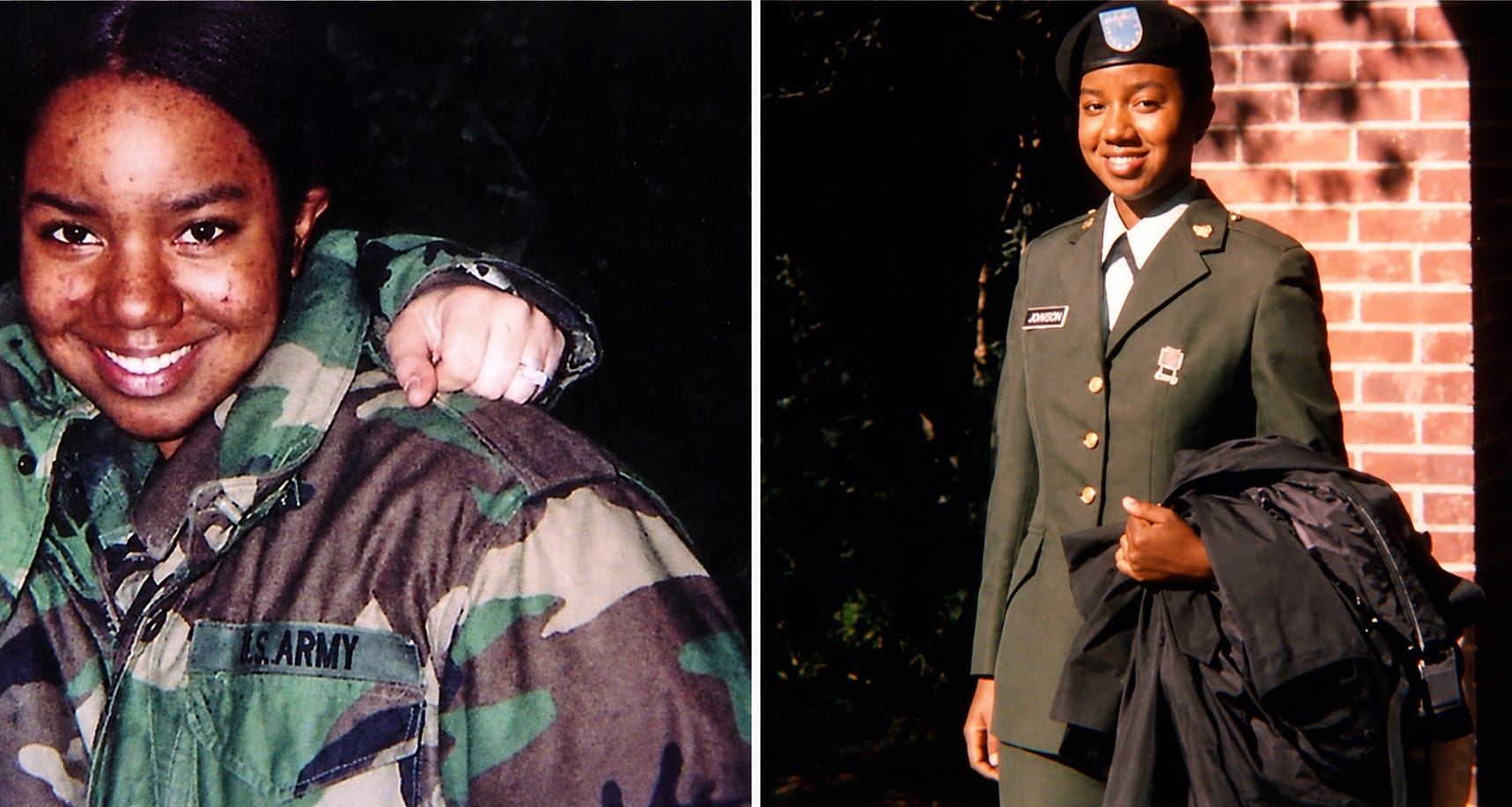
Years ago, while making my documentary Equal Means Equal, I learned about the death of Army Private First Class Lavena Johnson.
Lavena was 19 years old when she died while serving in Iraq in 2005.
The Army classified her death as a suicide.
What I learned about the condition of her body enraged and horrified me. Lavena had suffered injuries that included a broken nose, a black eye and loose teeth. Corrosive chemicals had been poured into her vagina. She had suffered a gunshot wound to the head. A burning substance had been used on her body, and a cement bench had been placed on top of her. Her family was initially prevented from seeing her body.
And with all of that staring them in the face, the military justice system still called Lavena Johnson’s death a suicide.
The details mattered to me then and they matter to me now. Sanitizing what happened makes it possible to look away.
I could not look away.
To this day, I have not been able to forget Lavena. Her story was one of the experiences that made the connection between violence against women and women’s legal inequality impossible for me to treat as an abstraction.
As I was investigating the treatment of women for Equal Means Equal, I interviewed journalist and Columbia University professor Helen Benedict, author of The Lonely Soldier, whose years of research into the experiences of women serving in Iraq exposed a reality that should have shocked the country.
Women Benedict interviewed described carrying knives in addition to their military weapons — not to protect themselves from the enemy, but from men on their own side. They described threats of rape from their “battle buddies,” the people who were supposed to watch their backs in war and whom they had been trained to see as brothers, fathers and family, but who were too often treating them as sexual prey.
And then Benedict told me the numbers.
When I interviewed Benedict in 2013, she had found statistics in Department of Veterans Affairs databases indicating that approximately 30 percent of women reported being raped while serving — nearly one in three. As she continued researching and interviewing women, she said the figure continued to appear: roughly one in three sexually assaulted, if not raped. At the same time, Benedict said the Department of Defense estimated that approximately 85 percent of sexual assaults were never reported.
Those figures should stop us cold.
They do not describe a few bad actors operating at the margins of an otherwise functioning system. They describe sexual violence affecting an enormous proportion of the women who serve, within an environment in which the overwhelming majority of assaults were never formally reported at all.
And rape is only the extreme end of the continuum. Sexual harassment, degradation, intimidation, coercion, retaliation and the constant negotiation of male power do not suddenly begin when conduct crosses the legal threshold into criminal sexual assault.
Pat Spearman told the Nevada Legislature something that struck me precisely because of how ordinary she made it sound after almost 30 years in the Army:
“I don’t know that I have met one woman veteran who has not experienced some type of unwanted sexual advances.”
When I asked Helen Benedict what caused what she called the rape epidemic in the military, she did not give me a comfortable answer.
She said:
“It’s partly that the military is a violent organization.”
Its purpose, she explained, includes teaching people to kill. Under lawful circumstances in war, killing is permitted; rape is not. But that produces what Benedict called an inherent contradiction because:
“rape is an act of violence, not of sex.”
Maureen’s story makes that distinction visceral. What three senior drill sergeants did to a 19- year-old woman subordinate to them was not an expression of sexual desire. It was an exercise of domination through violence.
The rape was the means.
The subordination was the message.
Of course, servicemembers are not supposed to direct violence against their own side. Rape violates everything the military is supposed to teach about camaraderie, trust, family and protecting one another in battle.
But the extraordinarily high rates of sexual violence against military women do not arise in a vacuum. The military takes power inequalities that already exist between men and women and places them inside an institution historically dominated by men, organized around hierarchy, obedience and command, steeped in traditions of hypermasculinity, and specifically designed to train human beings to employ violence.
Those conditions can exacerbate the power imbalance women already confront outside the military.
Benedict described what she called a “rape culture in the military,” partly fostered by military culture itself and partly inherited from the larger society. When I asked her what she meant by rape culture, she described a culture in which women are treated as “less than human” and “as sexual prey” rather than “respected equals.” She was careful to say that this message does not reach all men and that this is not a matter of men versus women. But, she said, there remains a profound cultural problem of women being portrayed as sexual prey and men being taught to regard women as available for the taking.
The fundamental contradiction is chilling: servicemembers are trained to trust one another with their lives, to protect one another in battle and to function as a military family, yet some of the women Benedict interviewed were arming themselves against the very men who were supposed to have their backs.
Military sexual violence is brutal. What happens afterward can be brutal too: disbelief, retaliation, destroyed careers, institutional self-protection, inadequate justice, and survivors forced to fight the institution they served while simultaneously trying to survive what was done to them.
Helen Benedict’s statistic — that an estimated 85 percent of military sexual assaults were not reported — raises an obvious question.
Why? The women who testified in Nevada answered it.
Pat Spearman described being a captain in Panama in 1986 when a full colonel summoned her to his office. She assumed he wanted to discuss her mission.
Instead, he began masturbating under his desk.
He told her he wanted to “bang her bones.” While sexually exposing himself to her, he told her that he knew she wanted to be on the fast track and that he could be very helpful to her career.
Pat understood the other half of that message perfectly well: he could destroy it too.
Several days later, the same man appeared outside her hotel room in civilian clothes and remained there for hours. A housekeeper eventually took Pat down a service elevator and let her escape through the loading dock.
Pat went to friends and told them what had happened. The wife assumed she would report him.
Pat said no.
The husband understood why:
“If she reports it, her career is over.”
Pat didn’t report him. Not in 1986.
She testified that she told no one until 2000, after she had her twenty years in and had been promoted to colonel.
But Pat did something else during those intervening years. She watched for the predators. When she saw one paying attention to a younger woman, she tried to get close to that woman and make sure she knew there was someone safe she could talk to.
“I never should have had to do that,” Pat told the legislators.
Sergeant First Class Dixie Thompson, U.S. Army retired and a former military policewoman, gave the committee another answer.
Dixie enlisted in the Women’s Army Corps in 1973. She testified that women reporting sexual assault or harassment were more likely to find themselves discharged, while sexual assaults were rarely prosecuted. She said women could be blamed, court-martialed or otherwise punished for reporting.
As a military policewoman, Dixie encountered many women who had been sexually assaulted. And sometimes, she told the committee:
“the best advice I could give them was to not report it.”
Think about what that means.
A military policewoman — a person inside the institution theoretically responsible for law, order and protection — concluded that the safest advice she could give a woman who had been sexually assaulted was not to tell the institution what had happened to her.
That is not merely underreporting.
That is a system teaching women that silence may be safer than justice.
And then comes the terrible irony: decades later, when those same women seek treatment, disability benefits or recognition of the injuries they carry, the absence of a contemporaneous report can become evidence against them.
The silence that helped a woman survive the institution can later be used to deny her help.
Dixie herself has never sought benefits for the military sexual trauma she experienced. As she told me:
“I have never applied for benefits for MST under PTSD guidelines, as living through it once was more than enough.”
Dr. Renee Dickerson gave the Nevada committee a name for what happens next. The assault is the original trauma.
But when the institution minimizes what happened, questions the survivor, fails to protect her, retaliates against her, damages her career or leaves the alleged offender in place while she is isolated or pushed out, the survivor can experience what Renee called a “second injury”: institutional betrayal.
Renee described a pattern in which sexual assault or harassment occurs; some survivors report it, while most do not; reports may be minimized or questioned; the survivor becomes isolated; her career may suffer; her mental and emotional health deteriorates; and eventually the survivor herself becomes viewed as the problem.
Meanwhile, the alleged offender may remain in position. Sometimes the survivor leaves the military instead.
Renee made another point that helps explain why military sexual trauma cannot be treated as something that happened once, long ago, and is now over.
The body remembers.
Trauma can return through sights, sounds, smells, touch, anniversaries and reminders. Survivors may experience hypervigilance, panic, flashbacks, sleep disturbances, isolation, physical illness, difficulty maintaining relationships and profound distrust of institutions.
Maureen Burns is living proof that the consequences of what happens during a few hours can last an entire lifetime.
There is movement.
Senators Jeanne Shaheen and John Kennedy have introduced the bipartisan Military Sexual Trauma Accountability Act, S.4877, legislation intended to create a route for servicemembers to sue the United States for military sexual trauma.
That is significant.
It recognizes something survivors and advocates have been saying for years: military service should not strip a woman of meaningful legal recourse when she is sexually assaulted.
We need the Military Sexual Trauma Accountability Act. We need changes to military reporting, investigation and prosecution. We need protection from retaliation, veterans to receive the care and benefits they have earned, states to use their political power to demand action from Congress, and civil remedies that allow survivors to seek justice.
Every one of them exists downstream from a more fundamental question:
Are women equal under the supreme law of the United States?
Statutes can be amended or repealed. Regulations can be rewritten. Programs can be defunded. Enforcement priorities can change with an administration. Judicial doctrines can expand and contract. Even hard-won protections can be weakened by political winds.
A constitutional guarantee is different. It establishes the rule against which all government action must be measured. It does not ask each generation of women to persuade the government, program by program and statute by statute, that they deserve equal treatment.
It begins with equality as the governing command.
That is why constitutional equality is not one more reform on our list.
It is the foundation that makes every other protection less dependent upon discretion.
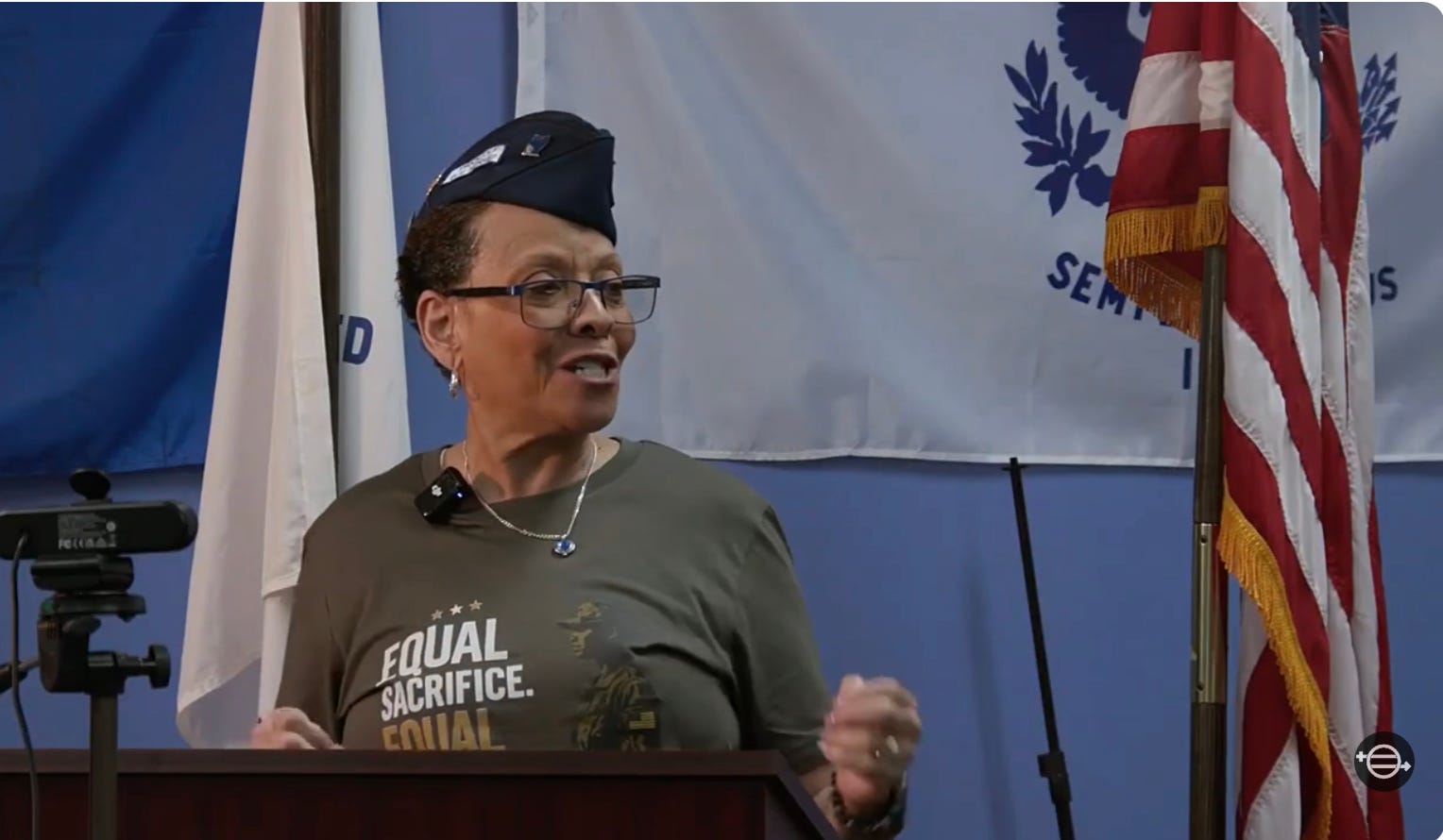
Nevada State Senator Patricia Spearman, U.S. Army Lieutenant Colonel (Ret.) speaking at Women Veterans Recognition Day 2026 in Chicago
Pat has served on both sides of this divide: as a soldier subject to the system and as a lawmaker trying to change it.
She served for almost three decades. She endured sexual harassment herself. She remained silent when she understood that speaking could destroy her military career, then spent years quietly trying to protect other women from the predators she had learned to recognize.
Later, as a Nevada State Senator, Pat led the successful effort to ratify the Equal Rights Amendment. In 2017, Nevada became the first state in nearly four decades to do so.
Speaking about that fight and her military service, Pat said:
“We are serving. We are being wounded. We are dying in combat. And yet we do not have equal rights.”
That sentence contains the contradiction this entire article is about. And, as Pat said in the same speech: Pat retired from the military, but she did not retire from the fight.
And that fight brought us together before the Nevada Legislature.
Pat asked Nevada to take another step.
She asked the Legislature to call upon Congress to recognize military sexual trauma as a presumptive condition, so survivors seeking care and benefits are not repeatedly forced to prove the legitimacy of trauma arising from what happened to them while serving their country.
I testified that military sexual trauma presents an overwhelming case for presumptive recognition precisely because trauma, fear, retaliation and military hierarchy can prevent survivors from creating the documentation that government later demands from them.
As I told the committee:
“We cannot punish women today for the silence our own institutions demanded of them yesterday.”
Pat testified.
Renee testified.
I testified.
Dixie testified.
And Maureen, from hospice care, told the Legislature what happened to her and asked that her country finally recognize that she was wounded while serving it.
Then something happened.
The presentation had not originally been attached to a recommendation in the committee’s work- session document.
The chairman stopped the proceedings and said that what the committee had just heard was nevertheless “an actionable agenda item.”
He recommended that the committee request the drafting of an official letter to Nevada’s congressional delegation urging federal legislative action to improve access to services for veterans affected by military sexual trauma, including consideration of MST as a presumptive condition for purposes of care and benefits.
A member moved to approve the recommendation. Another seconded it. There were no opposing votes recorded in the transcript.
The chair called the vote.
Nevada listened.
And Nevada acted.
That does not solve military sexual trauma. It does not undo what happened to Maureen, Lavena, Pat, Dixie or the countless women whose names we do not know. It does not overturn Feres. It does not enact federal legislation. It does not establish constitutional equality.
But it matters.
Because institutions do not change unless someone forces them to look directly at what they would rather not see.
Justice means more than teaching women how to avoid being raped. It means more than creating another training program, issuing another report or promising that the military takes sexual assault seriously.
It means accountability for perpetrators, protection from retaliation, independent and credible investigation, medical care, economic security, legal recourse and a system that does not make reporting the beginning of a second punishment.
It means recognizing the institutional betrayal that can compound the original trauma. It means opening courthouse doors that should never have been closed. It means refusing to accept a legal regime in which whether a servicewoman can seek redress for sexual assault may depend upon which federal circuit hears her case.
It means Congress acting where judicial doctrine has denied survivors a remedy.
But justice cannot ultimately depend upon whether the right Congress is willing to grant this year remains politically popular the next.
That brings us back to where we began.
Every statute, regulation, military policy and government action concerning women operates inside a constitutional framework. If that framework begins from a lesser standard of protection for sex discrimination, women must repeatedly fight government discrimination from within that lesser framework.
The Equal Rights Amendment changes the premise. Full constitutional equality changes the premise.
Government begins not with a qualified permission to treat women differently, but with equality as the constitutional command.
Forty-nine amici have joined our brief. Military women and veterans stand at the forefront of that coalition. Our appeal is moving forward in the First Circuit. Congress is being pressed to dismantle Feres barriers to justice for military sexual-trauma survivors. And now Nevada’s legislative committee has voted to take its own demand for action to the state’s congressional delegation.
These are different fronts in the same fight over whose suffering the law recognizes, whose voice institutions hear, and whether women are finally entitled to stand before their government as equals.
Helen Benedict ended our conversation all those years ago with something extraordinarily simple. After decades of studying violence against women, interviewing women soldiers, writing
books and articles and testifying before Congress, she came back to the principle underneath all of it:
“Just let’s all be equal here.”
She told me that discussion of the Equal Rights Amendment could help bring that principle back. More than a decade later, we are still fighting to make it real. And now I keep thinking about Maureen. Nineteen years old.
A drill sergeant. Three supervisors. Four hours. A lifetime carrying the wounds.
And finally, at 66, speaking from hospice care before a state legislature and asking her country to recognize what happened to her as what it was: a grievous wound suffered while serving the United States of America.
Her words deserve the last word:
“I served my country. I honored my oath. I fought for my life. I was gravely wounded. And I was a brave soldier.”
No posts
Comments
Nothing yet. Say the first thing.
Sign in to join the conversation.