
Last week, the UK reported a record number of flu cases, as the “K” variant—which was likewise responsible for the record-breaking flu season during Australia’s winter—rapidly spreads. The outbreak in Europe comes after Japan declared a “flu epidemic” in October in response to a remarkable number of early cases. US states including New York, Louisiana, and Colorado have also reported a surge in cases, and spread is likely to accelerate with holiday travel.
While the trends in infections across countries are similar, however, countries’ responses vary in a critical way. Nearly every other country in the world has paid sick leave. The US still does not.
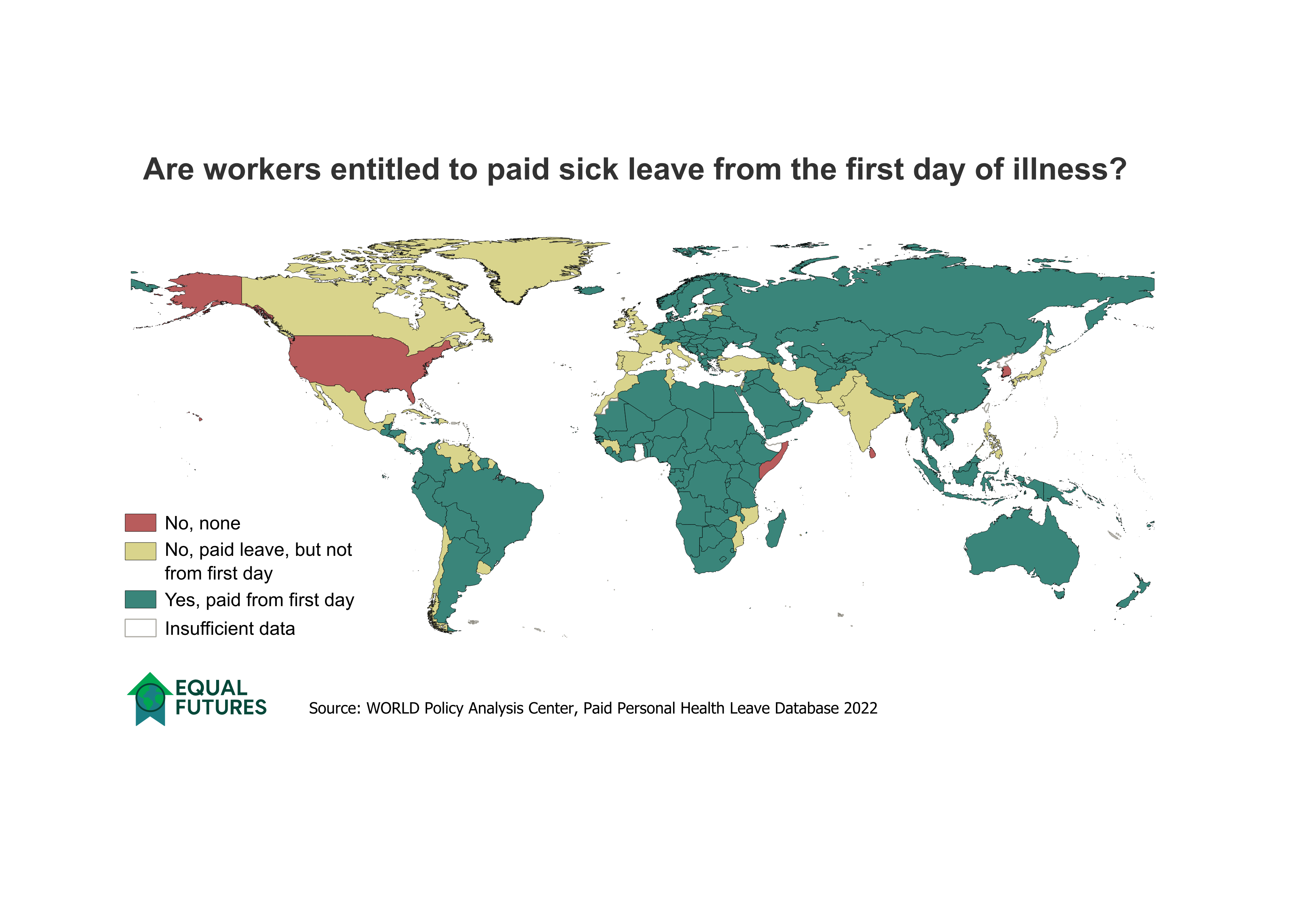
Today, Equal Futures is releasing a new policy brief–the second in our “Foundation of an Equal Future” series, looking at laws and policies that are fundamental to whether all people can thrive. Drawing on data from all 193 UN member states, we examine whether countries around the world took any steps to permanently improve their paid sick leave policies in the wake of COVID-19. We find modest progress on the duration, payment rate, and coverage of paid sick leave policies in a range of countries around the world. Other countries, however, seemed to have learned little from the pandemic–the US foremost among them.
On April 1, 2020, US workers became eligible to take two weeks of paid sick leave thanks to the Families First Coronavirus Response Act. Despite excluding millions of workers due to restrictions on eligibility linked to firm size and occupation, this represented a major expansion of the US social safety net–and one that undeniably saved lives. According to one analysis, in states where workers newly had access to sick leave as a result of the FFCRA, COVID cases dropped by 400 per day. Nevertheless, when the emergency sick leave provision expired at the end of 2020, Congress neglected to renew it. Over the following year, the US would report tens of millions more infections and nearly 450,000 COVID-related deaths.
While the worst of COVID is behind us, the unfolding flu season is a reminder of how essential paid sick leave is even in a typical year. Paid sick days not only make it possible for workers to stay home when they or their family members are sick–reducing spread by up to 11%—they also increase uptake of the flu vaccine. One study estimated that through its impacts on flu vaccines alone, universal paid sick leave in the US could reduce flu-related healthcare visits by 18,200 a year, while reducing absences from work by 63,800 days. Meanwhile, in the absence of universal paid sick leave, 27 million Americans have no paid sick days through their employers. The lowest-wage workers are worst off, and rates of coverage are especially low in the service sector, construction, and retail—all industries where women and people of color are overrepresented.
To be clear, simply enacting a paid sick leave policy is not sufficient to protect the health and economic security of all workers. For example, in some countries, workers have to take several days of unpaid leave before they qualify for sick leave—deterring uptake by those who need it and disproportionately harming low-wage workers. The payment levels for leave also shape whether it’s accessible by those with lower earnings or less savings to fall back on.
Another key issue is the scope of coverage. Excluding the self-employed, part-time workers, workers who recently changed jobs, or those who work for small businesses can drastically reduce the share of workers who are eligible, undermining the benefits for public health. These types of restrictions can also exacerbate underlying inequalities. For example, since more women than men work part-time–a gap that is shaped by restrictive gender norms around caregiving and the gender wage gap, among other factors–they are less likely to have access to leave when a minimum hour requirement is in place. This is also evident when it comes to unpaid leave in the US. The 1250-hour requirement of the Family and Medical Leave Act (FMLA) excludes nearly twice as many women as men.
Seasonal illnesses like the flu are inevitable–but the severity and inequity of their consequences are not. Enacting a universal paid sick leave policy that is affordable and accessible to all workers, while safeguarding other public health measures such as vaccinations, is a fundamental step toward better public health outcomes and more economically secure households. To date, 17 states and 18 cities and counties have passed paid leave, with advocates in some cases using globally comparative data to make the case. These are critical steps forward, but not enough to reach all workers across the country, especially in the context of preemption laws limiting local action. The US is long overdue in joining the rest of the world in making paid sick leave a national policy.
No posts
Comments
Nothing yet. Say the first thing.
Sign in to join the conversation.