
Equal rights are facing escalating threats across countries. In Georgia, parliament moved to erase all references to gender and gender identity from legislation, including laws banning gender-based violence and hate crimes. In Argentina, a presidential decree stripped non-citizens’ access to healthcare and higher education. In the UK, the Supreme Court ruled that “sex” means sex at birth, undermining protections against discrimination for transgender people. And in the US, where President Trump has repeatedly stated that immigrants should go “back to where they came from,” the violent escalation in immigration enforcement has been indisputably relying on racial profiling–with the backing of the Supreme Court.
Responding to these threats in the near term–through advocacy, organizing, litigation, and protest–is urgent. In the long-term, we also need to create the structures and protections to ensure that the current backsliding cannot happen again. One piece of the solution is strong guarantees for equal rights in countries’ foundational legal documents: their constitutions.
Today, Equal Futures is releasing a new policy brief that looks across the constitutions of all 193 member states to examine whether they take any approach to guaranteeing equal rights or prohibiting discrimination on the basis of sex and/or gender, race and/or ethnicity, language, citizenship status, foreign national origin, religion, socioeconomic status, disability, sexual orientation, and gender identity. We also look at trends over time, identifying how rights vary depending on how old constitutions are and whether the share of countries constitutionally protecting each of these rights has changed from 2014 to 2024.
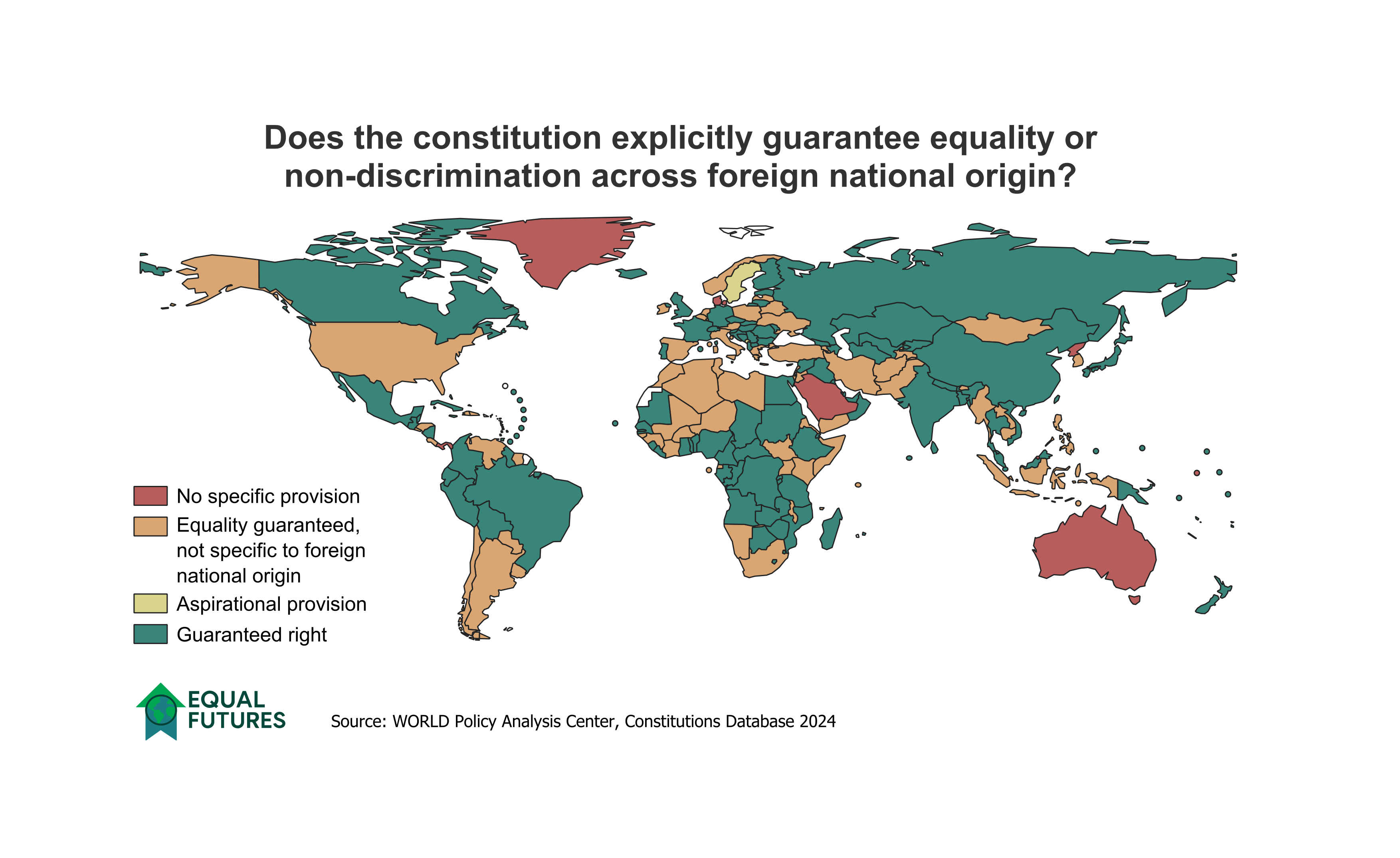
While we find that constitutions are getting stronger overall, progress has stalled in the last decade, and some of the biggest gaps are in areas where we’re seeing regression globally: the rights of immigrants, the rights of people with disabilities, and the rights of sexual and gender minorities. Just 22% of constitutions guarantee equal rights regardless of citizenship, while 59% do on the basis of national origin.
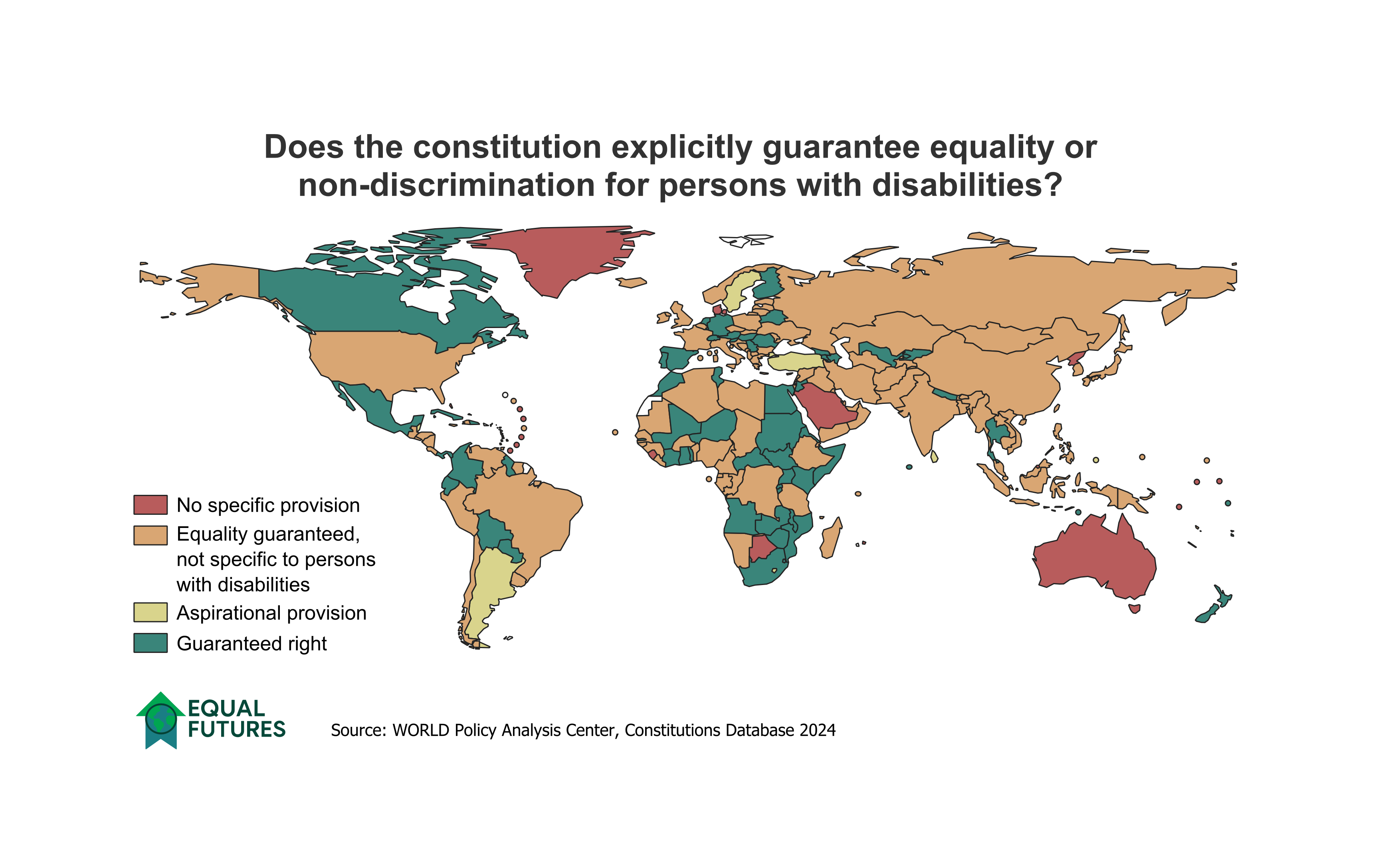
And although equal rights based on disability have increased substantially since the enactment of a global disability rights treaty in 2006, overall coverage remains low: just 32% have relevant provisions.
For the LGBTQ+ community, constitutions evidence both progress and backlash. As of 2024, 11 constitutions guarantee equal rights based on sexual orientation and 5 do for gender identity; all of these provisions were introduced since 1996. However, 32 constitutions have constitutionally banned same-sex marriage, allow legislation to ban it, or explicitly define marriage as between a man and a woman, all since 2000. Anti-LGBTQ constitutional amendments continued in 2025, with Slovakia becoming the latest country to ban same-sex adoptions and “recognize only two genders” through its constitution.
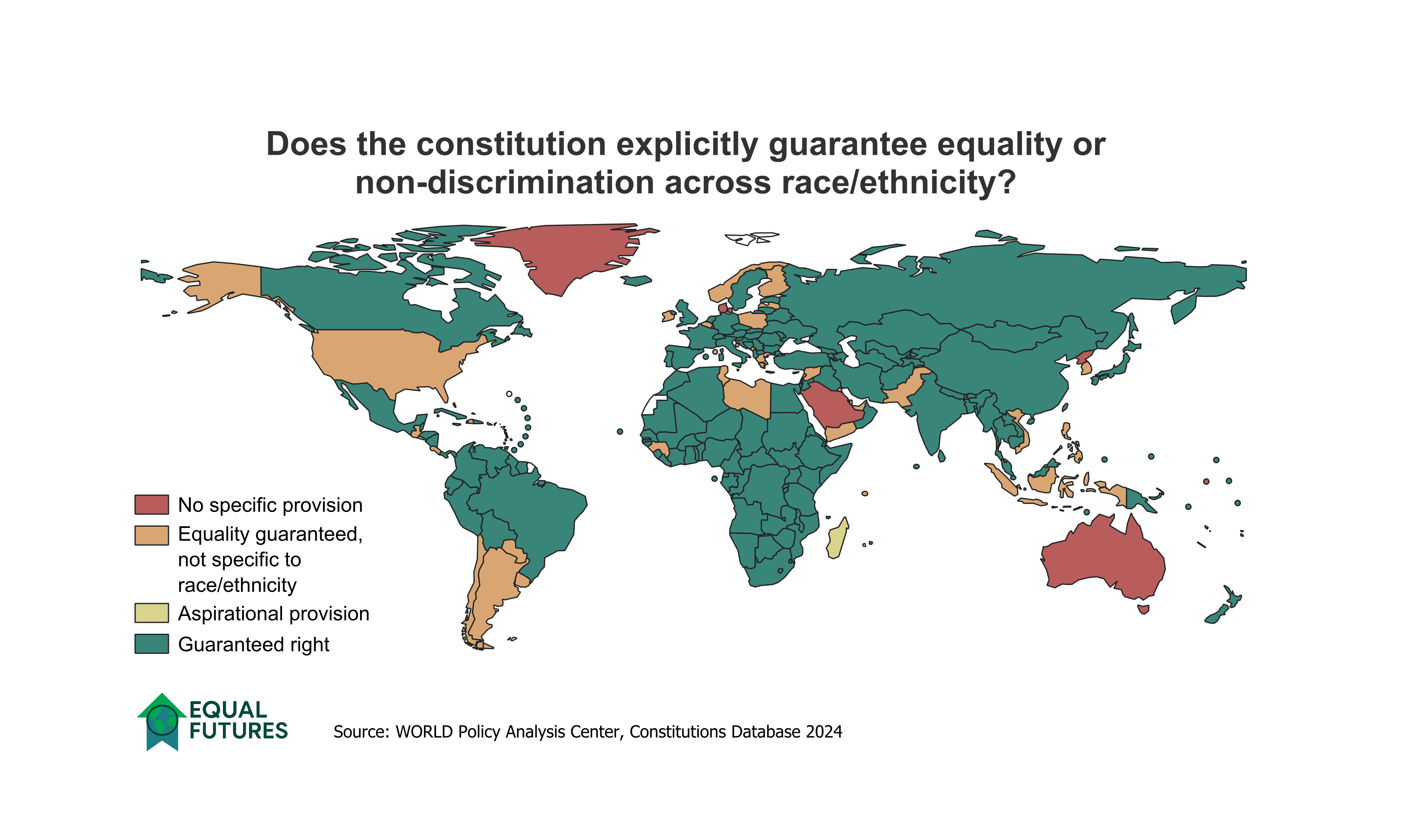
Moreover, even in areas with broad protection, such as equal rights regardless of sex or gender (covered by 86% of countries), exceptions embedded within some constitutions undercut these guarantees. Fourteen countries explicitly allow religious or customary law to supersede gender equality in at least some areas, such as family law–often undermining women’s equal rights to property, inheritance, and within marriage. Meanwhile, even as a relatively high share of countries (76%) protect equal rights regardless of race and/or ethnicity, this means that 46 countries have no explicit guarantee.
To be sure, whether a constitution comprehensively protects equal rights is not the only way it shapes a country’s susceptibility to democratic decline. Strong provisions around judicial independence, elections, and the freedom of civil society, among other topics, are likewise vital. Yet the importance of detailed equal rights provisions should not be overlooked, especially as broadly worded equality clauses have historically come up short for protecting the rights of many marginalized groups, including people with disabilities, LGBTQ+ people, and people living in poverty.
Moreover, detailed equal rights provisions have had impact, providing the foundation for invalidating discriminatory laws and practices from Serbia to Colombia to South Africa. Beyond the courts, constitutional equality rights have provided a tool for people to push back against discriminatory proposals and hold their elected leaders accountable for hateful or divisive rhetoric. For example, in 2009, 51 civil society organizations came together to condemn the Malaysian government’s “foreign workers first out” policy, citing the constitution’s guarantee that “all persons are equal before the law.” In South Africa, after former President Jacob Zuma made derogatory remarks about gay people, advocates successfully demanded an apology, in which he acknowledged that “Our Constitution clearly states that nobody should be discriminated against on many grounds including sexual orientation, and I uphold and abide by the Constitution of our land.”
Meanwhile, the erosion of legal rights for vulnerable populations has been identified as a contributor to the “enabling environment” for crimes against humanity. Across regions and across history, countries have been known to strip equal rights protections from targeted groups in the lead-up to atrocities or widespread campaigns of oppression. The Nuremberg Laws’ stripping citizenship from Jews in Germany in 1935, the denial of citizenship to the Rohingya in Myanmar through a 1982 law, and the recent crackdown on women’s legal rights in Taliban-controlled Afghanistan are all examples.
In this moment, pushing back against new threats to rights and the escalation in state-sanctioned discrimination must be a top priority. But to create a stronger foundation for withstanding threats in the future, we also need strong and unequivocal protections for equal rights that cannot easily be undone with shifts in national leadership. Constitutional guarantees are critical and fundamental.
No posts
Comments
Nothing yet. Say the first thing.
Sign in to join the conversation.